Aiming for simplicity and simplifying the customer journey is a key driver of customer satisfaction. In this article, I’ll guide you through the concept of simplexity.

In a world where complexity is the hallmark of growth, I advocate a marketing approach based on simplicity. This marketing strategy has been given a name: simplexity. This concept, born from the combination of simplicity and complexity, is meant to guide companies in designing their products and services differently. Simplexity aims to make what is naturally complex accessible without sacrificing functional richness. In this way, it contributes to customer satisfaction.
Contact us for your marketing studies
Key Takeaways
- Simplexity combines apparent simplicity with underlying complexity to create optimal user experiences
- This approach allows companies to differentiate themselves by making their products more accessible
- Brands that master simplexity generate higher customer satisfaction
- Implementation requires careful consideration of user experience and real needs
- Results are measured in terms of adoption, loyalty, and recommendation
What exactly is simplexity?
Simplexity, a term coined by neurobiologist Alain Berthoz, refers to the art of making complex things simple without distorting them. In a marketing context, this approach consists of creating an interface or user experience that appears simple while retaining the necessary functional richness.

The first generation Kindle was delivered in a “frustration-free” package. I find this approach absolutely brilliant because it meets a customer expectation: to discover and use their product as quickly as possible.
Unlike pure simplification, which removes elements, simplexity organizes them intelligently. It hides complexity without eliminating it, allowing users to progressively access features according to their needs. This strategy addresses a modern paradox: consumers want powerful products that are easy to use.
The idea of simplexity is not new. I like to think that Van Gogh was already striving to “make things simple.” In a letter to Gauguin dated June 17, 1890, he wrote: “How difficult it is to be simple,” citing Dr. Gachet. In artistic acts, there is a recurring constant: the search for the very essence of art and the effort to “make it simple.” Simplicity and creativity are closely linked. Brancusi, for example, wrote: “Simplicity is not a goal in art, but one reaches simplicity despite oneself by approaching the true meaning of things.”
Your customers don’t want a 16, 18, or 20 diameter drill bit. They want a hole of the right size.
Théodore Levitt
In e-commerce and websites in general, the trend toward complexity is a fact. Seth Godin highlighted the lack of differentiation of websites, lamenting that they all look alike and are nearly indistinguishable without their names. Here lies the problem… the visitor is overwhelmed by a flood of more or less relevant information.
Regarding simplicity in marketing, I distinguish 3 fundamental principles of simplexity (see table below).
| Principle | Description | Customer Benefit |
|---|---|---|
| Hierarchy | Prioritize essential functions on the surface | Immediate usability |
| Progressive disclosure | Reveal advanced options according to context | Natural skill development |
| Contextualization | Adapt the interface to usage situations | Maximum relevance |
How difficult it is to be simple.
Letter from Vincent Van Gogh to Paul Gauguin, June 17, 1890
These companies are specialists in simplexity
Apple remains the most emblematic example of marketing simplexity. The iPhone perfectly illustrates this concept: a clean interface hides technology of extraordinary complexity. Users intuitively access the basic functions, while advanced options remain available for experienced users. If you revisit Steve Jobs’ 2007 iPhone presentation (below), you will see that Jobs’ entire argument revolved around simplification.
Google has also mastered this approach with Gmail. The email composition interface initially displayed only the essential fields (recipient, subject, message), but gradually added sophisticated options like scheduled sending, read receipts, and privacy settings. This strategy satisfies both beginners and advanced users. You may also recall that the success of Google’s search engine is partly due to its minimalist homepage.
Tesla applies simplexity to automobiles with its central touchscreen. This seemingly minimalist interface controls hundreds of vehicle parameters, from climate control to autonomous driving settings. Elon Musk’s company has successfully transformed automotive complexity into an intuitive experience. Ask a Tesla driver what they think of their car: simplicity is often their number-one reason for satisfaction. Some even wonder how they drove normal cars without complaining.
Netflix has implemented simplexity in content recommendation. I have had the opportunity to discuss this multiple times, especially through my involvement in organizing the RecSys conference. The interface simply displays attractive thumbnails, but behind this simplicity are sophisticated algorithms. They analyze preferences, viewing history, and behavioral trends. Users enjoy a personalized experience without perceiving the underlying complexity.
In the food sector, I also observe a return to simplicity. I referred to this as the “search for ‘without’” in a prophetic 2022 article, which may have already foreshadowed the decline of plant-based meat and ultra-processing.

How to implement a simplexity strategy
User journey analysis
Implementing a simplexity strategy begins with a thorough analysis of user journeys. I recommend mapping needs precisely by expertise level and usage context. This allows identification of which features should be immediately visible and which can remain hidden.
Designing simplex interfaces requires a layered approach. The first layer presents the essentials, allowing users to complete 80% of common tasks. Subsequent layers gradually reveal advanced features, either through user interaction or automatic detection of needs.
Observing customers
To inform the user journey analysis, I find an ethnographic approach useful, meaning observation of customers. For this purpose, eye-tracking techniques are particularly recommended, as they allow seeing through the eyes of users.
For example, in the wine industry, tradition and complex appellations have long held sway (try reading a Burgundy label). New World wines, free from this tradition, highlighted other qualities and marketed intrinsic product qualities. This paid off, and today they are emulated by their old-world counterparts. In a file received by the French branch of our marketing consultancy, we conducted an eye-tracking analysis to understand how a label was perceived by customers. Despite being redesigned at great cost by a specialist consultant, the wine did not sell. Eye-tracking results showed that the “complexity score” was neither seen nor understood, and consumers completely ignored it. The beginning of the customer journey was therefore entirely unsuccessful.
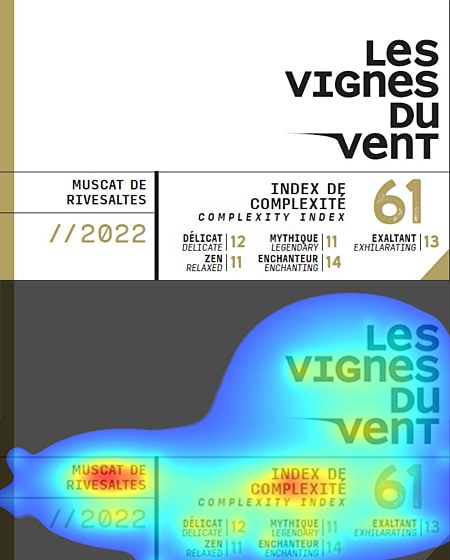
Eye-tracking analysis of a wine label. The results indicate that the system designed to facilitate consumer choice is not taken into account by the client. The appellation remains the first piece of information consulted.
The impact of simplexity on customer satisfaction
My observations show that simplexity generates higher customer satisfaction by reducing cognitive friction. Users appreciate being able to start using a product immediately and then gradually discover its advanced capabilities. This approach creates a sense of progressive mastery rather than initial intimidation.
Simplexity also promotes viral adoption. An easy-to-use product is naturally recommended, as users can quickly demonstrate its value to others. This ease of sharing is a major marketing advantage in a competitive environment.
Behavioral data show that simplex interfaces generate higher engagement rates. Users explore features more when they are revealed gradually, unlike overloaded interfaces which cause avoidance.
Customer retention also improves with simplexity. Users develop a positive relationship with products that grow with their skills, creating a sense of personal development associated with the brand.
Measuring the success of a simplex approach
Evaluating a simplexity strategy requires specific metrics. I first measure the “time to first value,” i.e., the time it takes for a new user to achieve their first product satisfaction. A successful simplex approach significantly reduces this time.
Retention rate is a key indicator. Simplex products generally show a more stable retention curve, as users are not discouraged by excessive initial complexity. I monitor retention at 7, 30, and 90 days closely.
Analysis of adoption paths shows how users progress in discovering features. An effective simplex strategy shows gradual, natural skill growth without spikes of abandonment when discovering new options.
Satisfaction scores (NPS, CSAT) provide a qualitative measure of experience. Simplex products often generate high scores because they create a positive experience from the first use while offering deeper exploration opportunities.

Frequently Asked Questions about marketing simplexity
Doesn’t simplexity risk frustrating advanced users?
This concern is understandable but unfounded. A well-designed simplexity strategy does not hide advanced features; it organizes them intelligently. Experienced users quickly access sophisticated options, often more efficiently than in a traditionally overloaded interface. The key is to maintain clear and consistent access paths.
How to prevent simplexity from becoming excessive simplification?
The difference lies in intent and execution. Simplification removes features, simplexity structures them. I always recommend starting from real user needs rather than imposing an aesthetic vision. Every hidden element must remain accessible in a logical and predictable path.
Which sectors are best suited for simplexity?
All sectors can benefit from simplexity, but it is especially effective in technology, financial services, and e-commerce. These fields naturally combine technical complexity with the need for broad accessibility. Automotive, home appliances, and professional software also offer excellent opportunities for application.
How to train teams in this approach?
Training in simplexity begins with awareness of cognitive biases and ergonomic principles. I recommend practical workshops where teams experiment with different levels of complexity on their own products. Observing real users remains the most effective teaching tool to understand the impact of each design decision. Design thinking training can also be valuable.
How long does it take to see results from a simplex strategy?
Initial indicators generally appear 4–6 weeks after implementation. Improvement in time to first value can be measured immediately, while impact on retention and satisfaction requires 2–3 months of observation. Full benefits, especially in recommendation and loyalty, emerge over 6–12 months.