Running has become the sport of the moment. Everyone is getting into it, especially Gen Z and women. This market, once a niche one, has become highly sought after by mainstream brands as well as specialized players. In this article, we analyze this market and its evolution.
It would seem that nothing is more on-trend than “running.” Everyone has taken up running, and marathons are fully booked. While the United States experienced a slowdown in the 2010s, Europe—and France in particular—has become the new El Dorado of running. Beyond the sport itself, there is also an economic reality: the running market is growing and attracting strong interest. In this analysis, our marketing consulting firm examines the trends shaping this market (younger participants, increasing female participation, technological innovation, and professionalization of distribution) as well as its outlook. Follow us at a running pace to discover this market!
Contact the IntoTheMinds marketing research firm
Key takeaways
- 52%: share of 20–39-year-olds among finishers of the New York Marathon in 2024, compared to around 43% in 2019
- 20%: share of Gen Z women among marathon runners in 2024, compared to 15% for men
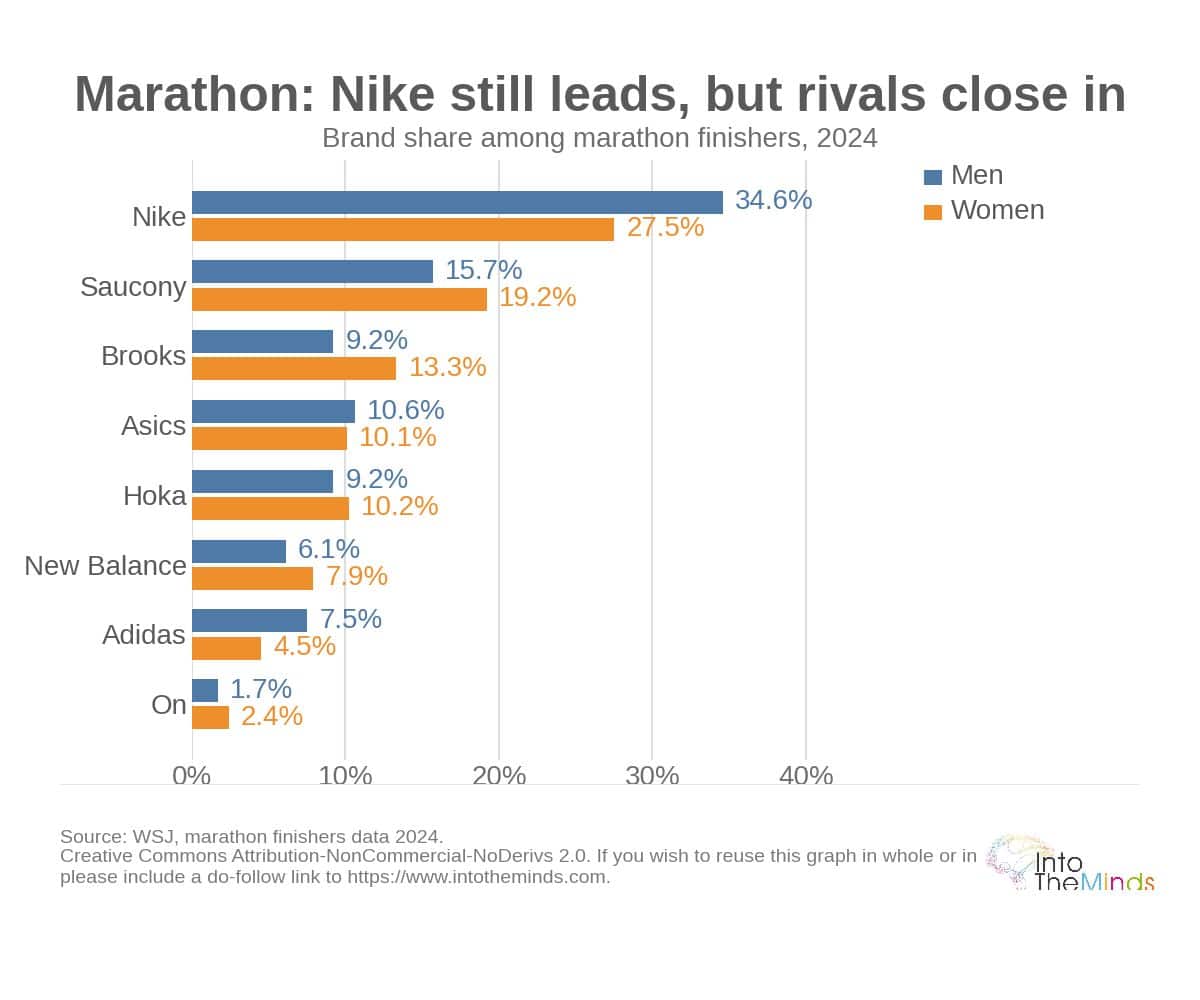
- 27.5%: share of Nike among shoes worn by female marathon finishers in 2024, compared to 34.6% for men over the same period
- 9 million: pairs of running shoes sold in France in 2024, representing +21% compared to 2023
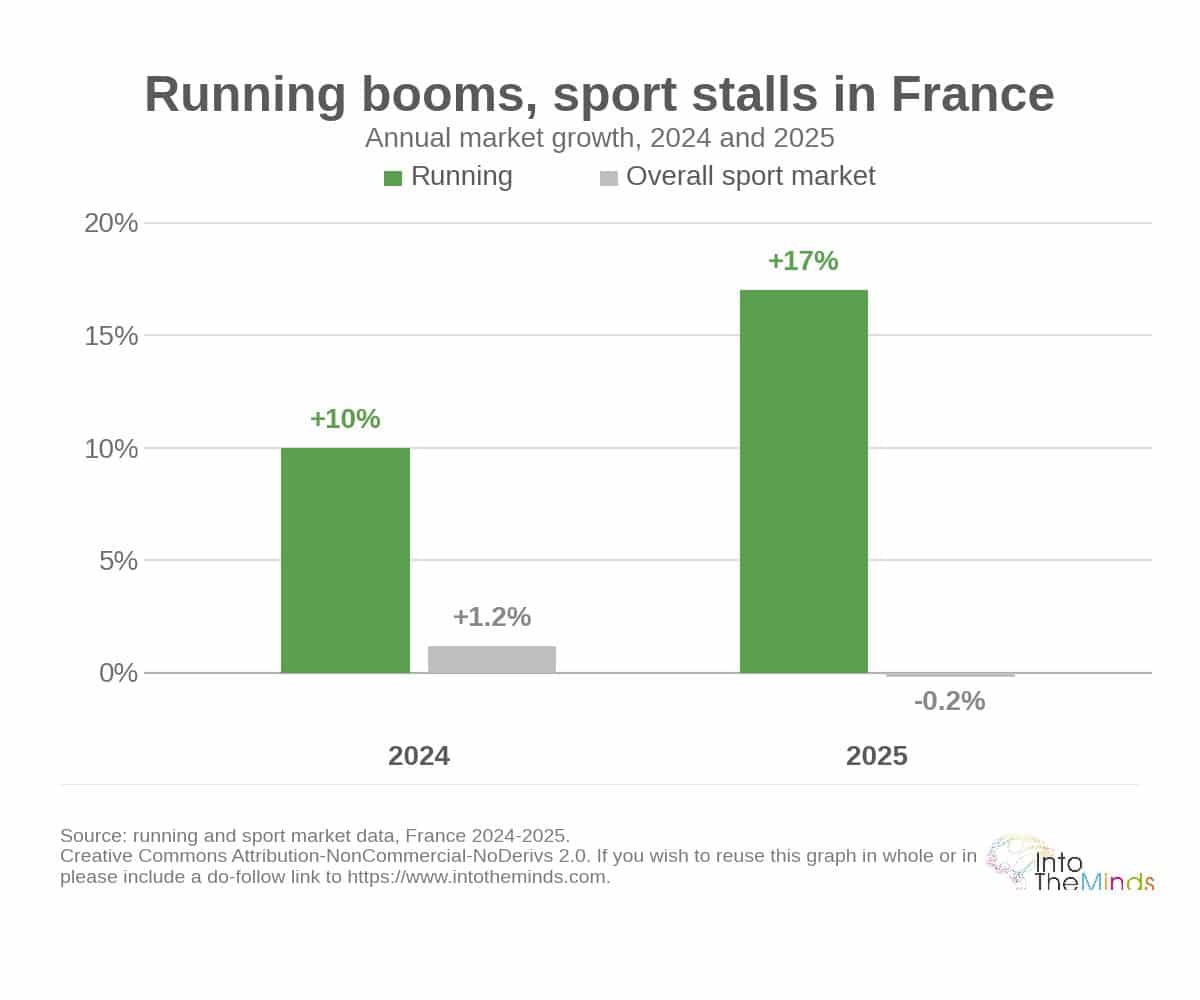
- The French running market reaches €1.4 billion in 2025, representing +17% compared to 2024
- 13.2 million French people will be running in 2025, compared to 12.4 million in 2024
- 2.91 million: people who completed a race in France in 2024, compared to 2.3 million in 2023
- Shoes account for €900 million in revenue in France, with an average price of €142 in 2025
A sector changing economic scale
The endurance running market is experiencing expansion that exceeds even the most optimistic forecasts. In France, 2025 figures confirm this trend with a market valued at €1.4 billion and growth of 17% in one year. This growth contrasts with the overall sports goods market, which declined by 0.2% over the same period.
This performance is explained by the continuous expansion of the participant base. In 2025, 13.2 million French people reported running, representing an increase of 6.5% compared to 2024. More surprisingly, 64% of them run at least once per week.
When comparing this situation with the United States, it becomes clear that the dynamic is not (or no longer) the same. Across the Atlantic, after peaking at 19 million participants in 2013, the number fell back to 17 million in 2015, representing a 9% decline. This correction was accompanied by an 11% drop in the most active runners between 2013 and 2015. The decline was particularly pronounced among 18–24-year-olds (-22%) and 25–34-year-olds (-19%). Paradoxically, those aged 65 and over increased by 25%.
| Indicator | France 2024 | France 2025 | Change |
|---|---|---|---|
| Participants (millions) | 12.4 | 13.2 | +6.5% |
| Total market (€ billions) | 1.2 | 1.4 | +17% |
| Shoes sold (millions) | 9 | – | +21% vs 2023 |
| Average shoe price (€) | 131 | 142 | +11€ |
The marathon is a growth driver
Since 2024, major international races have gained popularity. The number of finishers in the world’s largest marathons is exceptionally high:
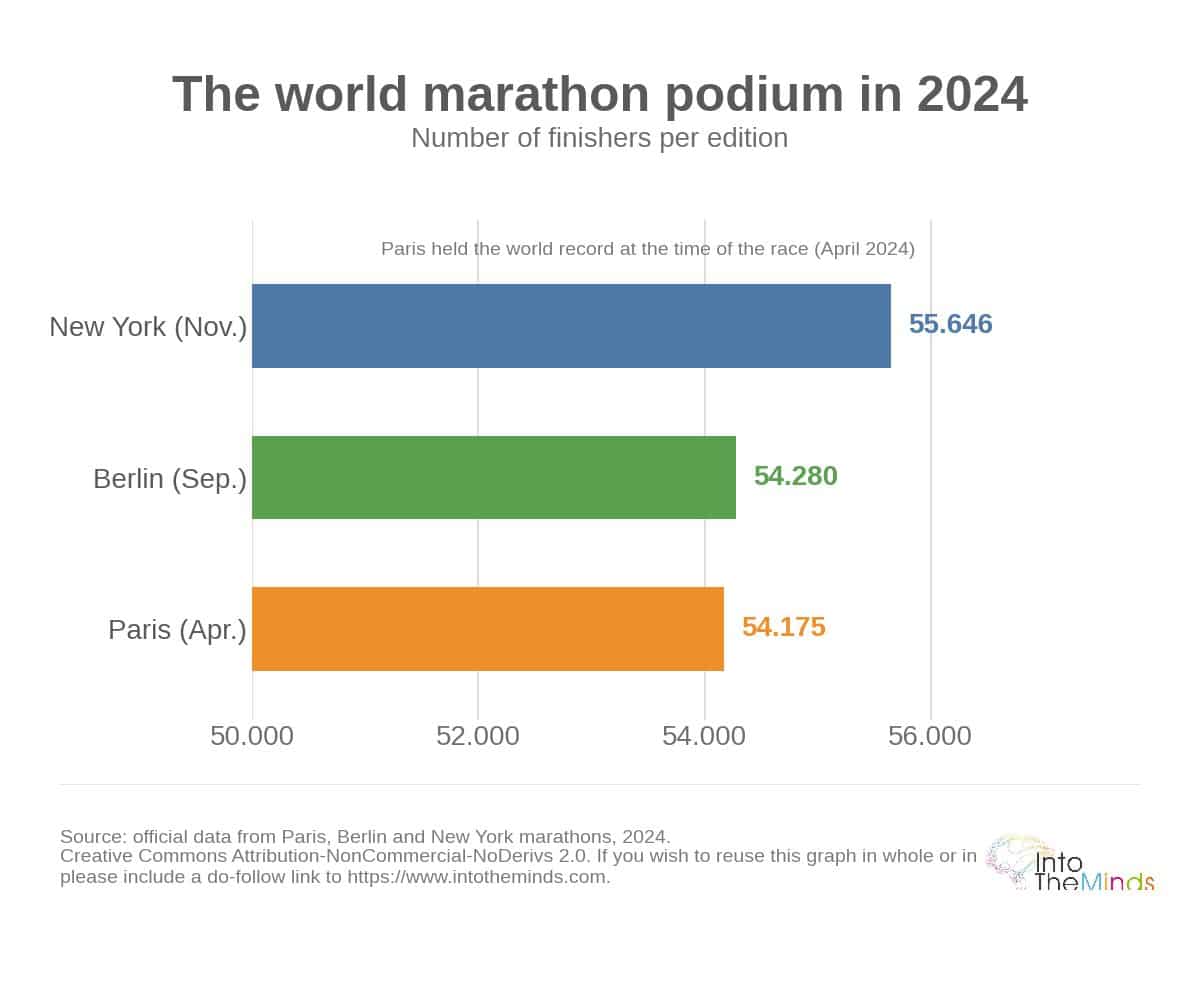
- Paris Marathon: 54,175 finishers
- Berlin Marathon: 54,280
- New York Marathon: 55,646
These figures demonstrate demand that now exceeds supply. Securing a place has become a real challenge, relying on a lottery (in the literal sense).
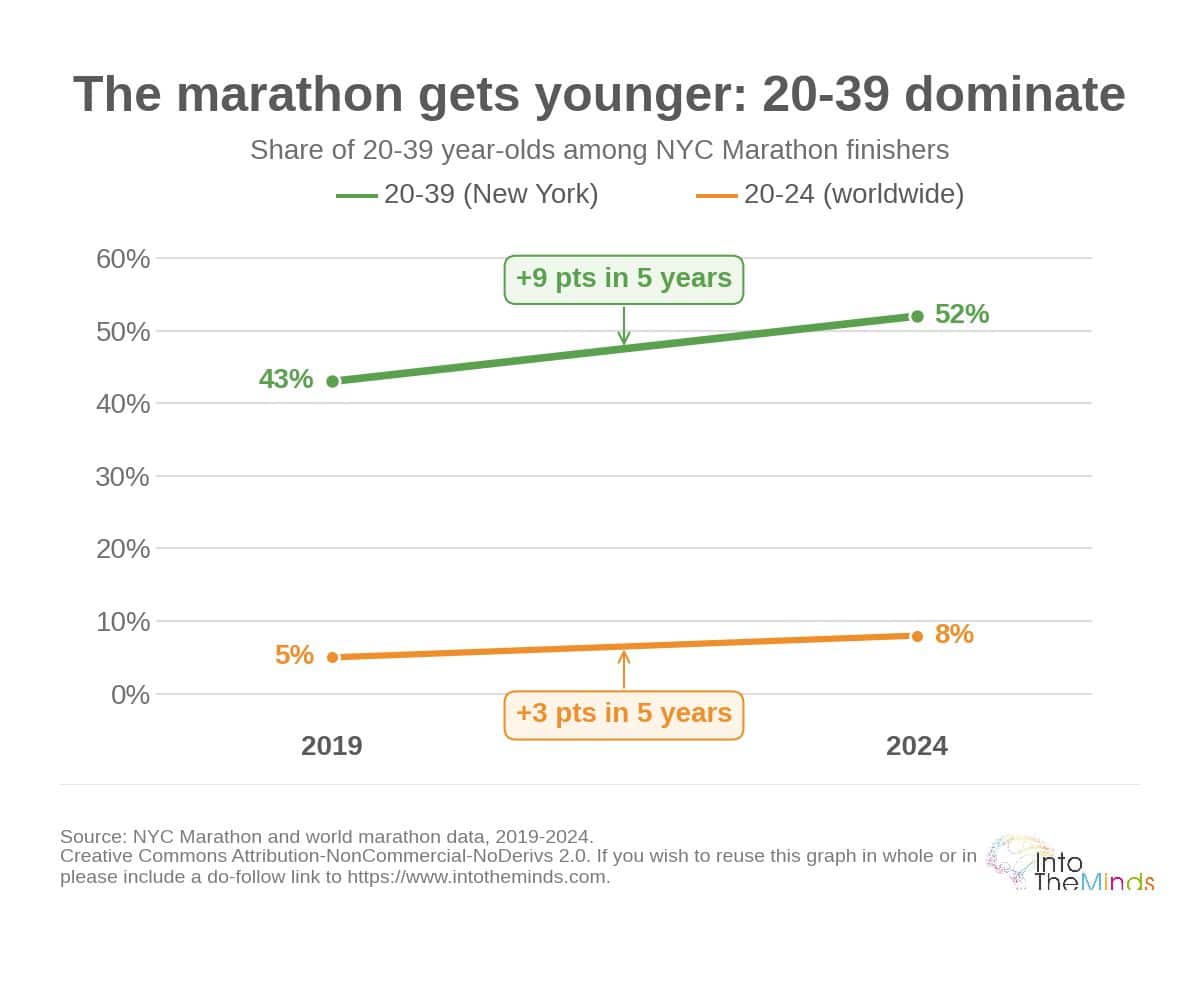
 This revival is also accompanied by a notable rejuvenation of participants. The share of 20–24-year-olds in marathons has increased from around 5% to 8% since 2021. In New York, 20–39-year-olds accounted for 43% of finishers in 2019 compared to more than 52% in 2024. This demographic shift is a strong signal for the future of the sector and the running market as a whole. Market analysis must indeed incorporate such trends in order to anticipate the future.
 The community aspect plays a decisive role in this growth. In 2024, 25% of regular runners on major tracking platforms belonged to a club, compared to 19% in 2019. Endurance running has become a social experience, and Generation Z finds this particularly attractive.
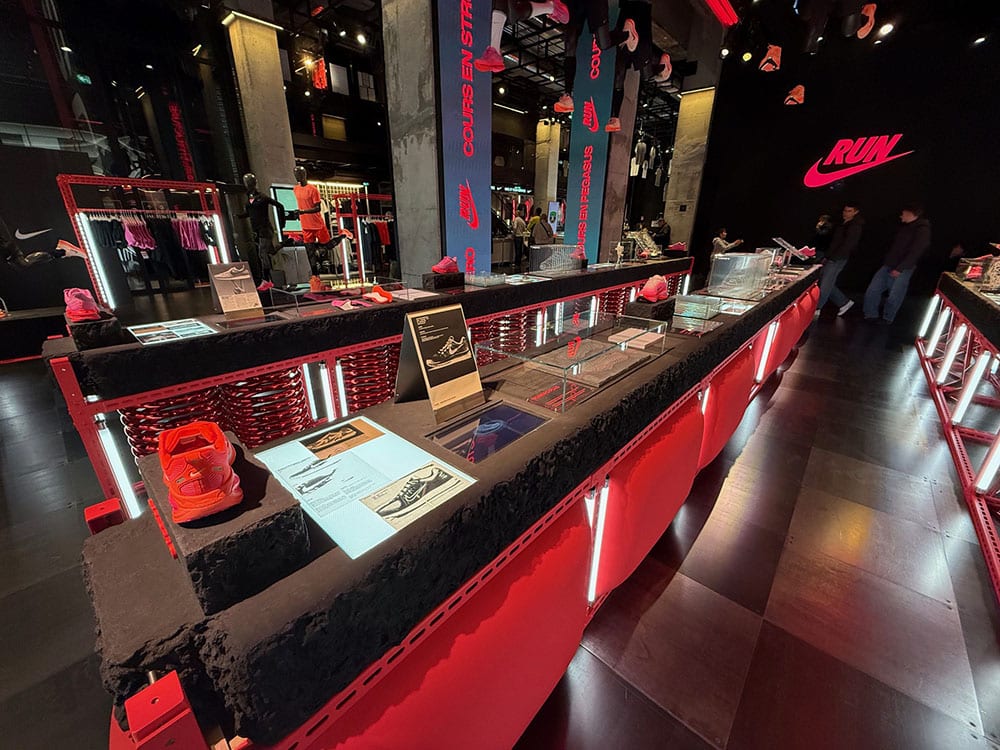
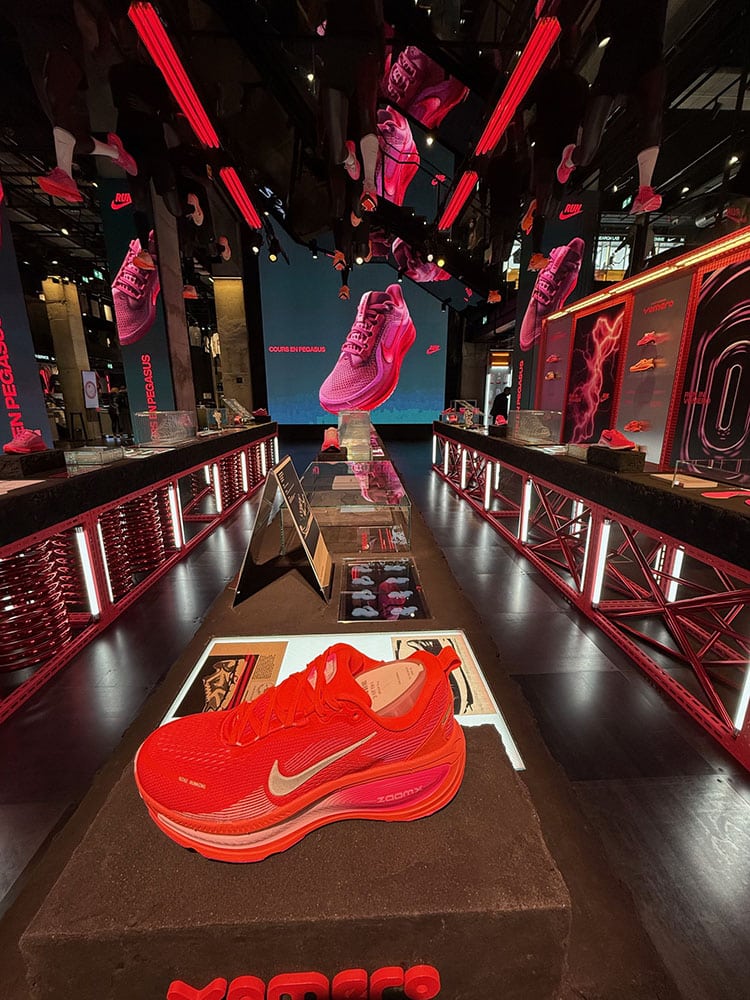
The promotion of new running shoe models relies on storytelling that highlights innovation. Photo taken in the Nike flagship store on the Champs-Élysées in Paris.
Trends in the running market
Innovation in running shoes
The development of the running market is largely based on technological advances. New foams, highly cushioned soles, carbon plates, and other 3D printing techniques are designed to help runners improve their performance (at least, that is the promise).
“Super shoes” perfectly illustrate this dynamic. These high-performance shoes, long reserved for elite athletes, have been adopted by 29% of French runners, while 17% are considering a purchase. This democratisation of technology justifies higher spending and contributes to the upmarket shift of the market.
Running shoes are becoming ultra-technical objects, or at least they are presented as such. This is the scenography designed to highlight a Nike model in the Paris flagship store.
Competition between brands is intensifying in parallel. Everyone is trying to increase their market share. In the 2024 marathons, Nike maintains a dominant position, but the landscape is becoming more diverse. Saucony, Brooks, Asics, Hoka, New Balance, Adidas, and On all hold visible shares among shoes worn on race day. This fragmentation encourages continuous innovation and premiumisation of the sector. It is also worth mentioning the marketing strategy behind these innovations, which we have discussed in our analysis of retailtainment.
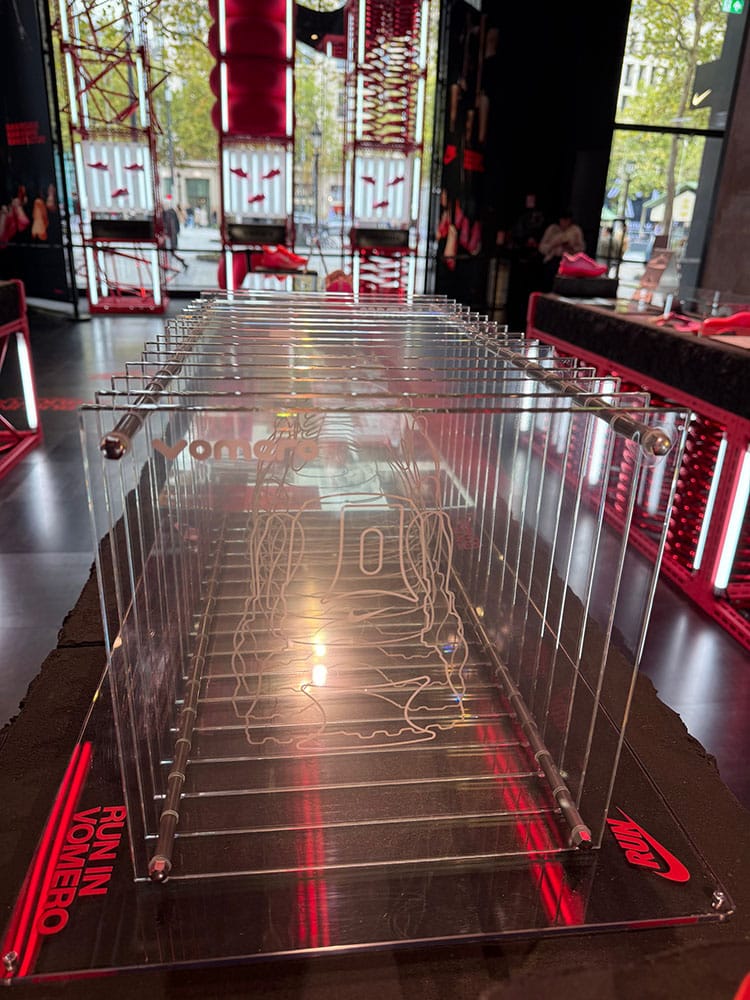

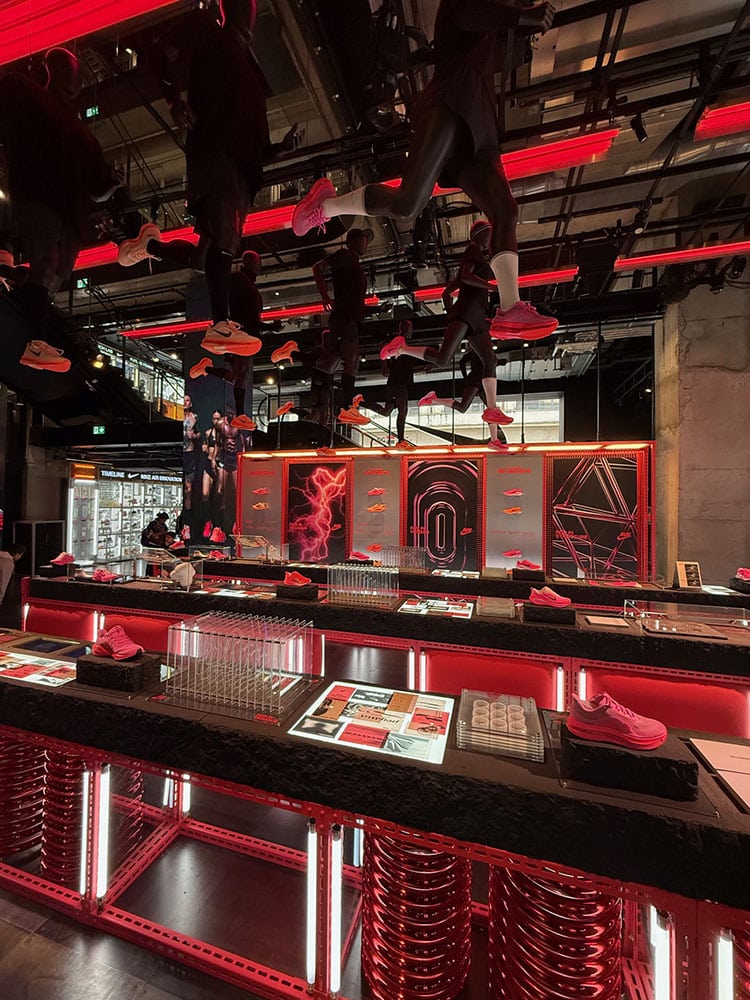
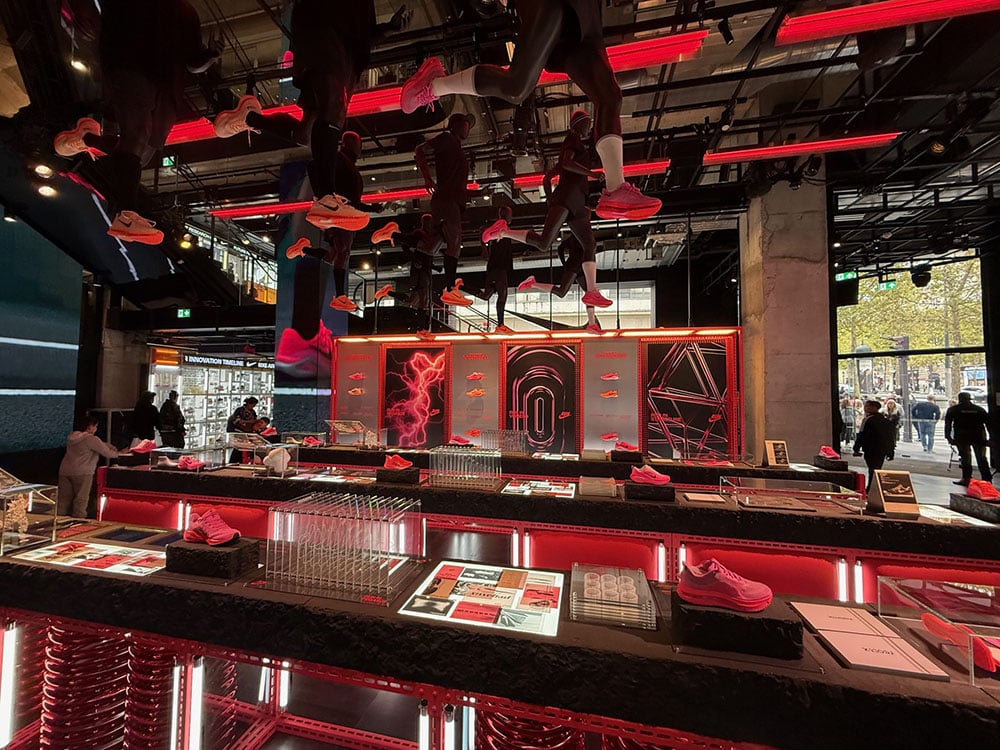

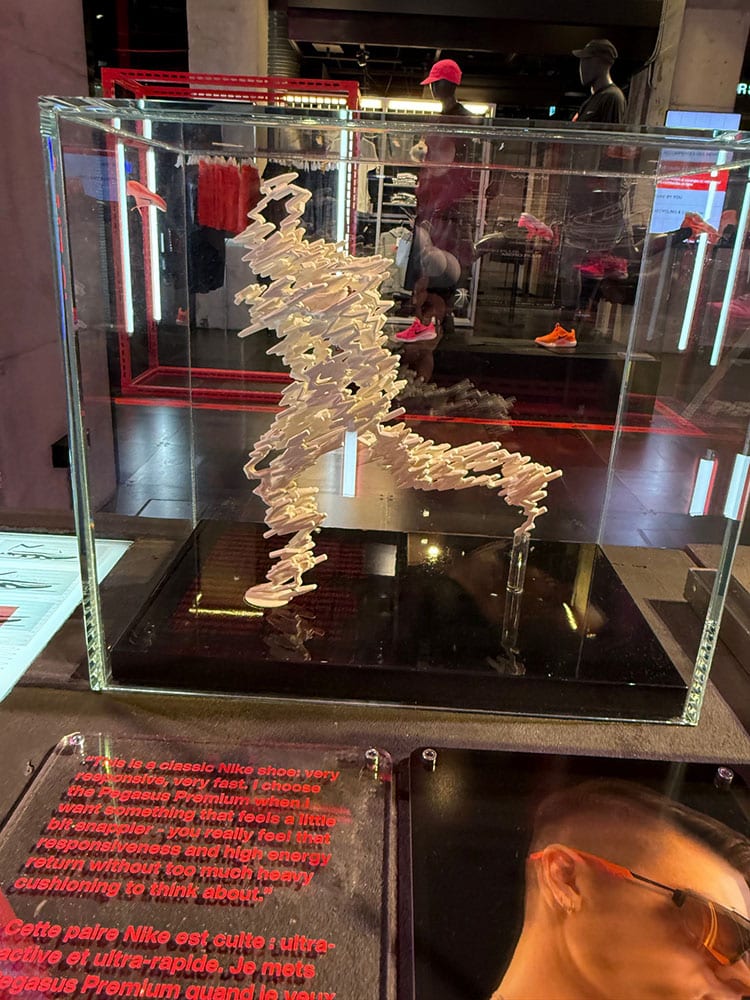
Our analysis of these brands’ marketing strategies shows that storytelling around innovation and technical performance is becoming increasingly important for shoes aimed at “runners”. During a recent visit to Nike’s flagship store in Paris, we were able to see an exhibition dedicated to the launch of a new model (see photos above). All the codes of engineering and innovation were present, including “old-school” diagrams that were probably not real and had been created for the occasion.
 In France, footwear is the main growth driver. In 2024, 9 million pairs were sold, up 21% compared to 2023. Revenue reached €900 million. The average price rose to €131 in 2024 and €142 in 2025, an increase of €11 in just one year. This may seem modest, but in a strained market with declining purchasing power, it is a significant achievement.
According to our analysis, this price evolution reflects a general upmarket shift. Between 2019 and 2025, the average price increased by €37. The acceptance of technological value is likely a key explanation. French consumers own on average 3.4 pairs, with different purchasing behaviours depending on gender:
- men replace their shoes every 11 months and spend €144/year
- women replace them every 13 months on average and spend €119/year
This dynamic is taking place in a context of distribution professionalisation. In 2025, between 250 and 300 specialised stores in France offer services such as gait analysis, personalised advice, and curated product selections. Ten years ago, there were only a handful of such stores.
One striking example is the opening of the first Decathlon store exclusively dedicated to running in Bordeaux. Even major retailers are entering this space, having clearly recognised its potential.
The feminisation of the market
Demographic change is another key structural factor in the endurance running market. In the United States, women represented 57% of marathon finishers in 2015, with 61% in half marathons and 44% in marathons. This feminisation has profoundly changed the nature of the market, making it more community-oriented and less focused purely on performance.
This transformation has direct commercial consequences. It supports the growth of social groups, training collectives, and charity clubs. Demand is expanding into apparel, accessories, nutrition, recovery, and digital services. Running is becoming a full lifestyle market, extending far beyond sports equipment.
In France, this trend is reflected in a surge in run clubs. Their number grew by 52% in 2024, with Paris now hosting more than 100. The number of athletes uploading their runs in the capital has increased more than fivefold since 2019, confirming the sport’s social and urban dimension.
The emergence of an ecosystem
Finally, the influence of running now extends well beyond its traditional boundaries. In France, the market for sports clothing, shoes, and accessories reached €10.3 billion in 2024, up 3.5%. A quarter of this spending relates to running, athletics, and trail running, confirming the economic weight of this segment.
Adjacent sectors are also benefiting from this momentum. Sports nutrition and energy products are growing strongly, driven by increasing demand for performance and recovery. We refer here in particular to our analysis of the protein products market. This expansion shows that running is no longer just a physical activity but a global universe combining performance, aesthetics, community, and health.
The experiential dimension is becoming increasingly important. In 2024, 2.91 million people finished a race in France, compared to 2.3 million in 2023. Competition is becoming a driver of consumption, but also of travel, social interaction, and identity building. The 2024 Paris Marathon broke a world record, and the 2025 edition sold out in six months.

Frequently asked questions about the running market
How large is the French running market in 2025?
The French running market is worth approximately €1.4 billion in 2025, up 17% compared to 2024. This growth contrasts with the overall sports goods market, which is down 0.2%. Footwear is the main segment with €900 million in revenue. This performance is supported by 13.2 million runners, 64% of whom run at least once a week.
Why are running shoe prices continuously increasing?
The price increase reflects an accepted technological upmarket shift. The average price rose from €131 in 2024 to €142 in 2025, up €11 in one year. This is driven by advanced technologies (carbon plates, innovative foams, customisation) and rising demand for premium models. “Super shoes”, once reserved for elites, have been adopted by 29% of French runners.
Can the running market sustain this growth?
Several indicators suggest sustainable growth. The younger demographic profile (20–39-year-olds account for 52% of New York Marathon finishers in 2024 vs. 43% in 2019) and the feminisation of participation provide strong foundations. However, the US example (a 9% decline in finishers between 2013 and 2015) shows saturation is possible. Expansion into experience-based consumption and adjacent services may mitigate this risk.
What are the main challenges for brands?
Increasing fragmentation intensifies competition. Nike remains dominant but faces pressure from Saucony, Brooks, Asics, Hoka, New Balance, Adidas, and On. Distribution is becoming more professionalised, with 250–300 specialist stores in France, requiring sophisticated omnichannel strategies. Community-building and experience are becoming critical success factors.
How can companies capture opportunities in this market?
Opportunities lie in technological innovation, services (gait analysis, coaching, nutrition), experiential offerings (events, communities, travel), and emerging segments (trail, ultra-distance, urban running). The feminisation of the market opens opportunities in technical apparel and accessories.

![Illustration of our post "Turnover: what strategies are companies implementing? [Study]"](/blog/app/uploads/banner-millenial-employee-120x90.jpg)