IntoTheMinds has been conducting market research in Belgium for over 20 years and supports companies of all sizes. Here is our TOP 10 list of the best free data sources.

IntoTheMinds has been conducting market research in Belgium for more than 20 years. The success of such a process relies on a rigorous methodology, but also on the use of reliable secondary data that can be accessed through structured desk research. This article lists the 10 best data sources for conducting market research in Belgium, whether for a product or service launch, a competitive analysis, or a market entry project.
Contact the IntoTheMinds Institute
Key takeaways
- Belgium has a leading federal statistical office (Statbel) and its interactive database be.STAT, both freely accessible for any market research project.
- Due to Belgium’s federal structure, a large share of relevant data is available at the regional level: IWEPS (Wallonia), Statistiek Vlaanderen (Flanders), and IBSA (Brussels) are essential sources.
- The Crossroads Bank for Enterprises (CBE) and the National Bank of Belgium’s Central Balance Sheet Office make it possible to analyze competitors’ financial health and estimate the size of B2B markets.
- Sector regulators (FSMA for finance, CREG and regional regulators for energy, BIPT for telecommunications) provide highly detailed information on regulated markets.
- Eurostat makes it possible to position Belgium within its European context and benchmark it against other EU countries.
Why does the Belgian market require a specific approach?
The Belgian market has characteristics that strongly influence the methodology of a market research project. With a sizeable population distributed across three regions with very different economic dynamics, Belgium is a federal state where many policy areas (economy, employment, energy, housing) are regionalized, resulting in multiple relevant data sources.
Four factors shape this specificity:
- three official languages (French, Dutch, and German), which affect primary data collection and access to sources
- a highly open economy driven by logistics (the Port of Antwerp), chemicals, agribusiness, and the European institutions located in Brussels
- significant regional disparities in income, employment, and consumer behaviour
- a two-tier regulatory framework: federal for some sectors, regional for others
This reality has a direct impact on the methodology of market research in Belgium: relying solely on national-level data is rarely relevant. Federal sources must systematically be complemented with regional sources. This is one of the first lessons learned from more than 20 years of projects conducted by IntoTheMinds in this market.
To give a concrete example of regional impacts, most of the surveys we conduct in Belgium are carried out in the country’s two main national languages, generally using strict quotas to ensure statistical representativeness. Below, you will find a concrete example of this type of market research project.
The 10 best data sources for your market research in Belgium
The sources presented below are ranked according to their usefulness during the successive stages of a market research project: macro-level assessment, competitive analysis, consumer understanding, regulatory framework, and sector-specific data. These are the sources that the IntoTheMinds team systematically uses in its projects, regardless of the markets being studied.
1. Statbel and be.STAT
Statbel, Belgium’s statistical office within the Federal Public Service Economy, is the essential starting point for any market research project in Belgium. Demographics, employment, prices, businesses, trade, and territorial data are covered in great depth. Its interactive database be.STAT is the country’s largest collection of socio-economic statistics, allowing users to explore, build, and export detailed tables. Demographic data by municipality are particularly useful for defining a catchment area or estimating the size of a local market.
2. data.gov.be and open data
data.gov.be is the federal open data portal, aggregating reusable datasets from all levels of government: federal state, regions, communities, provinces, and municipalities. Its value lies in two aspects: geolocated data that enable cross-analysis of multiple data sources, and standardized open licences that allow commercial reuse. For location analysis or geomarketing studies, it is a resource that should be used from the desk research phase onward.
3. IWEPS, Statistiek Vlaanderen and IBSA: regional statistics
Regional federal data must be complemented by regional statistical authorities, which produce detailed socio-economic analyses tailored to each territory:
- IWEPS (Walloon Institute for Evaluation, Foresight and Statistics) for the Walloon Region
- Statistiek Vlaanderen for the Flemish Region
- IBSA (Brussels Institute for Statistics and Analysis) for the Brussels-Capital Region
These three institutes cooperate with Statbel, the National Bank of Belgium (NBB), and the Federal Planning Bureau within the Interfederal Institute of Statistics. For any market research focused on a specific region—which is the most common case in Belgium—these sources are indispensable.
4. The Crossroads Bank for Enterprises (CBE)
The CBE / KBO is the database of the FPS Economy that contains all core identification data of registered entities: company name, dates, status, legal form, NACE codes, directors, and establishment units. Public access is available via the Public Search application, and an API is available for advanced use cases.
For a B2B market research study in Belgium, this source is the foundation of any competitive analysis: exhaustive lists of market players, partner or supplier verification, due diligence, or building qualified prospect databases.
5. The National Bank of Belgium Central Balance Sheet Office
The Central Balance Sheet Office of the National Bank of Belgium collects annual accounts from most companies operating in Belgium. Combined with CBE identification data, it enables financial benchmarking of competitors, calculation of profitability ratios, and assessment of the overall economic health of an industry. For any market study assessing sector attractiveness, analyzing financial statements of existing players is considered a non-negotiable step by the IntoTheMinds team.
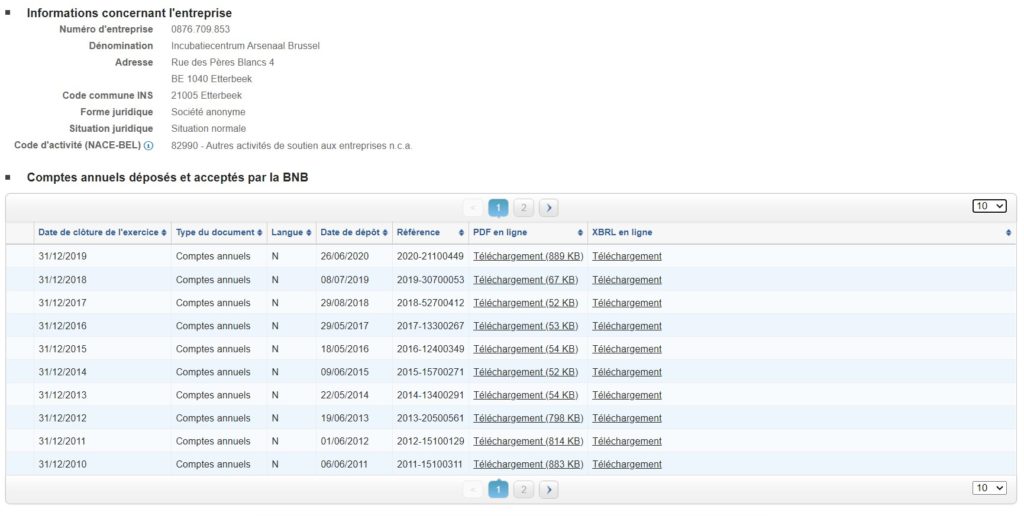
Simulation of a balance sheet request on the NBB website.
6. NBB and the Federal Planning Bureau
Two sources structure macroeconomic and cyclical analysis:
- NBB.Stat: monetary and financial statistics, credit, national accounts, foreign trade, and economic indicators
- Federal Planning Bureau: official economic forecasts and analyses, macroeconomic, demographic, sectoral, and environmental projections
The NBB is particularly useful for markets sensitive to financing conditions (real estate, capital goods, credit). The Federal Planning Bureau provides long-term projections, essential for anticipating sector evolution over 5–10 years.
7. Eurostat and the European dimension
Eurostat provides harmonized European-level data that makes it possible to position Belgium against neighboring countries and other EU economies. This comparative dimension is valuable for international benchmarking, contextualizing Belgian consumer behavior, and analyzing intra-European trade flows via the Comext database. Given Belgium’s central role in logistics and European institutions, Eurostat is regularly used in IntoTheMinds projects.
8. FSMA, Febelfin and Assuralia: the financial sector
For any market research in the Belgian financial sector, three sources must be used together:
the FSMA (Financial Services and Markets Authority) for licensed entity registers and supervision reports,
Febelfin for banking statistics (loans, deposits, employment, payments), and
Assuralia for insurance sector key figures (premiums, segments, trends).
These three sources are complementary for mapping regulated actors and sizing market segments.
9. ONEM and regional employment services
The Belgian labor market is analyzed at two levels. At federal level, the ONEM publishes national unemployment statistics. At regional level, employment services provide the most granular labor market data:
Le Forem for Wallonia,
VDAB for Flanders, and
Actiris for Brussels-Capital.
These institutions publish data on critical occupations and labor shortages, which are often decisive for evaluating the feasibility of an investment or location project.
10. Sector-specific sources
Several sources provide high-resolution data for specific markets that general portals cannot match:
- Real estate: Statbel (official price index) and Fednot (barometer based on real transactions)
- Energy: CREG at federal level, complemented by regional regulators CWaPE (Wallonia), VREG (Flanders), and BRUGEL (Brussels)
- Telecom: the BIPT publishes market observatories, operator market shares, and sector indicators
- Tourism: VISITWallonia, Toerisme Vlaanderen, and visit.brussels complement Statbel’s overnight stay data
- SMEs and self-employed: the FPS Economy publishes statistics and sector analyses on Belgian enterprises
Table of sources by market research objective
| Market research objective | Main sources | Practical use |
|---|---|---|
| Macroeconomic framing | Statbel, NBB, Federal Planning Bureau, Eurostat | Analysis of the economic environment, business cycle forecasting, project context |
| Market sizing | be.STAT, BCE, Eurostat | Calculation of total addressable market, segmentation by size and activity (NACE codes) |
| Competitive mapping | BCE / KBO, FSMA | Exhaustive list of sector players, monitoring, partner due diligence |
| Financial benchmarking of competitors | Central Balance Sheet Office (NBB), BCE | Profitability ratios, debt levels, sector attractiveness |
| Demand analysis and segmentation | Statbel, IWEPS, Statistiek Vlaanderen, IBSA | Definition of B2C target segments, purchasing power, consumer profiles |
| Location/establishment study | Statbel (municipal data), data.gov.be | Location selection, geomarketing analysis, catchment area definition |
| Regulated markets (finance, energy, telecoms) | FSMA, CREG, BIPT | Market shares of operators, licensed entities, competitive dynamics |
| Labour market | ONEM, Le Forem, VDAB, Actiris | Labour availability, shortage occupations, HR feasibility of a project |
| PESTEL analysis and regulatory framework | FPS Economy, CREG, FSMA, BIPT | Barriers to entry, compliance, ESG constraints, sector regulation |
| Foreign trade | NBB, Statbel, Eurostat (Comext) | Import/export flows by product and country, value chains and global distribution |
How to combine these sources in your market research?
The quality of market research in Belgium does not depend on the number of sources used, but on how they are combined. Treating each source in isolation is a common mistake that leads to fragmented and inconsistent analysis. In Belgium, this integration almost always requires combining federal and regional data.
The recommended approach follows a three-step logic:
- Macroeconomic framing: Statbel, NBB, the Federal Planning Bureau and Eurostat are used to size the market, identify long-term trends, and place Belgium within its European context. This framing directly feeds into the PESTEL analysis, especially the economic, social and environmental dimensions, and supports early strategic decision-making.
- Competitive analysis: BCE, Central Balance Sheet Office and, depending on the sector, FSMA, CREG or BIPT allow mapping existing players, assessing their financial health, and identifying dominant positions. For B2B market research in Belgium, this phase is often the most decisive for evaluating the true attractiveness of a sector.
- Behavioural and demand analysis: regional statistics (IWEPS, Statistiek Vlaanderen, IBSA), Statbel and specialised sector sources help understand customer expectations, identify underserved segments, and refine positioning. At this stage, secondary data is often complemented by primary research—particularly qualitative approaches—(interviews, surveys, satisfaction studies) to obtain insights that official datasets cannot provide.
Also read
- Top 10 data sources in France
- Top 10 data sources in Luxembourg
- Top 10 data sources in the Netherlands
- Top 10 data sources in Switzerland
- Top 10 data sources in Germany
- Top 10 data sources in the United Kingdom
- Top 10 data sources in Italy
- Top 10 data sources in Spain
- Top 10 data sources in Portugal
- Top 10 data sources in the EU

FAQ: Questions you may have
How much does a market research study cost in Belgium?
The cost varies depending on the depth of the analysis, the chosen methodology, and the sectors covered. A study based solely on secondary sources (official data, registries, sector reports) is less expensive than a study combining secondary data with primary data collection (interviews, surveys, customer satisfaction studies). The multilingual and federal structure of the Belgian market can increase the complexity of primary data collection. To obtain a quote tailored to your project, contact the IntoTheMinds team.
What is the difference between B2B and B2C market research in Belgium?
A B2B market research study in Belgium relies primarily on the BCE, the NBB Central Balance Sheet database, and sector-specific sources to analyze market players, their financial health, and purchasing potential. A B2C market research study in Belgium makes greater use of Statbel demographic data, regional statistics (IWEPS, Statistiek Vlaanderen, IBSA), and specialized sector sources. The strong regional and linguistic segmentation of the Belgian market is a key differentiating factor in both cases.
Should you hire a consultancy for market research in Belgium?
Official data sources are freely accessible, but their use requires a deep understanding of the Belgian ecosystem, particularly the division of competences between federal and regional levels, as well as a rigorous methodology. A specialized consultancy provides the ability to cross-reference data sources, interpret them within their regional and linguistic context, and complement secondary analysis with primary research. IntoTheMinds has been conducting market research in Belgium for over 20 years and has strong expertise in the specificities of this market.
How do you conduct a PESTEL analysis for the Belgian market?
A PESTEL analysis in Belgium uses different sources depending on each dimension: Statbel and Eurostat for economic and social aspects, the Federal Public Service Economy and FSMA for legal and regulatory aspects, CREG, regional energy regulators, and BIPT for technological and environmental dimensions, and the Federal Planning Bureau for forward-looking analysis. The regionalization of many competences requires systematically verifying whether each dataset belongs to the federal or regional level in order to make reliable decisions.
Which sources should be used for brand awareness or customer satisfaction surveys in Belgium?
Secondary data (Statbel, regional statistics) provides a reference framework, but a brand awareness survey or a customer satisfaction survey in Belgium requires primary data collection from target populations. The multilingual nature of the Belgian market (French, Dutch, German) requires adapting questionnaires and data collection channels to each linguistic community to ensure representative results.
Why are regional sources so important in Belgium?
Many economic competences (employment, energy, housing, innovation, spatial planning) are regionalized in Belgium. The most detailed and relevant data in these areas are therefore produced by regional institutions: IWEPS in Wallonia, Statistiek Vlaanderen in Flanders, and IBSA in Brussels, as well as regional employment services (Forem, VDAB, Actiris) and energy regulators (CWaPE, VREG, BRUGEL). A market study limited to federal sources would miss regional differences that are often decisive for project feasibility.