This article provides a comprehensive analysis of the private label brand market, based on the latest available figures. The market research firm IntoTheMinds, a specialist in the retail market, has conducted in-depth analysis of several markets to deliver this summary.
Private label brands (PLBs) are booming. The inflationary surge of 2022-2023 gave them a real boost. For firms like IntoTheMinds that study the retail market, we could not overlook the need for a dedicated analysis. To give you an idea of the scale of the phenomenon, PLBs already account for 48.1% of volumes sold in mass retail in Western Europe. Their sales also increased by 1.5% in 2025 in this market alone. In France, the PLB market is worth €51 billion, with a value share of 35.6%, which remains below the European average. However, the catch-up trend is well underway. In France, in 2023, PLBs grew by 2.3% in volume, compared with a 3.5% decline for national brands. Our market research firm, drawing on more than 20 years of experience in retail, has analyzed all the available data to provide you with a concise overview of this market.
Contact IntoTheMinds
Key takeaways
- PLBs account for 48.1% of volumes in Western Europe in 2025, compared with 22.0% in North America: the gap between regions is considerable.
- In France, the value share of PLBs reached 35.6% in 2025, nearly 4 percentage points below the Western European average (39.2% in mid-2024).
- The price advantage of conventional PLBs over national brands stands at around -35% in France and exceeds -53% in Germany as of mid-2026.
- Nearly two-thirds of French PLB revenue is generated by micro-enterprises and SMEs, and 90.5% of premium PLBs are produced by French companies.
- Carrefour is targeting a 40% PLB share by 2030, a sign that retailers are now managing their private labels like genuine national brands.
What is a private label brand (PLB)?
Before looking at PLB market figures country by country, it is useful to establish the basics:
- definition
- positioning versus national brands
- terminology
Below you will find the essential information needed to understand exactly what this term encompasses.
Definition and key characteristics
A private label brand is a commercial brand whose characteristics are defined by the company responsible for its retail sales and which owns the brand. The manufacturer, generally a subcontracting SME, produces the goods according to strict specifications established by the retailer. The retailer is responsible for bringing the product to market and determines ordering conditions through competitive tenders, with each supply contract governed by precise technical specifications.
PLBs fall into 4 main categories:
- Conventional PLBs: the core of the market. In a country such as France, these account for between 27.8% and 29.5% of value share, depending on the month.
- Thematic PLBs (organic, regional, gourmet): between 4.3% and 5.4% of value share
- Entry-level products: between 2.2% and 2.5%, but consistently the most dynamic in terms of volume
- Premium PLBs: a deliberate move upmarket, with gross margins that can reach 40%
Differences from national brands
The fundamental distinction lies in brand ownership and the distribution model. A national brand is sold by numerous competing retailers without exclusivity. A PLB, by contrast, is exclusive to the retailer that owns it. This exclusivity creates a direct link between perceived product quality and the retailer’s image: a poor-quality PLB damages the retailer’s reputation, which is not the case for a national brand.
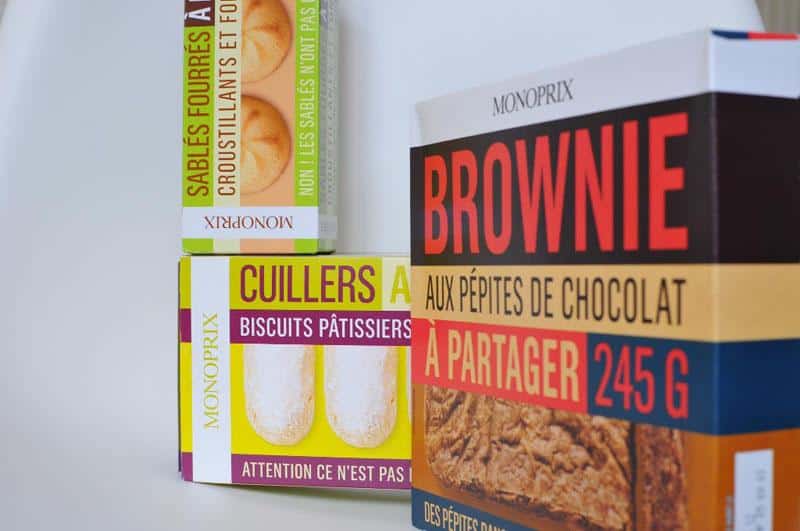
The products marketed by Monoprix in France have always caught my eye as a marketing expert. Indeed, the visual identity is strong and distinctive, and therefore contributes to the retailer’s positioning.
The price gap is the primary argument in favor of PLBs. In France, conventional PLBs are on average 35% cheaper than equivalent national brands. In Germany, this gap exceeded 53% in mid-2026 for strictly comparable products. However, price is no longer the only driver: a large majority of French consumers (72%) now associate PLBs with good value for money, compared with just 22% for national brands on the same criterion.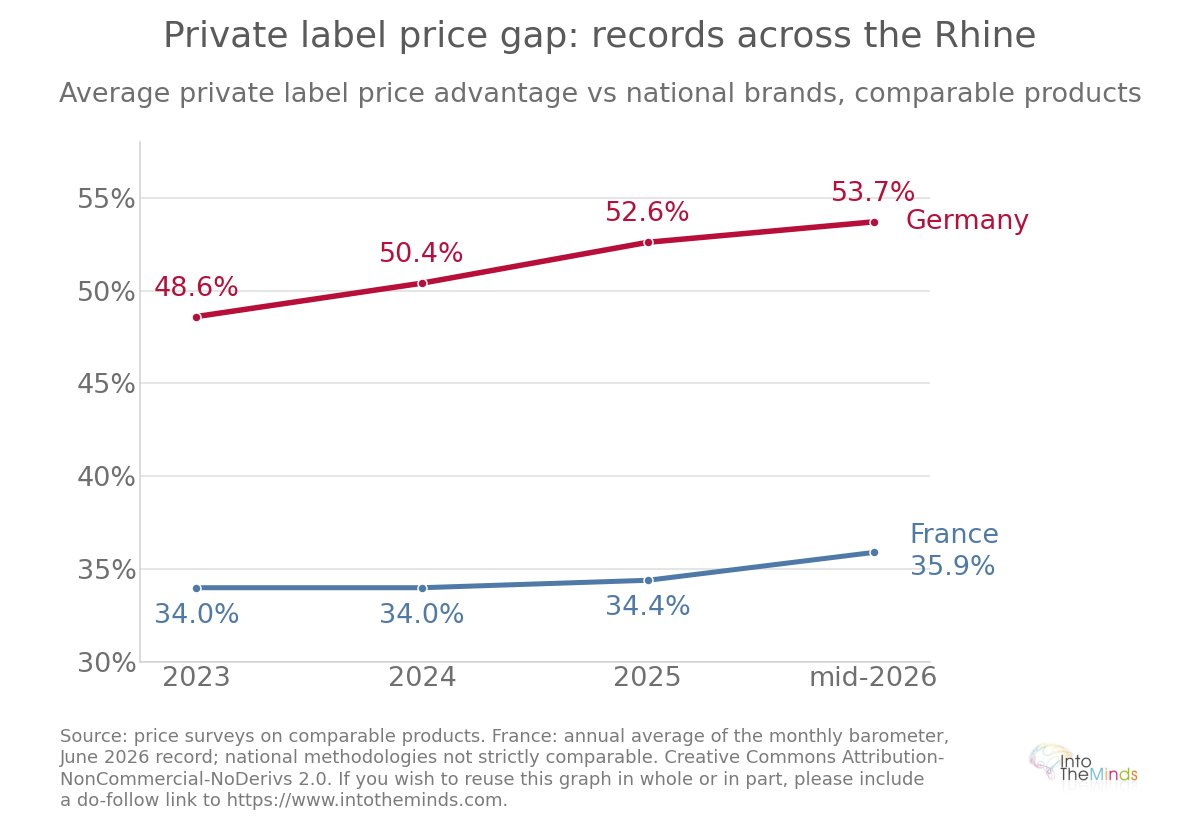
In France, conventional PLBs are on average 35% cheaper than equivalent national brands. In Germany, this gap exceeds 53%.
Terminology and synonyms
The term “private label brand” coexists with several other names depending on the context. In English, the terms private label and store brand are the most common. In retail panel data, the acronym PLB is universally used. It is worth noting that manufacturers sometimes distinguish between “copycat brands” (close reproductions of national brands) and “flag brands” (a distinct name, but with visible identification of the retailer on the packaging), with the latter posing less reputational risk for the retailer. The retailer’s visual identity plays a key role in recognition on the shelf. Copycat brands also create certain trademark-related issues that we also address.
History and evolution of PLBs in France
I thought it would be useful to provide some marketing history to shed light on current market dynamics. In this section, I propose tracing the evolution of PLBs from their origins to the present day.
The origins of private label brands
The ancestors of PLBs date back to the 19th century, with chain-store operators such as Félix Potin. These retailers owned their own factories and sold products under their own names, such as sugar packaged in one-kilogram boxes bearing the “Félix Potin” name, instead of the usual bulk format. Groupe Casino inherited this tradition as early as 1901, by putting its brand on grocery products and then integrating industrial facilities to supply products under its own brand. The Dutch retailer Spar launched its own brand as early as 1950.
Development since the 1970s
The decisive break came in 1976, when Carrefour launched 50 products known as “free products”. The positioning was clear: priority was given to functional quality over packaging appearance, with a simple blue and red stripe serving as the visual signature. The marketing communication campaign was significant, and the sourcing system, with technical specifications and rigorous supplier selection, foreshadowed modern PLBs. In 1985, these products officially carried the Carrefour brand and fully became an extension of the retailer’s image.
The following decade saw the professionalization of the sector. Retailers invested in quality departments staffed with engineers and technicians, commissioned external providers to audit their suppliers, and ventured into product categories previously reserved for national brands.
Recent trends in the PLB market
The long-term trajectory in France reveals a decade of decline between 2014 and 2021: the volume share of PLBs fell from 47.3% to 42.2%. The rebound triggered by inflation was significant, bringing this share back to 45.5% in 2025. However, 2025 is not a historical record: the levels seen in 2014 have not been recovered.
To place this trajectory in a broader context, the chart below illustrates the acceleration driven by inflation from 2022 onwards and the stabilization observed in 2025.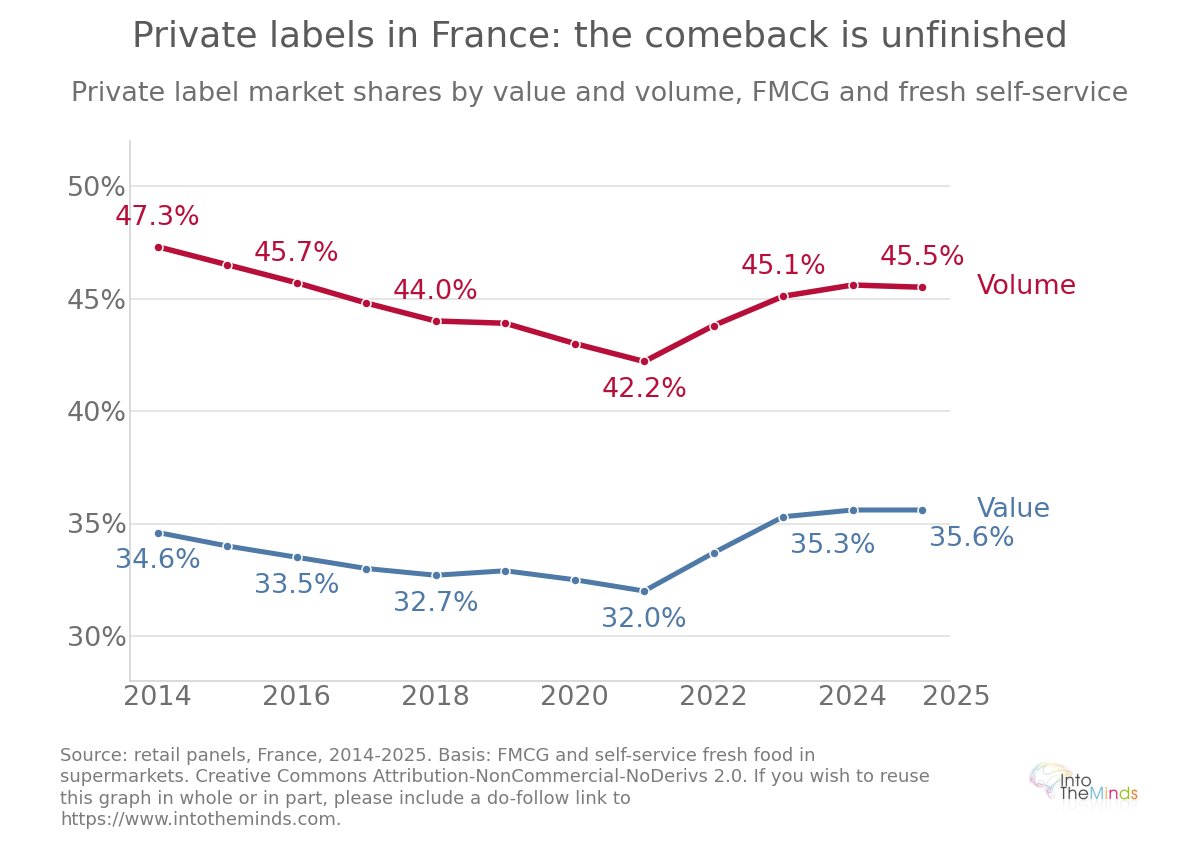
In France, PLBs were more inflationary than national brands during the crisis: +14.4% in 2023 versus +12.1% for brands.
The Private Label Market Worldwide and in Europe
This section will analyze the latest figures for the private label market. I will first look at the global perspective, then at Europe, before focusing on the most significant national markets. This hierarchy will allow you to place each figure in its proper context.
The global private label market: highly contrasting dynamics
In 2025, private label sales by volume increased by 1.3% worldwide, with a 0.2 percentage-point gain in global market share. However, this average masks very different realities across continents. The table below provides an initial overview.
| Region (2025) | Private label volume market share | Change in sales volume |
|---|---|---|
| Western Europe | 48.1% (+0.4pt) | +1.5% |
| Eastern Europe | 29.9% | +0.6% |
| Africa Middle East | 25.2% | -0.7% |
| North America | 22.0% | -0.6% |
| Latin America | 7.2% | +4.7% |
| Asia Pacific | 5.6% | +5.2% |
The strongest growth comes from Asia Pacific (+5.2%), followed by Latin America (+4.7%). These are two regions where private labels start from a very low base. It is therefore logical that they are growing rapidly.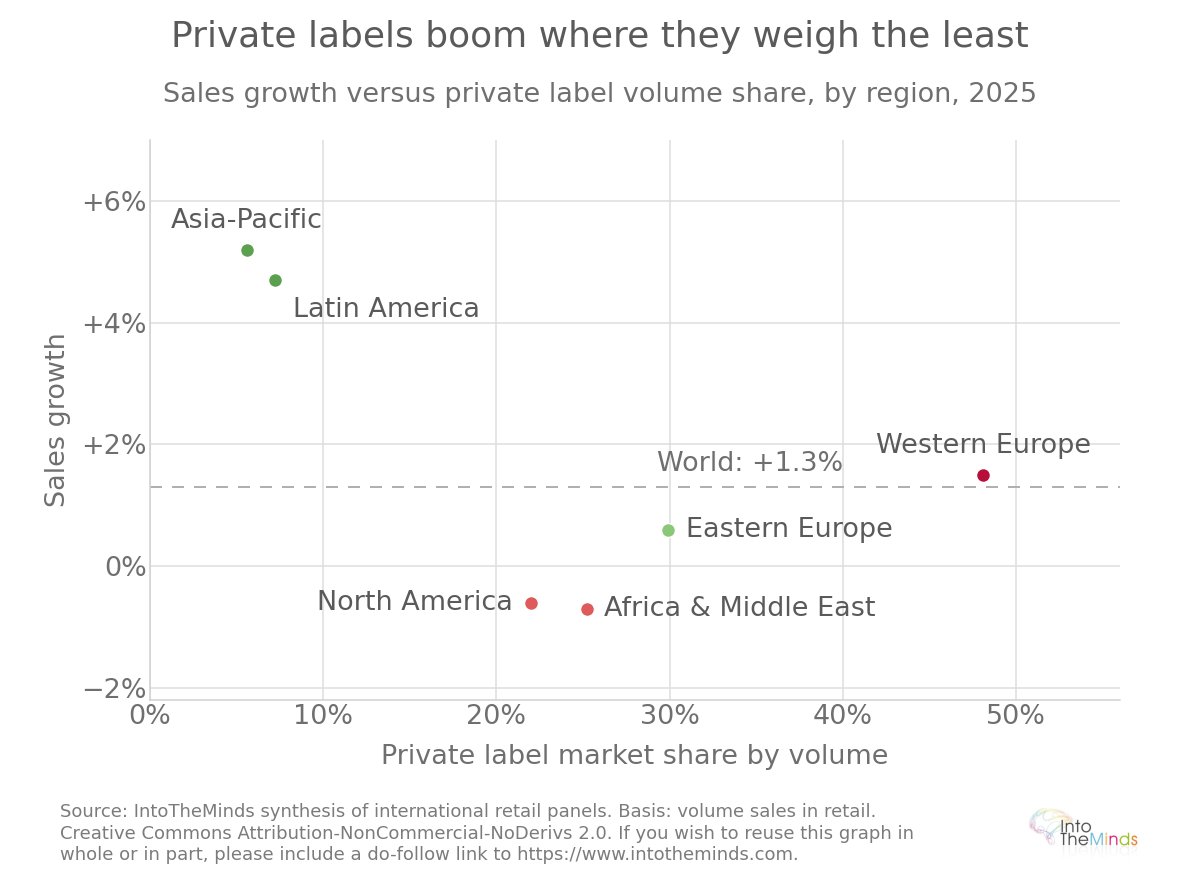
By contrast, North America declined by 0.6% (see chart above). The market there is much more mature, and national brands are proving more resilient. This growing strength of private labels is occurring in a context where the combined value of the world’s 100 most valuable brands fell from $8.7 trillion in 2022 to $6.9 trillion in 2023. This signals a relative weakening of major brands compared with retailers, while declining purchasing power is also playing a role.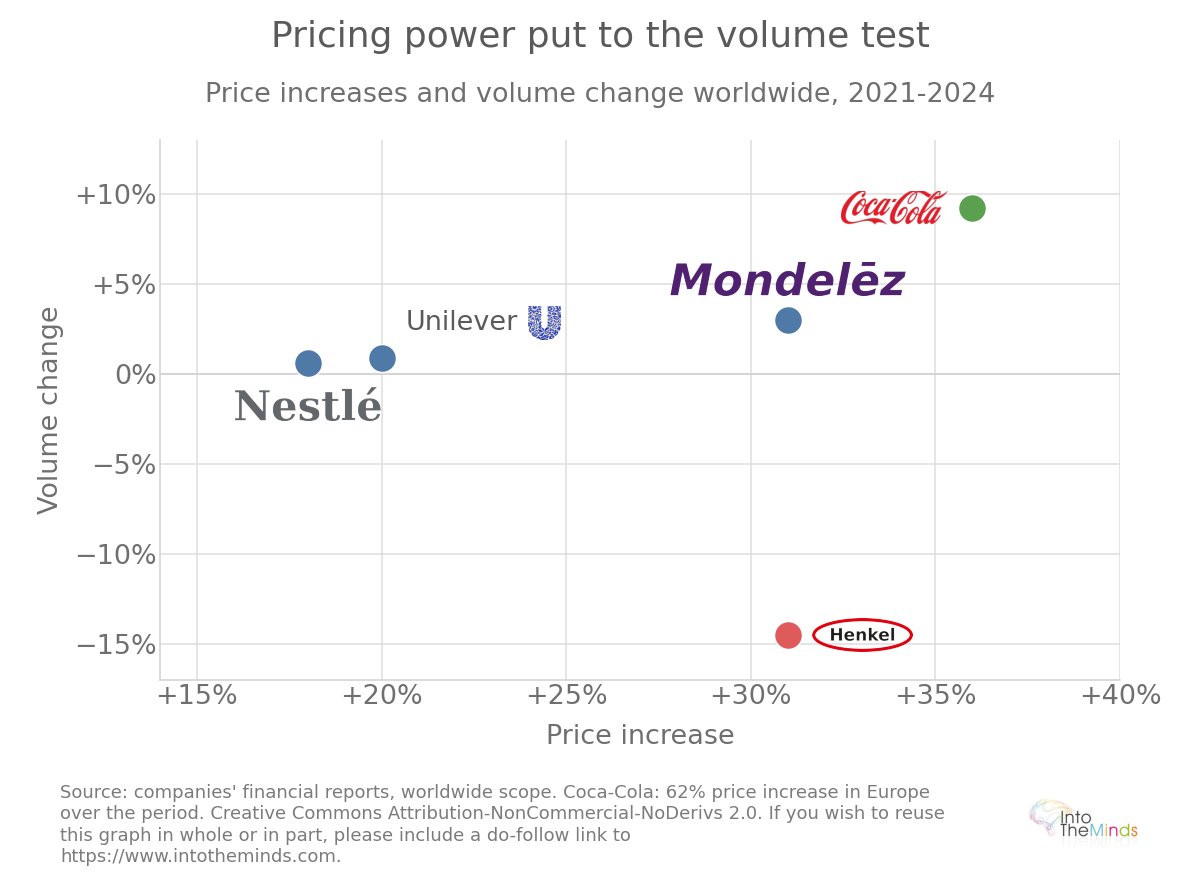
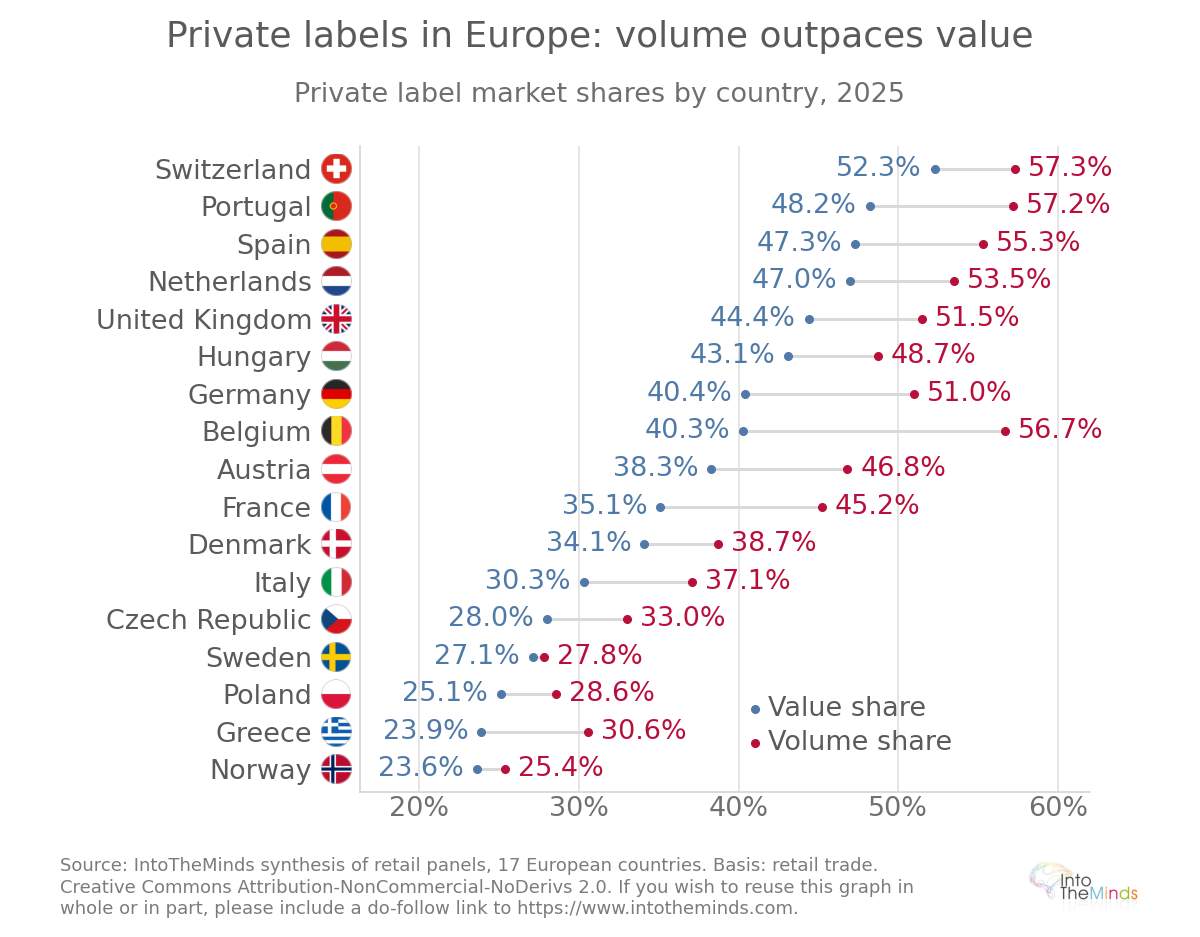
Across the 17 European countries studied, private label market share reached 38.8% in 2025.
Europe, a stronghold of the private label market (€387 billion)
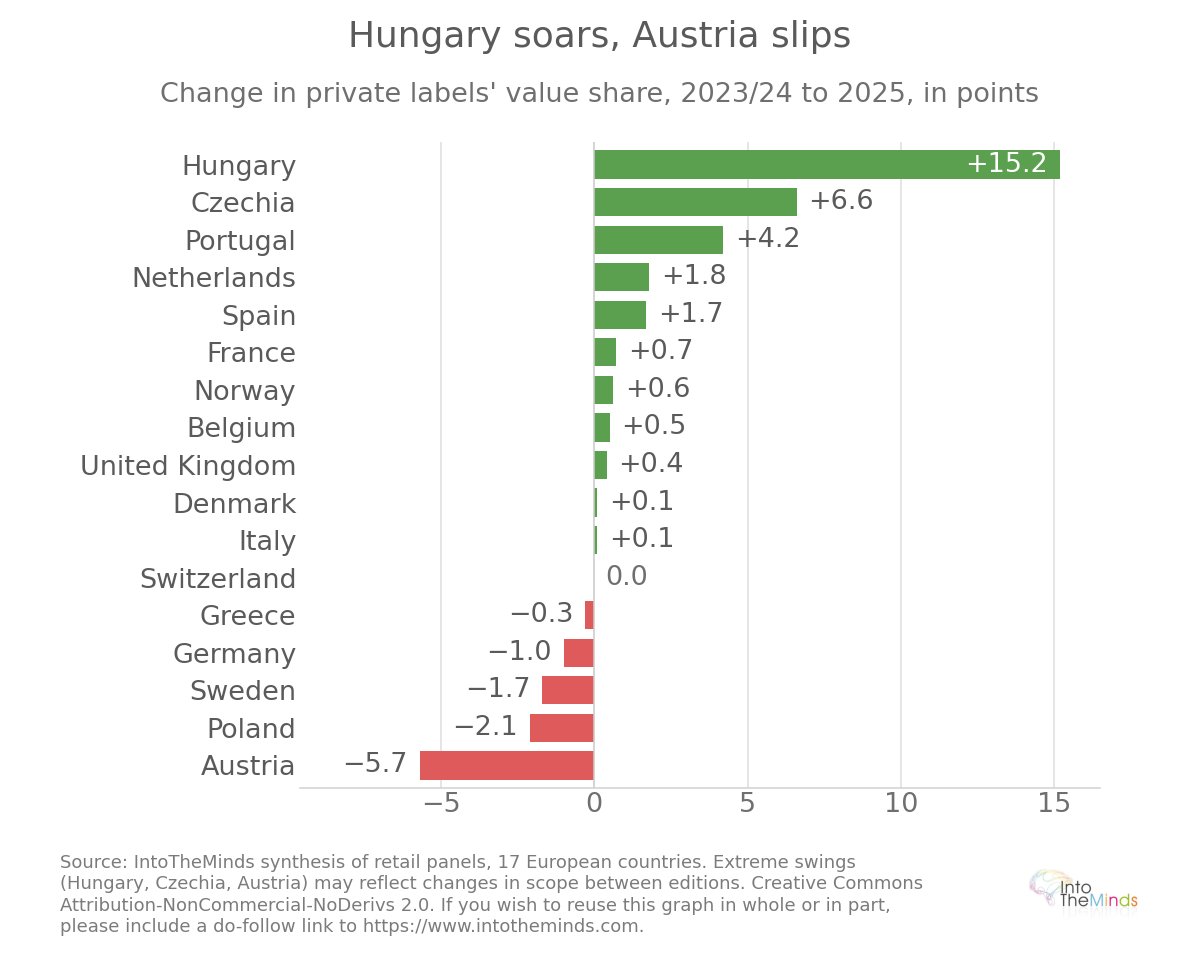
Across the 17 European countries studied, private label market share reached 38.8% in 2025, up 0.33 percentage points year-on-year. Total sales exceeded €387 billion, an increase of €15.3 billion. Private labels now account for more than 30% market share in 12 countries and more than 40% in 8 countries. The international PLMA (the world’s leading private label trade show)is a testament to this vitality. The 39th edition brought together more than 3,200 exhibitors from over 75 countries.
| Country (2025) | Value market share | Volume market share |
|---|---|---|
| Switzerland | 52.3% | 57.3% |
| Portugal | 48.2% | 57.2% |
| Spain | 47.3% | 55.3% |
| Netherlands | 47.0% | 53.5% |
| United Kingdom | 44.4% | 51.5% |
| Germany | 40.4% | 51.0% |
| Belgium | 40.3% | 56.7% |
| France | 35.1% | 45.2% |
| Italy | 30.3% | 37.1% |
| Poland | 25.1% | 28.6% |
The private label market in Germany: target of 50%!
Germany illustrates the most advanced structural shift in continental Europe. The share of private labels in the turnover of grocery and drugstore markets rose from 41.3% in 2021 to 43.8% in 2022, 46.1% in 2023, and a record 46.9% in 2025. During the first eight months of 2024, private labels accounted for 51% of the market by volume, compared with 49% for manufacturer brands.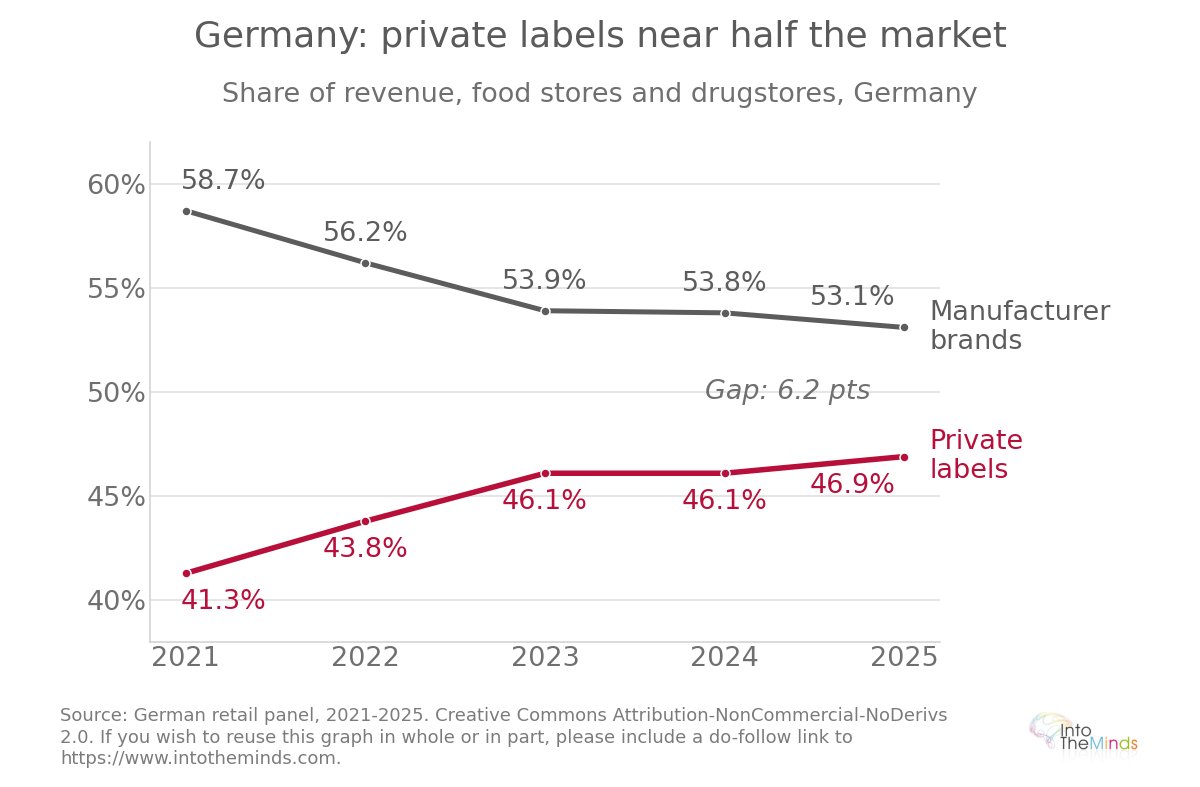
The causes go beyond the price argument alone. According to a survey conducted among a representative sample, 4 out of 10 Germans now consider brands to be “cash pumps”, a sentiment fueled by shrinkflation, a technique I was still denouncing in 2025 (see examples here). Consumer trust has been undermined. After enriching themselves beyond reason, brands therefore felt compelled to step up their promotional activity. In the first half of 2024, just consider that 29.5% of the turnover generated by branded products was made under promotion! It was only 14.8% for private labels.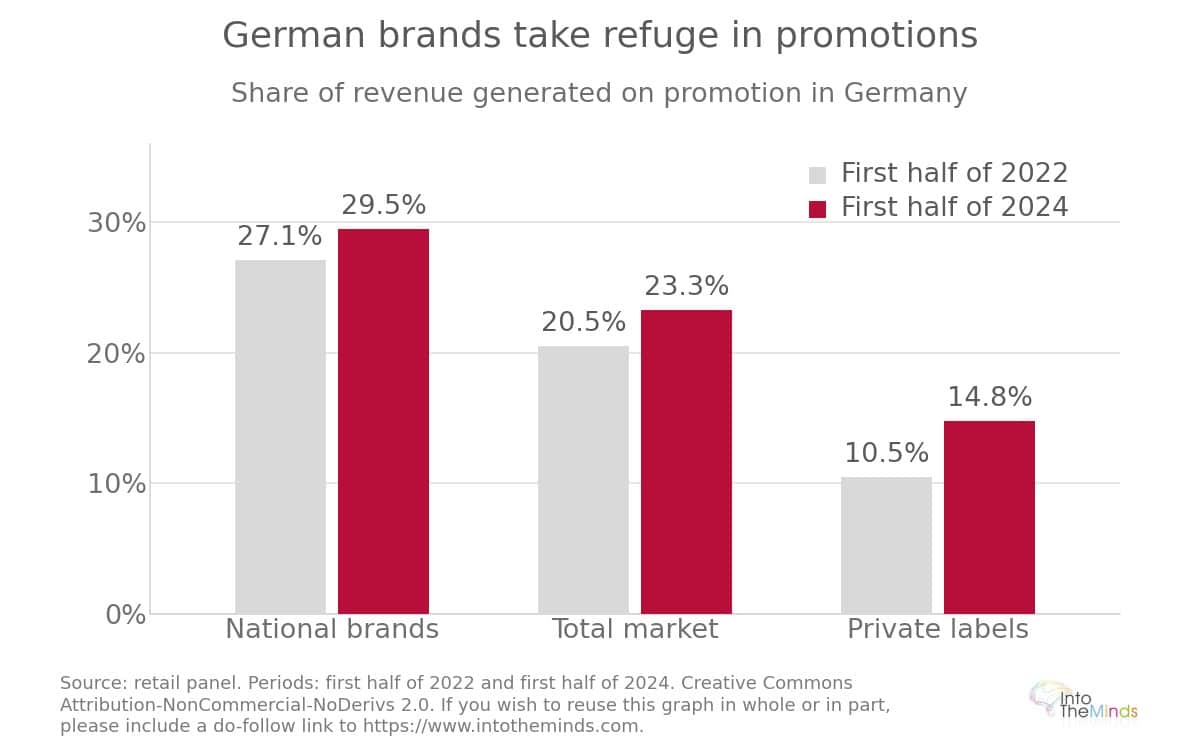
Retailers, for their part, have professionalized their private labels to the point of dominating value-for-money rankings. Retailers such as Aldi, dm and Lidl regularly top value-for-money rankings. Emotional “love brands” nevertheless remain resilient: Haribo recorded record sales in 2025, and the drugstore brand Balea has become a cult favorite among Generation Z on social media.
In Germany, the price advantage of private labels over strictly comparable products exceeded 53% in mid-2026: a gap that has continued to widen since 2023.
The private label market in France: €51 billion and catching up
The French private label market is worth €51 billion. With a 45.5% volume share and 35.6% value share in 2025, France remains “a country of brands”. But as you may have seen from the German figures, it remains below the Western European average. This lag can be explained by the structure of French distribution:
- the weight of hard discount is lower there than in Spain or Germany
- customers are attached to the diversity of the in-store offering.
The table below shows you the evolution of private label market shares in France over the last 12 years.
| Year | Private label value market share | Private label volume market share |
|---|---|---|
| 2014 | 34.6% | 47.3% |
| 2017 | 33.0% | 44.8% |
| 2021 | 32.0% | 42.2% |
| 2022 | 33.7% | 43.8% |
| 2023 | 35.3% | 45.1% |
| 2025 | 35.6% | 45.5% |
For the cumulative first four months of 2026 (data through April 19), private labels were up 2.5% in volume, compared with 1.2% for national brands. In April 2026 alone, the gap was even more pronounced: +3.2% versus +1.4%. The gains were nevertheless highly concentrated: out of 276 categories, 17 alone accounted for 50% of the growth. The identified potential lies in beer, coffee, soft drinks, health and beauty, and sweet grocery products. To better understand the purchasing behaviors underlying these dynamics (a little promotional plug along the way 😉), you should know that our firm studies these purchasing dynamics for several major retail players: Leclerc, Auchan, Delhaize, for example. To do so, we apply our B2C market research methods.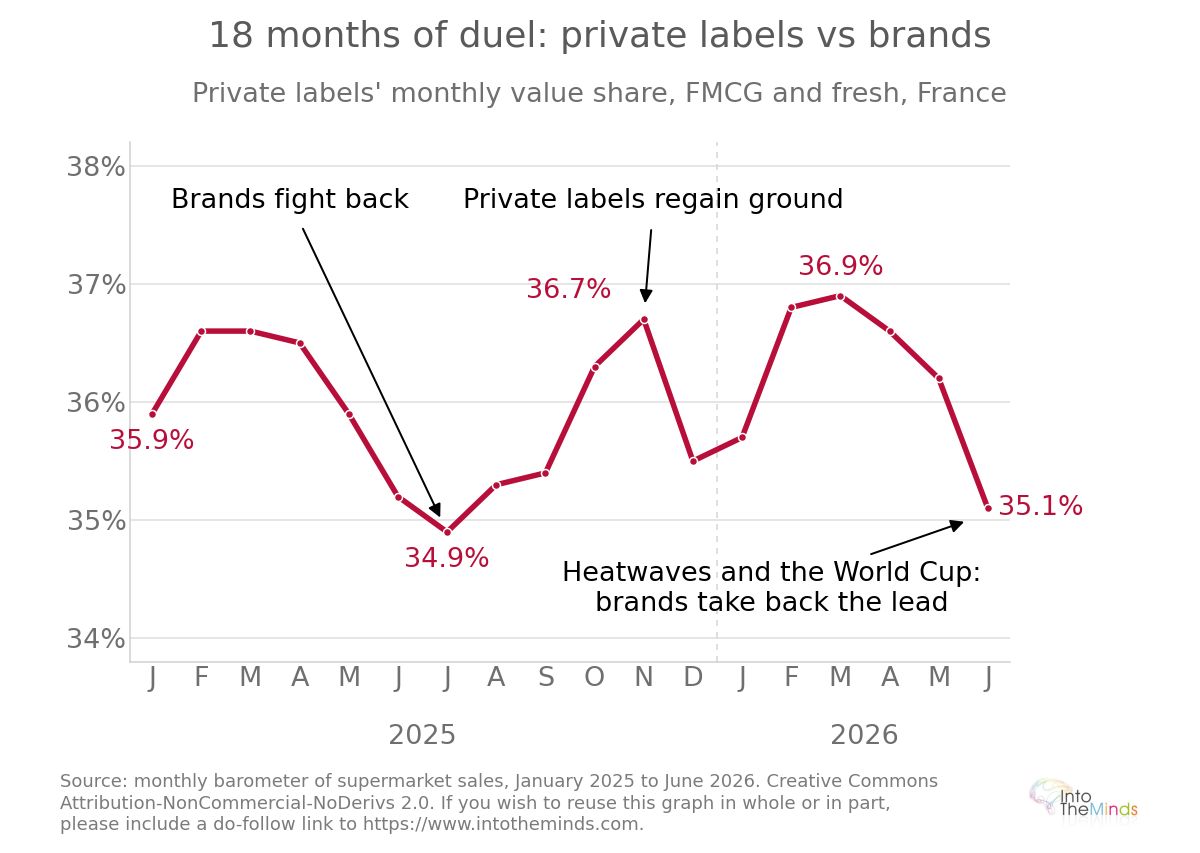 The private label market in Spain and the United Kingdom
Spain is Europe’s most dynamic market in 2025, with a 47.3% value share and 55.3% volume share. It is also the market showing the strongest annual growth in Europe. Annual growth at the end of March 2024 reached 12.9%, the highest among the 6 major European markets.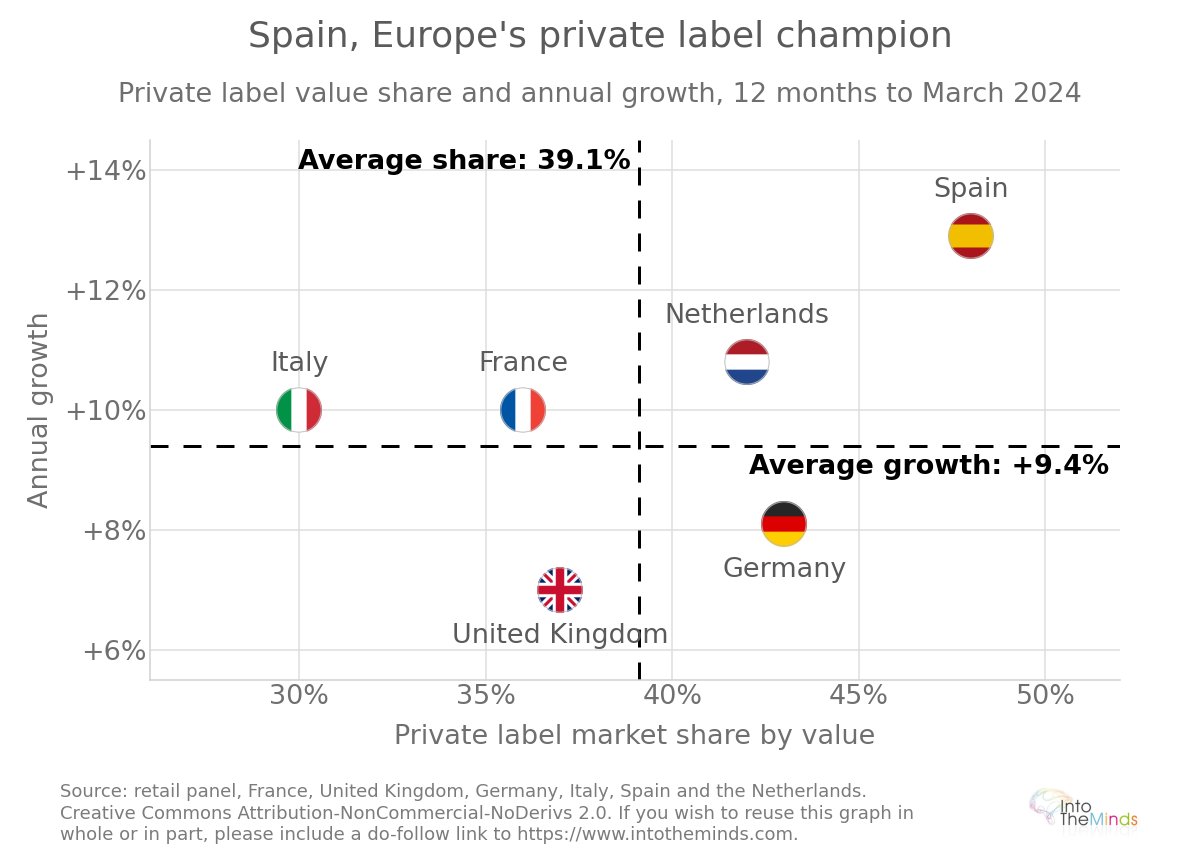
The United Kingdom, with a 44.4% value share and 51.5% volume share in 2025, represents the second-largest private label market in absolute value, at €53 billion (data through the end of March 2024). Its trajectory is more stable than that of Spain or Germany, as British retailers have historically invested early in the quality of their private labels.
In France, nearly two-thirds of private label turnover is generated by very small businesses and SMEs, and 90.5% of premium private labels are produced by French companies.
Private label retailer strategy
Who manufactures private labels, and how do retailers manage them? In this section, I give you a few keys to understanding the subject. If you want to explore the topic further, I strongly recommend visiting the SIAL trade show, which takes place every 2 years.
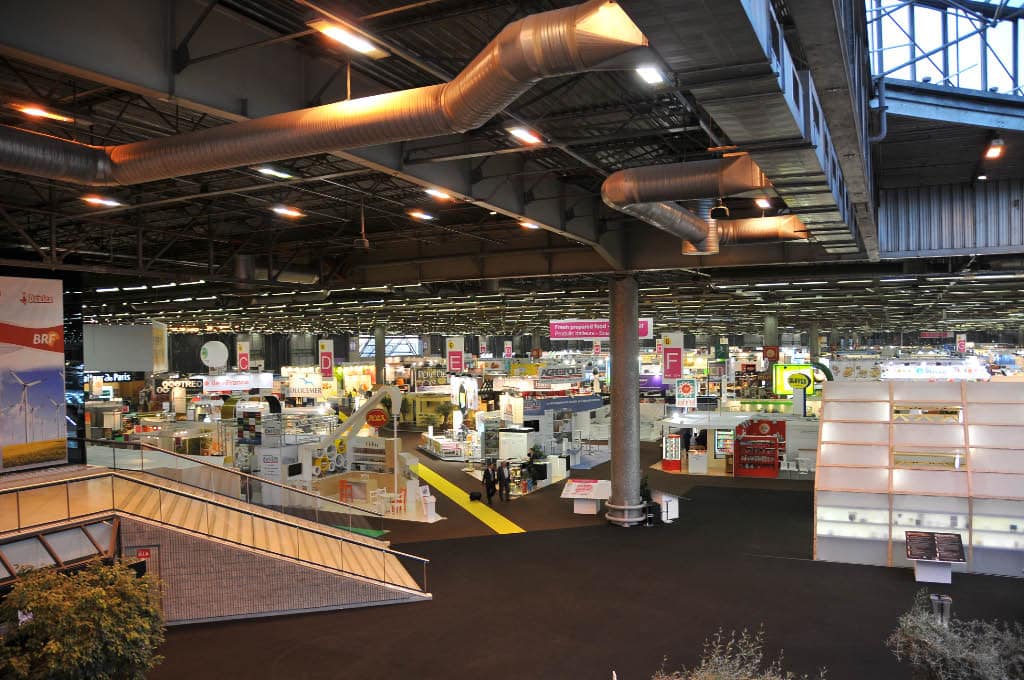
SIAL is a trade show held every 2 years that brings together 7,500 exhibitors. It provides an opportunity to take the pulse of the food industry market, and in particular the private label market, since many manufacturers attend the event.
Who manufactures private label products?
Private label products are rarely manufactured by retailers themselves. Les Mousquetaires (Intermarché) are an exception, with their own industrial subsidiaries (this is known as vertical integration, and I showed you through the analysis of Decathlon’s strategy that this can pay off).
In France, nearly two-thirds of private label turnover is generated by French very small businesses and SMEs (76.4% when including mid-sized companies), and 90.5% of premium private labels are produced by French companies. Manufacturers of major national brands have also participated in private label production: Panzani, for example, manufactured spaghetti for Casino or Auchan on the same production line as its own brand, while William Saurin produced ravioli for Cora, Carrefour or E.Leclerc.
Manufacturers fall into 3 profiles according to their degree of involvement in private labels:
- National brand manufacturers: private label turnover shares of 0 to 20%, often reluctant but tempted by economies of scale
- Mixed manufacturers: 20 to 80% of private label turnover, such as Bonduelle for vegetables
- Contract manufacturers: 80% to 100% of their turnover comes from private labels. These are specialized companies, often equipped with state-of-the-art technology. Their advertising expenditure is virtually zero because the end customer is responsible for promoting the product.
Retailer strategies in the private label market
French retailers now view private labels as a central strategic priority. Carrefour, which is celebrating the 50th anniversary in 2026 of its “produits libres” launched in 1976, is targeting a 40% private label share by 2030. The internal rules are as follows:
- a private label is managed like a national brand
- 20 to 30 innovations per year and per category
- 9 to 12 months of R&D per product
- tests in external laboratories and consumer panels (including those conducted by IntoTheMinds 😀)
- if the product does not perform, it is removed from the shelf.
The terroir segment illustrates this move upmarket. These gourmet private labels account for only 1.9% of the French food market (€2.22 billion at the end of April 2025), but offer a gross margin that can reach 40% (if you have read my analysis of the retail media market, you know that the average margin is below 5%).
Each retailer structures its offering:
- Carrefour capitalizes on Reflets de France (created in 1996, 600 references, monthly committee originating from the Robuchon group)
- E.Leclerc is modernizing Nos Régions ont du talent (1999, 300 references, with industrial-scale volumes such as 3.6 million Bertel buckwheat galettes)
- Intermarché is adding Intermarché Terroirs (2025, 150 references) alongside Itinéraire de Nos Régions (2022, 240 references)
- Monoprix is developing Monoprix Gourmet (1986, 700 references).
32% of shoppers say they no longer perceive any difference between private labels and traditional brands.
Consumer perception and the future of the private label market
A survey of 1,000 French consumers in 2026 confirms the normalization of private labels. Nearly 75% of respondents say they are familiar with the distinction between private labels and national brands, and 76.6% believe that the image of private labels has improved in recent years, compared with 48.2% for national brands. Price remains the primary purchase driver (77.5%), but 32% of shoppers say they no longer perceive any difference with brands.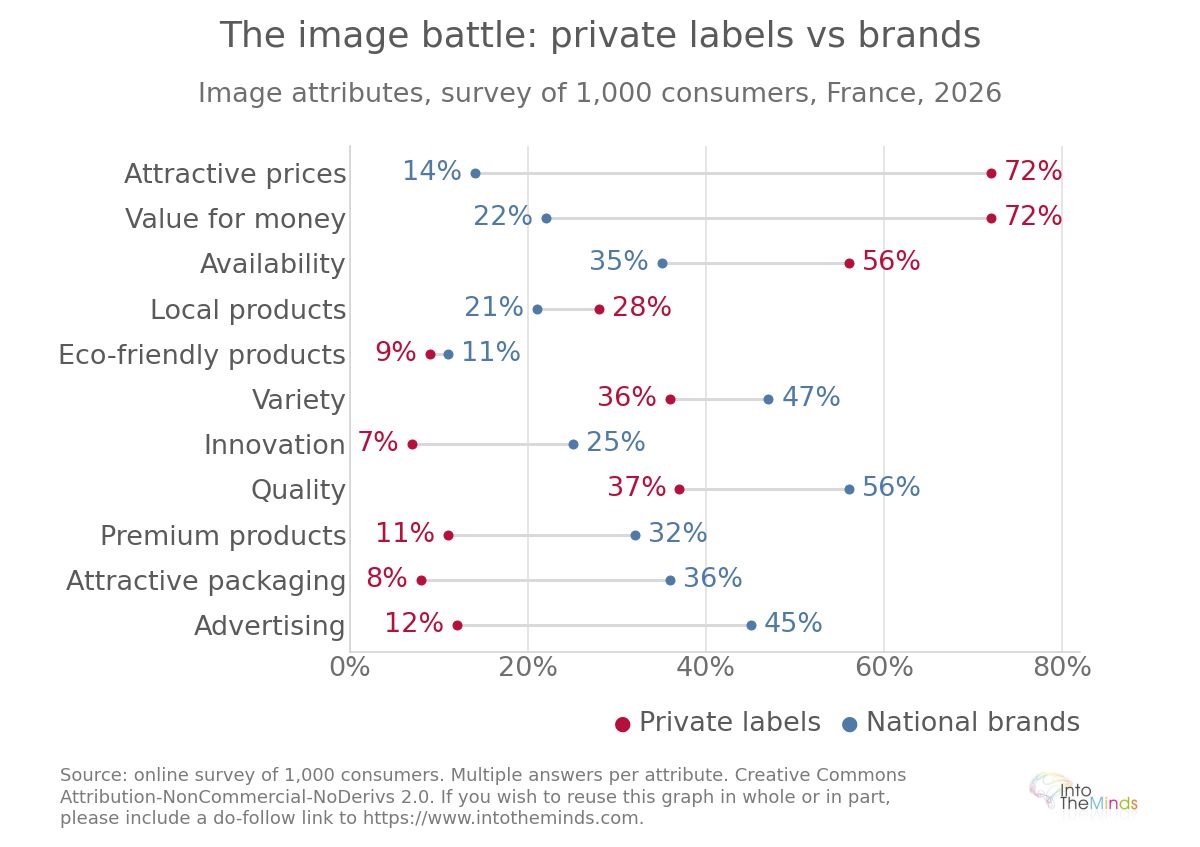
A generational paradox deserves attention: 44% of purchases by those under 35 go to private labels, but their private label purchases are declining by 3.1% in volume in favor of national brands (+1.4%). Those aged 50-64, on the other hand, are increasing their private label purchases by 3.0%. Younger consumers, who are more curious and mobile (36% enjoy trying new things), are generally turning away from hypermarkets and supermarkets. Large families and lower-income households are driving demand. To accurately measure these changes in brand image and awareness, a targeted brand awareness survey by retailer or private label range provides insights that sales panels cannot offer.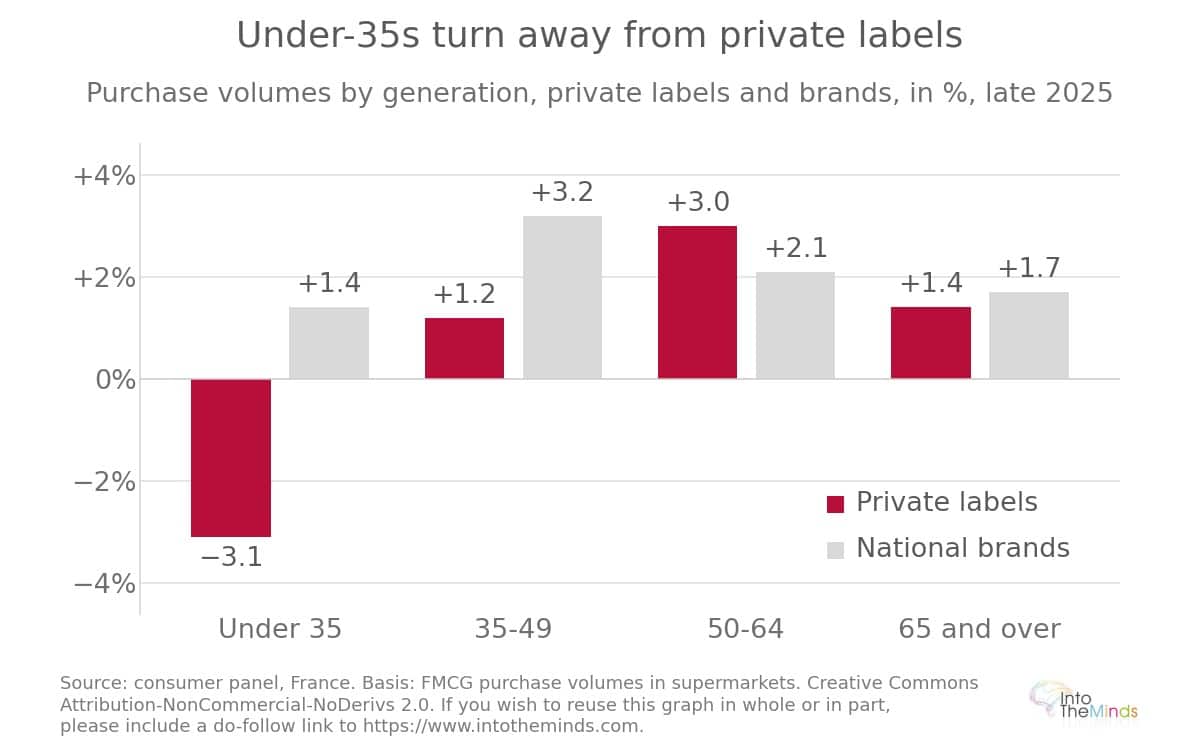
The international comparison suggests catch-up potential for France. The European average shows that the 39% market share threshold in value is an achievable target. To conclude, let us highlight 3 points requiring attention:
- the response from national brands, which came back strongly on innovation and promotion in 2025.
- the generational fragility already mentioned.
- an identified risk in Germany: if brands disappear from shelves, variety and competition diminish. This increases the “power” of retailers which, by becoming manufacturers themselves, ultimately control prices and consumption habits.

FAQ: Your questions answered
What exactly is a private label?
A private label is a brand owned by a retailer, which defines its characteristics. The product is generally manufactured by a subcontractor, often an SME, according to precise specifications governed by a supply contract. The brand is exclusive to the retailer and is not available from its competitors. In France, nearly two-thirds of private label turnover is generated by French very small businesses and SMEs.
What is the private label market share in France?
In 2025, private labels accounted for 35.6% of sales by value and 45.5% by volume in French hypermarkets and supermarkets. The total market is worth €51 billion. France remains behind the Western European average (48.1% by volume), but the catch-up trend is underway: as of April 19, 2026, private labels were up 2.5% in volume compared with 1.2% for national brands. If you would like to analyze your positioning in this market, our team can conduct a B2B market research tailored to your sector.
What are Carrefour’s private labels?
Carrefour structures its private label offering around several ranges. The Carrefour brand covers most everyday products. Reflets de France (created in 1996, 600 references) is dedicated to local and gourmet products, with a monthly validation committee from the Robuchon group. Carrefour is targeting a 40% private label share in its customers’ baskets by 2030, as part of its Carrefour 2030 plan.
Are private label products good quality?
As early as the end of 2023, 88% of French shoppers said they were satisfied with the quality of private labels. Retailers belonging to the French Trade and Distribution Federation had 12,000 inspections of their points of sale carried out in 2023 by independent organizations (FSQS standard). Premium private labels achieve appreciation (71%) and trust (75%) scores equivalent to national brands in the food sector. In health and beauty, national brands retain a perceived advantage (80% perceived quality compared with 59% for standard private labels). To measure your customers’ satisfaction with a private label range, a targeted customer satisfaction survey remains the most reliable tool.
Why are private labels growing faster than national brands?
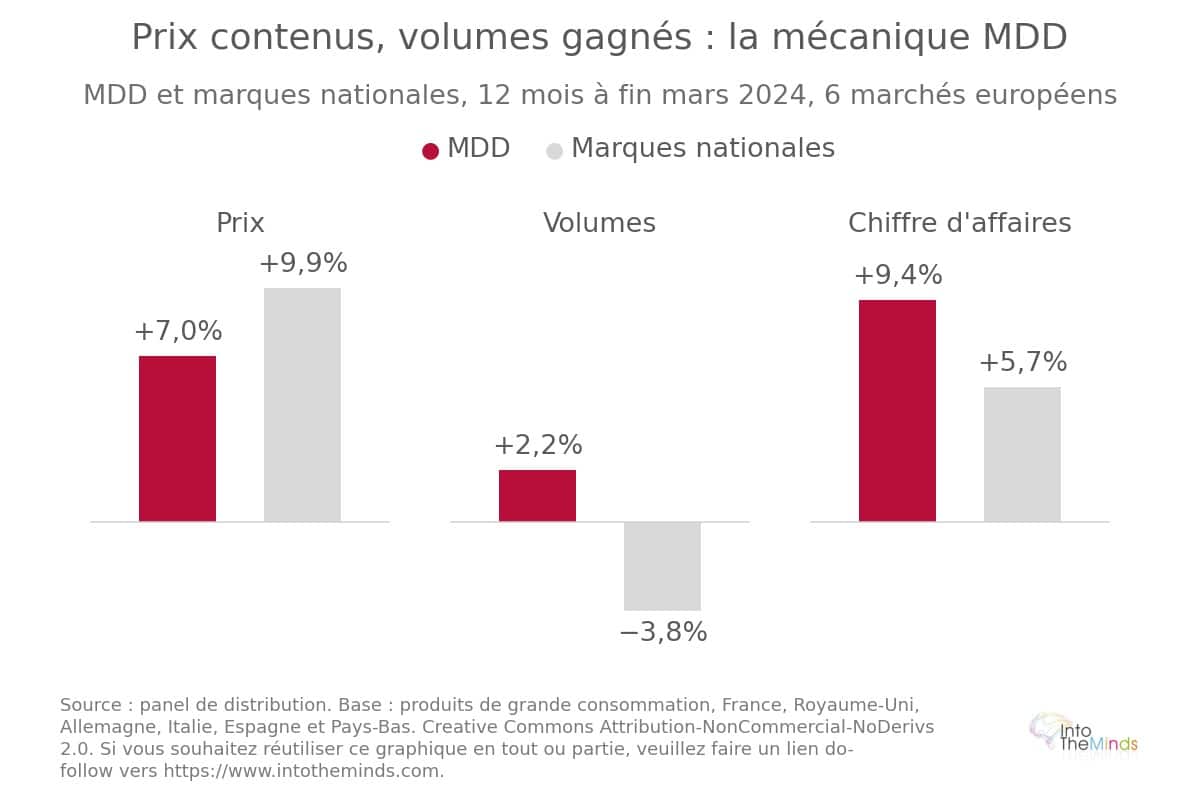
Inflation has played an accelerating role: across the 6 major European markets, private label prices increased by 7.0% compared with 9.9% for national brands (over twelve months through the end of March 2024), allowing private labels to gain volume (+2.2%) while brands lost volume (-3.8%). But the explanation goes beyond price. Retailers have professionalized their ranges, invested in local and premium products, and created a retailer loyalty effect. In Germany, distrust of shrinkflation practices by major brands accelerated the shift toward private labels.

![Illustration of our post "What do customers expect from downtown stores? [Survey]"](/blog/app/uploads/retail-shopping-covid19-120x90.jpg)

![Illustration of our post "Digitization: food & beverage industry companies lag far behind [Research]"](/blog/app/uploads/marche-alimentation-bio-long-120x90.jpg)