Impressive margins, record efficiency: the retail media market is posting double-digit growth thanks to its proven effectiveness throughout the customer journey. In this article, IntoTheMinds offers a comprehensive analysis of the retail media market from every angle, comparing different countries.
Le retail media has established itself in less than a decade as one of the most dynamic advertising channels in the world. The model emerged at Amazon in the United States in the early 2000s and allows retailers to monetize their audience and first-party data by offering advertising space directly along their customers’ purchase journey, both online and in-store. In 2025, global retail media investments continued to rise, approaching the budgets allocated to television. In France, the market has now comfortably exceeded one billion euros, driven by sustained annual growth since 2021. These figures provide an initial indication of the scale of the retail media market. However, they do not yet reveal the extreme market concentration, the exceptionally high margins that attract retailers, or the structural challenges holding back the sector’s maturity. This is why our market research firm, drawing on its experience in retail, has analyzed all the available data to provide you with a concise overview of this market.
Contact the IntoTheMinds institute
Key takeaways
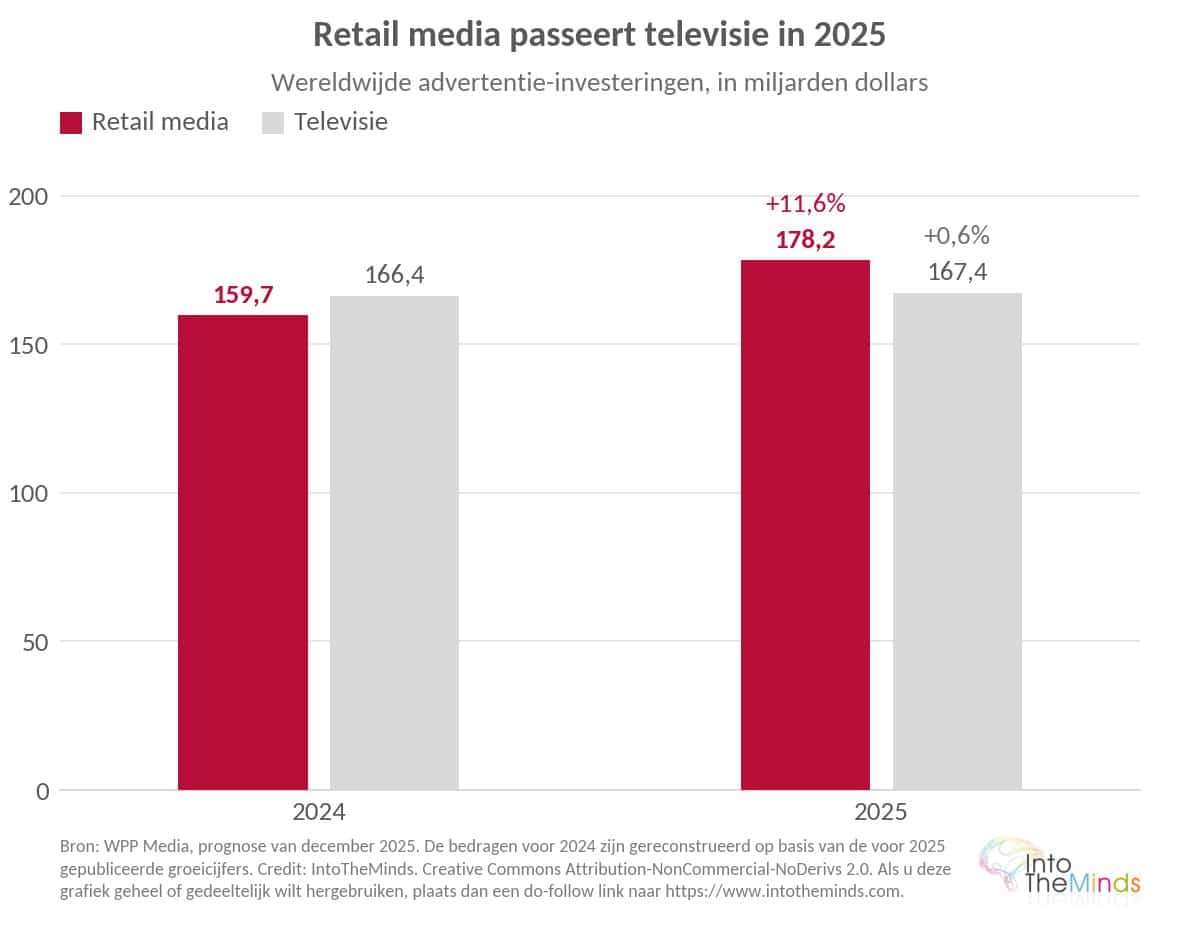
- In 2025, the global retail media market exceeded $178 billion, surpassing television for the first time, according to WPP Media.
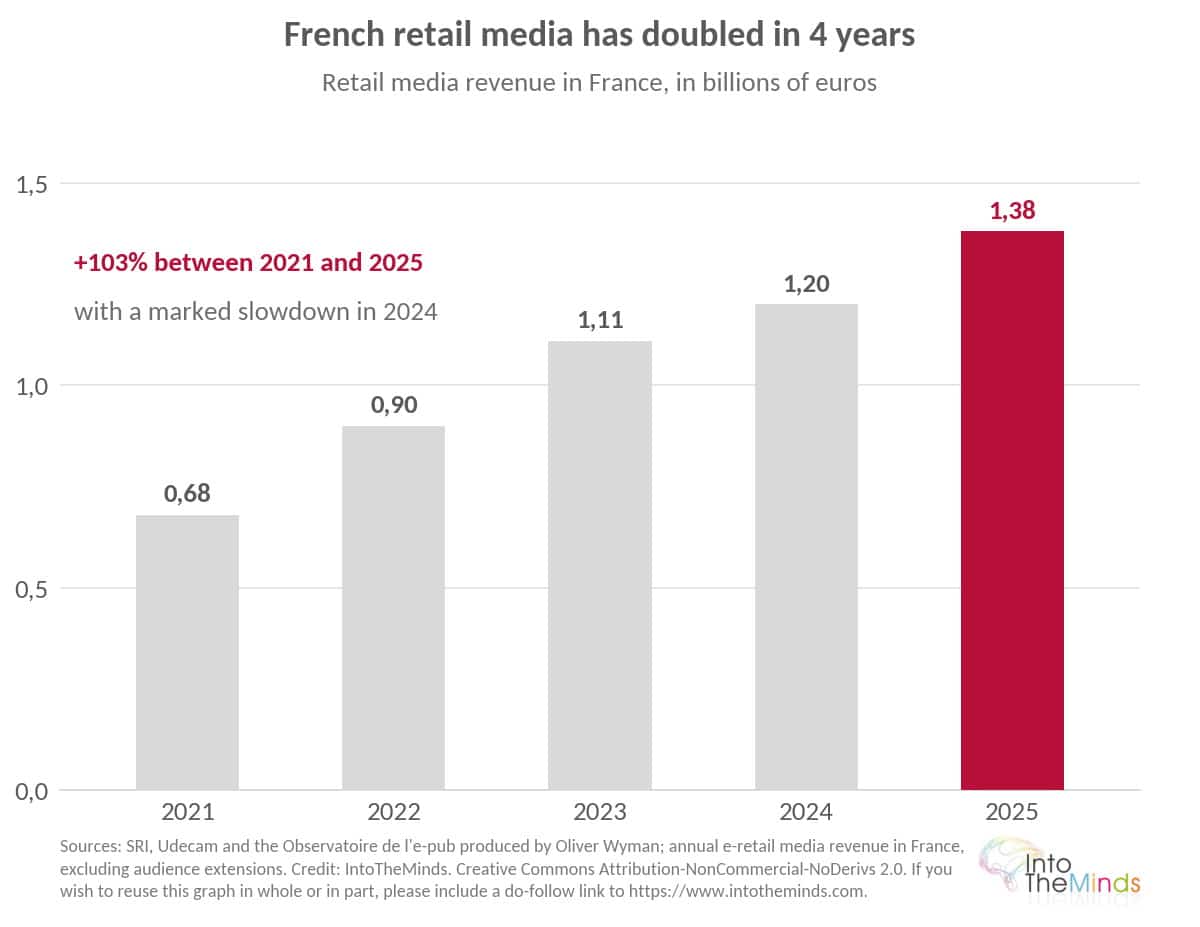
- In France, e-retail media revenues reached €1.38 billion in 2025, representing a +13% year-on-year increase (35th Observatoire de l’e-pub).
- Amazon clearly dominates the U.S. market, capturing a very large share of spending, just as it does in Europe, where its market share is also significant.
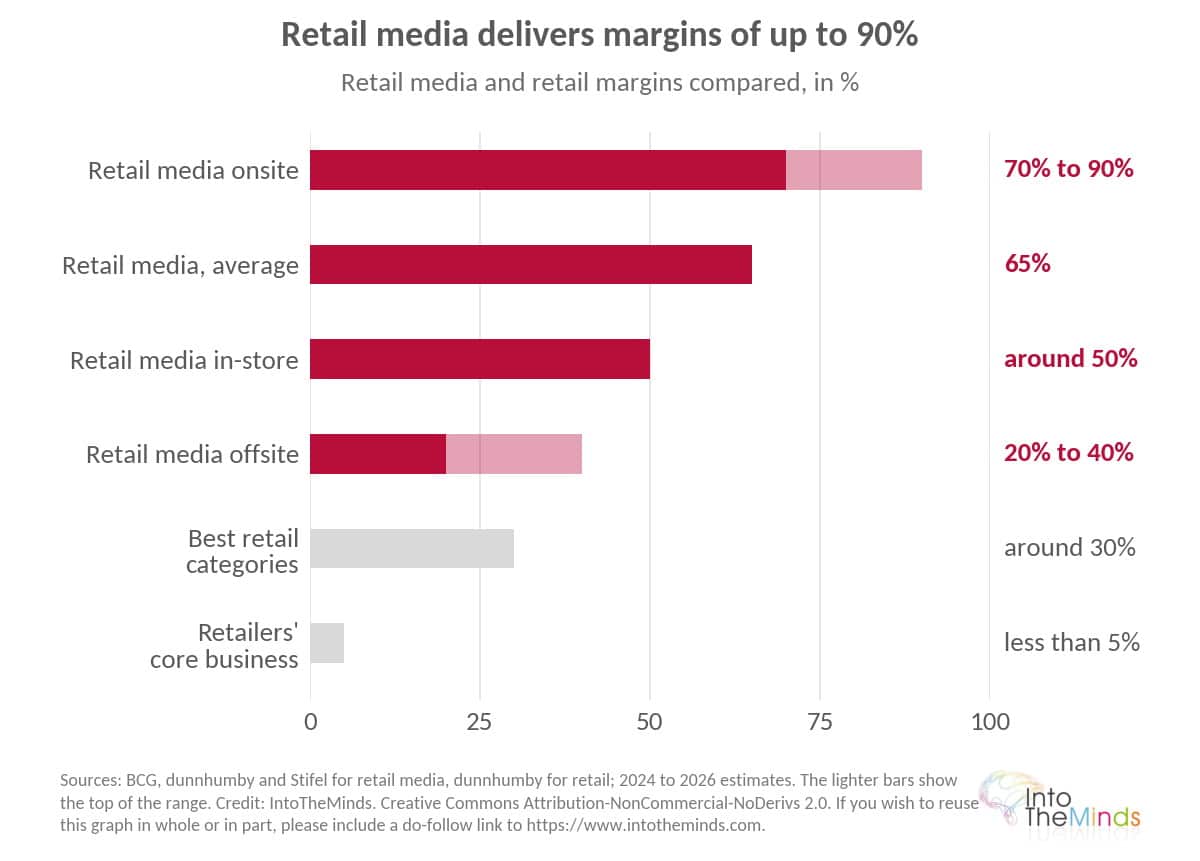
- Retail media margins are estimated at between 60% and 75%, compared with less than 5% in retailers’ core business.
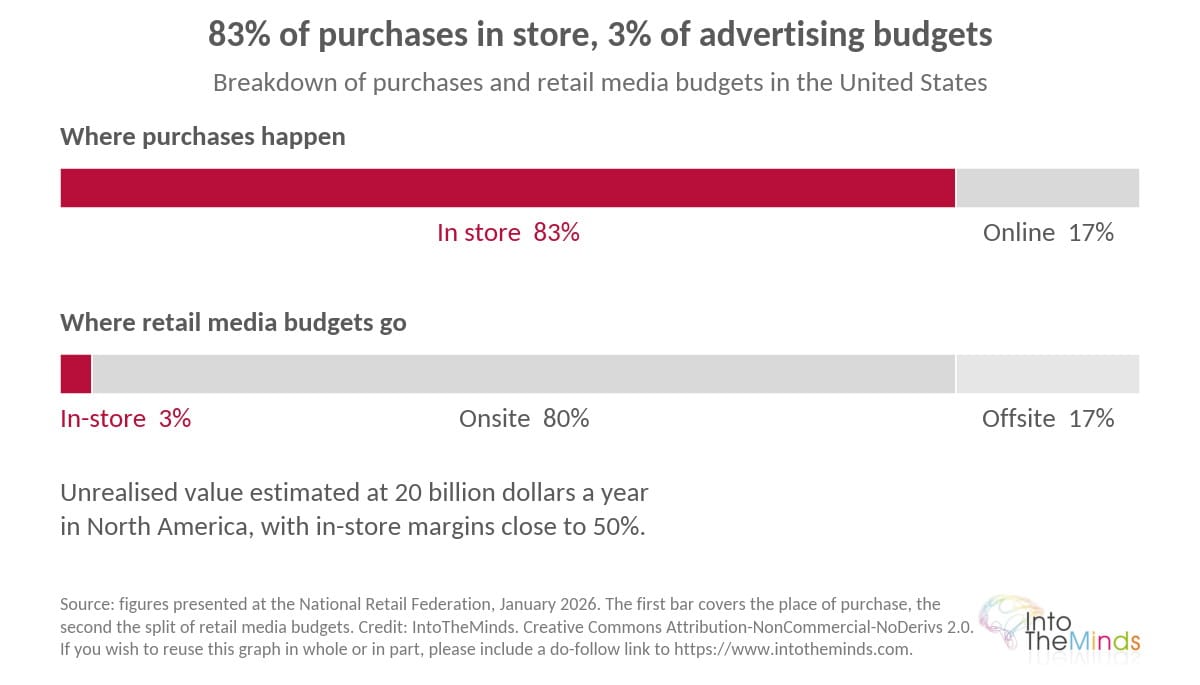
- In-store retail media remains underexploited: it captures only a marginal share of budgets, even though the vast majority of purchases still take place in physical stores.
- Measurement standardization and the emergence of agentic commerce through AI are the two main short-term challenges facing the sector.
What is retail media?
Retail media refers to all advertising opportunities deployed along the customer’s purchase journey, whether in-store or online. A retailer that sells advertising space on its e-commerce website, in its mobile app, or on screens in its stores is engaging in retail media. What distinguishes this channel from other forms of digital advertising is its immediate proximity to the point of purchase: a consumer searching for a product through an online retailer’s internal search engine is, by definition, showing purchase intent.
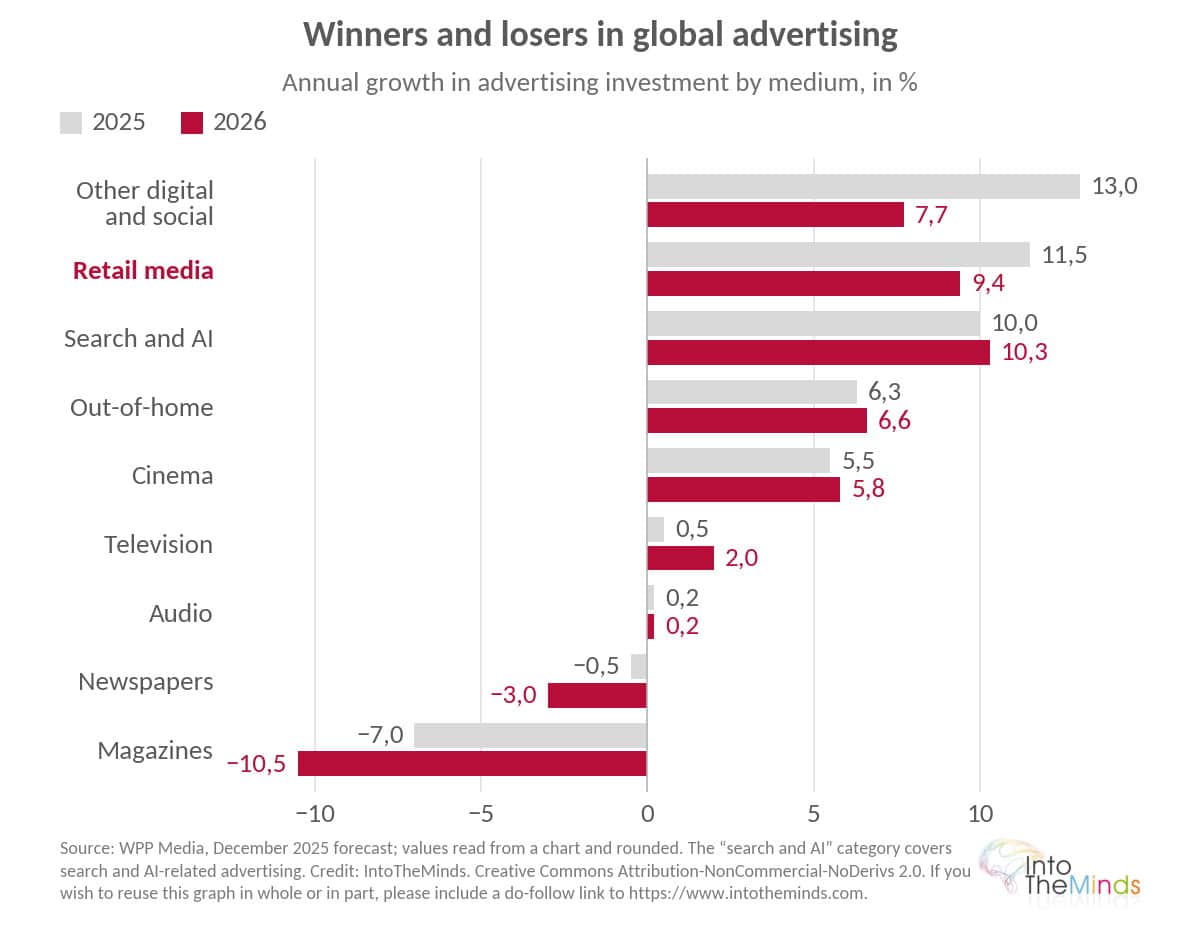
To put retail media into a broader context, below are 2 charts showing
- on the one hand, that retail media has now overtaken television
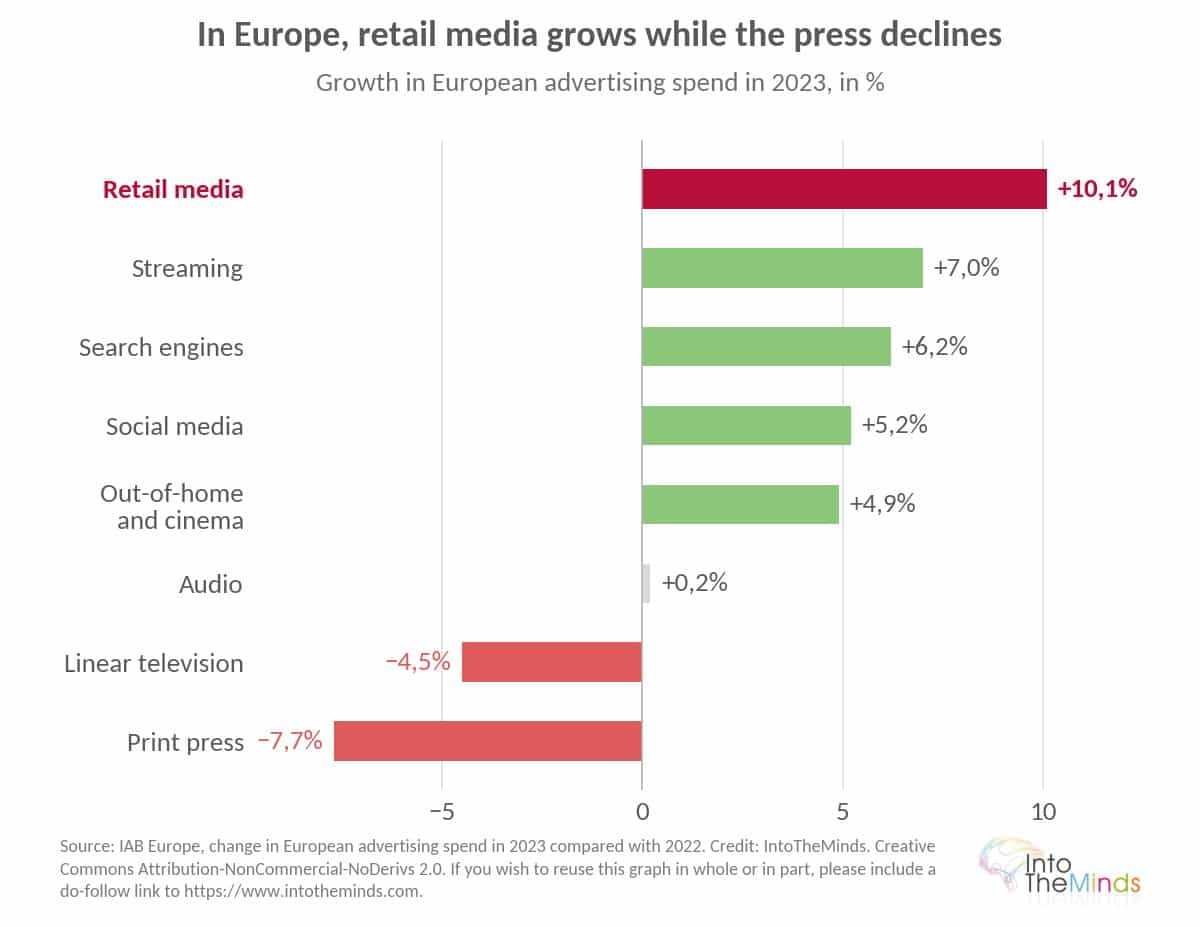
- on the other hand, that the growth rate of retail media is higher than that of other channels
Definition and fundamental principles
Retail media can be considered the third major wave of digital advertising, after search and social media. Its principle is based on three pillars:
- These data, known as first-party data, have gained considerable value since the GDPR came into force on 25 May 2018. We had already drawn our readers’ attention at the time to what we called data sovereignty, and the future has proven us right. The collection of third-party data has fallen by more than 30% since the phase-out of third-party cookies. It all started with Safari in 2017, followed by Firefox in 2019, and now even Chrome is “affected”.
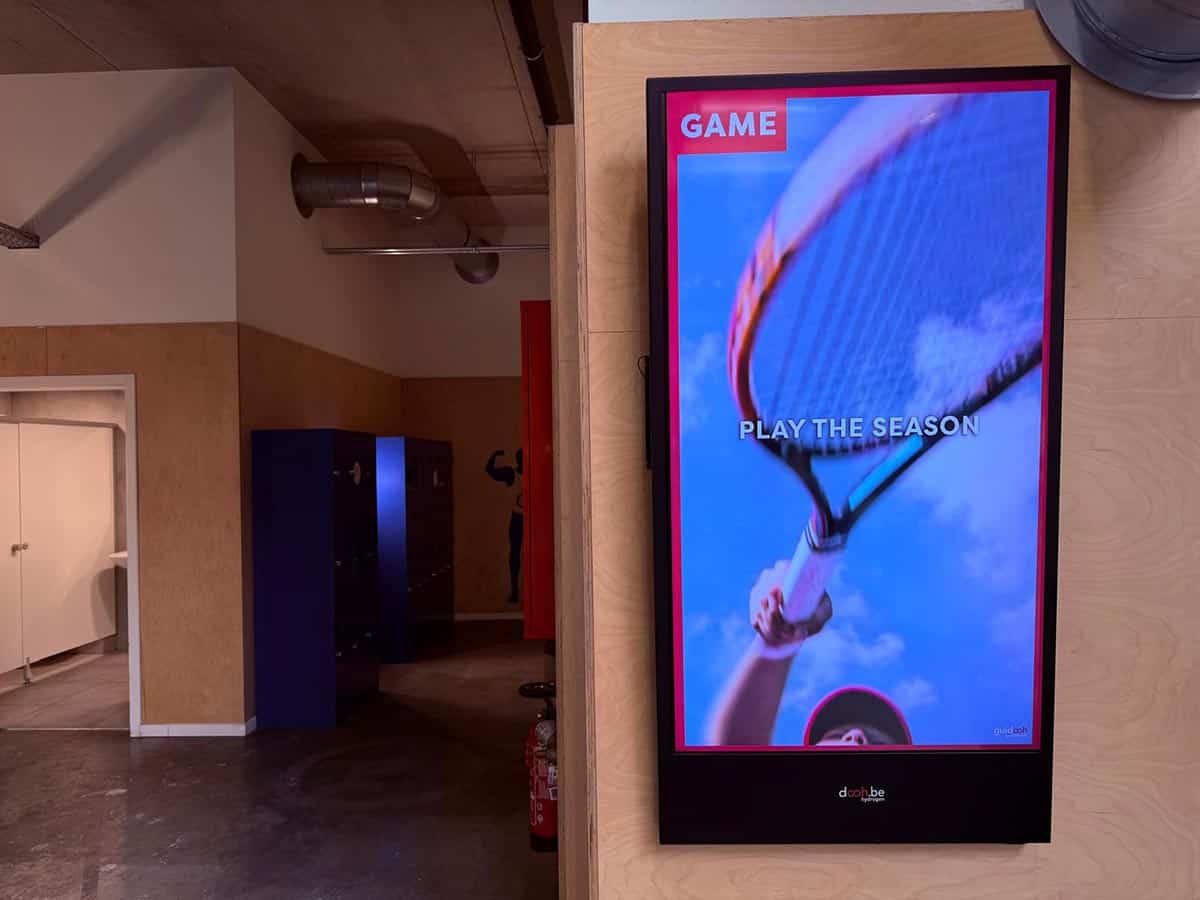
Retail media can be applied in all types of places frequented by customers. In this photo, an advertising screen in a gym belonging to the Jim’s group in Belgium.
Finally, allow us to clarify the difference between retail media and e-retail media:
- Retail media encompasses all types of media, including physical screens in stores. However, remember that physical screens are not the only possible media. Retail media can also explore more creative formats such as 3D holograms (see the example below of the London Nike Store, which I had already visited in the past).
- E-retail media is limited to digital channels: e-commerce websites, mobile applications and marketplaces.
This distinction is important for understanding growth dynamics, as the two segments are not developing at the same pace. The retail media market is evolving at two different speeds.
Retail media vs e-retail media: key differences
- Digital retail media (e-retail media): sponsored products in internal search results, banners on category pages, videos on the homepage, targeted promotional emails, sponsored recommendations in the shopping cart.
- In-store retail media: DOOH (digital out-of-home) screens in aisles, sponsored end caps, electronic labels that can be accessed via NFC or QR code, personalised in-store radio (see an example in the video below, in which I present e-ink solutions).
- Offsite retail media: extension of first-party audiences to inventories outside retailers’ own websites, through programmatic advertising.
In France in 2024, sponsored links accounted for 72% of e-retail media revenue, up 17% year on year, compared with 28% for display advertising, which increased by 5%. Sponsored search remains the dominant driver of the channel.
Concrete examples and use cases
The documented cases illustrate the diversity of retail media strategies. Here are some examples with figures:
- Mondelez, with a campaign combining Côte d’Or and Milka deployed at Carrefour, Coopérative U and Intermarché in France from 16 January to 14 May 2023, generated €10.70 for every €1 invested.
- Magnum Mini, through Carrefour Links, achieved a sales uplift of 10% to 13% in March 2023 thanks to targeting across three segments developed by Artefact. In this regard, we refer you to our analysis of the Magnum marketing strategy.
- At Rewe in Germany, a beverage manufacturer achieved nearly three times its investment through sponsored product-listing ads, with some brands reaching returns of up to 15 times their budget.
The in-store formats deliver comparable results:
- DOOH spots broadcast for the Yoplait range at Imediacenter (Auchan’s media agency) in Noyelles-Godault generated a 43.2% increase in sales in 2024.
- The Mattel-Barbie campaign in 50 Carrefour stores in October 2024 generated 20% additional revenue and a 6% increase in average basket value compared with comparable stores that were not exposed to the campaign.
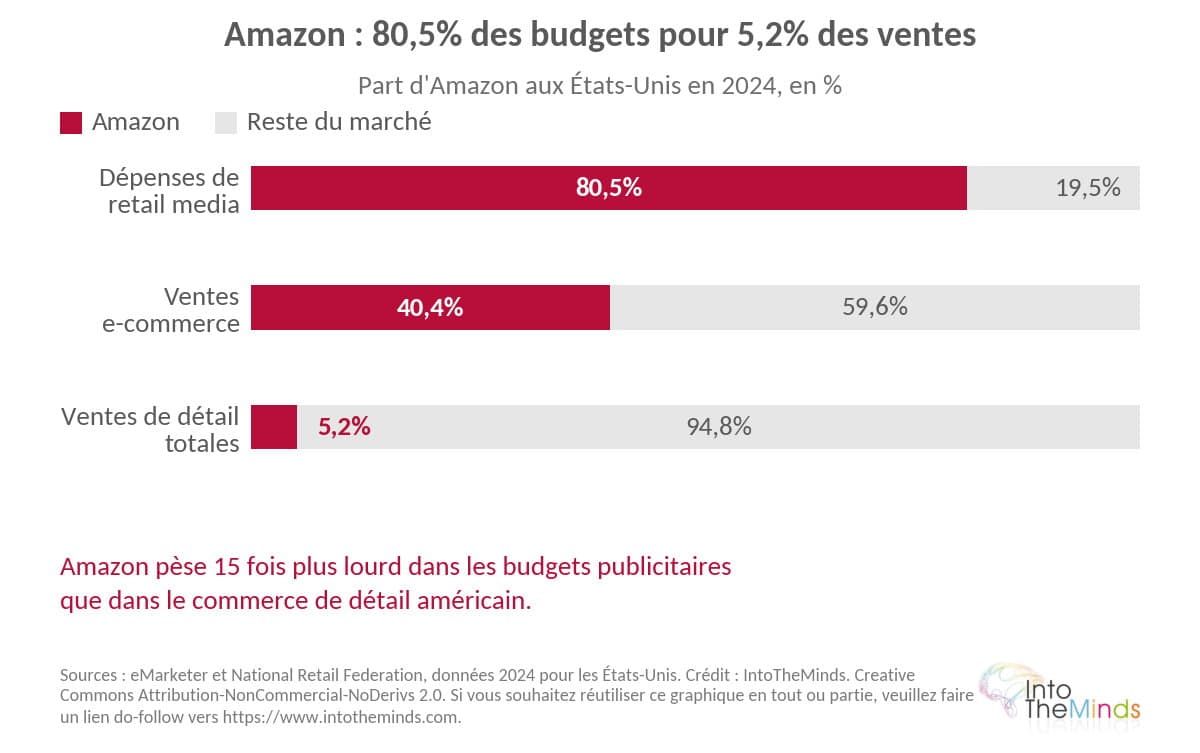
In the United States, Amazon accounted for 80.5% of retail media spending in 2024.
The retail media market: figures and outlook
If you are interested in market data, you will find it here. We have compiled and analysed all official data sources. The first observation is that the market has reached an entirely different scale in just a few years. In 2021, the global retail media market excluding Amazon and China was estimated at $14 billion. Its outlook was projected at $32 billion in 2025. As you will see below, reality has far exceeded these estimates.
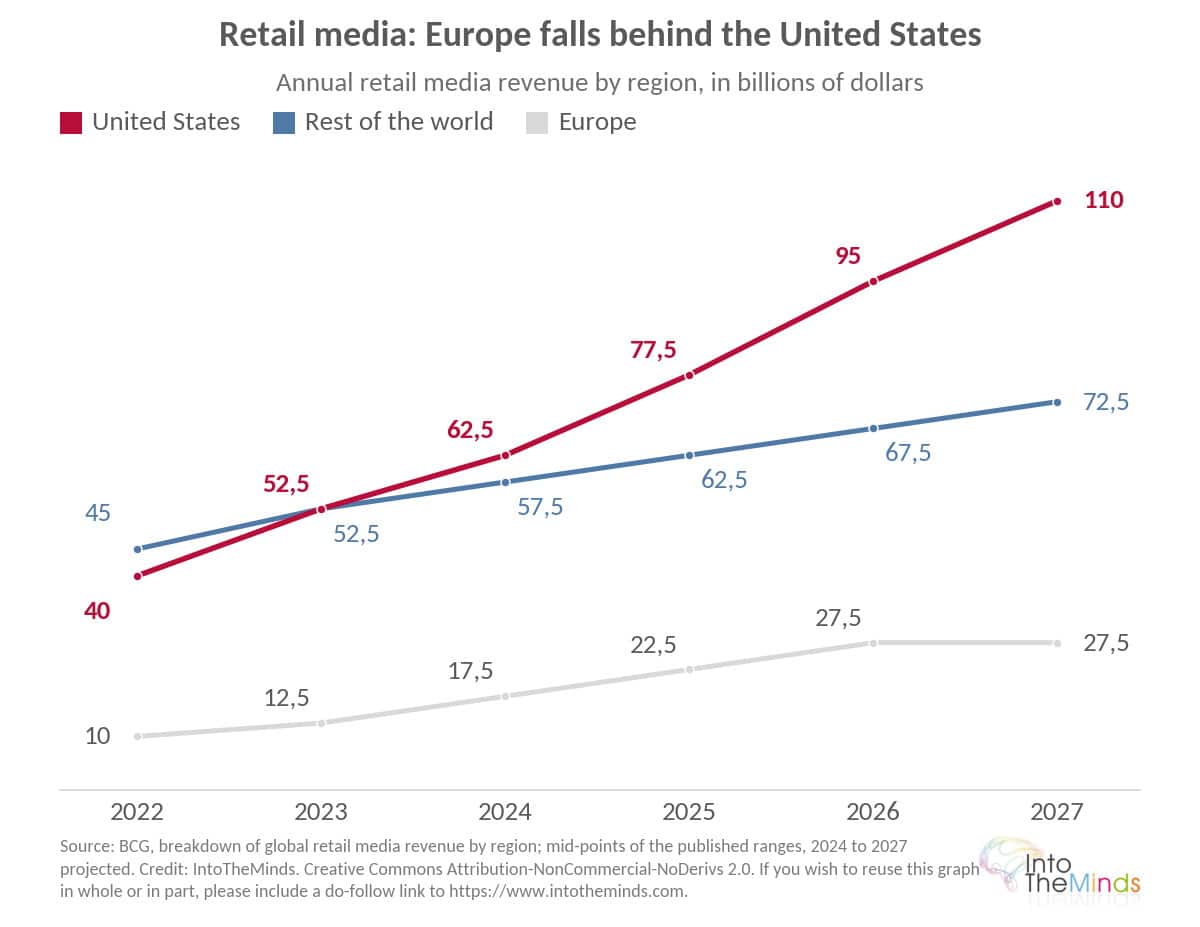
The retail media market is growing at an annual rate of 17%. It will reach $220 billion by 2027!
Retail media market size and growth
The retail media market is growing at an annual rate of 17%. Global revenues are expected to increase from $95 billion in 2022 to $220 billion in 2027! Global revenues for 2025 are estimated at $174.2 billion, representing growth of 11.3%, and a further increase of 9.4% is expected in 2026. By 2028, Reuters forecasts that retail media networks will account for 15.4% of global advertising revenues.
| Year | Global revenues | Annual growth | French market |
|---|---|---|---|
| 2022 | $95 bn | +17% | €887m (+30%) |
| 2023 | $120 bn | +17% | €1.11 bn (+24%) |
| 2024 | $130–145 bn | +17% | €1.2 bn (+14%) |
| 2025 | $165–170 bn | ~+17% | €1.38 bn (+13%) |
| 2026 (forecast) | $180–200 bn | +9.4% (WPP) | N/A |
| 2027 (forecast) | $190–220 bn | N/A | N/A |
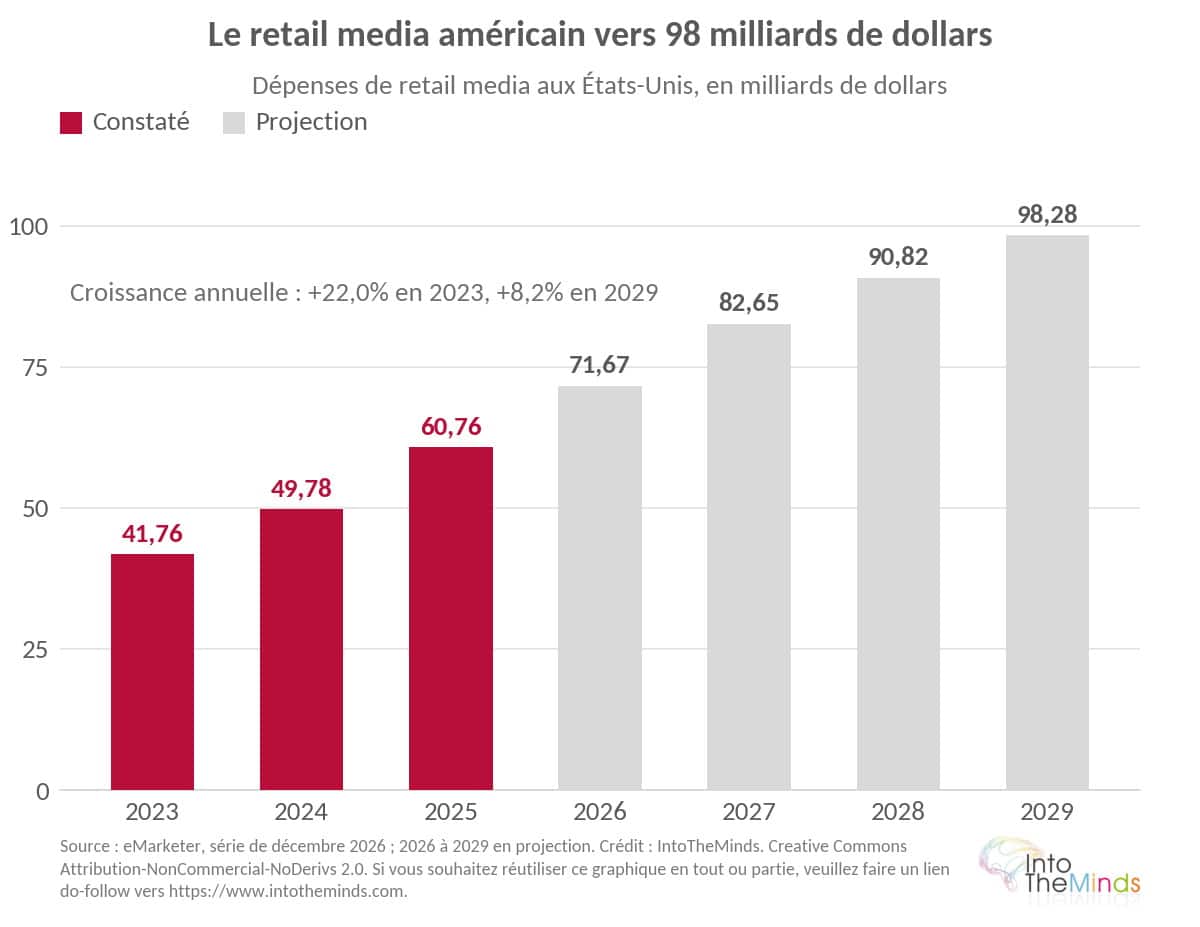
In Europe, IAB Europe estimates spending at €14.3 billion in 2024, of which €10.5 billion was captured by Amazon, and forecasts €21.9 billion in 2026. In the United States, spending increased from $41.76 billion in 2023 to $60.76 billion in 2025. It is expected to reach $82.65 billion by 2027.
The main players and leaders in retail media
The concentration of the market around Amazon is unparalleled in the advertising landscape. In the United States, Amazon accounted for 80.5% of retail media spending in 2024, while representing only 40.4% of US e-commerce and 5.2% of total retail sales. In Europe, IAB Europe attributed nearly three-quarters of revenues to Amazon in 2023.
In response to this dominance, European retailers have developed alliances. In France, the key players are:
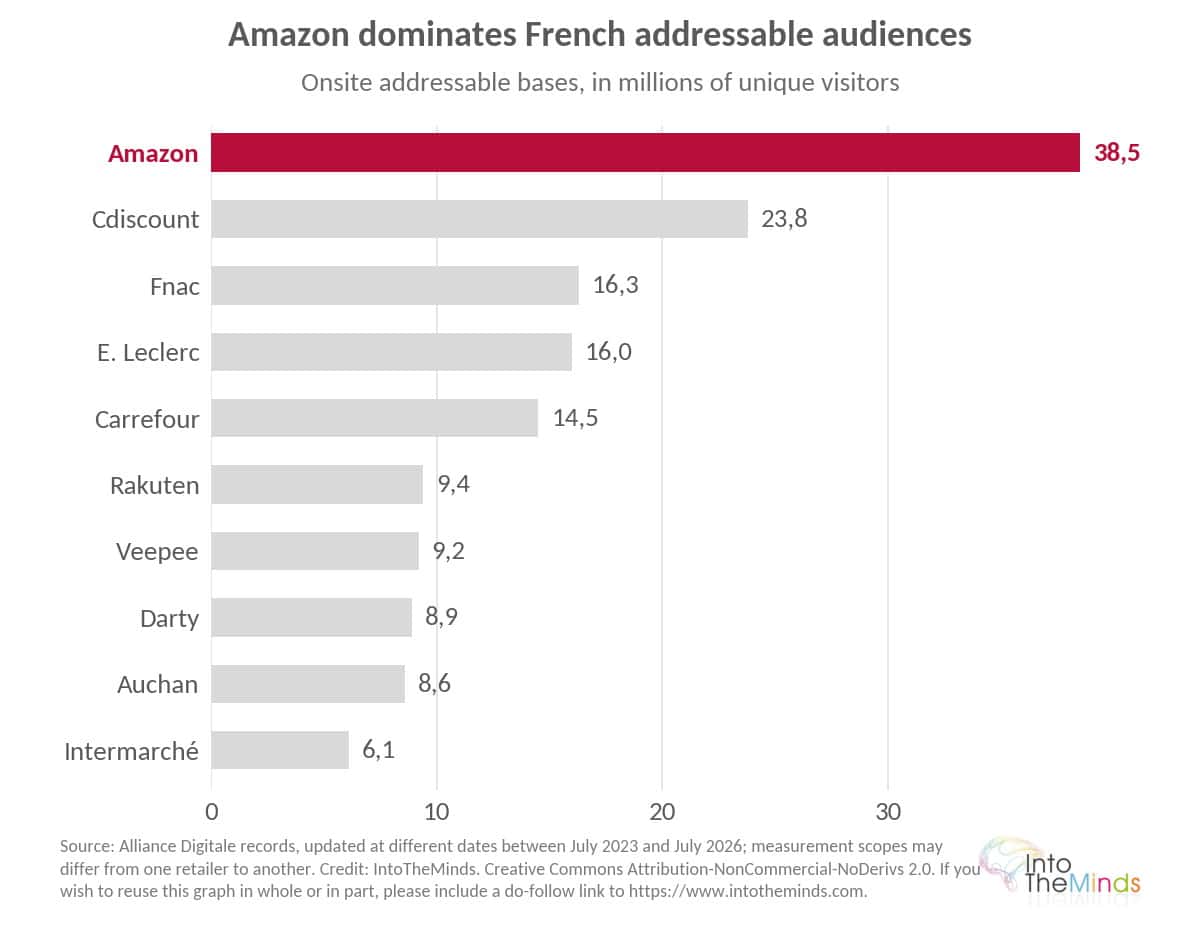
- Amazon Ads: the undisputed leader, accounting for approximately 75% of sponsored search revenues in France in 2025.
- Unlimitail: a joint venture between Carrefour and Publicis, launched in June 2023, bringing together 13 retailers representing more than 20 banners, 120 million loyal customers in Europe and 60% of French internet users.
- Valiuz (Association familiale Mulliez) and Groupement Les Mousquetaires: an alliance combining 55 million unique customers and approximately 8,000 points of sale, with €100 million in business volume in 2025.
- ConsoRégie: the advertising network of the E. Leclerc Group, which rolled out sponsored products across its websites in April 2025, reaching 16 million users.
- Criteo: a technology company founded in Paris in 2005 and listed on NASDAQ since 2013, which provides technology to Carrefour, Fnac Darty, Intermarché and Monoprix, among others.
- Mirakl Ads: a solution dedicated to B2B and B2C marketplaces.
Major trends and growth drivers
Three structural dynamics explain the sustained growth of the retail media market since 2020.
- The gradual phase-out of third-party cookies, which deprives advertisers of their traditional targeting tools and pushes them towards retailers’ first-party data.
- Pressure on retailers’ margins: retail media margins are exceptionally high. They are estimated at between 60% and 70%. Compare them with traditional retail margins (<5%) and it becomes immediately clear why the retail media market is attracting so much interest. In terms of EBITDA, the retail media margin has stood between 65% and 75% since 2021. Retail media already accounts for between 5% and 15% of retailers’ overall profitability.
- The rise of social commerce and the fragmentation of customer journeys, which make visibility on transactional platforms even more valuable for brands.
Retail media formats and channels
Retail media is not a single channel. Its strength lies precisely in the multiplicity of touchpoints it encompasses, from the internal search engine of an e-commerce site to screens installed in the aisles of a hypermarket.
Digital retail media and e-commerce
Sponsored search is by far the dominant format. In France, retail search grew from €401 million in 2021 (59% of retail media) to €761 million in 2023 (68%), and then reached 75% of the market in 2025, generating €1 billion in revenue. Christophe Blot (Cdiscount Advertising) pointed out in September 2025 that the search engine alone generates half of an e-commerce site’s revenue.
The new formats are nevertheless gaining ground. According to Cdiscount Advertising, a product page with five customer reviews increases its conversion rate by 30%, while sponsored videos double or triple conversion rates. Fnac Darty, through its retail media network Retailink, was a pioneer in sponsored product video. Here are 2 concrete results:
- At Jow, which claimed 8 million users in France in March 2026, 50% of the personalized recipes offered are purchased
- Barilla achieves a 70% market share in Jow shopping baskets, compared with around 30% in traditional e-commerce.
In-store retail media and physical experiences
The central paradox of the retail media market lies in the gap between where the purchase takes place and where advertising investment is made. According to the NRF, more than 83% of purchases in the United States take place in stores, while according to Fevad, more than 85% of transactions in France take place in physical stores. Yet in-store activation captures only 3% of budgets, with 80% allocated to onsite and 17% to offsite according to NRF 2026 data.
Measured results confirm the untapped potential. At NRF 2026, 60% of consumers said that in-store retail media had triggered a purchase, while 65% said it increased spending. HighCo DOOH, with two Monoprix pilot stores in Paris equipped with a total of eight screens during the last quarter of 2025, measured a 47% uplift in sales and an 86% increase in volumes sold. In France, 100% of food retailers offered in-store retail media with DOOH in February 2025, according to Claire Koralewski, while Carrefour had more than 4,700 screens deployed across 1,525 equipped stores in August 2025, out of a total network of 6,280 stores.
New channels and emerging innovations
Several formats are expanding the scope of retail media. Shopping centres represent a growing area: Westfield Rise, the retail media network of Unibail-Rodamco-Westfield launched in 2022, operates 1,800 screens in European shopping centres, has delivered 1,500 campaigns in France and is targeting €180 million in net revenue by 2028, compared with €35 million in 2021. Programmatic audio grew by 23% in the first half of 2025 according to the SRI, although it still accounts for less than 1% of the market. Boulanger is deploying an audio system with Valiuz covering 95% of its store network, with the potential to reach 70 million visitors over one year.

Challenges and opportunities for brands and retailers
Retail media is reshaping the roles of advertisers and retailers and creating strong economic incentives on both sides.
Benefits for advertisers and brands
In 2024, BCG estimated that 75% of fast-moving consumer goods companies were already investing in retail media and that two-thirds planned to increase these investments in the short term. Retail media is the top e-commerce investment priority for retailers, at 44%, ahead of marketplaces (42%) and social commerce (39%). According to Warc in April 2024, 72% of customers who saw a sponsored ad on Amazon made a purchase within two hours.
The shift in budgets was documented by Forrester in September 2024: 36% of retail media activities are funded through existing trade marketing budgets and 26% through shopper activation budgets. At Danone, 21% of media budgets are allocated to retail media. At PepsiCo, 70% of in-store activities fall under retail media, according to Sally Groult.
Benefits for distributors and retailers
The economic argument is decisive. In 2024, BCG estimated that retail media revenues represent 3% to 5% of a mature retailer’s turnover, with 60% to 70% of these revenues being entirely incremental to existing revenue sources. Amazon illustrates this logic at the extreme: its advertising revenues were close to $30 billion in the first half of 2025, up 20% year on year, making them one of the major contributors to its overall profitability.
In May 2022, Carrefour estimated that retail media would contribute one-third of the €600 million in additional recurring operating income expected by 2026. At Rewe in Germany, the investment in 3,200 screens was fully recouped within two years through advertising revenues.
Challenges and limitations of the current model
Measurement remains the main obstacle. Retail media networks offer attribution windows of 1, 7, 14 or 30 days, different interaction types (post-click or post-view) and divergent product scopes, which can cause ROAS to vary by a factor of 1 to 10 according to Florence Bréban (Datagram). The lack of standards makes comparisons between platforms very difficult for advertisers operating across multiple retailers.
The fragmentation of the European market is another structural barrier. While Amazon offers the same tools on a single platform, European retailers operate heterogeneous systems. WPP Media anticipated in December 2025 a rationalisation trend in which only the largest and most technologically advanced networks will prevail.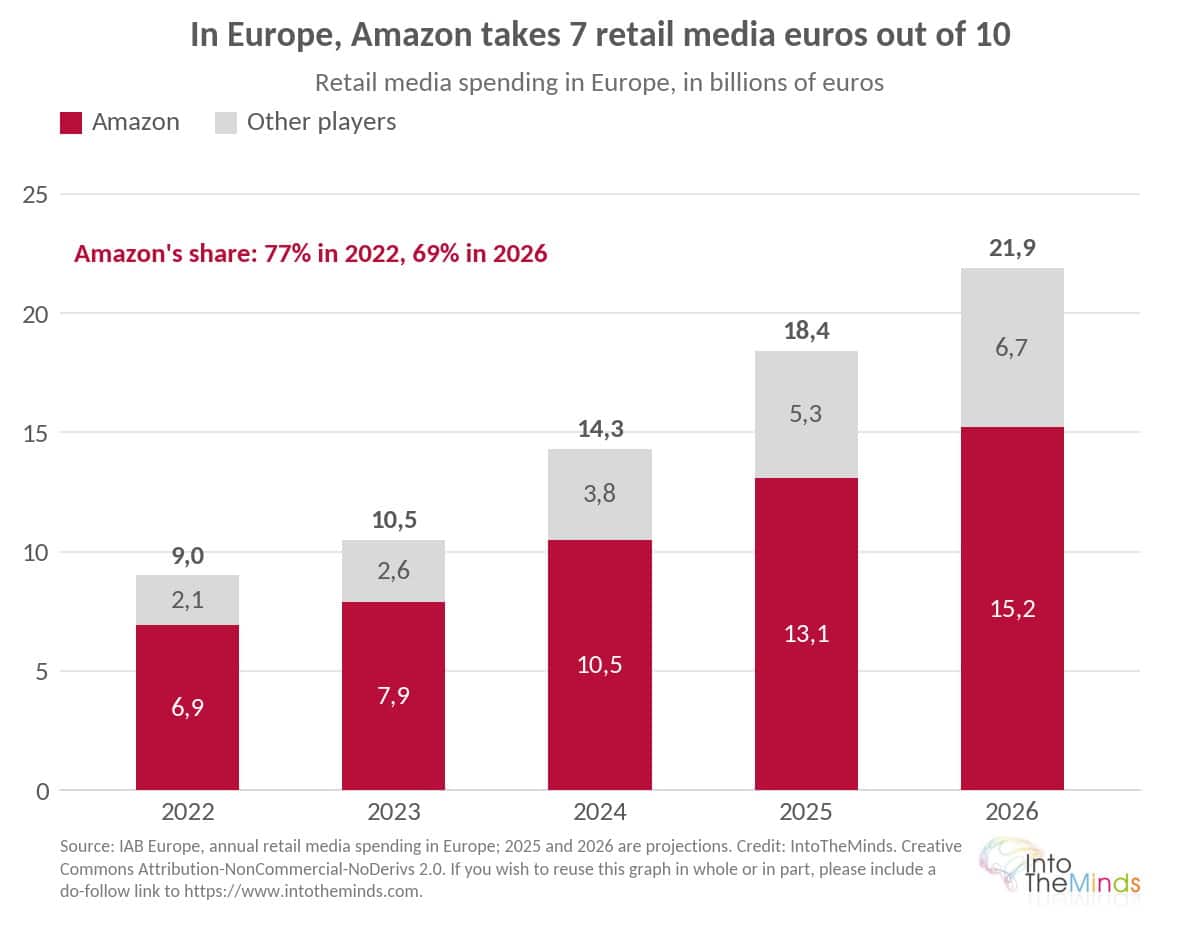
Tools, technologies and performance measurement
The retail media technology ecosystem has become significantly more structured since 2018, with specialised players covering each segment of the value chain.
The main retail media platforms
Founded in Paris in 2005, Criteo acquired Storetail in 2018 and launched its self-service Retail Media Platform in May 2020. By May 2022, the platform had integrated around one hundred retailers worldwide, including Target, Macy’s, Carrefour and Auchan, as well as 120 partner agencies and more than a thousand brands. Mirakl Ads targets B2B and B2C marketplaces and is used by companies including Douglas, Fressnapf and Media Markt in Germany. Criteo’s Commerce Max enables brands to extend their retail media campaigns across the open internet, beyond the websites of partner retailers.
Comparability standards and essential KPIs
The most frequently cited indicators are:
- ROAS (Return On Ad Spend): the benchmark metric for brands, with an attribution window that varies from one advertising platform to another.
- Incremental sales: the preferred indicator for FMCG manufacturers, which seek to isolate the net effect of a campaign.
- CPC / CPM / CPA: standard media-buying metrics applicable to onsite and offsite formats.
- Advertising revenue generated and inventory fill rate: indicators used by retailers.
According to the 2023 Epsilon/CitrusAd survey, 47% of brands cited total sales and ROAS as their main measurement metrics, ahead of total reach (41%) and brand lift (37%). Standardising attribution windows is one of the priority areas for IAB France and IAB Europe in the years ahead.
AI and data: performance drivers
Artificial intelligence is gradually being integrated into retail media tools, from bid optimisation (predictive bidding at Criteo) to personalised product recommendations. According to Publicis Sapient in January 2025, 63% of retail executives believed that generative AI would be very important for personalisation. Les Mousquetaires is testing AI use cases in 14 pilot Intermarché stores, with a twelve-month ROI threshold.
The emerging threat comes from agentic commerce. OpenAI launched transactional features (Instant Checkout, Operator) in the United States at the end of 2025, with partnerships including Walmart, Target and eBay. At NRF 2026, Google presented the Universal Commerce Protocol, an open-source standard enabling its Search and Gemini agents to go all the way through to checkout. These developments are once again placing retailers’ first-party data at the centre of the competitive landscape.
How to implement a retail media strategy?
Whether you are an advertising brand or a retailer, the conditions for a successful retail media strategy are based on a logic of progressive testing, rigorous measurement and integration into an omnichannel approach.
Approach for an advertising brand
The first step is to identify the retailers where the products are listed and analyse the formats available on each platform. A May 2025 survey of 149 US media buyers shows that
- 62% use retail media to increase brand awareness
- 56% to generate product sales
- 50% to improve targeting, reflecting a shift from the bottom towards the top of the funnel.
A brand starting out in retail media is best advised to focus on sponsored products in search before expanding into display and video formats.
Measurement must be configured from the outset: selecting the attribution window, defining incremental sales as the primary KPI, and systematically comparing the results of different advertising platforms. Mondelez has standardised its measurement methodologies internally and carries out annual marketing mix modelling to assess the effectiveness of its retail media campaigns.
Approach for a retailer or distributor
A retailer wishing to launch a retail media offering should first assess three assets: its traffic, its customer database and the available inventory formats (onsite, offsite, in-store). The choice of technology solution depends on the size and maturity of the organisation: Criteo, CitrusAd and Mirakl Ads are the most widely used options in Europe.
Structuring a clear offering for advertisers is crucial. According to dunnhumby, a mature offering can generate more than 1% of total revenue, below which the potential is considered underexploited. Integrating retail media into the retailer’s CRM and omnichannel strategy maximises the value of first-party data and strengthens customer loyalty.
Best practices and pitfalls to avoid
- Do not isolate retail media from the rest of the digital strategy: it should be coordinated with search, social and TV campaigns.
- Avoid excessive advertising on product pages, as this can degrade the customer experience and ultimately reduce conversion rates.
- Document the selected attribution windows precisely in order to compare performance across platforms.
- Invest in team training: according to Srinivasan Nithyanandam (Infosys) in July 2025, commerce operates according to a purchasing logic, whereas media involves a sales-oriented approach, creating organisational friction in many retail organisations.
- As Yves Puget pointed out in his April 2024 editorial, these tools do not eliminate the need to master the fundamentals of commerce: without traffic and conversion rates, there is nothing to monetise.

FAQ: Your questions answered
What is the potential of retail media in France?
The French e-retail media market reached €1.38 billion in 2025, up 13% year-on-year according to the 35th Observatoire de l’e-pub. This figure excludes audience extensions: when these are included, the market would remain below €2 billion according to Oliver Wyman. France ranks among the most advanced European markets, with 65% of retailers having at least one retail media technology in 2023 according to IAB France. The in-store potential remains largely untapped despite the rapid deployment of retail media by food retailers. To accurately assess opportunities within a specific segment or for a specific retailer, a B2C market research study can provide the data required for decision-making.
How do you measure the ROI of a retail media campaign?
ROAS (Return On Ad Spend) is the most widely used indicator, but it varies significantly depending on the attribution rules selected: the window can range from 1 to 30 days depending on the advertising platform, which can cause the result to vary by a factor of 1 to 10 according to Datagram. FMCG manufacturers prefer incremental sales, which isolate the net effect of the campaign. An Unlimitail analysis on Carrefour.fr indicates an average ROAS of 3.19 for sponsored products and 4.22 for display, with a 14-day attribution window. Standardising measurement methods remains a priority for the entire industry.
Retail media and customer data: what are the compliance challenges?
Retail media relies on retailers’ first-party data, collected from loyalty-card holders or registered customers. This data is subject to the GDPR, which came into force on 25 May 2018 and requires explicit consent for its use for advertising purposes. In March 2023, Carrefour had 14 million loyalty-card holders in France, of whom only 7 million had consented to receive commercial offers. This illustrates the gap between the total customer base and the addressable audience. Managing these consents is a major operational challenge for advertising platforms seeking to commercialise qualified audiences to brands.
B2B retail media: a market worth exploring?
B2B retail media is emerging rapidly, particularly through industrial and specialised marketplaces. Players such as ManoMano Pro, Agriconomie and Adeo Retail Media (Leroy Merlin) are developing offerings that enable brands to gain visibility in professional catalogues. In April 2024, Kingfisher was targeting retail media revenues of 3% or more of its online sales, with an objective of generating 30% of its revenue from online sales. For B2B retailers wishing to assess their positioning in this market, a B2B market research study makes it possible to objectively assess opportunities and identify priority segments.
How can a brand assess its awareness on retail media platforms?
Presence on retail media platforms directly influences brand awareness, particularly through sponsored products that appear at the top of search results. According to the KODDI survey of May 2025, 62% of US media buyers now use retail media to increase brand awareness, beyond the sole objective of conversion. A brand awareness survey makes it possible to measure the actual impact of these investments on brand recognition among target consumers and adjust budgets accordingly.
What are the differences between the French, German and US markets?
The United States remains the most advanced market, with $60.76 billion in spending in 2025 according to eMarketer and an Amazon share of more than 75%. Europe faces a structural lag: in Germany, two-thirds of retailers were not yet using retail media in 2024 according to IAB Europe, whereas France has an adoption rate of 65%. The fragmentation of European ecosystems compared with Amazon’s unified platform is the main competitive disadvantage. France stands out for the rapid development of collective advertising platforms (Unlimitail, Valiuz, ConsoRégie) and for a DOOH deployment rate in food retail reaching 100%, according to Claire Koralewski in February 2025.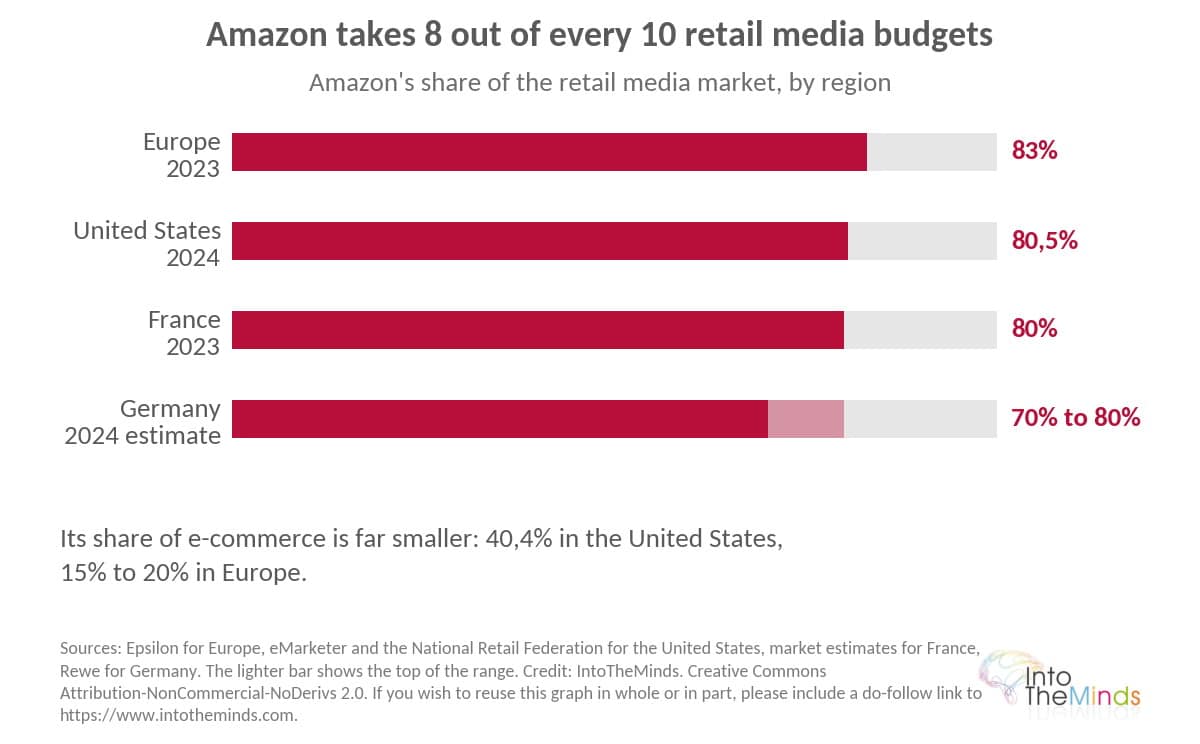



![Illustration of our post "Colruyt champion of price changes [Research]"](/blog/app/uploads/pricing-120x90.jpg)