In this study, you will discover how motorists in 3 different countries (France, Belgium, Germany) perceive traffic restrictions in city centers. Designed to limit fine particulate emissions, these zones are not gaining widespread acceptance, even though drivers seem to believe in some of their benefits.
![What do Europeans think about LEZ? [Survey]](/blog/app/uploads/zfe-lez-umwelzone.jpg)
Our polling institute has just conducted a study in 3 European countries to understand perceptions of Low-Emission Zones (known as “LEZ” in Belgium and “Umweltzonen” in Germany). The result is striking. Low-Emission Zones (LEZ) and their European equivalents are not rejected because they are considered ineffective: 63% of the motorists surveyed believe they have an impact on air quality. They are rejected because they are perceived as unfair. Across the three cities studied, Grenoble, Brussels and Stuttgart, 61% of respondents believe that the LEZ primarily penalizes lower-income households. What our study reveals is that there is a genuine question surrounding citizens’ acceptance of environmental policies. Our exploratory study therefore deserves to be pursued with a larger sample. In the meantime, here are the results. If you have any questions or would like to use these results in one of your articles, please do not hesitate to contact us.
Contact the IntoTheMinds institute
Key takeaways
- Among the 300 motorists surveyed in Grenoble, Brussels and Stuttgart on July 6, 2026, 61% believe that LEZ primarily penalize lower-income households.
- In France, the perception of unfairness reaches 73%: an intensity unmatched in the other two countries.
- 63% of respondents believe in the impact of LEZ on air quality, yet 42% nevertheless want the system abolished or relaxed.
- In response to the restrictions, 44% of respondents changed their travel patterns, while only 15% actually changed vehicles: the constraint changes mobility far more than it renews the vehicle fleet.
- In Germany, with 77% of respondents aware of the restrictions after eighteen years of Umweltzonen, opposition is the least radical: only 14% want them abolished outright, compared with 34% in France.
- Across all three countries, 54% of respondents want their low-emission zone abolished or relaxed, while only 15% want it strengthened.
A cross-border consensus on unfairness
The table below provides an overview of perceptions, country by country, regarding LEZ or their Belgian and German equivalents. On almost all indicators, residents of Grenoble, Brussels and Stuttgart share similar views, although there are some nuances (sometimes significant) in their respective beliefs.
| Indicator | France (Grenoble) | Belgium (Brussels) | Germany (Stuttgart) | Overall |
|---|---|---|---|---|
| Says they are informed about the restrictions | 50% | 52% | 77% | 60% |
| Believes in improved air quality | 55% | 68% | 67% | 63% |
| Believes in improved traffic flow | 38% | 47% | 38% | 41% |
| Believes in renewal of the vehicle fleet | 45% | 52% | 44% | 47% |
| Considers the LEZ socially unfair | 73% | 50% | 61% | 61% |
| Does not share this view | 12% | 31% | 18% | 20% |
| Wants the zone abolished | 34% | 16% | 14% | 21% |
| Wants the zone relaxed | 25% | 36% | 38% | 33% |
| Wants to keep it as it is | 19% | 20% | 25% | 21% |
| Wants it strengthened or expanded | 10% | 18% | 18% | 15% |
Source: IntoTheMinds, exploratory LEZ study, July 6, 2026. Base: 300 motorists, 100 per city. The “Overall” column is an unweighted average of the three cities. Values are rounded to the nearest whole number, so totals may therefore differ from 100% by one percentage point.
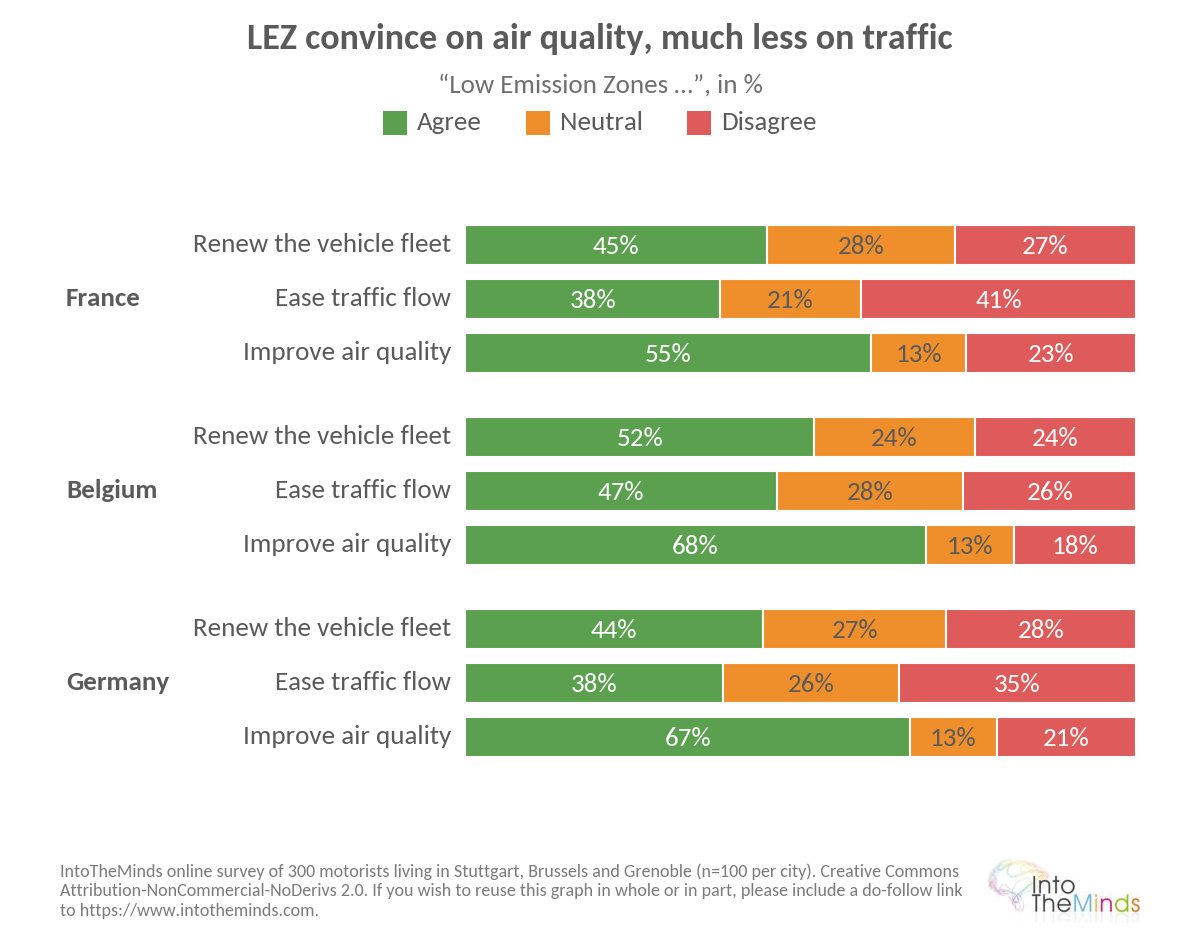
The credibility given to LEZ stops at air quality (between 55% in France and 68% in Belgium, with an average of 63%). But when it comes to improving traffic flow, support falls to between 38% and 47% depending on the country. The same applies to vehicle fleet renewal, which convinces only between 44% and 52% of respondents. If we wanted to summarize the situation, we could say that the system is perceived as useful for breathing, questionable for getting around, and costly for people’s wallets.
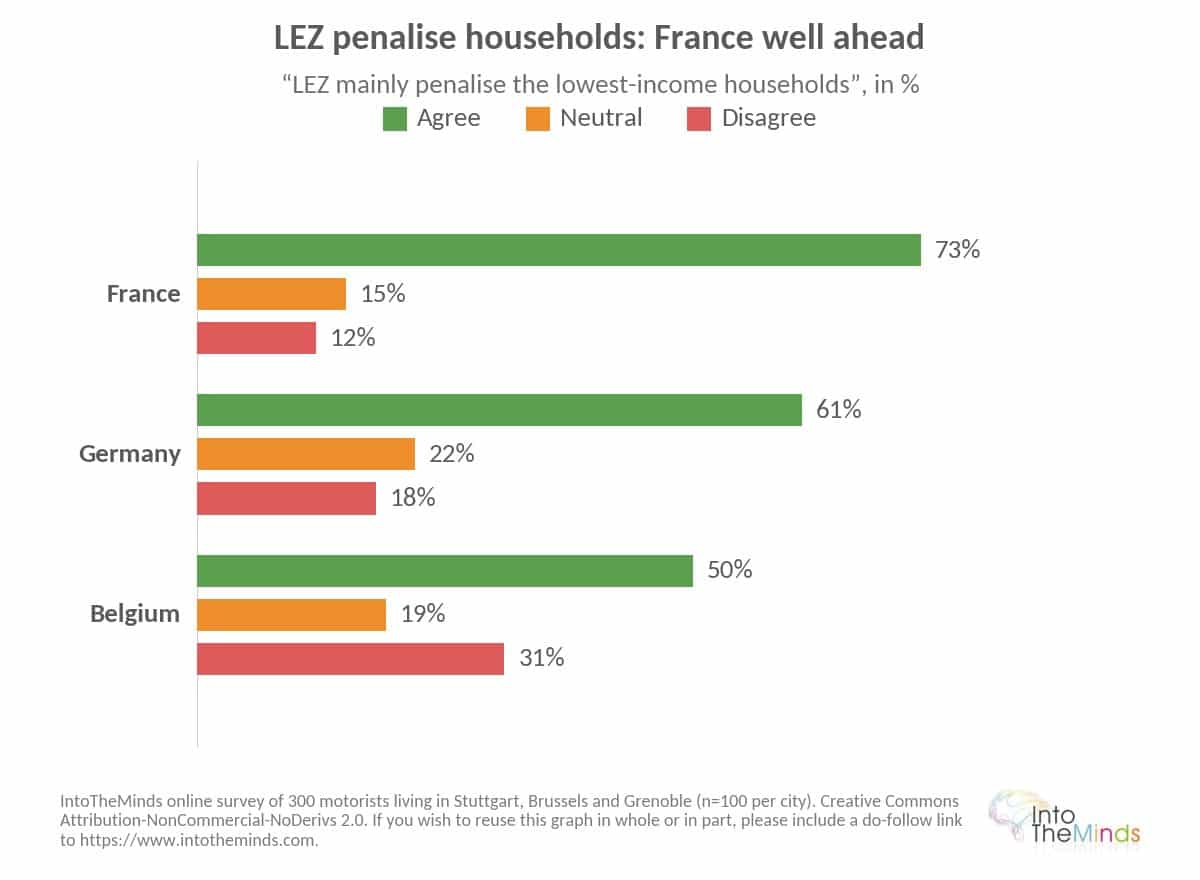
This survey provides us with another insight. And this one is not necessarily positive. LEZ and their Belgian and German equivalents are perceived as unfair. And this perception is very widely shared, regardless of the country. The perception of unfairness is shared by 61% of respondents across the three countries surveyed. European motorists therefore agree less on what LEZ deliver than on who pays the price.
Finally, the desired future of the system reveals three distinct political climates:
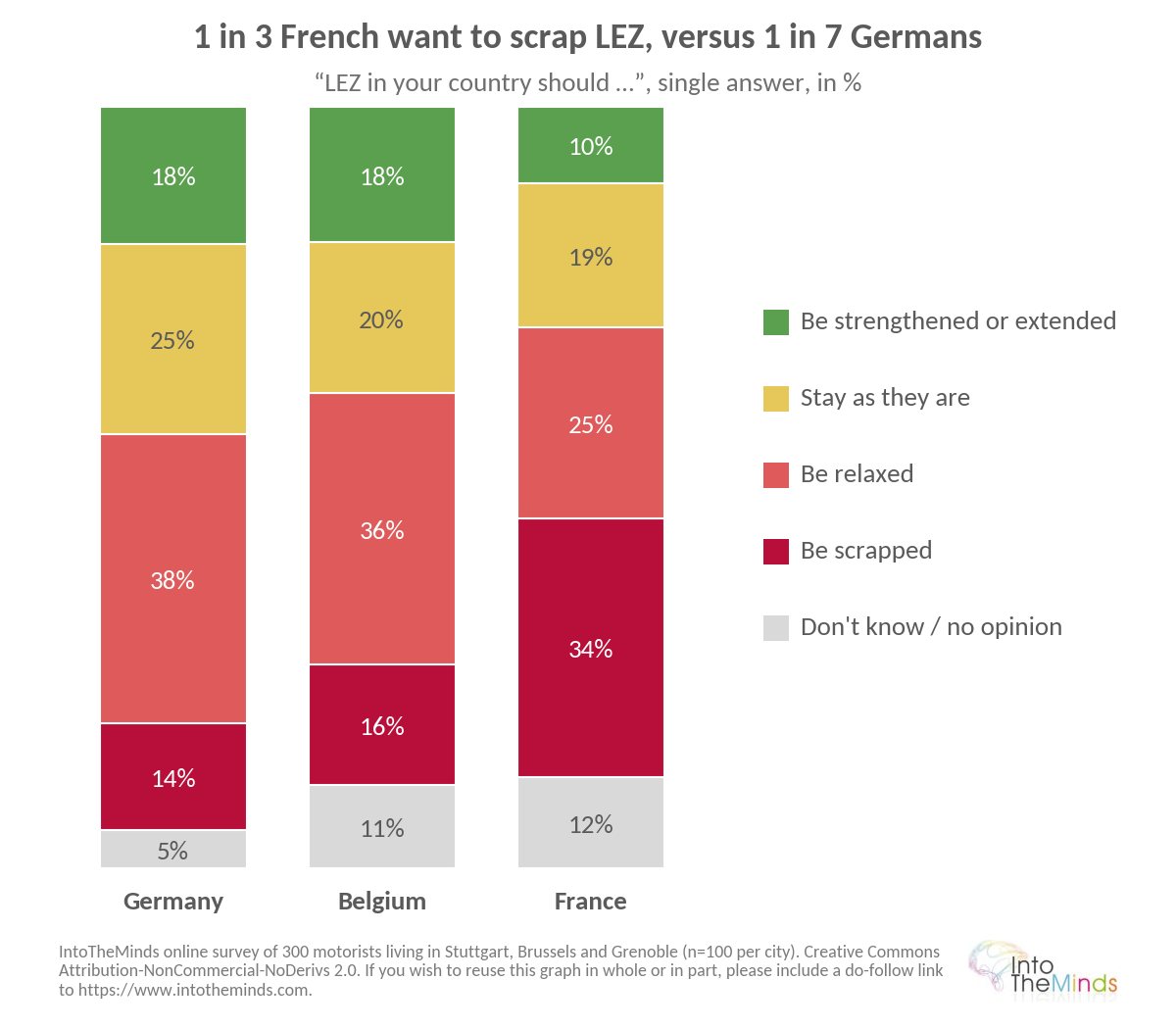
- In France, a clear majority of 59% want the zone abolished or relaxed. Moreover, 34% of those surveyed are calling for its outright abolition.
- Belgium and Germany clearly lean toward relaxation rather than abolition.
One figure nevertheless cuts across all three countries: the camp calling for stronger restrictions accounts for only 15% of public opinion, and just 10% in France. A public policy whose supporters for further development represent one sixth of public opinion is unlikely to survive a change of government for long unless it is defended by something other than its own virtue.
The system is perceived as useful for breathing, questionable for getting around, and costly for people’s wallets.
Who feels penalized? Those who depend on cars
The perception of unfairness is not evenly distributed. We observe heterogeneity according to
- age
- gender
| Subgroup | France (Grenoble) | Belgium (Brussels) | Germany (Stuttgart) | Overall |
|---|---|---|---|---|
| 18-34 years | 59% | 45% | 50% | 50% |
| 35-54 years | 81% | 57% | 64% | 68% |
| 55 years and over | 77% | 60% | 71% | 72% |
| Men | 77% | 60% | 68% | 68% |
| Women | 70% | 39% | 49% | 54% |
Source: IntoTheMinds, exploratory LEZ study, 6 July 2026. Share of respondents agreeing with “LEZs primarily penalize the least affluent households”. Base: 100 respondents per city. Unlike the previous table, the “Overall” column is not the average of the three columns: it is calculated based on all respondents in the subgroup, across the three cities combined. Since the age groups and genders are not distributed identically from one city to another, it differs from this average by one to two percentage points. Some subgroups include fewer than 20 respondents, which calls for caution when making more granular comparisons.
What we also observe in the data is that the perception of unfairness appears to increase with age:
- 50% among 18-34-year-olds
- 68% among 35-54-year-olds
- 72% among those over 55.
However, age structures differ significantly from one city to another. The median age ranges from 33 in Brussels to 39 in Stuttgart and 47 in Grenoble. The gap between France and Belgium nevertheless persists within each age group, ruling out the hypothesis of a simple demographic composition effect.
These gradients are very likely indicators of car dependency, rather than effects of age or gender in themselves. This is the conclusion reached by academic research on the acceptability of low-emission zones, notably the benchmark study on the Madrid scheme. The latter shows that travel patterns discriminate much more strongly than sociodemographic variables (Tarriño-Ortiz et al., 2021).
This shift in perspective changes the implications for public policy. The focus should be on people who are dependent on their cars, regardless of their demographic profile, rather than on age or gender categories.
The paradox
The study’s most counter-intuitive finding invalidates the dominant communication strategy surrounding LEZ. While nearly two-thirds of respondents are convinced that the system actually improves air quality, an average of 42% nevertheless want it abolished or relaxed:
- 49% in Belgium
- 42% in France
- 34% in Germany
This is therefore a paradox.
- Among respondents who consider the zone socially unfair: 63% want to abolish or relax it, and 27% support outright abolition.
- Among those who do not consider it unfair: 39% nevertheless want to abolish or relax it, and 11% call for its outright abolition.
The fairness assessment distinguishes respondents far more sharply than their belief in the system’s effectiveness. Attitudes toward the LEZ are not formed on the basis of a collective cost-benefit calculation. They are formed through a judgment of distributive justice. Explaining that “the LEZ works” does not shift opinion, because the objection was never about effectiveness. This is also established by a meta-analysis of the determinants of support for climate policies (Bergquist et al., 2022, Nature Climate Change). This “study of studies” ranks perceptions of fairness among the most powerful predictors, far ahead of sociodemographic characteristics.
Mobility changes faster than cars
A low-emission zone is justified by a precise theory of change. It is somewhat like a nudge, but a very constraining nudge designed to accelerate the replacement of polluting vehicles. However, the behaviors reported by respondents show that this mechanism works only at the margins.
| Reaction to restrictions | Share of respondents |
|---|---|
| Uses public transport, cycles or walks | 23% |
| Avoids traveling within the zone | 21% |
| Nothing, vehicle already compliant | 20% |
| Plans to change vehicle | 17% |
| Nothing, does not plan to change vehicle | 16% |
| Has already changed vehicle | 15% |
| Considering moving or changing workplace | 8% |
| Has paid for a day pass | 7% |
| Has paid one or more fines | 7% |
Source: IntoTheMinds, exploratory LEZ study, July 6, 2026. Results combined across the three cities, based on 300 respondents. Multiple answers possible, so the total exceeds 100%.
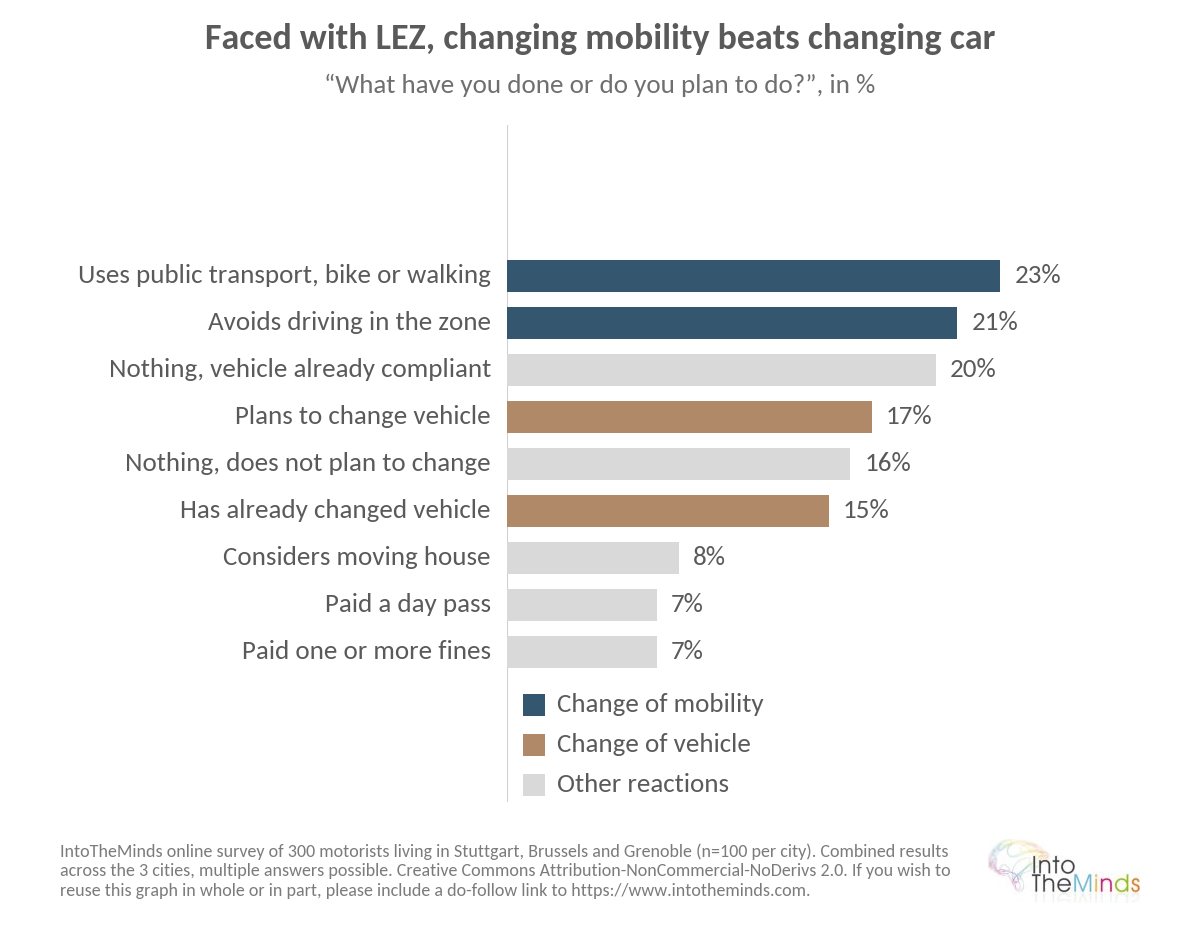
Grouped by category, these responses tell a simple story. Mobility adaptation concerns 44% of respondents. This corresponds to the sum of switching to public transport, cycling and walking (23%), and simply avoiding the zone (21%). Actual or planned vehicle replacement concerns only 32% of respondents, of whom 15% have actually done so. Finally, 36% report having done nothing, either because their vehicle was already compliant (20%) or because they explicitly refuse to change (16%).
Three lessons emerge.
- The first reaction to the constraint is to change one’s travel patterns, not one’s vehicle.
- Avoidance weighs just as heavily as modal shift: one in five respondents simply bypasses the zone, which does not reduce pollution but moves it elsewhere, generally toward less dense and less affluent peripheral areas.
- Deliberate refusal is not marginal, since 16% of respondents say they will not change vehicles. At the margin, paid circumvention remains limited (7% have paid for a day pass, 7% a fine), but 8% are considering moving house or changing workplace, a response of an entirely different magnitude for urban planning.
What Germany teaches France
The most discriminating variable in the study is knowledge of the LEZ rules or those of their Belgian or German equivalent. We observe a strong gap between France and Belgium on the one hand, and Germany on the other. In Stuttgart, 77% of respondents say they are informed about the restrictions, compared with 52% in Brussels and 50% in Grenoble. That is a 27-point gap separating the oldest zone (Stuttgart) from the other two. It is also worth noting that this is the least contested zone.
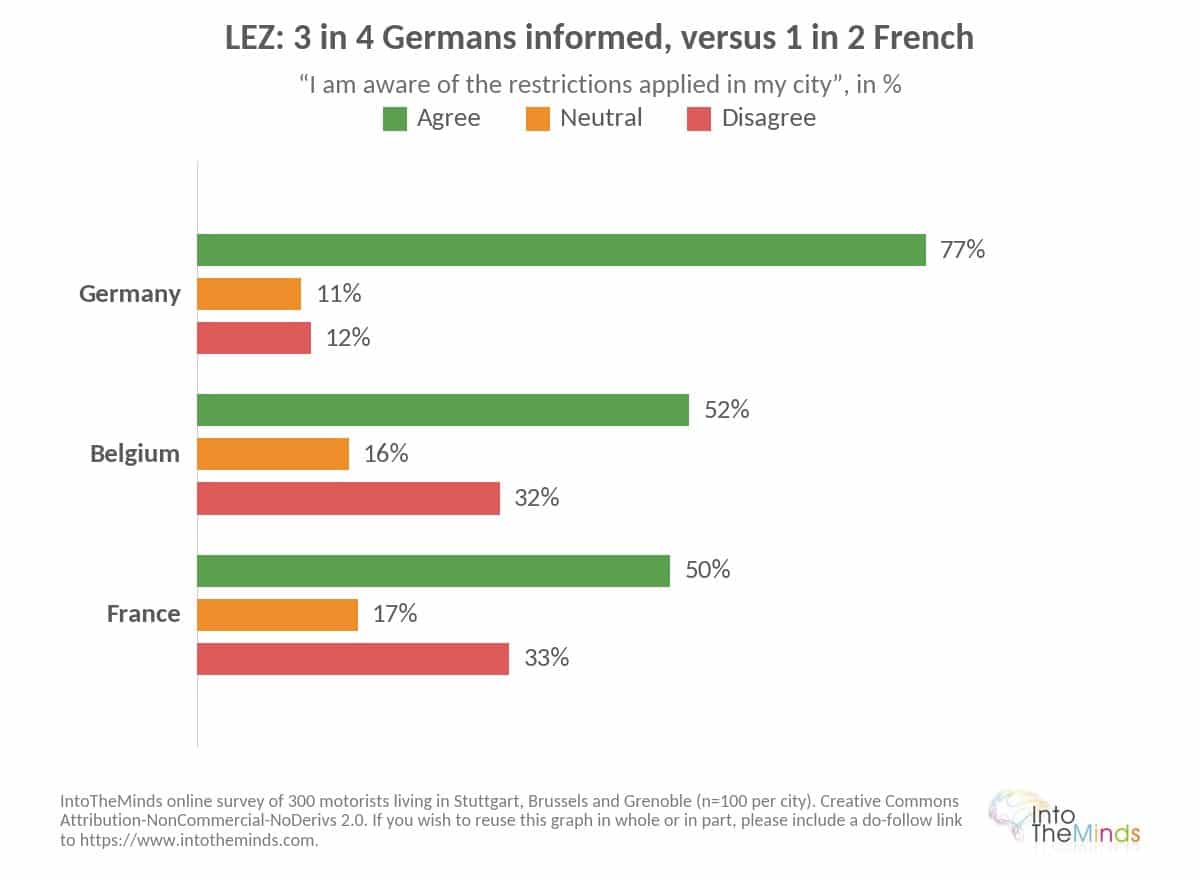
We could therefore hypothesize that time normalizes the constraint, but does not erase the perception of unfairness. Indeed, even in Germany, after eighteen years of Umweltzonen, 52% of respondents want their zone relaxed or abolished, and 61% consider it socially burdensome.
Belgium provides a second nuance. A recent quasi-experimental study in Antwerp and Brussels concludes that Belgian LEZ have improved air quality by reducing, rather than widening, socioeconomic disparities in exposure (Bruyneel et al., 2025, Environment International). Yet 50% of Brussels respondents still consider the system unfair. There is an asymmetry between objective reality and perception, and this represents a risk for politicians.
This political risk is documented. It is particularly present in the debate in Brussels. In Milan, the ban on polluting vehicles in “Area B” significantly increased support for the Lega among directly affected motorists, while the effect was weaker among those who received compensation (Colantone et al., 2024, American Political Science Review). With 34% supporting outright abolition, France presents the highest political volatility profile in the study.
Methodology
Exploratory online study conducted by IntoTheMinds on July 6, 2026, among 300 motorists residing in three cities subject to a low-emission zone: Grenoble, Brussels and Stuttgart, with 100 respondents per city. Six questions per respondent: awareness of the system, perceived benefits, behaviors adopted, social fairness, and desired future. Convenience samples, unweighted and non-representative of the population of each country. The theoretical margin of error for a 50% proportion based on 100 respondents is approximately ±10 percentage points. Age structures differ from one city to another, with the median age ranging from 33 in Brussels to 39 in Stuttgart and 47 in Grenoble. Values are rounded to the nearest whole number. This is a snapshot intended to detect a signal, not a representative measurement: the differences discussed here are broad and consistent with one another, but their exact magnitude should be confirmed using a representative, weighted sample.

FAQ: your questions answered
What is a LEZ and which vehicles are affected?
A low-emission zone is an urban area where access is restricted to the least-polluting vehicles, classified according to the Crit’Air sticker system. In France, the system was established by the 2019 Mobility Orientation Act and subsequently expanded by the 2021 Climate and Resilience Act, which made it mandatory in urban areas with more than 150,000 inhabitants. Each local authority then defines its boundaries, timetable and exemptions. The vehicles concerned include passenger cars, light commercial vehicles, heavy goods vehicles, buses and, depending on the zone, motorized two-wheelers. Restrictions are introduced gradually: first unclassified vehicles, followed by Crit’Air 5, 4 and 3 vehicles, according to timetables specific to each metropolitan area.
Will LEZ be abolished in France?
The abolition of LEZ was voted by the National Assembly as part of the bill on simplifying economic life, which was finally adopted on April 15, 2026. However, the Constitutional Council struck down this provision on May 21, 2026, ruling that it had insufficient connection with the original purpose of the bill and therefore constituted a legislative rider (Banque des Territoires). The system therefore remains in force, but its political future remains uncertain. This is precisely what makes the measurement of social acceptability interesting: the system was saved by a procedural decision, not by public support.
Why are LEZ less well accepted in France than in Germany?
The July 2026 IntoTheMinds study points to an information deficit: only 50% of French respondents say they are informed about the restrictions, compared with 77% in Germany. Beyond information, it is the perception of unfairness that shapes opinion: 73% of French respondents believe that the LEZ primarily penalizes lower-income households, compared with 61% in Germany. Germany has gone through the acceptance cycle after eighteen years of Umweltzonen; France is halfway through, at a point where the costs are already present but the benefits are not yet visible. If you would like to measure the acceptability of a public policy among your target audiences, IntoTheMinds conducts bespoke opinion polls.
How can you obtain a Crit’Air sticker to drive in a LEZ?
The Crit’Air sticker, known as the air quality certificate, can be obtained from the official French government website using the information shown on the vehicle registration certificate. It classifies vehicles from Crit’Air 1 (the least polluting) to Crit’Air 5 and “unclassified” (the oldest). This classification determines driving rights in each French LEZ, including the Greater Paris metropolitan LEZ, which covers 77 municipalities within the perimeter formed by the A86 motorway. Restrictions there apply Monday to Friday from 8 a.m. to 8 p.m. for passenger cars, light commercial vehicles and two-wheelers, and 7 days a week from 8 a.m. to 8 p.m. for buses, coaches and heavy goods vehicles (Banque des Territoires). Each urban area with a LEZ applies its own timetable and enforcement procedures.
Can you obtain an exemption to drive in a LEZ?
Yes. Permanent exemptions exist at national level for vehicles serving the public interest and for holders of a mobility inclusion card. Local authorities may also grant local, temporary or category-specific exemptions, as well as day passes allowing motorists to drive within the zone a limited number of days per year. Our study shows that these passes are actually used: 7% of respondents say they have paid for one. Conditions vary considerably from one zone to another, making it essential to consult the official website of the relevant zone. To analyze the specific needs of your customers or users in relation to these systems, a customer satisfaction survey can provide actionable data.
How can the acceptability of an LEZ or mobility policy be measured among residents?
The July 2026 IntoTheMinds study illustrates the value of a multi-country exploratory approach for detecting opinion signals before they become political crises. A confirmatory study should combine a representative sample in each country (1,000 respondents or more), cross-quotas for age, income and location, and a direct measure of car dependency. IntoTheMinds designs and conducts this type of research for both B2C and B2B organizations, for public and private mobility stakeholders.
What are the implications for private mobility companies?
17% of respondents plan to change vehicles and 15% have already done so, while 23% have switched to public transport, cycling or walking. This segment represents demand for affordable compliance solutions (recent used vehicles, retrofits, long-term rental, multimodal offers) that is obscured by the political debate. To identify and qualify this demand, a brand awareness survey or targeted market study can precisely measure the expectations of the segments most exposed to traffic restrictions.