This article provides a comprehensive analysis of Vorwerk’s strategy and the Thermomix market. The latest market figures have been analyzed to identify trends and the challenges the German brand will face.
You are probably familiar with the Thermomix, this premium household appliance that is not sold through traditional distribution channels. The highly successful launch of the TM7 gives me the opportunity to analyze the strategy of Vorwerk, the company behind the Thermomix. I carried out this exercise using the tools that my marketing consulting agency عادة uses. Based on the latest available figures, I take a close look at the marketing, commercial, and industrial strategy, ultimately leading to growth prospects and the challenges facing Vorwerk. Enjoy reading!
Contact the IntoTheMinds marketing agency
Key takeaways
- The Thermomix now represents more than 50% of Vorwerk’s global revenue (€1.7 billion out of €3.17 billion in 2024)
- The launch of the TM7 in February 2025 is the most successful product launch in the company’s history, with 860,000 units sold in 9 months
- International expansion is accelerating, with 57% of revenue generated outside Germany in 2025
- In Germany, Vorwerk enjoys a 90% market share with its Thermomix and equips 10% of households
- The network of advisors reached a historic record of 128,000 people worldwide in November 2025
- Profitability remains under pressure despite commercial success, with operating margin dropping from 9.1% to 6.8% in 2024
A strategic focus on the Thermomix
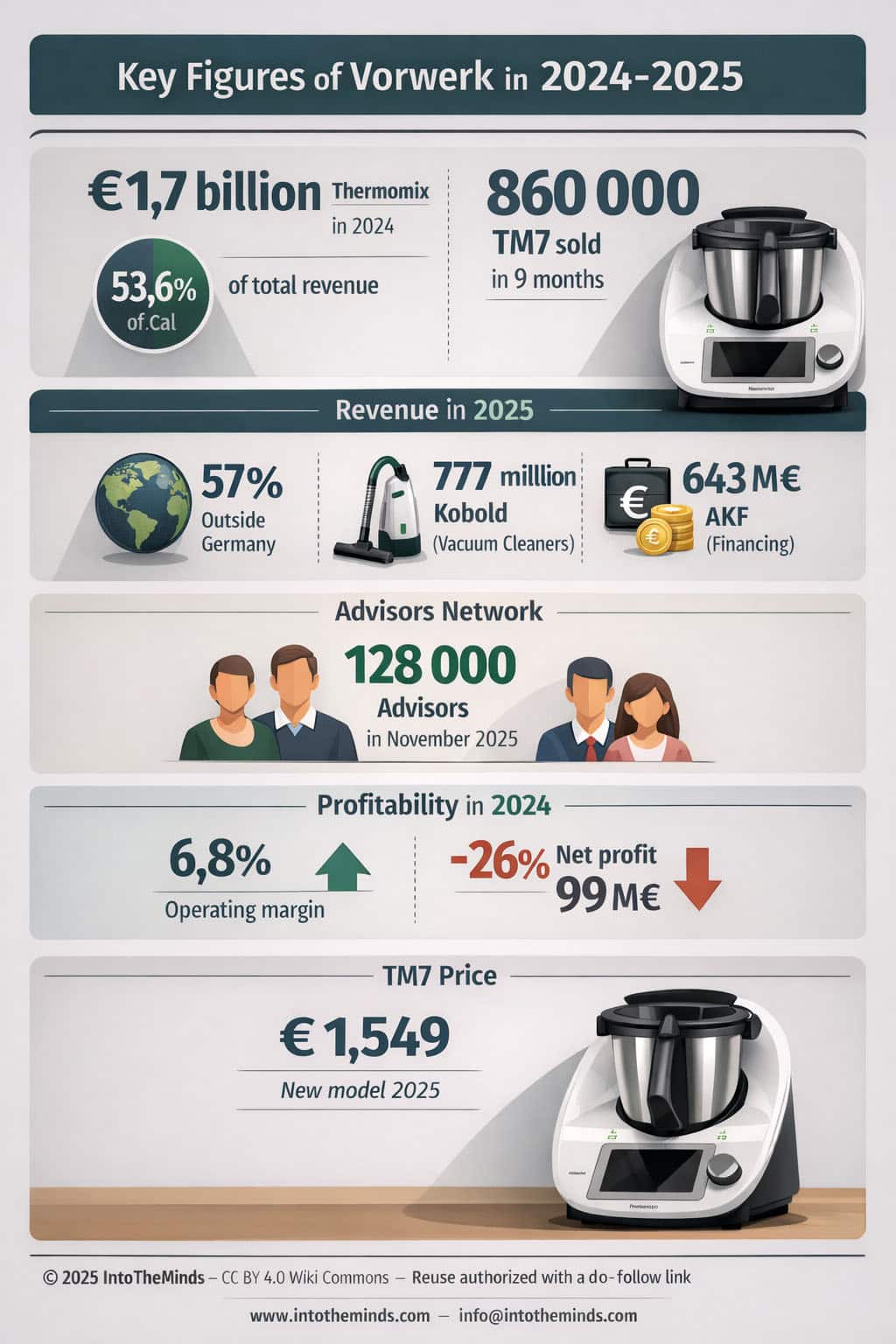
The Thermomix is Vorwerk’s flagship product. On its own, it generates €1.7 billion, or 53.6% of total revenue. Alongside it, Vorwerk has 2 other, lesser-known historical activities:
- Kobold (vacuum cleaners), representing €777 million
- AKF (leasing and financing), generating €643 million.
Other activities account for only €34 million.
This breakdown perfectly illustrates Vorwerk’s strategy: to invest heavily in its food processor, whose marketing positioning is clearly premium. Since 2015, around 15 million digital Thermomix units have been sold worldwide. The customer ecosystem is therefore considerable. The TM6, launched in 2019, alone exceeded 8 million units sold.
However, this dominance was not built without setbacks. Global annual sales fell from 1.5 million to 1.2 million units in 2023 and 2024. Vorwerk explained this slowdown by households being cautious about major spending and a wait-and-see effect before a generational shift. The new crisis looming in 2026 therefore does not bode well for Thermomix sales.
The launch of the Thermomix TM7
The launch of the TM7 in February 2025 marked a real turning point. I have rarely seen such enthusiasm for a household appliance. By June 2025, Vorwerk had already announced more than 300,000 pre-orders! Delivery times reached 18 weeks, with a peak of 23 weeks.
Figures from November 2025 confirm this success: 860,000 TM7 units sold since launch, making it the most successful product introduction in the company’s history. This success is even more remarkable given that the price increased by €50 compared to the TM6, reaching €1,549. You will note (with a hint of irony) that even at these stratospheric price levels, Vorwerk uses psychological pricing techniques.
Between mid-2023 and February 2025, Vorwerk even increased its prices by €200, nearly 15%. This upmarket strategy confirms the premium positioning of the Thermomix and its status as a desirable object rather than a purely functional appliance.
A product considered as an investment
One particularly unique aspect of the Thermomix, in my view, is that it largely escapes the depreciation cycle typical of household appliances. The Thermomix remains practically the only appliance with a significant resale value. Since my wife wants one, I monitor auction sites and have observed this firsthand. At an auction in April 2026, a TM6 model was sold for €700 excluding fees (nearly €800 including fees).
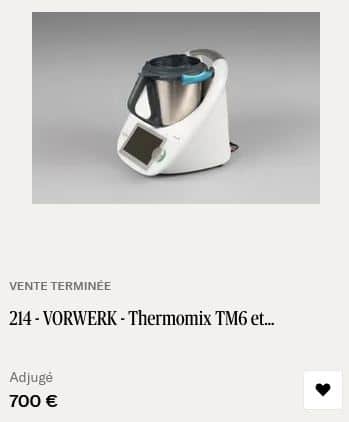
This Thermomix TM6 seized by the courts was auctioned without any guarantee of functionality for the modest sum of €700 excluding fees (around €800 including fees). This proves that even second-hand, the Thermomix continues to attract buyers and retains a high value. (screenshot from drouot.com)
This observation reveals the product’s unique status. Beyond its culinary performance, the Thermomix is a patrimonial asset with credible residual value. This aspect likely reassures buyers given the high entry price and reinforces Vorwerk’s premium strategy.
Technological innovation and platform strategy
Vorwerk invested €173 million over four years to develop the TM7, mainly in Wuppertal (Germany). The goal was to transform the Thermomix into an evolving platform. This “platform” strategy is particularly interesting because it allows the company to “lock in” customers and keep them captive. It was also Nespresso’s strategy until its patent expired. In fact, Nespresso may have pushed it a bit too far in my view by trying to make its machines smart enough to order on your behalf.
Returning to the TM7, the technical improvements are substantial:
- The new motor significantly reduces noise: speed 2, the most commonly used, drops from 68 to 35 decibels.
- The bowl can now be handled while hot thanks to insulation
- The system allows, for the first time, cooking without a lid in certain cases.
Software innovation is the other major focus. Vorwerk is betting on a connected architecture to progressively enrich functionalities. Voice control is being introduced via Cookidoo, and artificial intelligence is expected to enable personalized uses, such as suggesting recipes based on ingredients available at home. Personally, I have always been somewhat skeptical about the usefulness of voice commands, but I think this is a generational issue.
This platform approach brings the Thermomix closer to digital products, centered on the ecosystem rather than the physical object alone. The Cookidoo subscription, maintained at €60 per year for 100,000 guided recipes, illustrates this recurring service logic. Once again, this can be compared to Nespresso subscriptions.
The Thermomix is a desirable object rather than a simple functional appliance.
Analysis of Vorwerk’s commercial strategy
A unique business model: emotional direct selling
Vorwerk’s success is based on an atypical distribution model. The Thermomix is not sold in stores but exclusively through in-home demonstrations via a network of independent advisors. This approach transforms the act of purchase into an emotional experience (with a touch of social pressure). Broadly speaking, it is the same strategy as Tupperware.
The figures for the advisor network reflect this strategy. In February 2025, Vorwerk had 116,000 advisors worldwide, twice as many as in 2019. This figure fluctuated slightly (115,000 in June) before reaching a historic record of 128,000 in November 2025.
This growth takes place in a favorable context. In Germany, the direct selling market generated €20.89 billion in 2024, up 3% from 2022, while the number of advisors slightly declined by 0.2% to 908,000. Vorwerk therefore stands out for its ability to continue attracting and energizing its network.
The product itself fuels this relational dynamic. Its “highly emotional” nature goes beyond the traditional price-function trade-off. The purchase is driven by projection, demonstration, and adherence to a universe. The design of the TM7, particularly its large screen, reinforces this visual and experiential dimension.
The German market: a global showcase
Germany remains the best-documented and most emblematic market. Vorwerk claims a 90% market share there and equips one in ten households. The Thermomix has achieved iconic status, even becoming a generic name for this type of food processor.
This market is the subject of intense social debate, massive content on social media, and polarization between enthusiasts and skeptics. This exceptional visibility makes it a global showcase for the brand.
However, the future is no longer decided solely in this market. Germany remains important as a design hub and symbolic showcase, but additional growth must come from elsewhere: receptive European markets such as Portugal, newly opened countries, and especially Asia-Pacific.
Geographical expansion
Vorwerk remains fundamentally European: 85% of its activity was still concentrated in Europe as of February 2025. However, 57% of revenue is now generated outside Germany, mainly within Europe.
Market penetration varies significantly by country:
- Portugal appears to be the most mature market, with one in five households equipped, compared to one in ten in Germany.
- Vorwerk also highlights its success in Poland and the Czech Republic, showing that Thermomix sales are not limited to affluent markets.
- Vorwerk opened the Benelux and Greece in 2024
- Its presence in Asia-Pacific was strengthened in 2024 with Singapore and Malaysia.
- The largest distributor in Australia and New Zealand was acquired in 2024.
Two markets remain problematic:
- China has not regained its pre-pandemic momentum following the zero-Covid policy.
- The United States is also underperforming, despite its tradition of direct selling, due to insufficient growth in the advisor network.

Vorwerk’s commercial and marketing outlook
Industrial and financial challenges
Research and development remains concentrated in Wuppertal, along with part of the component manufacturing. Assembly takes place in France, where Vorwerk has even built a second factory. However, the CEO has complained about the administrative burden in France, high energy costs, and German-level wages.
This tension is illustrated by the elimination of 160 positions in Wuppertal-Laaken in November 2025, mainly in research, development, and administrative functions. This move, paradoxical amid the success of the TM7, is explained by the rapid transformation of the market and the impact of artificial intelligence.
The 2024 financial data show a solid but pressured group. Revenue declined slightly (-1%) to €3.17 billion, but net profit dropped from €133 million to €99 million. The operating margin fell from 9.1% to 6.8%.
Vorwerk attributes this deterioration to heavy investments in new products, geographic expansion, and strengthening of the advisor network.
Opportunities and risks
Vorwerk’s outlook is based on three pillars:
- Internationalization aims to reduce European exposure by strengthening Asia-Pacific.
- Continuous innovation is transforming the Thermomix into an evolving hardware and software platform.
- The activation of the human network remains at the core of the business model.
The main risk stems from this strength: Vorwerk is becoming increasingly dependent on the Thermomix. Other activities still contribute to revenue but do not offer the same brand power or level of commercial traction.
In November 2025, Vorwerk estimates that Thermomix revenue could increase from €1.7 billion to nearly €2 billion. If this target is achieved, it will reinforce the central role of the Thermomix while increasing the group’s dependency.
Towards a new business model
If we summarize 2025 for Vorwerk, we can say that the company has succeeded in transforming a kitchen appliance into a premium platform and a service ecosystem. This represents a particularly interesting strategic shift that builds on its already established premium positioning. The Thermomix market goes beyond that of a simple household appliance: it is a hybrid market at the crossroads of home technology, accessible luxury, relationship-based selling, and digital services.
This hybridization explains both the product’s resilience, the strong launch of the TM7, and Vorwerk’s international ambitions. The German company’s strategy illustrates how a brand can transcend its original category to create a new competitive space.
| Indicator | 2024 | 2025 | Change |
|---|---|---|---|
| Total revenue (€bn) | 3.17 | – | -1% vs 2023 |
| Thermomix revenue (€bn) | 1.7 | ~2.0 (forecast) | +17% |
| Net profit (€m) | 99 | – | -26% vs 2023 |
| Operating margin | 6.8% | – | -2.3 pts |
| Advisors worldwide | – | 128,000 | +10% vs Feb. |
| TM7 sales (units) | – | 860,000 | 9 months |
| TM7 price (€) | – | 1,549 | +€50 vs TM6 |

Frequently asked questions about Vorwerk’s strategy
Why is Vorwerk focusing so heavily on the Thermomix?
The focus on the Thermomix is explained by its exceptional profitability and growth potential. With €1.7 billion in revenue in 2024—more than half of the group total—the Thermomix generates significantly higher margins than other activities. Its direct sales model also creates a unique customer relationship that is difficult for competitors to replicate.
How does Vorwerk justify such high prices?
The TM7 price (€1,549) is justified by several factors: technological innovation (€173 million in R&D investment), European manufacturing, the Cookidoo software ecosystem, and above all its premium positioning. Vorwerk does not sell a simple appliance but a complete culinary experience, including training, support, and regular updates.
Is dependence on the Thermomix risky?
This concentration does indeed present risks. A slowdown in the Thermomix market would directly affect the group’s overall performance. However, Vorwerk is relying on continuous innovation and geographic expansion to sustain growth. The company is also developing the ecosystem around the product (services, accessories, subscriptions) to diversify its revenue streams.
Which markets are most promising for Vorwerk?
Asia-Pacific represents the main growth driver, with recent openings in Singapore and Malaysia, and strengthening in Australia–New Zealand. Europe still offers potential, particularly in countries where penetration remains low compared to Portugal (1 in 5 households equipped). The United States and China remain challenges to be addressed.
How does Vorwerk plan to integrate artificial intelligence?
AI is being gradually integrated through the Cookidoo ecosystem: voice control, personalized recipe suggestions based on available ingredients, and optimization of cooking times. Vorwerk is relying on software updates to enhance the experience without requiring a device replacement, thereby strengthening loyalty among its installed base of 15 million users.