In this article, you will find a detailed analysis of fundraising rounds within the French Tech ecosystem between 2020 and 2026. We have conducted sectoral, longitudinal, and regional analyses. A broader overview rounds out the study, including a comparison between the French Tech ecosystem and other countries.

Since May 2020, French startups have raised €56.9 billion across 3,401 deals. France is the 3rd largest European venture capital market, behind the United Kingdom and Germany. Our analysis shows that it weathered the 2022 downturn better than its neighbors. However, its 2026 rebound, with €9.8 billion raised as of October 23, relies on a handful of mega-rounds in artificial intelligence, while the number of deals continues to decline. These figures provide an initial measure of the dynamics of French Tech fundraising. Our market research agency supports numerous startups before, during, and after their fundraising. We have therefore analyzed all available data to offer you a concise overview of the French Tech fundraising market.
Contact the IntoTheMinds institute
Key takeaways
- May 2020 – October 23, 2026: €56.9 billion was raised in France across 3,401 deals, representing 14.6% of the amounts raised in Europe.
- At the bottom of the cycle, France retained 61% of its 2021 level, compared to 48% for Europe.
- France, 2026: €9.8 billion as of October 23, or 60% more than at the same date in 2025. The 14 rounds of €100 million or more account for two-thirds of the amounts.
- AI captures 59% of French amounts in 2026, compared to 3% in 2022 and around 29% in Europe in 2026.
- Paris concentrates 72% of the amounts and 60% of localized fundraising rounds.
How much have French startups raised since 2020?
The funds raised by French Tech companies follow a pronounced cycle, and the 2026 rebound relies on a small number of deals.
A trough after 2021, followed by a rebound in 2026
French startups raised €10.9 billion in 2021, then €11.1 billion in 2022. Right in the middle of the venture capital correction, French amounts therefore edged up slightly, while Europe’s lost a quarter. The trough came next: €8.9 billion in 2023, then €6.7 billion in 2024.
The 2023 figure owes a great deal to Verkor, with €2.5 billion. Without this company, 2023 and 2024 form a single plateau around €6.5 billion, or roughly 60% of the 2021 level.
The table below shows the other side of the cycle: the number of deals has been falling since 2025, while the amounts raised are increasing.
| Year (France) | Number of rounds | Median round |
|---|---|---|
| 2020 (from May 22) | 190 | €2.0M |
| 2021 | 677 | €3.5M |
| 2022 | 631 | €4.7M |
| 2023 | 576 | €3.5M |
| 2024 | 563 | €4.0M |
| 2025 | 448 | €4.7M |
| 2026 (as of October 23) | 316 | €6.0M |
The number of fundraising rounds fell by a third between 2021 and 2025, from 677 to 448. Over a comparable period, the median round doubles, from €3.0 million in 2021 to €6.0 million in 2026. Part of this shift may be due to the coverage of roundups, which are more inclined to cite large rounds. The trend is clear, though its magnitude should be read with caution.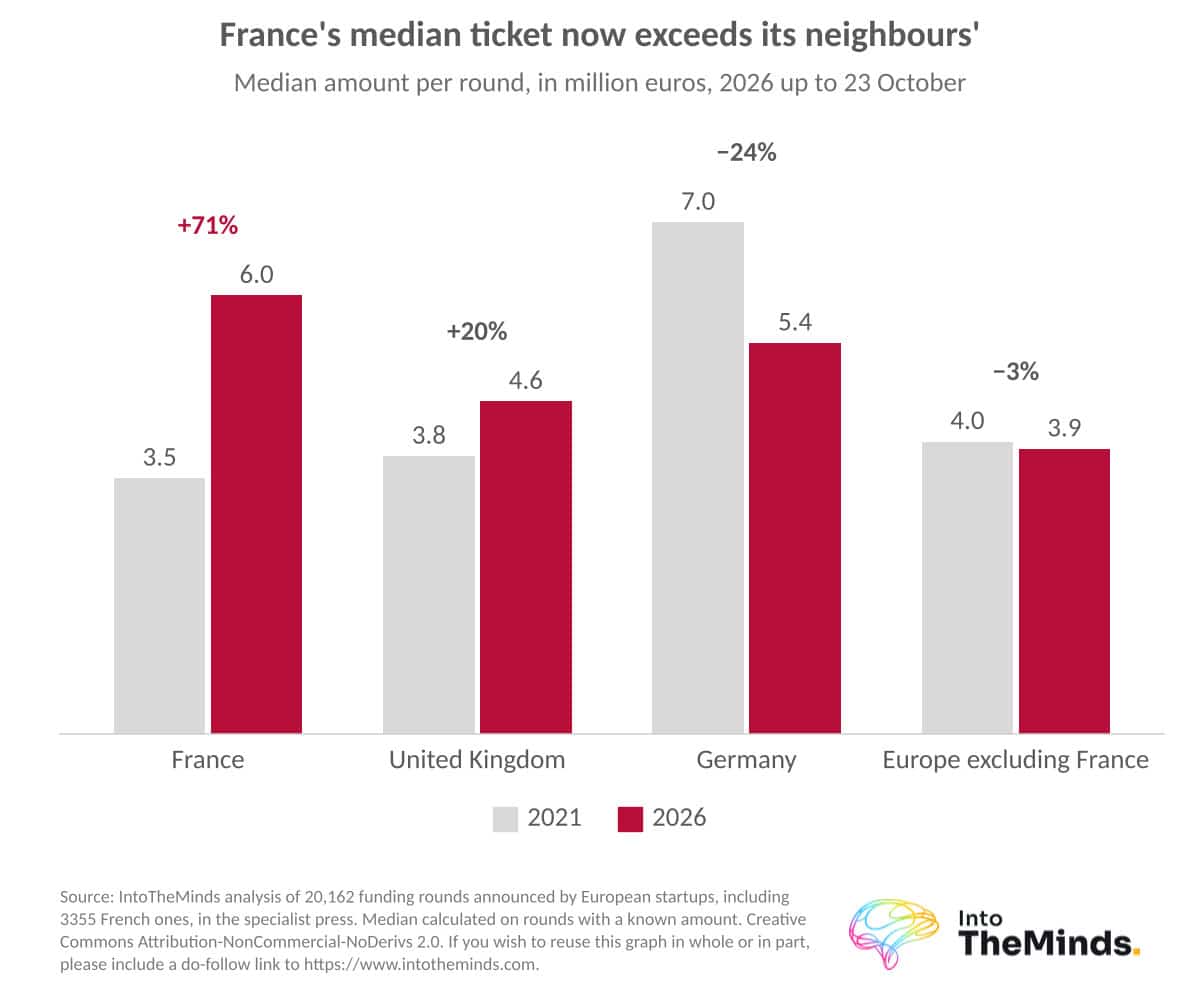
The calculation scope significantly changes the totals. Another review of the French Tech ecosystem, focused on Growth-stage rounds and hybrid financing, puts 2025 at €7.39 billion across 618 deals, compared to €7.8 billion and 723 deals in 2024. Definitions differ, particularly regarding debt, but the diagnosis converges: there are fewer transactions and ticket sizes are larger.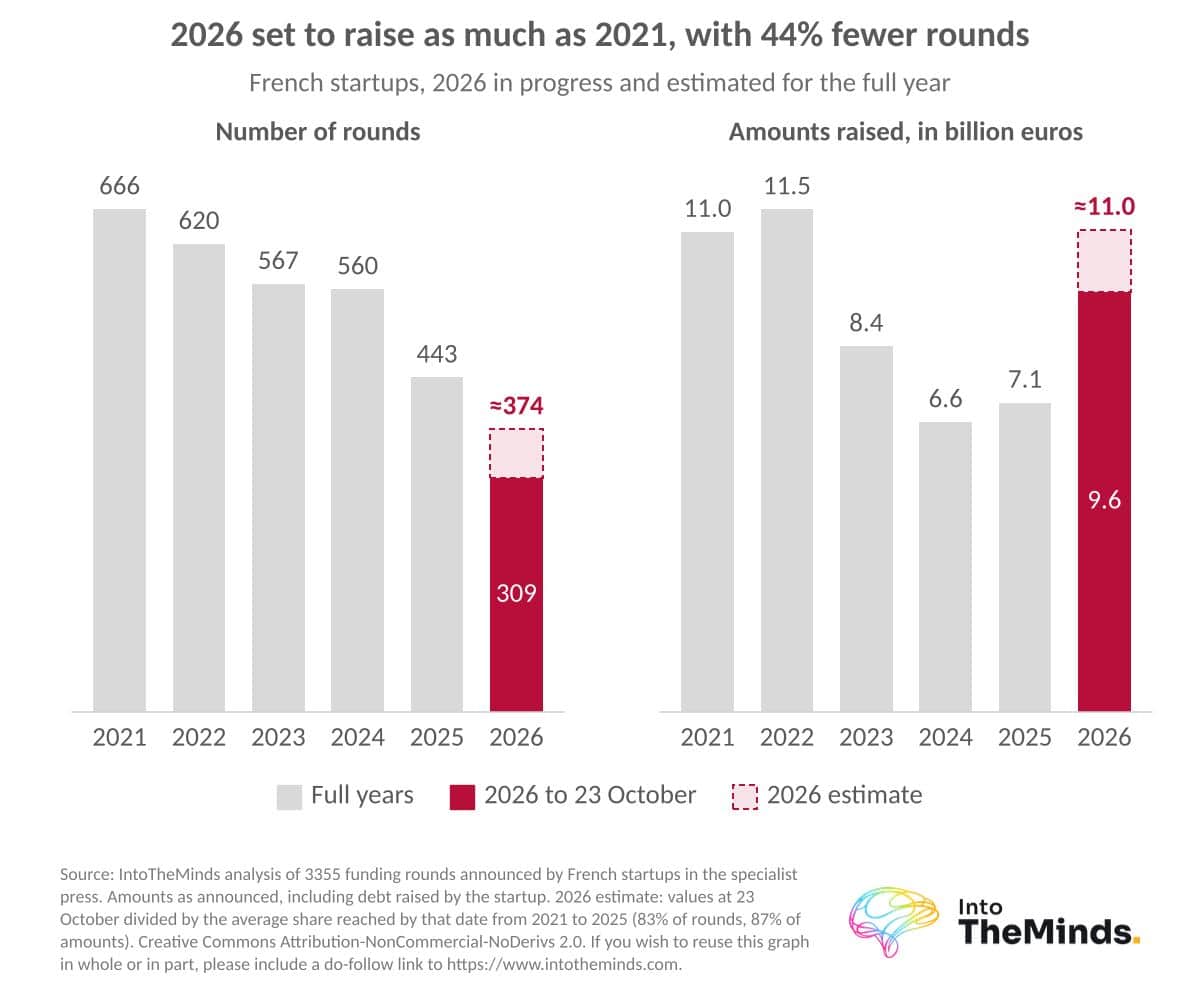
In 2026, 14 rounds of €100 million or more account for two-thirds of the amounts raised in France.
The rebound relies on a handful of mega-rounds
As of October 23, 2026, 14 rounds of €100 million and more raised €6.5 billion, compared to €2.3 billion across 6 rounds at the same date in 2025. Other deals are still declining: €3.3 billion versus €3.8 billion, across 302 rounds versus 372. Excluding mega-rounds, the French market has plateaued around €4.5 billion per year since 2023, compared to €6.1 to €6.3 billion in 2021 and 2022.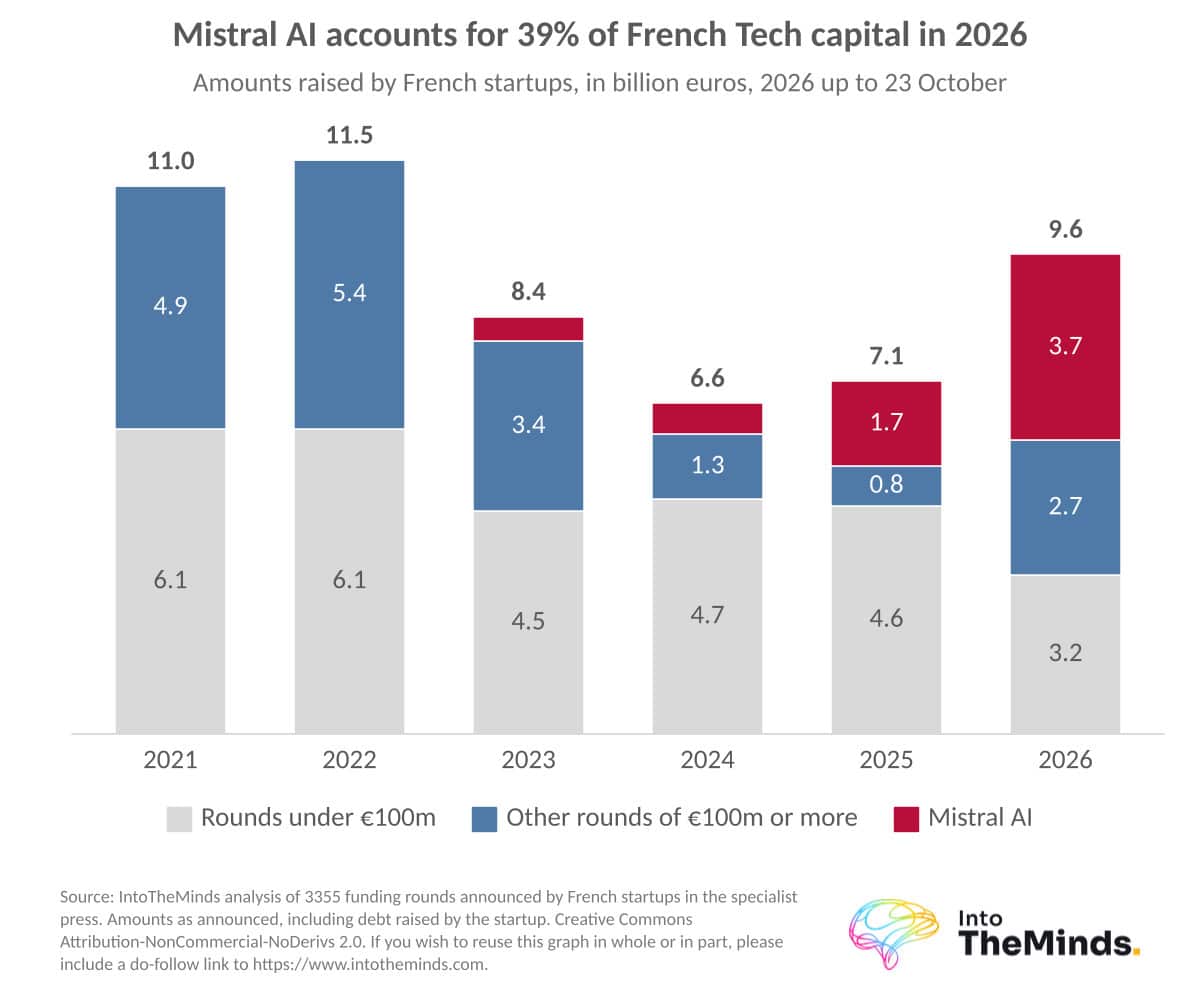
Mistral AI carries weight of its own. Its 7 deals total €6.6 billion, representing 11.7% of everything France has raised since May 2020. These include the €3 billion round in September 2026 and €830 million in debt raised at the end of March 2026 for a data center. The ranking of the largest rounds tells the story of the cycle:
- Mistral AI, €3,000 million in 2026 (AI)
- Verkor, in batteries, with a round combining debt and grants
- Mistral AI, €1,700 million in 2025 (AI)
- AMI Labs, €900 million in 2026 (AI)
- Sorare, €580 million in 2021; Doctolib, €500 million in 2022; Qonto, €486 million in 2022
The champions of 2021 and 2022 came from e-commerce, fintech, and healthcare. Those of 2025 and 2026 come primarily from AI.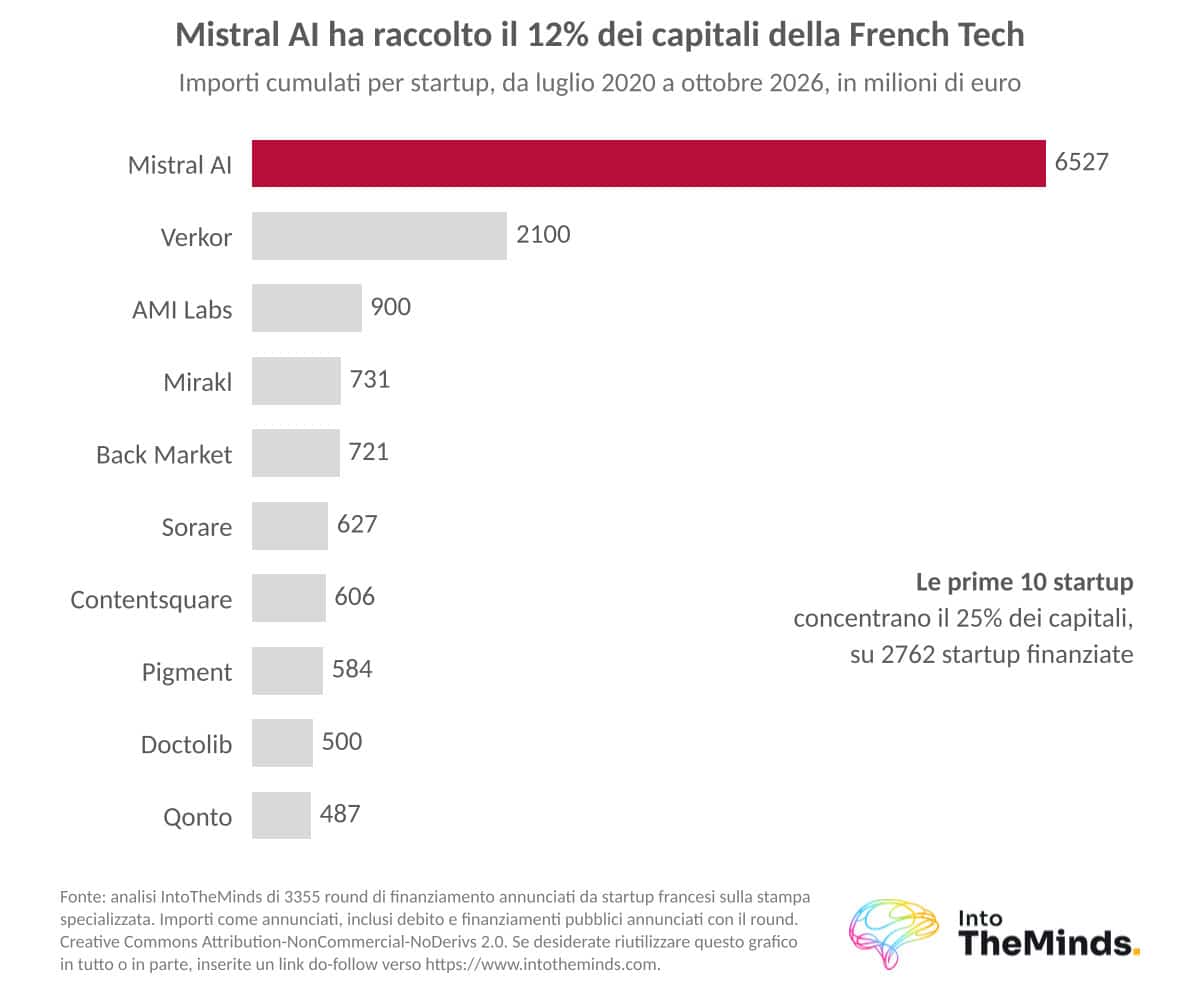
Which sectors attract the most capital in France?
The cumulative ranking by sector masks a rapid restructuring of French Tech since 2022.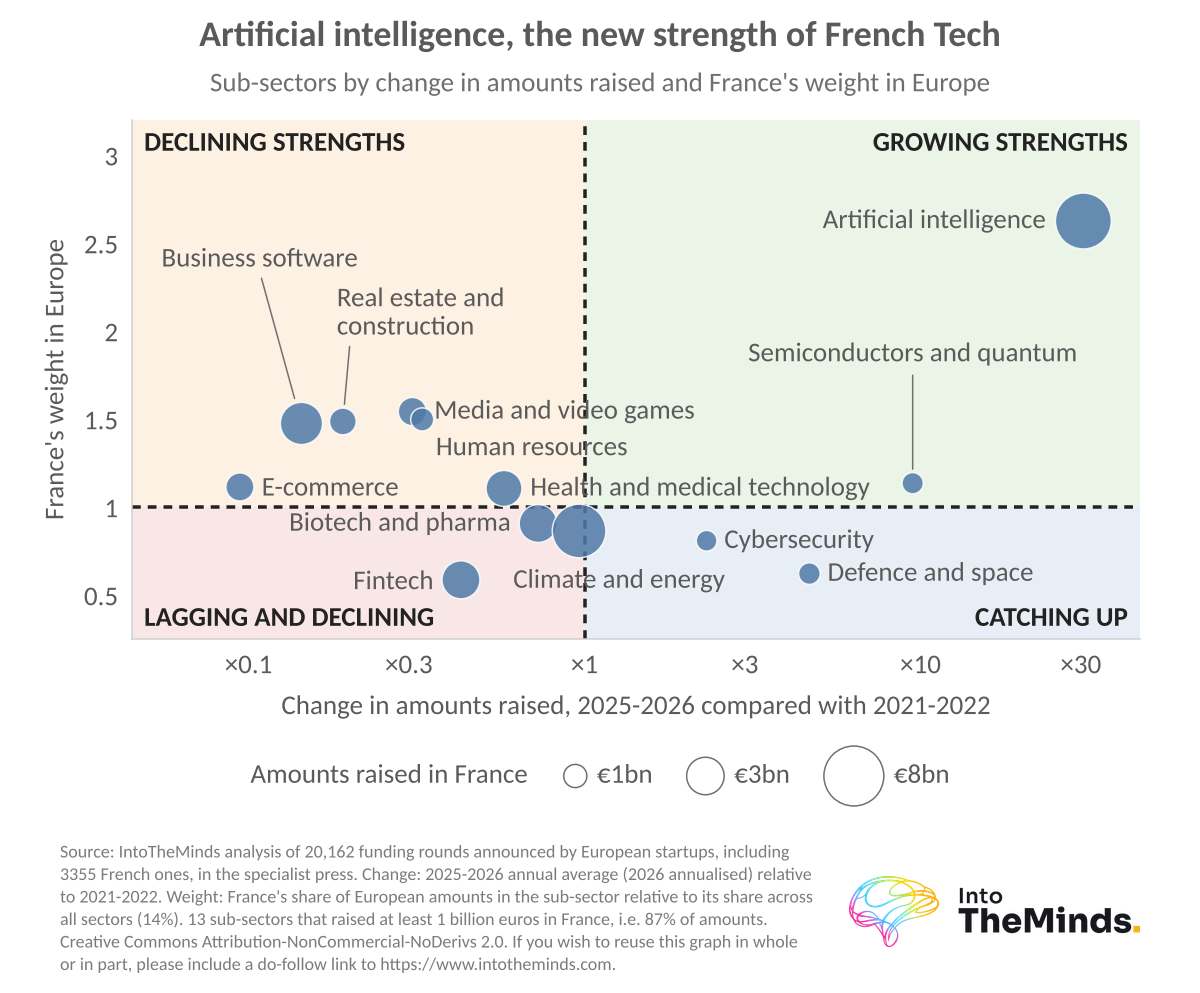
IT and telecoms: a declining share excluding champions
The IT and telecoms sector accounts for 29.8% of French amounts since May 2020, compared to roughly 20% in Europe. Next come the environment (14.4%), healthcare and pharma (13.0%), then banking and insurance (9.4%). However, excluding Mistral AI and AMI Labs, IT raised €2.0 billion in 2022, €1.2 billion in 2025, and less than €1 billion as of October 23, 2026. For 2021, €1.0 billion in funding is unclassified, including Ledger and Hugging Face, which slightly overstates the sector’s growth since then.
Another review, covering the Growth scope, places software and technology in first place in both 2024 and 2025, with €3.3 billion raised in 2025. The sector remains number one, but it holds that position thanks to its champions.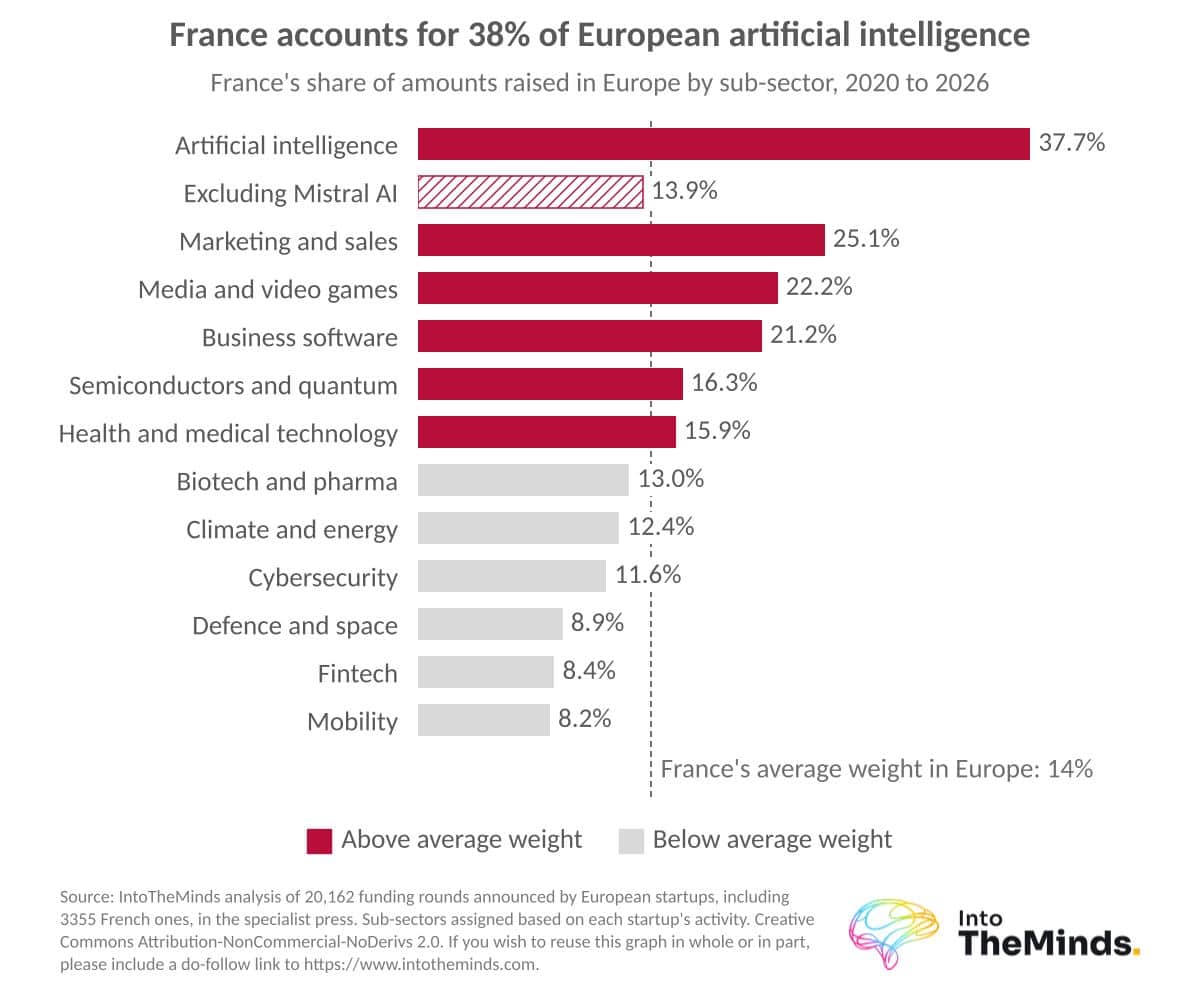
Healthcare and environment: volumes holding steady
Healthcare and pharma have raised around €1 billion per year since 2023. It is the second-largest sector by number of deals: 538 rounds, or 15.8% of the total. Life sciences recorded €970 million in 2025, stable amounts in a constrained environment.
The environment sector peaked in 2023 at €3.6 billion, including €2.5 billion for Verkor, before falling back below €1 billion per year. With 331 fundraising rounds, it is the third-largest sector by number of deals, at around fifty rounds per year since 2024. Greentech raised €1 billion in 2025, down roughly 50% year-on-year, as investors are wary of long industrial cycles and deferred profitability.
Two sectors are emerging in 2026. Quantum computing raised over €0.5 billion with Pasqal (€340 million), Quobly (€115 million), and Alice & Bob (€59 million). In defense and space, Loft Orbital (€170 million in 2025) and Harmattan AI (€172 million in 2026) mark the first rounds exceeding €100 million.
Banking and retail: a sharp decline since 2022
Banking and insurance, including fintech, raised €1.85 billion in 2022, then €0.35 billion in 2025. Fintech suffers from regulatory exposure and deferred profitability. Retail, driven in 2021 and 2022 by Back Market or Ankorstore, has fallen to almost nothing since 2023.
AI concentrates amounts, not deal count
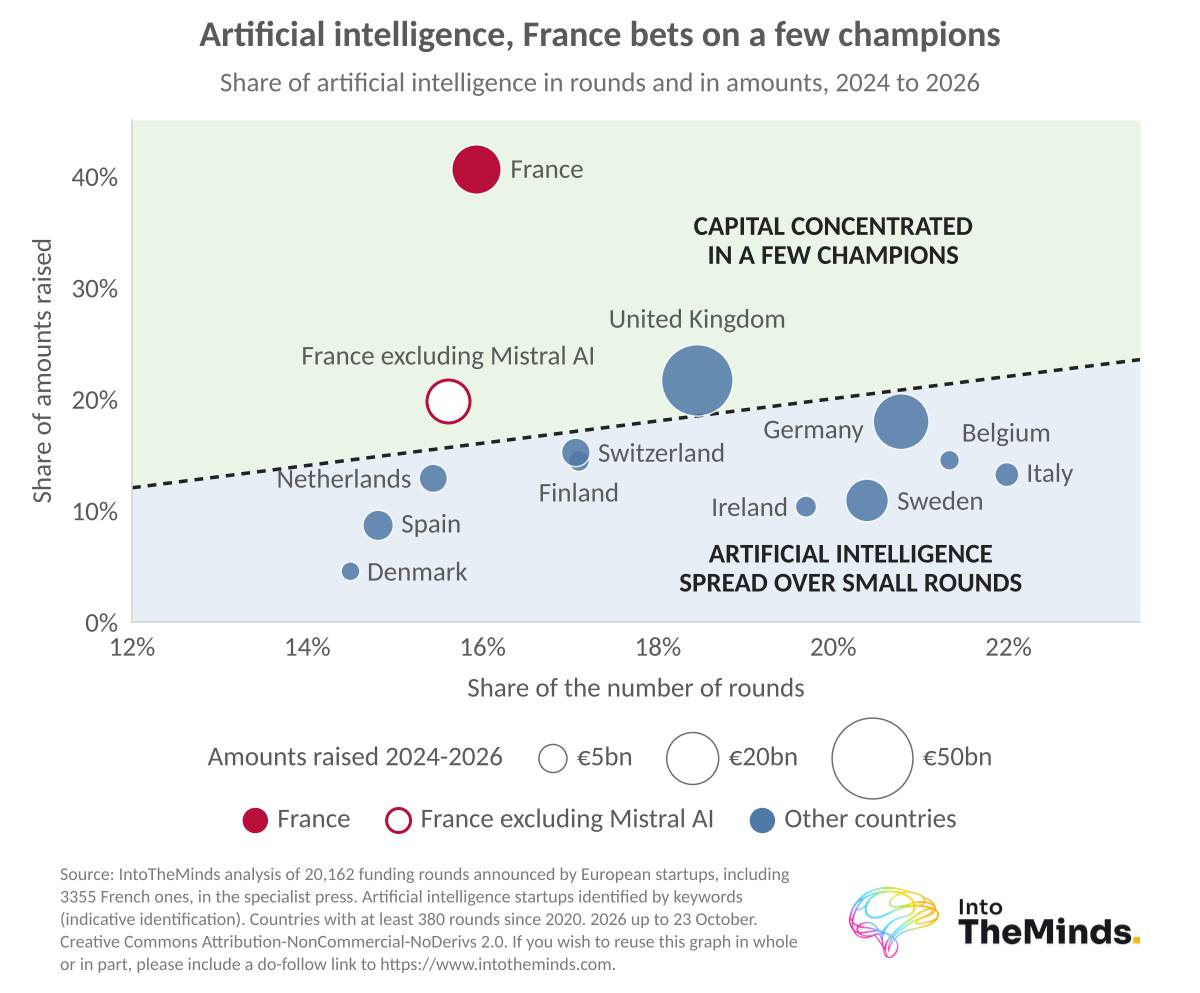
Artificial intelligence startups captured 3% of French amounts in 2022, 20% in 2024, and 59% as of October 23, 2026. Europe follows the same slope, at half that level. In terms of deal count, France does not stand out: AI accounts for 20% of its 2026 fundraising rounds, compared to 21% in Europe. The gap comes down to a few giant rounds, led by Mistral AI and AMI Labs.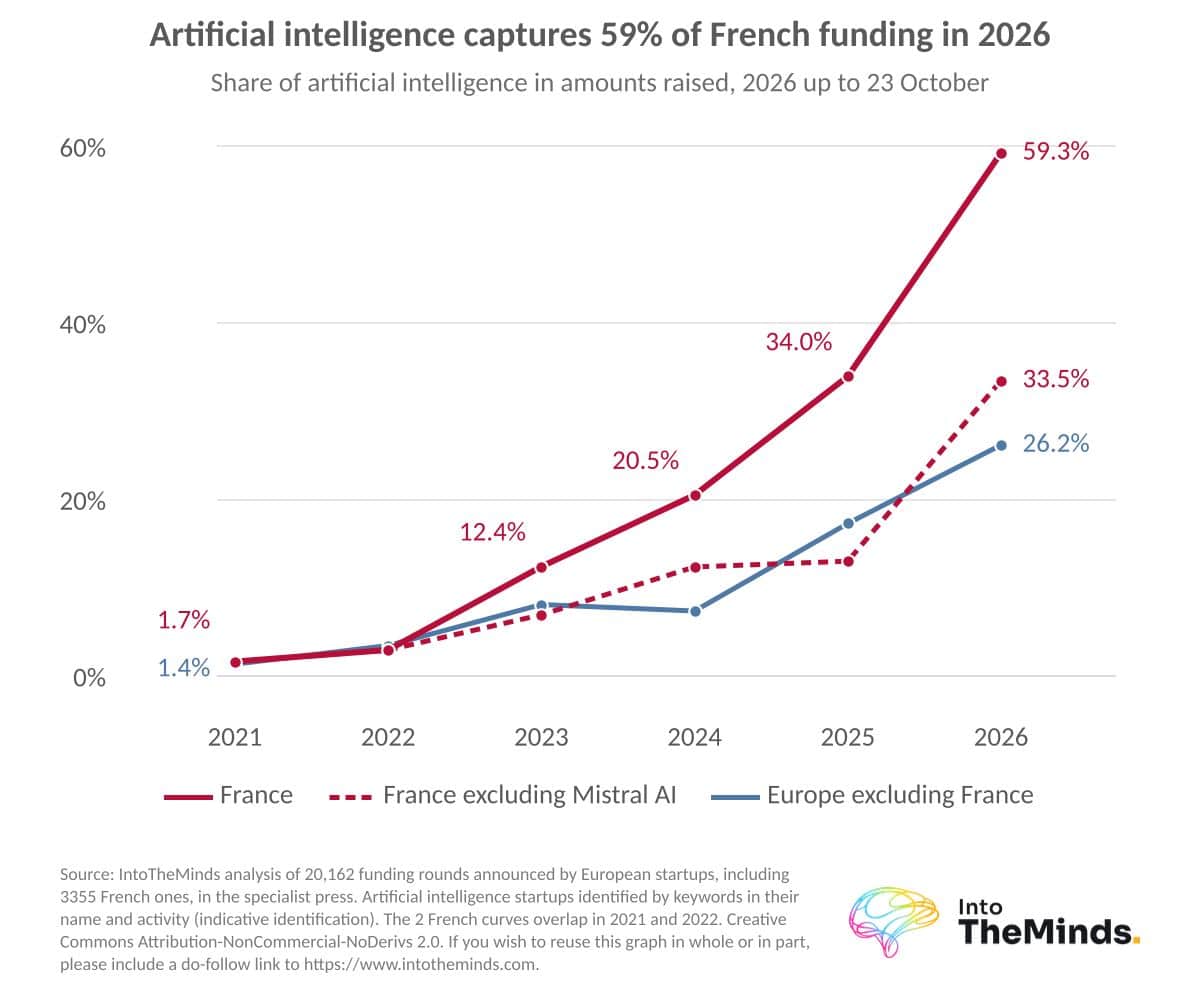
A barometer covering 409 fundraising rounds announced in France since January 2026 confirms this reading: AI appears in 37% of deals and 57% of amounts, and 39% of amounts excluding Mistral AI. Here is how these amounts break down:
- 46% for companies whose product is artificial intelligence itself
- 11% for those where AI is a component of a business solution
- 43% for companies without AI
French Tech: funding stages
A startup raising funds obtains capital from business angels, venture capital funds, or family offices, who receive an equity stake in return. These funds finance hiring, product development, and commercial expansion. Here are the indicative benchmarks by stage:
- Pre-seed: very first round, generally from €100k to €1 million
- Seed: most often between €0.5 and €3 million, to build the first versions of the product and find product-market fit
- Series A: from a few million to around €15 million, to accelerate the growth of an already proven model
- Series B and C: between roughly €10 million and €100 million, to scale up
Seed and Series A
We only managed to document the stage for 28% of the French fundraising rounds in our database. Moreover, this mainly concerns rounds completed between 2022 and 2024. On this sample, seed and Series A rounds are negotiated at the same amounts as elsewhere in Europe: a median of €2.0 million across 548 seed rounds, and €10.0 million across 270 Series A rounds.
In Series C, the French median reaches €55 million, compared to €78 million in Europe.
Series B and C
The gap then widens. The French median is €21.4 million in Series B (81 rounds), compared to €31.6 million in Europe. Series C rounds remain rare, with 22 deals. Focusing solely on 2022 to 2024, the direction of the gap holds: €22.5 million versus €30.0 million in Series B, and €48 million versus €70 million in Series C. The later the round, the wider the gap with European medians becomes in absolute terms.
Valuation and lead investor
The price set for the company at the time of the round, its valuation, determines the share of equity the founders give up. The lead investor organizes the round, negotiates its terms, and brings together the other backers. In 2025, investors proved more selective: they demand solid financial and legal structuring, and risk management as well as insurance coverage now carry weight in negotiations.
Amounts raised by French Tech
This table shows how the distribution of fundraising rounds tightened in France between 2021 and 2026.
| Round size | Share of rounds in 2021 | Share of rounds in 2026 (as of October 23) |
|---|---|---|
| Under €2M | 30.5% | 20.3% |
| €2M to €10M | 41.2% | 43.0% |
| €10M to €50M | 20.3% | 29.4% |
| €50M and above | 8.0% | 7.3% |
Since May 2020, 94 rounds of €100 million or more, representing 2.8% of deals, account for 46% of French amounts. The French market is slightly less concentrated than the European market, where 4% of deals make up 54% of amounts. The decline in small tickets may reflect tougher seed conditions or reporting skewed toward large rounds: this data does not allow us to separate the two effects.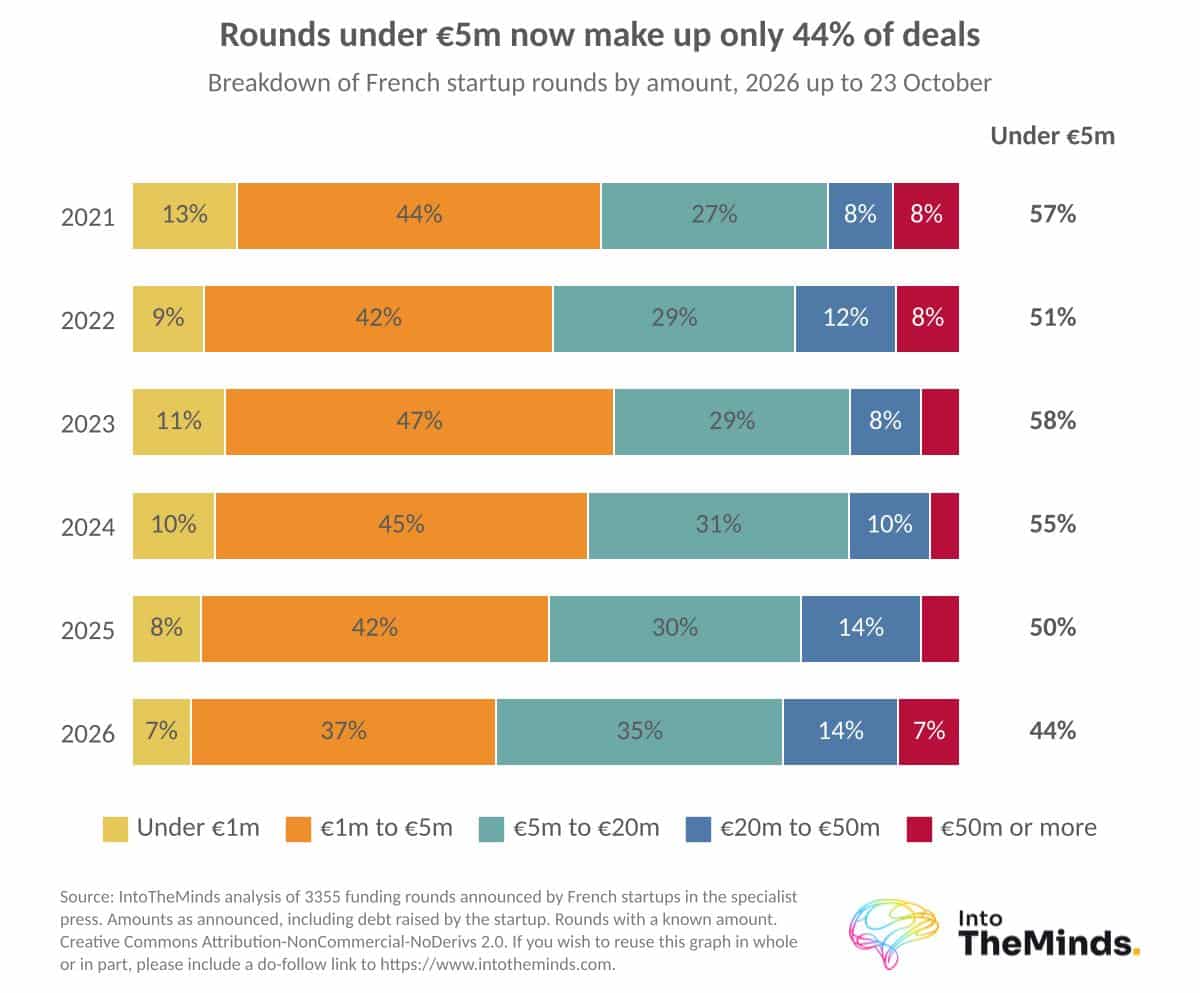
Regional analysis: Paris and the regions
The geography of French Tech fundraising is highly imbalanced.
Paris captures nearly 3/4 of the amounts
Paris captures 72% of the amounts and 60% of the fundraising rounds whose location is known. Including the rest of the Île-de-France region, the share rises to 78% of the amounts. Paris accounts for 83% of 2026 amounts, barely less than in 2021 (84%). Excluding Mistral AI and AMI Labs, its 2026 share drops back to 66%, between 2024 (60%) and 2025 (69%). Looking strictly at Growth rounds, Île-de-France captured 74% of the amounts in 2025, compared to 67% a year earlier. Auvergne-Rhône-Alpes (7.3%) and Occitanie (4.3%) follow far behind, and these three regions alone bring together 85% of the funds.
Paris captures 72% of the amounts and 60% of the fundraising rounds whose location is known.
The regions raise often, but smaller amounts
Outside Île-de-France, startups complete a third of the rounds but capture 22% of the amounts, and 18% excluding Verkor. Their median round is €3.0 million, compared to €5.0 million in Paris.
| Metropolitan area | Rounds | Amount raised | Median round |
|---|---|---|---|
| Paris | 1746 | €36.8B | €5.0M |
| Grenoble | 66 | €3.4B | €6.5M |
| Île-de-France excluding Paris | 204 | €3.1B | €5.0M |
| Lyon | 161 | €1.4B | €3.0M |
| Marseille and Aix | 59 | €0.9B | €4.0M |
| Toulouse | 79 | €0.7B | €4.5M |
Lyon is the most active regional hub, while Grenoble leads it in amounts thanks to Verkor. The regions raised €1.3 billion in 2025 and €1.2 billion as of October 23, 2026, far from the €1.9 billion of 2022. They have not benefited from the rebound.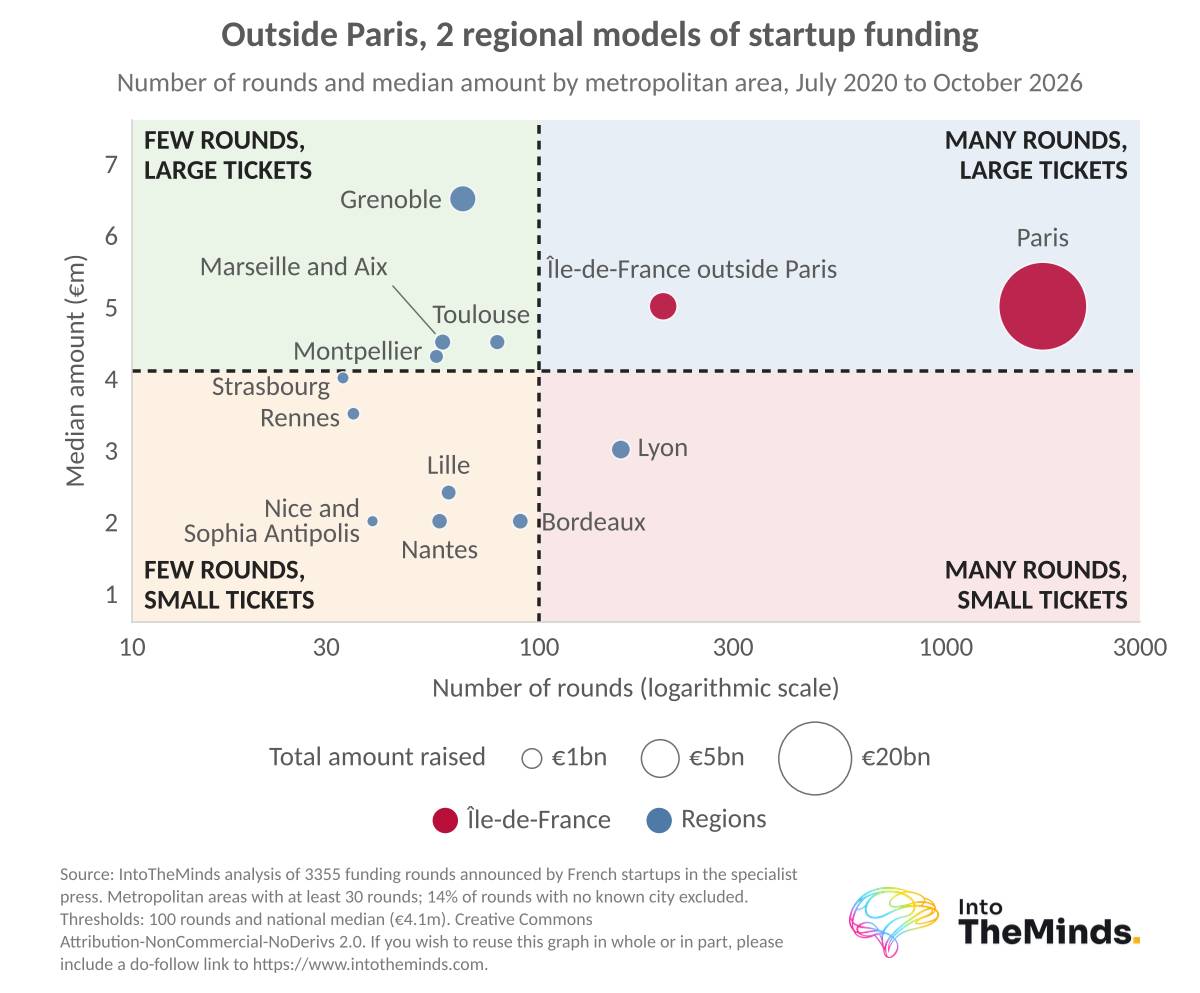
France: 3rd largest European market
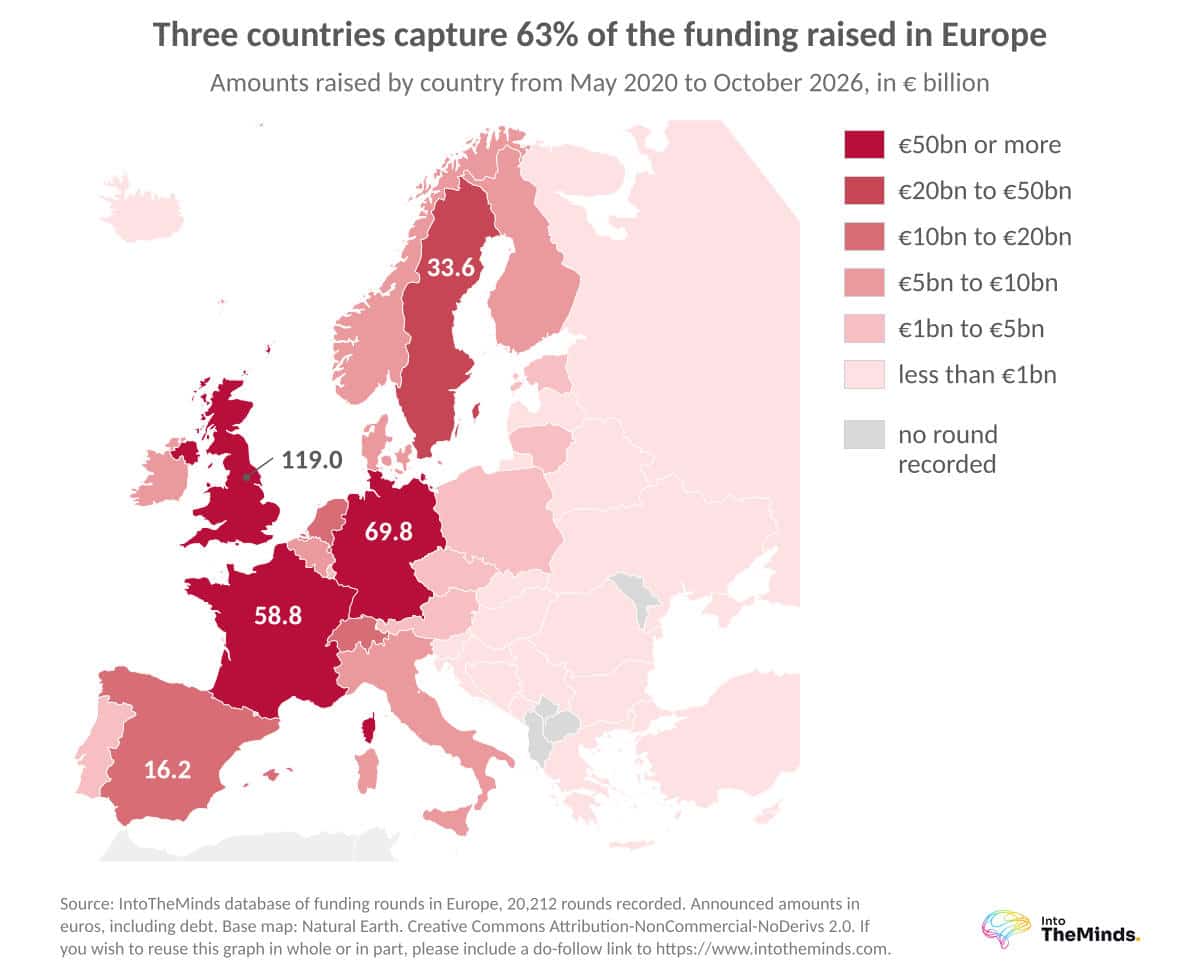
French Tech ranks third in Europe, behind the United Kingdom and Germany.
| Country | Amounts raised (May 2020 to October 23, 2026) |
|---|---|
| United Kingdom | €119.0B |
| Germany | €69.8B |
| France | €56.9B |
| Sweden | €33.6B |
United Kingdom: the undisputed leader
With €119.0 billion, the United Kingdom raised more than double France’s total over the period. No other European market comes close.
Germany: fewer deals, larger amounts
Germany counts 2,829 fundraising rounds, compared to 3,401 in France, for an average amount of €25 million versus €17 million. Adjusted for population, the two countries are nearly neck and neck: €836 raised per inhabitant across the Rhine, €824 in France. In 2023, with €8.9 billion versus €6.8 billion, France moved ahead of Germany. Without Verkor’s €2.5 billion, it would have remained third.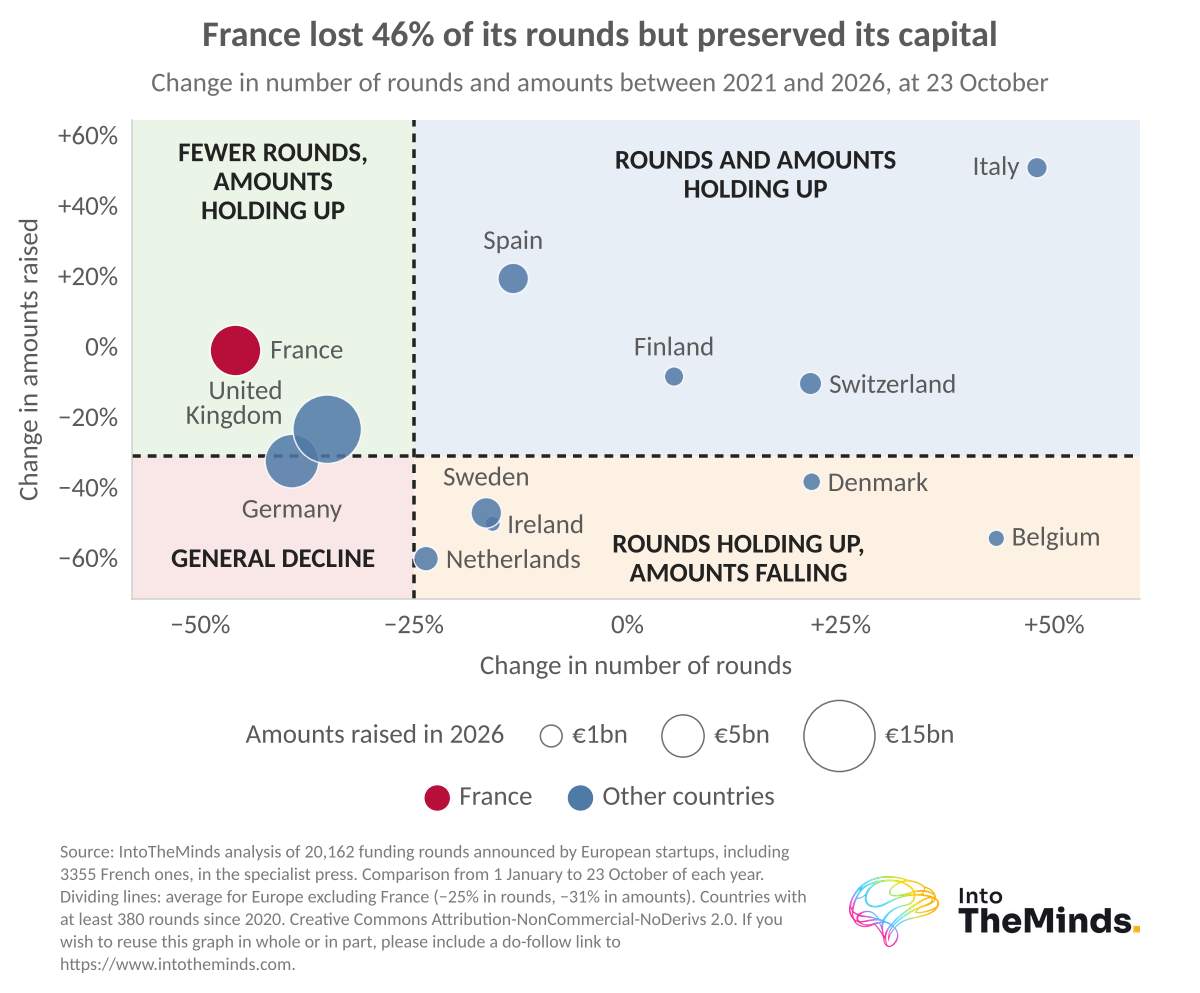
France: an eroding share of deals
France accounted for 18.5% of European fundraising rounds in 2022, and 13.5% as of October 23, 2026. Its share of amounts depends on a few very large rounds: 10.8% in 2024, 17.7% in 2026. Its median round, €4.0 million, exceeds the European median of €3.6 million.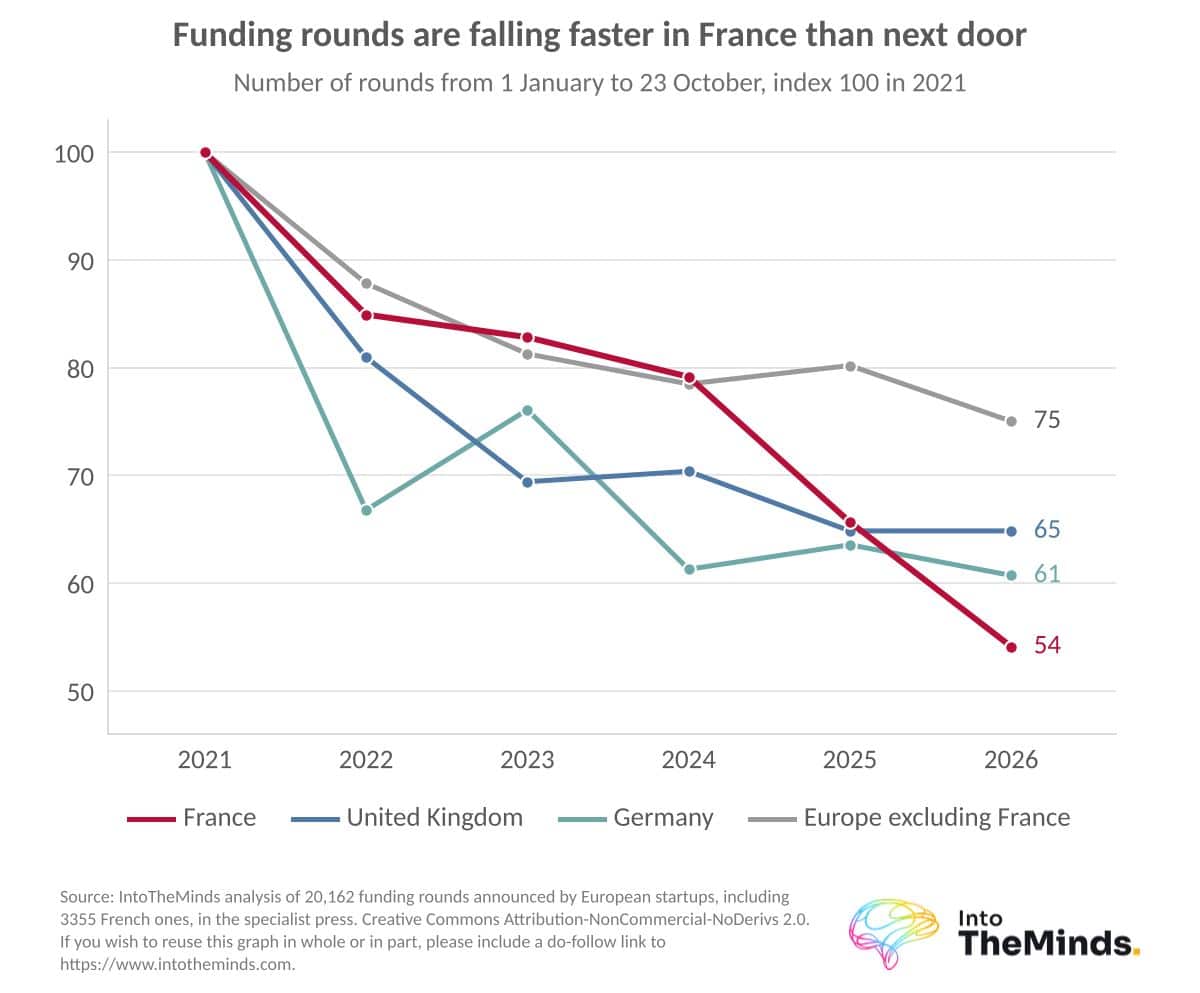
French Tech programs for funding seed stage
For founders, the State supplements private funds through several schemes.
The French Tech Seed fund, endowed with €400 million, is managed by the public investment bank and steered by La French Tech. Originating from the Programme d’investissements d’avenir (PIA), it was launched in 2018. French Tech Seed co-invests alongside private investors in DeepTech companies with fewer than 50 employees and less than 3 years old that have already completed a fundraising round. Two entry pathways exist: referral by an accredited prescriber, or laureate status in the iLab competitions or the PIA Concours Nationaux Innovation (2018 cohorts and onward).
Since 2023, this program has selected startups with disruptive technologies, most of them stemming from research. Its 3rd cohort includes 80 laureates, including 13 in space, 11 in AI, and 11 in health. The laureates have raised €1.5 billion in total.
What to watch for your next fundraising rounds
We have selected 5 indicators to anticipate the upcoming year of French Tech fundraising:
- The recovery of mid-sized rounds: those under €100 million have not returned to their 2022 level.
- Dependence on a few names: when a single company accounts for over 10% of six years of fundraising, the annual total becomes highly sensitive to its timetable.
- Seed funding: if the share of small tickets continues to fall, the pipeline of scale-ups will shrink.
- The transition to Series B and C, where French rounds remain smaller.
- The regions, which are raising less than in 2022.
If you are preparing a round, pay close attention to your legal structuring and risk management: in 2025, capital concentrated on a limited number of companies deemed strategic, and weakly differentiated projects struggled to close. A solid B2B market research study strengthens your case in front of the lead investor.
FAQ: questions you may ask
Where do the figures in this fundraising review come from?
All figures come from IntoTheMinds’ proprietary database that we have built since 2020. The amounts cover the period from May 22, 2020 to October 23, 2026. It merges weekly roundups and a file maintained since May 2020, after removing duplicates and transactions by listed companies. Its amounts are not directly comparable to barometers from other players, whose definitions differ regarding debt.
Our database is for internal use only and we do not make it available to third parties.
What share of French fundraising is led by female founders?
Women represent 11.0% of identified French founders, compared to a 10.4% European average. Fundraising rounds with at least one female founder account for 15.3% of deals but 11.1% of amounts. Healthcare (16.5%) has nearly twice as many female founders as IT (8.9%).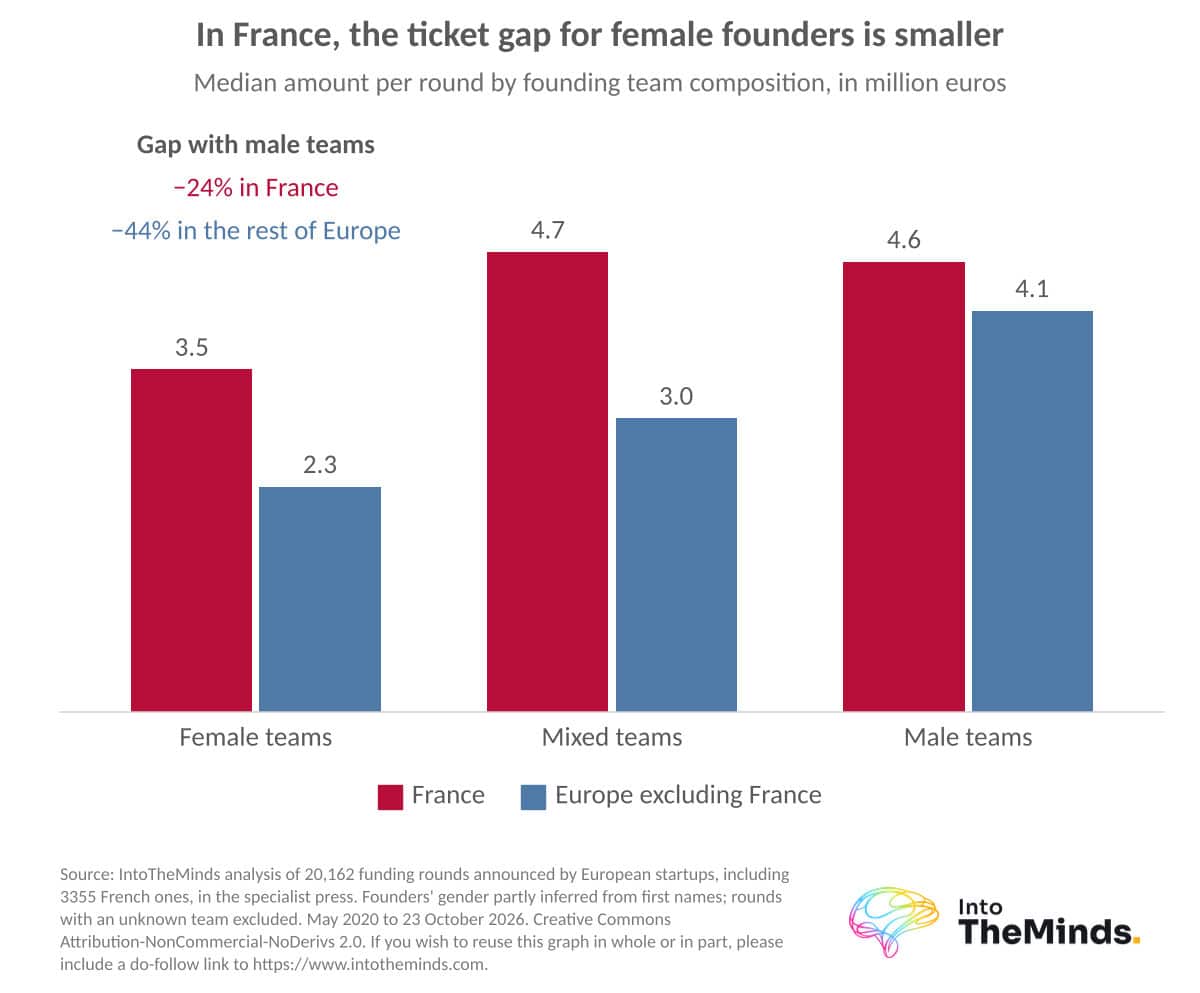
What are the funds raised by startups used for?
Product and R&D come first: 70% of rounds whose use is known finance them primarily. Commercial growth (12%) and industrialization (9%) follow. By amount, industrialization rises to 23%, driven by Verkor, Electra, and HoloSolis.
What are the criteria to join the French Tech and Next40 programs?
A company must have its headquarters in France, have been founded on or after January 1, 2006, not be publicly listed, and have non-negative shareholders’ equity. At most 25% of the capital may be held by a large corporate group. For the performance track, the company must report revenue of at least €20 million and average annual growth of at least 15% over the past 3 years.
How much did French startups raise in 2025?
A brand awareness survey among your target audience quantifies your actual visibility. This type of data supports your narrative when facing investors, who have been more selective since 2025.