IKEA: A New Strategy to Maintain Market Leadership
IKEA-strategy
IKEA-sensory-marketing-EMAC-2010.jpg
Retail
IKEA’s strategy is undergoing a radical shift. After 80 years defined by large-format stores and massive volumes, a new course is being set for 2026. In this analysis, discover how IKEA is fundamentally transforming its strategy. Backed by data, you will learn why the company is closing its large stores and the role omnichannel retailing plays in its future.
In 2026, IKEA is selling less and attracting more people. The Swedish group’s global revenue is declining for the second consecutive year, to €44.6 billion. At the same time, volumes and the number of customers are increasing by around 3%. This paradox is the visible result of a change in IKEA’s strategy. And according to the retailer, it would be the deepest change in its history. After 80 years spent covering the world with ever-larger stores, IKEA is reducing the size of its outlets, lowering its margins and seeking to move closer to customers. Our market research firm wanted to take this strategy apart, drawing on its experience in retail and the latest available figures.
Contact the IntoTheMinds institute
Key takeaways
- Global revenue fell from €47.6 billion in 2022-2023 to €44.6 billion in 2024-2025, but volumes and the number of customers increased by around 3%.
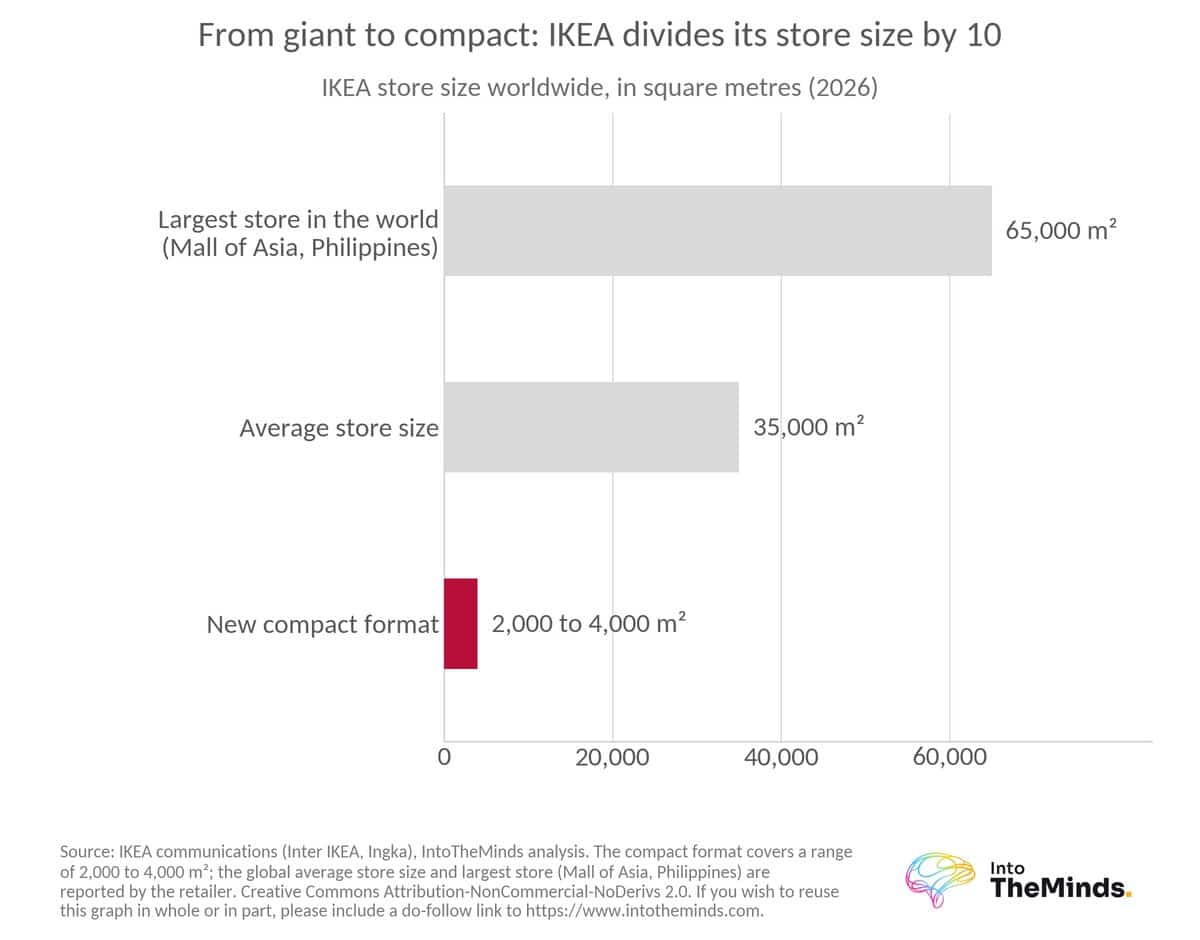
- The core of the shift is the format: stores of 2,000 to 4,000 m² are gradually replacing the rollout of stores averaging 35,000 m².
- The shift is being implemented everywhere, but at different speeds: closure of seven large stores in China, the first German compact store in Ingolstadt, and ten new openings targeted in France by 2030.
- It is only possible because e-commerce has reached maturity: 28% of global sales in 2024, 28.9% in France in 2024-2025, and a quarter of sales in Germany.
- The strategy comes at a price: Inter IKEA’s profit fell by 26% and the group is cutting 850 positions to simplify its organization.
The limits of IKEA’s model
IKEA’s historical model is based on a simple mechanism that has remained unchanged since the invention of flat-pack furniture in 1956: very large stores, a guided route through the different rooms of the home, and a customer who walks through the entire sales floor. A traditional store measures 35,000 m² on average, up to 65,000 m² for the world’s largest store in Pasay, Philippines, and offers at least 10,000 products. Its commercial raison d’être is the unplanned purchase: visitors leave with items they had not thought about when they entered. It is precisely this mechanism that long kept the retailer away from online sales, since e-commerce deprives the retailer of this opportunity.
This mechanism has reached its growth limits, and the figures show it unambiguously. After continuous growth through 2022-2023, global revenue fell by 5.3% in 2024, to €45.1 billion, and then by 1% in 2024-2025, to €44.6 billion (see table and chart below).
| Financial year | Global revenue | Change | E-commerce share |
|---|---|---|---|
| 2019 | n.a. | n.a. | 11% |
| 2020-2021 | €37.4 billion | +6.3% | n.a. |
| 2021-2022 | €39.5 billion | +5.6% | n.a. |
| 2022-2023 | €47.6 billion | +6.6% | 26% |
| 2024 | €45.1 billion | -5.3% | 28% |
| 2024-2025 | €44.6 billion | -1% | n.a. |
Reading note: the €47.6 billion in 2022-2023 corresponds to the retail sales of all franchisees combined (Inter IKEA scope). That same year, the Ingka Group, which operates almost all of the stores, generated €41.7 billion, of which 26% was online, i.e. more than €10.8 billion.
This decline is not unique to the retailer. The global furniture market contracted by 3.8% in 2024, and the European situation is even tougher (this decline can also be seen in the evolution of related markets such as DIY):
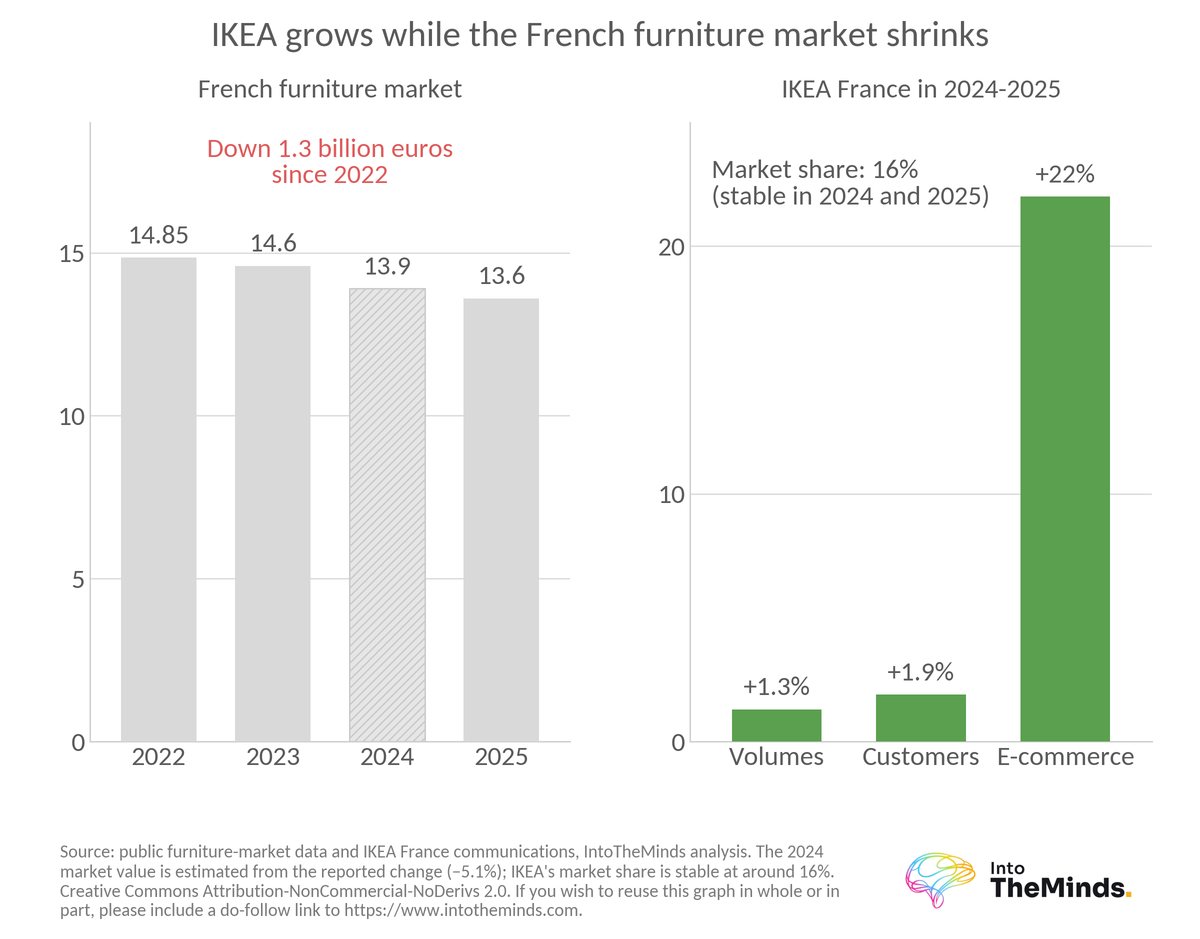
- In France, the furniture market peaked at €14.85 billion in 2022 before declining for three consecutive years, falling to €13.6 billion in 2025, meaning €1.3 billion was lost in three years.
- In Germany, it fell back to €23.9 billion, meaning it is even below its 2020 level!
The main driver behind the furniture market is the real estate market. When it is struggling, nothing goes right. And that is exactly what is happening. In France, housing starts fell by 22% in 2023, dropping below 300,000 units, while existing-home sales fell by 17%, to 955,000 transactions compared with 1.2 million in 2022, while one-third of furniture sales are directly linked to moving house.
This contraction is compounded by a reshaping of the competitive landscape. IKEA is no longer the only player in the affordable design furniture segment. Its positioning has whetted the appetite of Temu and Danish retailer Jysk. Continuing to open 20,000 m² boxes on the outskirts of cities to capture shrinking demand was no longer an option.
If we had to sum up IKEA’s new philosophy, it would be “shrink without disappointing”.
The IKEA store is no longer a large-format store
At the heart of IKEA’s shift is a change of scale. IKEA is moving from 15,000 to 30,000 m² stores to stores of 2,000 to 4,000 m². Better still, these new stores are being established in existing buildings rather than being built on undeveloped land. Beyond the cost savings, there is the issue of speed. A smaller format can open much faster. When a real estate opportunity arises, IKEA can therefore seize it more quickly. Example: the British store in Harlow, opened in summer 2025 on 343 m², was operational within 100 days.
Reduced assortment but the promise remains
Reducing the floor space means rationalizing the offering. This is a dilemma often encountered by retailers. Here are some concrete examples:
- Limoges was the location of the first French IKEA compact store, which opened on May 27, 2026, on 3,000 m². The assortment has been reduced to 3,900 products, of which 1,800 are available for immediate take-away.
- In Le Mans (also in France), the floor space is 2,100 m². The assortment is reduced to 2,500 products.
- In Ingolstadt, Germany, the floor space is 2,950 m². IKEA offers 2,650 products for take-away and 1,000 products on display that can only be ordered.
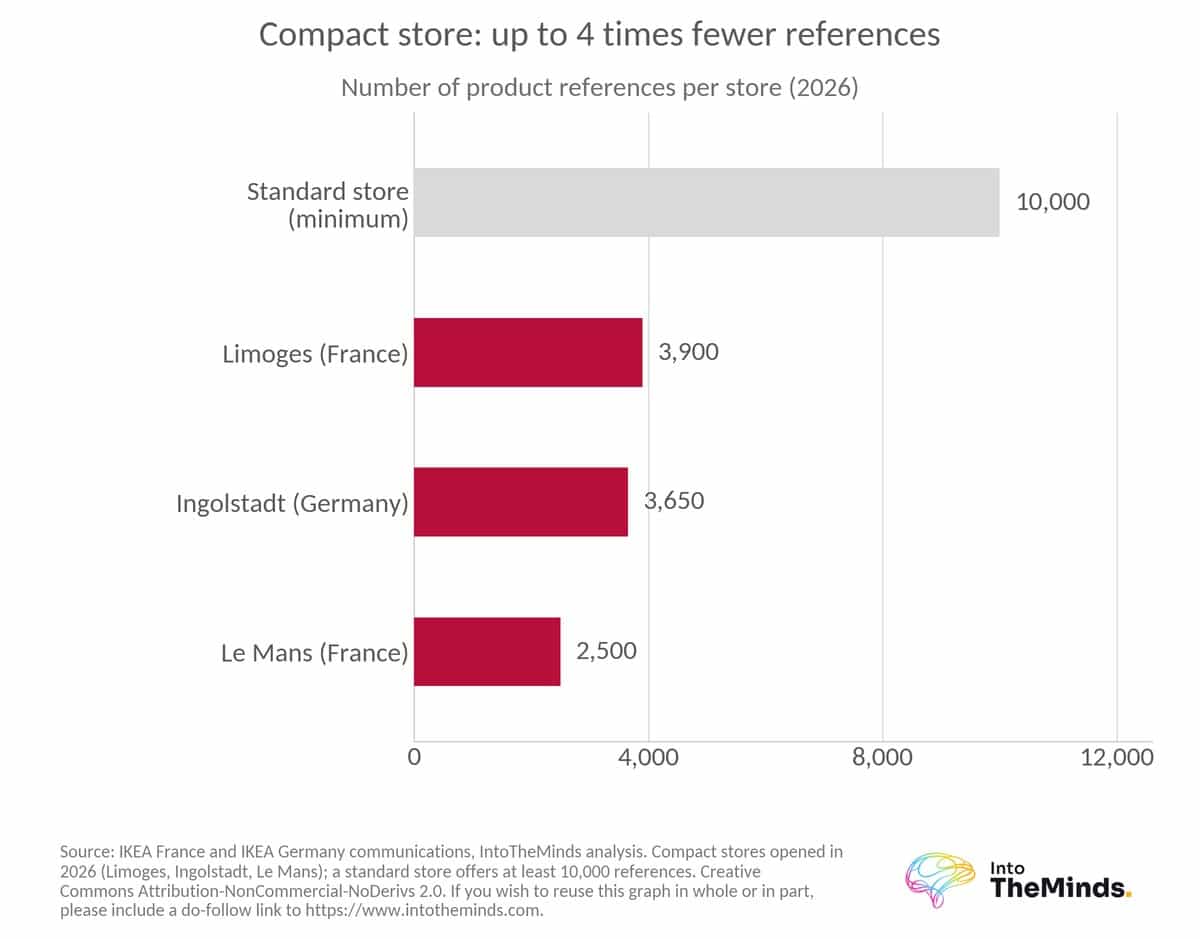
What is also interesting is to see that the store layout codes have been adapted. For example, the high shelving has been reduced to three meters, and payment is made exclusively at self-service checkouts, with no cash payments.
If we had to sum up IKEA’s new philosophy, it would be “shrink without disappointing”. The retailer is choosing to preserve what underpins its experience rather than offer a reduced version of the catalog. Let’s take the Limoges store as an example. Two-thirds of the floor space is dedicated to inspiration and planning, design and financing services. There is even a food offering. We can therefore only agree with Johan Laurell, CEO of IKEA France, when he says that customers find there “their colors, their décor, their principles”
China: the radical version of the shift
IKEA is everywhere. Even in China. And this is where we can see just how far IKEA’s new strategy can go. In January 2026, IKEA announced the closure of 7 of its 40 stores. In return, the retailer will open more than 10 small stores over two years, focusing on Beijing and Shenzhen.
This is quite a radical transition from a large-scale expansion strategy to a culture of precision. But this physical retreat is also accompanied by digital expansion. IKEA has already had an online presence in China since 2018. It offers its products through other platforms:
- Tmall since 2020 with 3,800 products
- JD.com since August 2025 with 6,500 products
Germany in crisis but full of opportunities
Germany accounts for around 15% of IKEA Group activity. The furniture crisis there is severe. According to the German retail federation, 4,500 store closures are expected in the current year alone. Yet these closures are freeing up precisely the 2,000 to 4,000 m² premises located in strategic areas. The size of these stores is also exactly what IKEA needs. The crisis in the furniture market therefore supports IKEA’s new strategy.
France: 10 openings by 2030
France is IKEA’s third-largest market worldwide. And it can be said that IKEA is going all out there. After 45 years of presence and only 37 stores opened, the retailer aims to
- open 10 additional compact stores by 2030
- has identified nearly 25 cities with potential
- wants to achieve an additional €35 million for the 2026-2030 period.
The reasoning is twofold:
- reach an urban population that no longer wants to travel to the outskirts
- circumvent administrative delays that make any large-scale opening difficult.
The bet is measured, since ten small stores represent little more than the equivalent floor space of one large store, but it multiplies the number of touchpoints in areas where the retailer was previously absent.
The IKEA store opens its doors to other retailers!
The latest symptom of IKEA’s strategic change is the arrival of other brands inside its stores. IKEA has launched a test:
- Decathlon is integrated into Croydon in the United Kingdom (1,188 m² out of the store’s 25,000 m², with a dedicated entrance)
- Kjell & Company in Sweden as part of an 18-month pilot launched at the end of 2025
- Thomas Philipps in Austria on approximately 2,600 m² in Klagenfurt.
And in the United States, IKEA is selling its products outside its own stores for the first time, in Best Buy stores. In both cases, the logic is the same: give customers more reasons to visit, or go where customers already are.
The small format is not the cause of the change, but its consequence: it becomes viable because the omnichannel transformation has reached maturity.
Omnichannel becomes a prerequisite
Let’s start with a strong statement: a 3,000 m² store displaying 3,900 products instead of 10,000 only works if the rest of the catalog remains quickly accessible. The small format is therefore not the cause of the change, but its consequence: it becomes viable because the omnichannel transformation has reached maturity. IKEA’s hybrid recommendation system had already pointed in this direction.
Let’s take a step back from IKEA’s figures. Worldwide, the share of e-commerce increased from 11% in 2019 to 26% in 2022-2023, representing more than €10.8 billion, and then to 28% in 2024. In Germany, online sales reached nearly €1.5 billion, or 25% of national revenue.
In France, the change is spectacular. The share of online sales increased from 10.2% in 2019 to 35% in 2020-2021, while stores were closed. It then fell back to 20% in 2021-2022. Since then, it has risen steadily:
- 24.6% in 2022-2023
- 27% in 2023-2024
- 28.9% in 2024-2025.
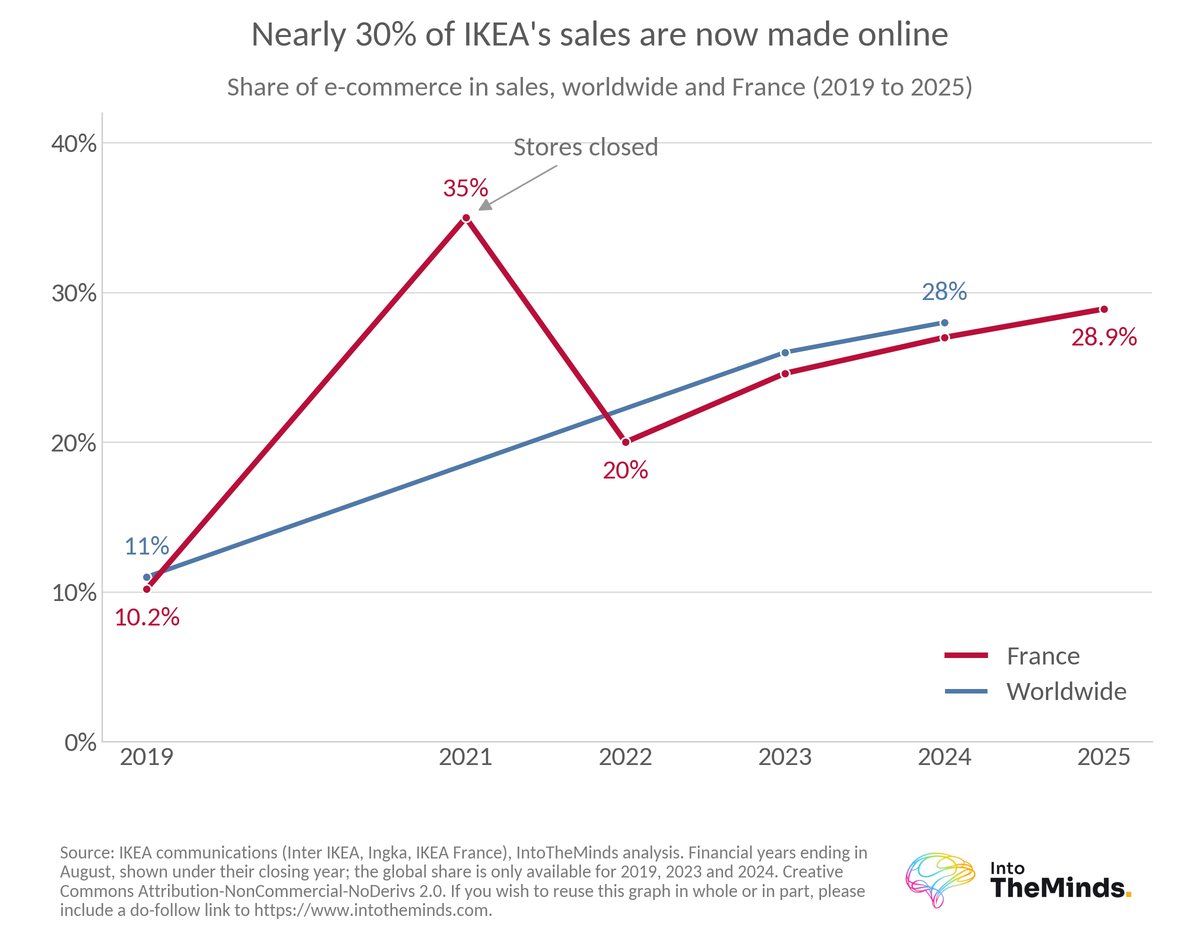
E-commerce now exceeds €1 billion, compared with €650 million three years earlier. The distribution of purchases illustrates the shift better than an isolated percentage: in 2021-2022, 80% of purchases were made in stores, 8% digitally and 12% through omnichannel channels, compared with 85%, 4% and 11% respectively in 2019.
In France, IKEA’s e-commerce revenue now exceeds €1 billion, compared with €650 million three years earlier.
This shift required an overhaul of logistics, funded by a series of technology acquisitions:
- TaskRabbit, acquired in 2017, brought home assembly services
- Made4net, in 2023, enables warehouse management
- Locus, in October 2025, optimizes delivery routes (€100 million in annual savings!)
To succeed, however, one crucial question must be answered: which products should be kept. On 3,000 m², every product on display must justify its place. To make its decisions, IKEA relies on techniques inherited from market research:
- qualitative approach involving visits to customers’ homes
- data analysis from its loyalty program (13.5 million members in France in 2026)
Lower margins but more traffic
The change in formats is accompanied by a second, equally structural choice: preserve traffic by lowering prices, even at the cost of sacrificing short-term profitability. The reversal could not be clearer. At the end of December 2021, IKEA passed on a worldwide price increase of around 9%, driven by the cost of wood, cotton, steel and transportation. Since then, the retailer has been lowering prices across the 63 markets where it operates. In France, this policy translated into around €200 million devoted to price reductions in 2024, covering approximately 2,000 products.
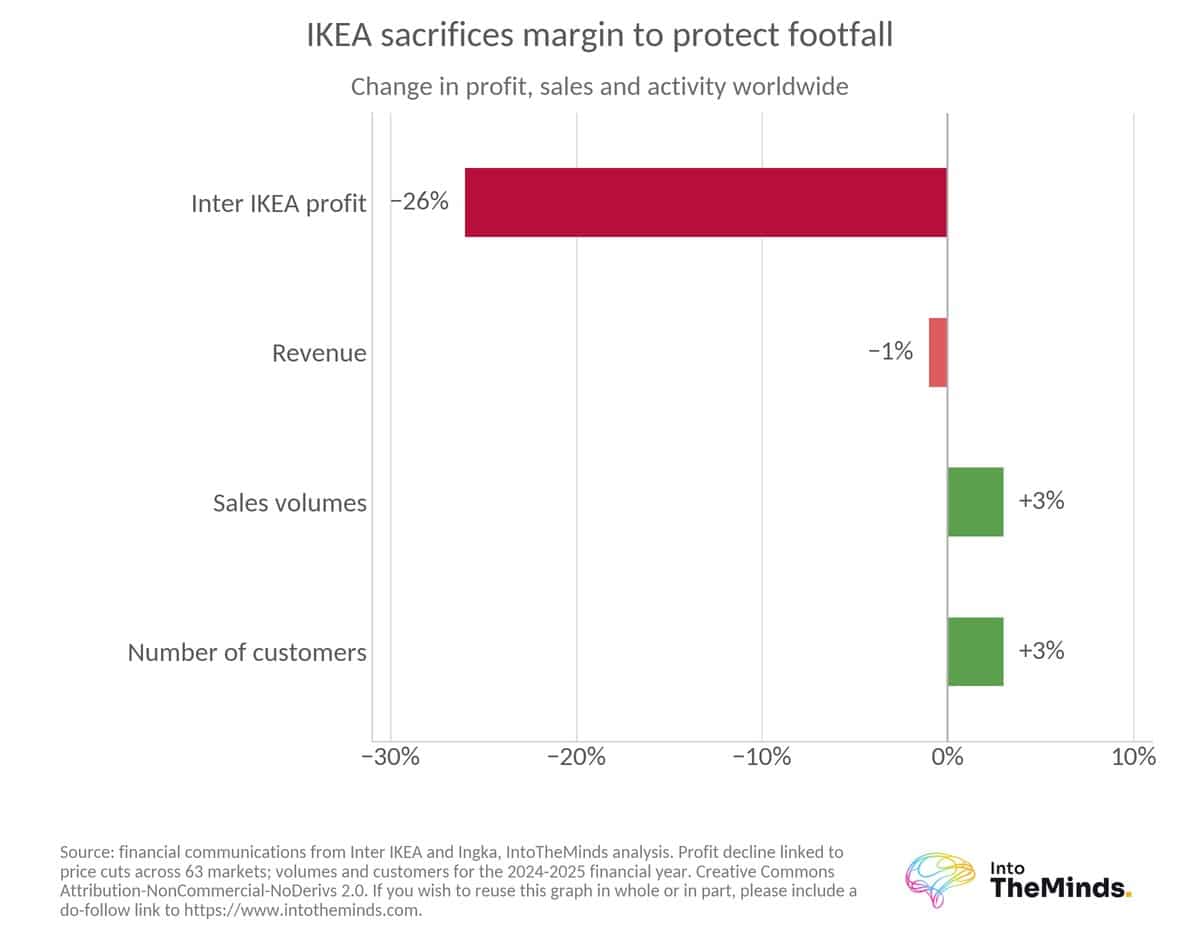
The impact is visible in the accounts:
- Inter IKEA’s profit fell by 26%, a direct consequence of these price reductions.
- Volumes increased by around 3% worldwide in 2024-2025, at the same time as the number of customers.
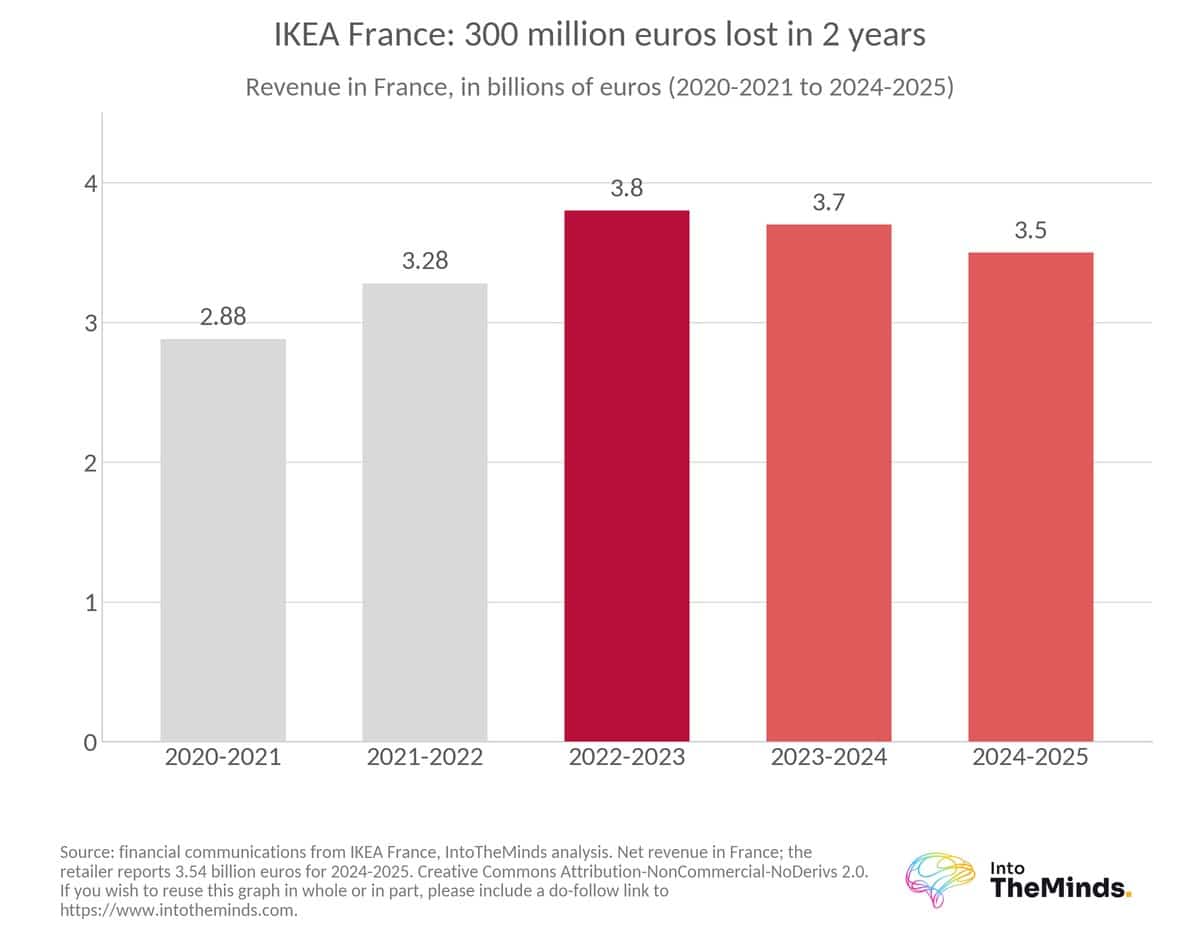
- In France, the retailer lost 4.4% in revenue in 2024-2025 (€3.5 billion) but gained 1.9% in customers and 1.3% in volumes, maintaining its market share at around 16%.
To finance this effort without destroying long-term profitability, the group is simplifying its organization (and therefore reducing costs).
- March 2026: 800 positions eliminated
- May 2026: 850 positions eliminated, including 300 in Sweden, out of approximately 27,000 employees
Two growth drivers are helping offset the pressure on revenue:
- Kitchen: a strategic market where one in four kitchens sold in France is reportedly an IKEA kitchen
- Second-hand: the challenge is to recover value that currently escapes the retailer entirely:
To get an idea of the opportunity offered by second-hand sales, all you have to do is look at classified-ad sites
- in Oslo, 8,700 IKEA products are listed on a single third-party platform
- 500,000 are listed on Leboncoin in France
The IKEA Preowned marketplace, tested in Oslo and Madrid in 2024, offers a 15% bonus to sellers who choose a voucher rather than a cash payment, bringing the transaction back into the brand’s ecosystem.
What remains to be proven
The shift is not yet a done deal, and the areas of vulnerability have been identified.
The economic model
A small store has neither the same inventory turnover nor the same cost structure as a large store. The risk is to duplicate an organization designed for the large format instead of simplifying it. We believe that 3 conditions must be met simultaneously for the model to work:
- maintain the customer promise regarding the offer and prices
- absorb new logistical constraints while maintaining a good service level at a controlled cost,
- significantly improve revenue per square meter.
If IKEA fails on any one of these three pillars, the whole model collapses.
Brand consistency
Customers accept not finding the entire catalog in a smaller store. But they must be able to access it quickly through omnichannel channels. Any break in the customer experience, however, is unforgiving.
Online growth
With 28.9% of French sales made digitally, the retailer may have reached a plateau. This would explain the return to growth through an increase in the number of stores.
Faced with these uncertainties, IKEA is moving forward with an asset that is difficult to replicate: the strength of its brand. France’s leading furniture retailer, the company is outperforming a declining market. In addition, surveys have placed IKEA among the top 10 retailers preferred by French consumers every year since 2021. In Germany, some experts say that IKEA would in fact be the only retailer in the country capable of leveraging a smaller store backed by an integrated online shop.
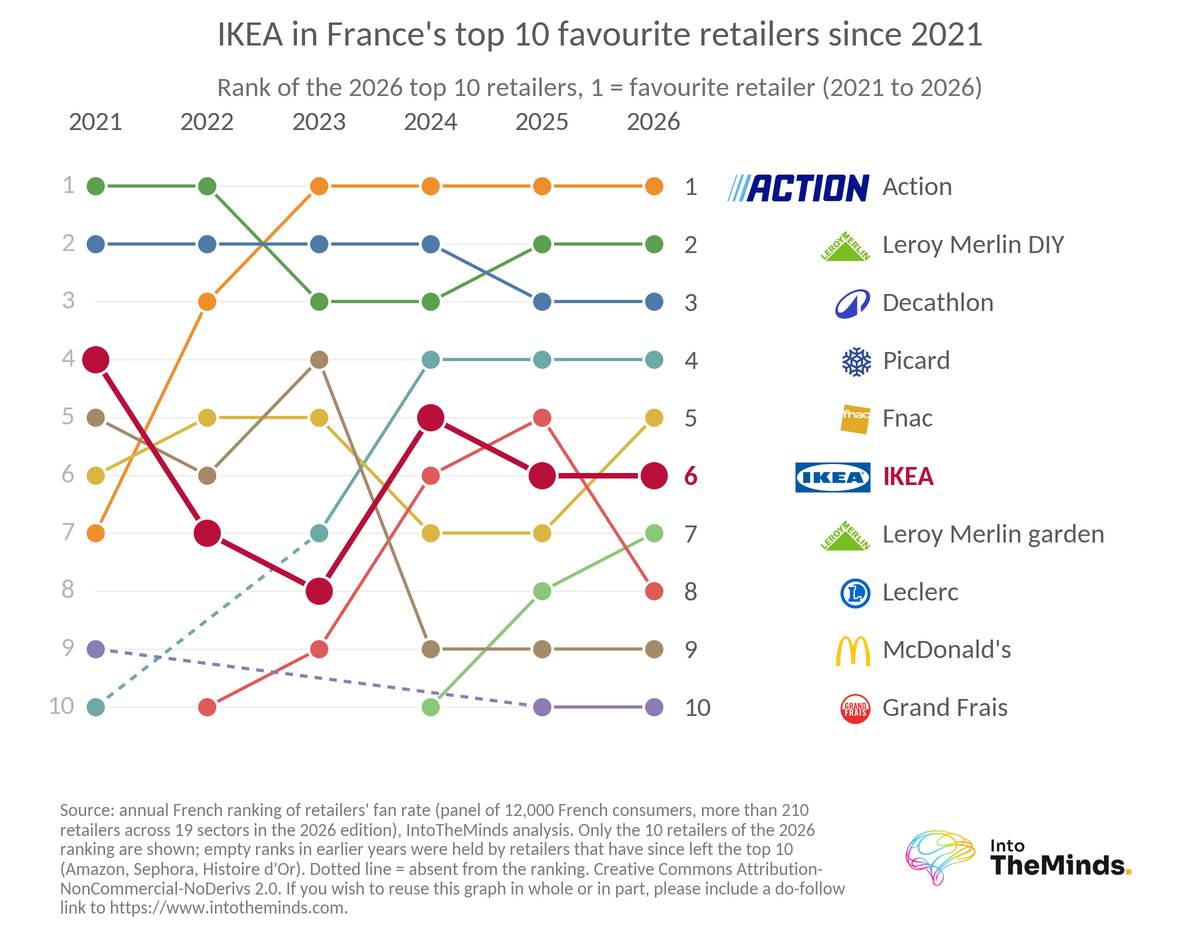
Ultimately, this may be where the key issue lies: the shift is risky, but no competitor is in a position to imitate it.

FAQ: your questions answered
What is IKEA’s new strategy in 2026?
The deepest change lies in abandoning the all-large-format approach. After decades of stores averaging 35,000 m², the retailer is rolling out formats of 2,000 to 4,000 m² in medium-sized cities and urban centers, which are faster to open and less costly to operate. This shift is accompanied by a price-cutting policy across 63 markets, a simplification of the organization and an expansion of the second-hand business. It is only possible because e-commerce, which accounted for 28% of global sales in 2024, makes it possible to compensate for the reduction in the number of products displayed.
Why is IKEA opening smaller stores?
For three cumulative reasons. First, to move closer to urban customers who no longer want to travel to the outskirts, in a declining furniture market. Second, to gain speed and reduce costs, with a small format being installed in an existing building, as in Harlow in the United Kingdom, where the store opened in 100 days. Finally, to seize the many real estate opportunities created by retail failures, which are freeing up 2,000 to 4,000 m² premises in good locations, at more accessible rents than in major metropolitan areas.
How is this shift playing out in France?
IKEA opened its first Compact store in Limoges on May 27, 2026, on 3,000 m² with 3,900 products, followed by Le Mans in July 2026 on 2,100 m² with 2,500 products. The retailer is targeting ten additional openings by 2030, with nearly 25 potential cities identified and €35 million announced for 2026-2030. The context remains difficult, with French revenue of €3.5 billion in 2024-2025, down 4.4%, but the retailer is maintaining its market share at around 16% and seeing both volumes and customer numbers increase.
Why is revenue falling while volumes are increasing?
Because IKEA has chosen to trade margin for traffic. After a price increase of around 9% passed on at the end of 2021, the retailer launched price reductions across the 63 markets where it operates, including around €200 million in France in 2024 on approximately 2,000 products. The value of sales therefore falls mechanically while the quantities sold increase: volumes and customer numbers increased by around 3% worldwide in 2024-2025. The cost of this choice is visible in Inter IKEA’s profit, which fell by 26%.
What are the risks of the small-format strategy?
A small store has neither the same inventory turnover nor the same cost structure as a large store. Three conditions must be met simultaneously: maintain the customer promise regarding the offer and prices, absorb new logistical constraints while maintaining a good service level at a controlled cost, and significantly improve revenue per square meter. There is also the risk of a break in the customer experience, with customers accepting a reduced offer provided they can quickly access the rest of the catalog.
How can a retailer evaluate a format or assortment strategy for its own business?
The approach is based on measuring customers’ actual expectations and deciding which products justify their shelf space. IntoTheMinds supports this type of decision through B2C and B2B market research, as well as customer satisfaction surveys and opinion polls tailored to each sector.



![Illustration of our post "Pricing: strategies, techniques, examples [Guide 2025]"](/blog/app/uploads/pricing-120x90.jpg)