Magnum’s marketing strategy has stood the test of time thanks to a strong brand identity and a commitment to constant innovation. In this article, we analyse 35 years of Magnum marketing and provide you with the latest figures.
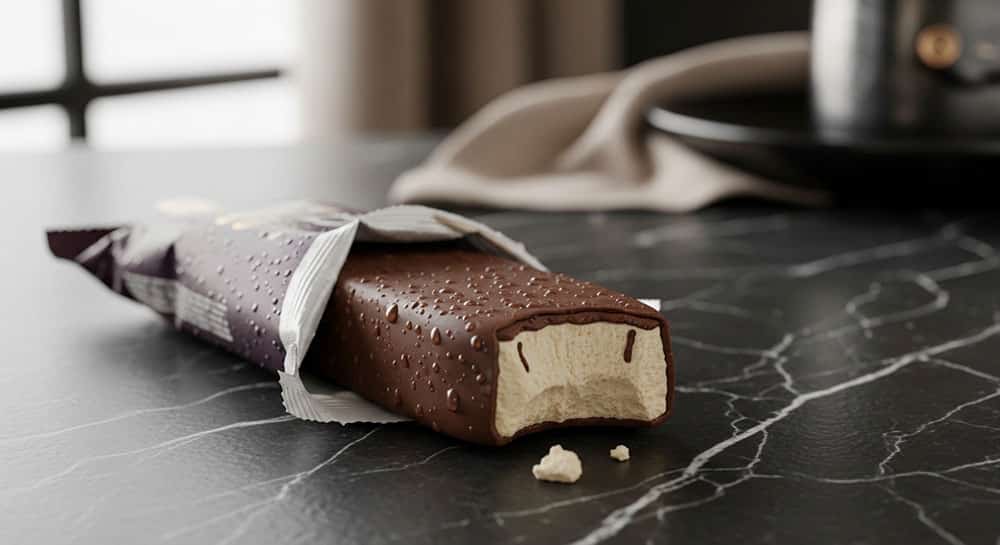
Launched in 1989 as a groundbreaking concept in the adult ice cream market, Magnum has established itself over three decades as one of the most recognized ice cream brands in the world. Its marketing strategy is based on a consistently premium positioning, emotionally driven campaigns, and sustained product innovation. It is a particularly instructive case study for understanding how a mass-market brand can build a lasting image while adapting to market changes. As a market research agency and marketing consultancy, we could not overlook the analysis of this iconic brand. Enjoy the reading!
Contact the IntoTheMinds institute
Key takeaways
- Magnum was launched in 1989 in Germany, France, and Great Britain with an explicitly adult positioning in a market then dominated by family and children’s products.
- By 1993, Magnum’s market share in impulse ice cream increased from 8% to 20% in Germany, thanks notably to the launch of the three-pack and winter advertising campaigns.
- In France (summer 2023), 6 Magnum products ranked in the top 10 best-selling ice creams, with a 23.0% category value share over P7–P8 periods.
- Magnum, a flagship brand of the Unilever group, claims a leading position in the global market with annual revenues in the billions of euros.
- Premium ice creams accounted for 35% of category revenue in France (MAT P1 2026), a growing share confirming the long-term strength of Magnum’s premium positioning.
Who is Magnum and what is its marketing positioning?
To understand Magnum’s marketing, one must first return to the brand’s foundational identity and its positioning. As a marketing enthusiast, I must immediately highlight the coherence of this marketing strategy over the past 35 years. Not only is it remarkable, but it is also an intangible asset of significant value. Before reading further, I suggest watching the video below, which in my view perfectly symbolizes Magnum’s DNA.
The history and identity of the Magnum brand
Magnum was launched in 1989 by Frisko, a Danish frozen food subsidiary of Unilever via its Miko division. The original product was a 120 ml (15 cm, 94 g) vanilla ice cream bar coated with a thick layer of crunchy chocolate. Its name derives from the Latin magnus, meaning “large.” This format was twice the size of standard ice cream bars available at the time, and the product was explicitly designed for adults in a category previously focused on children and families.
The initial rollout was simultaneous across several European countries: Germany, the Netherlands, Belgium, Denmark, Switzerland, Sweden, followed by France and Great Britain. By 1994, Magnum was sold in 35 countries, with an estimated global turnover of around 900 million dollars. The brand operated under different umbrella names depending on the country (Miko in France, Wall’s in the UK, Ola in the Netherlands), unified under the internal double-heart logo known as the Heartbrand.
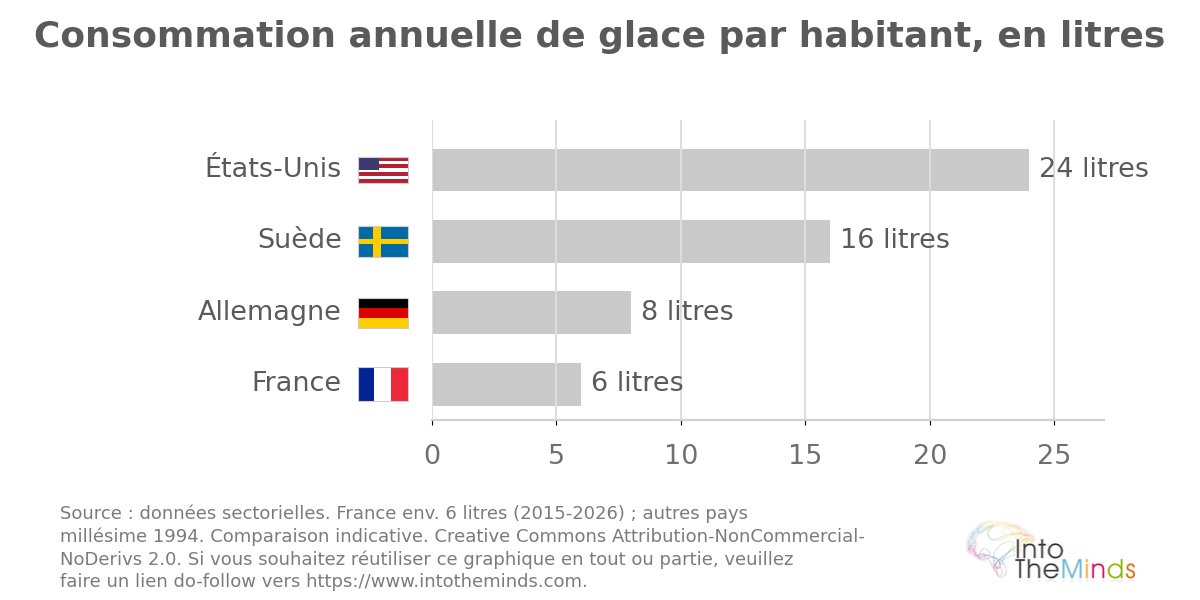
Magnum’s expansion across these markets was driven by the strong commercial potential of the ice cream segment. And as shown in the chart below, ice cream consumption is not necessarily correlated with sunshine levels.
Magnum’s premium positioning in the market
Magnum’s positioning is based on a precise concept: the “affordable little luxury.” The brand targets adults aged 25 to 35 who want a moment of indulgence without constraints. This positioning has proven particularly resilient across economic cycles: during downturns, consumers who cut back on travel or expensive leisure activities tend to shift toward affordable indulgent food experiences.
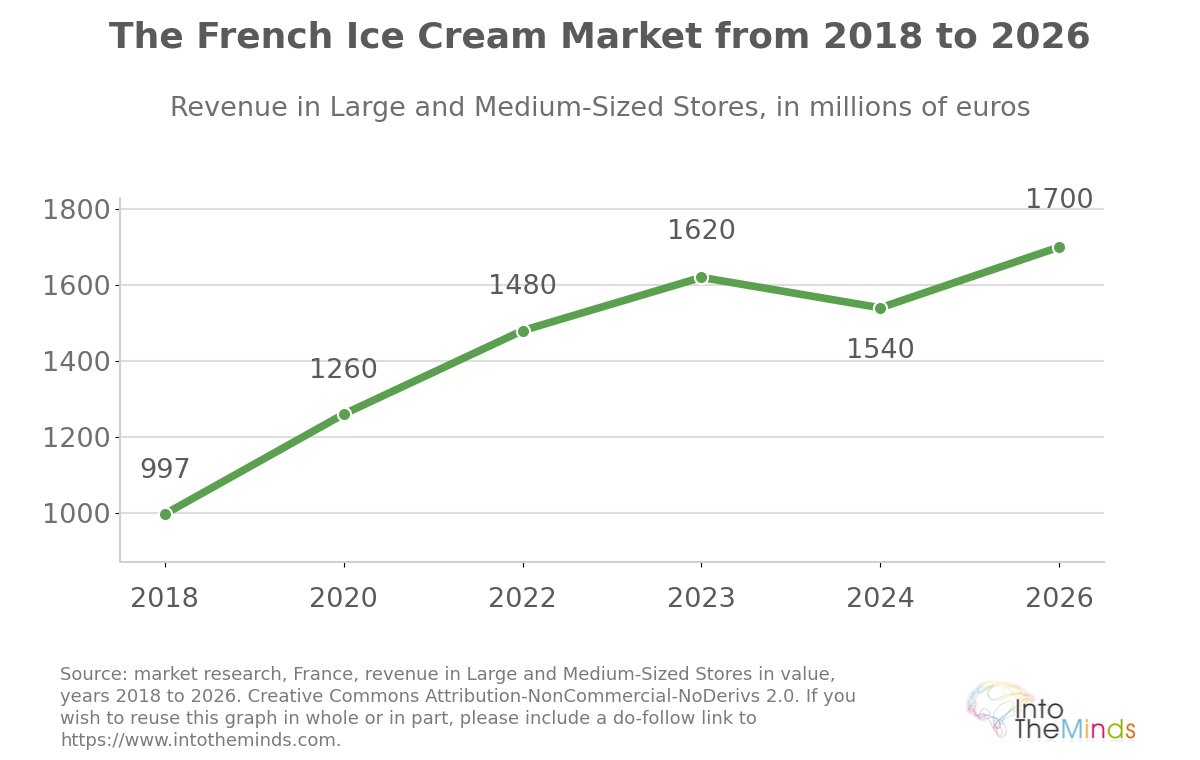
In France, Magnum’s retail market share reached 13.8% in 2010, rising to 16.4% in summer 2015. In 2023, Magnum held a 23.0% category value share, with €94.974 million in sales. Premium ice creams accounted for 35% of category revenue in France, an increasing share that confirms the alignment of this positioning with broader market trends.
Magnum’s values and marketing DNA
Three core values structure the brand’s DNA: indulgent pleasure, glamour, and sensory quality. The most distinctive differentiator is its sound signature: the audible “crack” of the chocolate shell on the first bite. This founding idea—making the chocolate coating the hero rather than the ice cream itself—has underpinned a premiumization strategy sustained for over three decades. The current tagline “Take pleasure seriously” summarizes this assumed hedonism.
Magnum’s communication strategy
Le Magnum marketing is based on a coherent communication architecture, whose pillars were established in the early years and progressively enriched.
The pillars of Magnum communication
- Sensuality and glamour: advertising spots adopt a cinematic blockbuster style, with visual codes close to haute couture and auteur cinema.
- Connection with the Cannes Film Festival: Magnum is present every year on the Croisette, where it deploys on-the-ground activations and immersive spaces (“Maison Magnum”). The brand has also been present at Roland-Garros (since 2018, replacing Häagen-Dazs after more than 25 years of collaboration) and at the Paris 2024 Olympic and Paralympic Games.
- Limited editions: each year, a new creative platform is launched. Among the most notable: Temptation (2008, for the 20th anniversary), Gold (2010, later made permanent), 5 Kisses (2014), Pink & Black (2015, including the lighting of the Palais de Tokyo in Paris), “Unleash the Beast” (2016), and more recently Chill (2024) and “The House of Magnum” (April–May 2026).
- Experiential marketing: pop-up stores enabling product customization, first in Paris (Le Marais) in 2012 (around 400 visits per day on average over three weeks), then in major European capitals and New York from April 2016 onwards. These pop-up stores have become a hallmark of Magnum’s marketing strategy and remain deeply embedded in its brand identity.
The evolution of Magnum marketing campaigns
The “The House of Magnum” campaign (April–May 2026, see below) positions the brand as an ice cream haute couture house, illustrating the continuity of its globally consistent glamour and fashion-driven narrative. This strategic direction has remained unchanged since the US launch in 2011, supported by a national campaign exceeding $10 million featuring Rachel Bilson, as well as collaborations with Karl Lagerfeld (a trilogy of short films), Stacey Bendet for the launch of Magnum Mini, and Zac Posen for Magnum Gold (launched at the Tribeca Film Festival in April 2013, featuring a $1.5 million 24-carat gold dress).
The digital strategy has expanded beyond traditional social networks:
- partnership with the Tinder app
- collaborations with home delivery platforms (Deliveroo, Uber Eats, with a partnership generating €10 million in revenue)
- presence in esports through a partnership with French club Team Vitality since December 2023
These initiatives reflect a clear intention to reach new consumption occasions.
Magnum and strategic partnerships
Beyond celebrity endorsements, Magnum has developed structural partnerships. The collaboration with Chilean startup NotCo, announced in September 2025, aims to reformulate recipes using the artificial intelligence platform Giuseppe AI to identify plant-based substitutes, reduce calories, and manage rising raw material costs. This partnership was initially rolled out to US teams.
Magnum ambassadors and celebrities in marketing
Since 2008, Magnum has relied on seasonal ambassadors whose glamorous and international profiles reinforce the brand’s premium positioning.
Iconic faces of Magnum campaigns
The list of ambassadors reflects consistent positioning: Eva Longoria (2008), Eva Mendes (2009), Benicio del Toro (2010), Rachel Bilson (US launch, 2011). More recently, Troye Sivan, Grammy-nominated singer-songwriter, joined the brand for the #WhereverPleasureTakesYou campaign, alongside Nicky Doll and Iggy Pop. Fashion designers such as Karl Lagerfeld and Alexander Wang have also participated in specific campaigns.
How Magnum selects its ambassadors
The core criterion is alignment with the values of glamour, sensuality, and self-confidence that the brand projects. Ambassadors are selected for their ability to embody “unapologetic pleasure” for an international adult audience. Consistency between the celebrity profile and the brand’s aspirational universe takes precedence over mere fame.
Flagship products and their marketing strategy
The Magnum range and its positioning
| Product / Format | Launch year | Market data (France) |
|---|---|---|
| Classic stick (120 ml) | 1989 | Top 7 and Top 8 best-selling ice creams in summer 2023 (€4.8M and €5.0M) |
| Magnum Mini (60 ml) | 2005 | 20% of Magnum sales (France, 2016) |
| Magnum Gold | 2010 (limited edition, then permanent) | US launch: Tribeca Film Festival, April 2013 |
| Magnum Almond (multipack) | Historic reference | Top 1 and Top 2 best-selling ice creams in summer 2023 (€10.9M and €10.1M) |
| Magnum tubs (440 ml) | March 2016 (relaunch), April 2017 (major launch) | €4.1M turnover, top innovation 2017 (France) |
| Magnum Ruby (pink chocolate) | 2020 | First ruby chocolate ice cream stick |
| Magnum Bonbons (bites) | September 2024 | Snacking format, box of 12 bites |
| Magnum Cones (4 × 90 ml) | July 2025 | €4.90–€5 in France (hazelnut & chocolate, mango & white chocolate) |
Product innovation as a marketing lever
Innovation is a structural pillar of Magnum’s marketing. In 2024, the share of new product launches in the French ice cream market reached 13% of total sales, significantly above the average for fast-moving consumer goods. The brand plans multiple innovations in the coming years, particularly at its Saint-Dizier production site.
Innovative formats have systematically targeted new consumption occasions: the 60 ml Mini range (2005) addressed consumers seeking indulgence while controlling calorie intake; the first alcohol-infused ice cream sticks (Magnum Mini Limoncello and Irish Cream, launched in France in 2011 at around €3.50 per six-pack) explored the aperitif occasion; Bonbon bites (2024) target snacking. A light version, considered too far removed from the brand’s identity, was discontinued.
Magnum packaging as a differentiation tool
The “M” monogram on the packaging and the consistent gold design codes across all countries represent strong visual assets. The Signature range (Pistachio and Peach) uses warm aesthetic codes (ochre, brown, gold, terracotta) that deliberately move away from conventional frozen food visual language. This graphic direction aligns with the “smart indulgence” concept the brand has developed since gaining greater strategic independence.
The impact and performance of Magnum campaigns
Measurable results of marketing strategies
Available market data for France provides a concrete measure of Magnum’s marketing effectiveness. In Germany, as early as 1993, Magnum’s impulse market share rose from 8% to 20%, supported by the launch of the three-pack and a communication innovation: winter advertising, which tripled winter sales in a market where annual per capita consumption was only 8 litres.
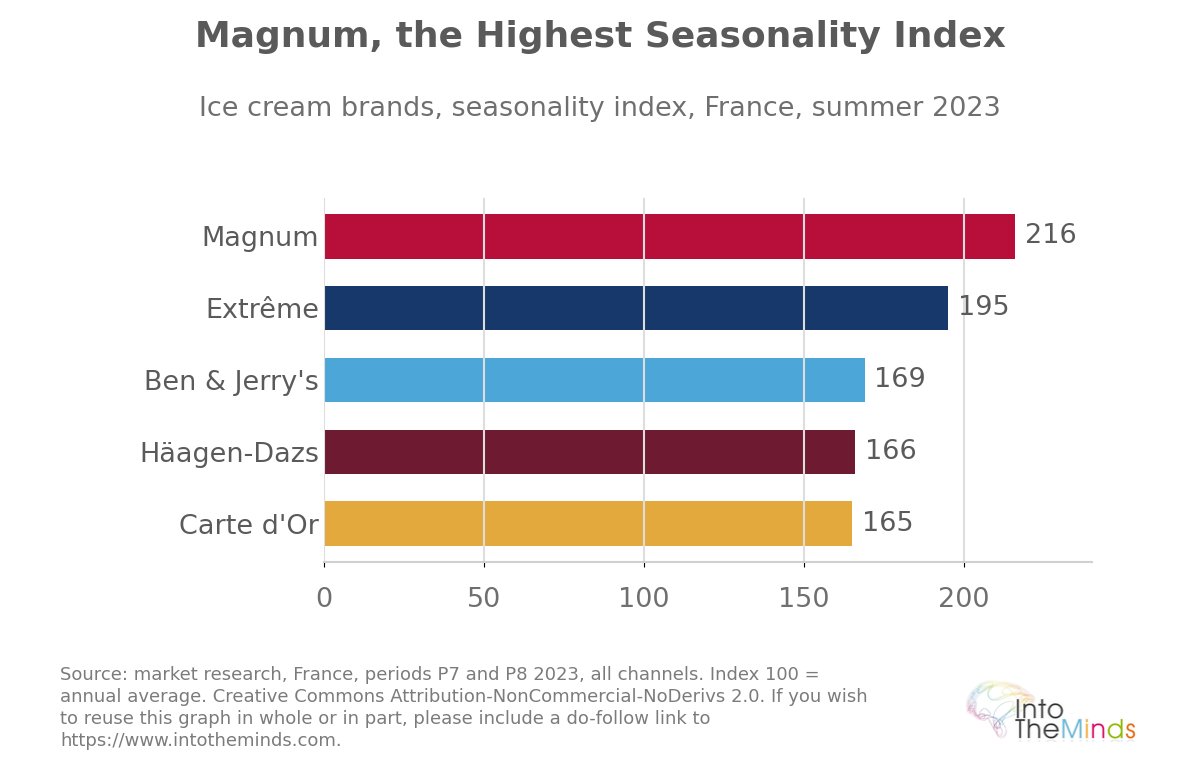
In France during the summer of 2023, six Magnum products ranked in the top 10 best-selling ice creams. Magnum holds a strong value market share in France, positioning itself among the leading players in the sector. The brand maintains robust organic growth, consistently outperforming market expectations.
Brand awareness and perception of Magnum
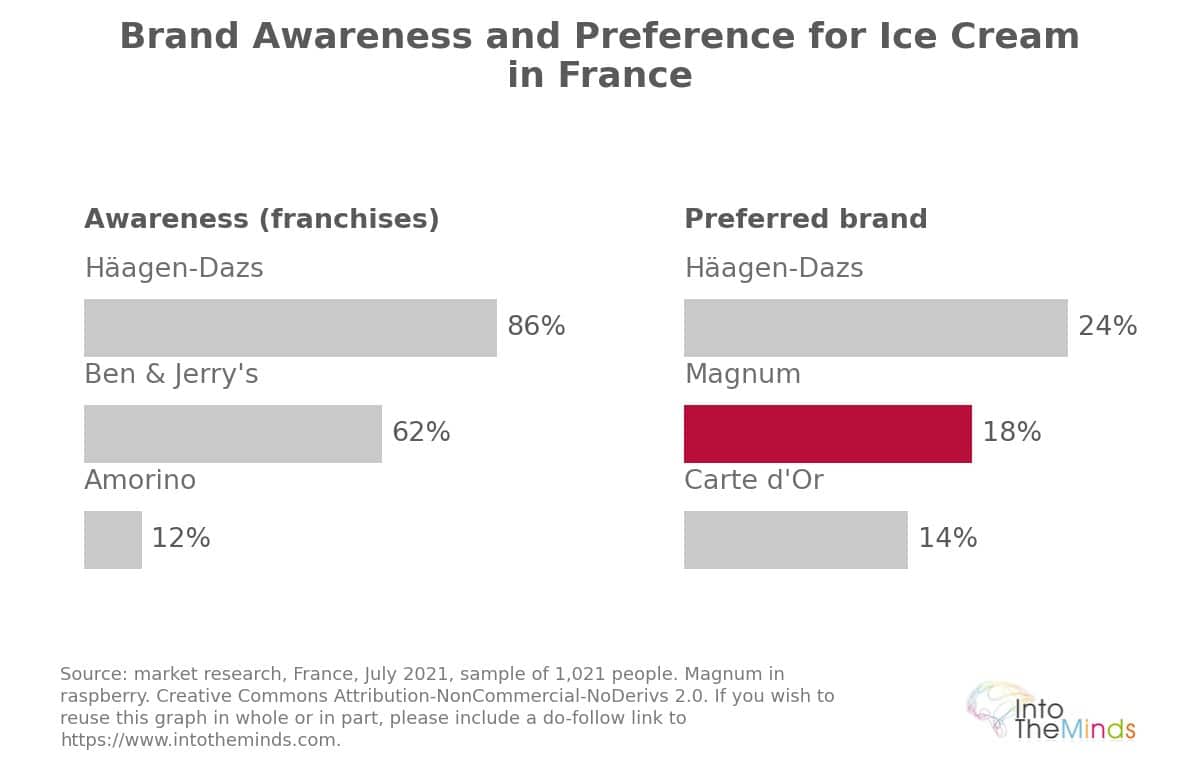
According to a study conducted in France in July 2021 (see results above), 18% of French consumers named Magnum as their favourite ice cream brand, behind Häagen-Dazs (24%) and ahead of Carte d’Or (14%). In 2017, Magnum ranked 2nd in the list of most preferred brands in the “fresh products, frozen ice cream” category (behind La Laitière, ahead of Carte d’Or and Häagen-Dazs), having climbed six places in three years according to “Le Grand Livre des Marques”.

FAQ: Questions you may have
What is Magnum’s positioning?
Magnum positions itself in the “affordable luxury” segment within the adult ice cream category. The brand primarily targets adults aged 25 to 35 who are looking for a moment of sensory indulgence. This premium positioning, based on the quality of chocolate (originally Belgian), the generous format, and glamorous visual codes, has been consistently maintained since its launch in 1989. Measuring the perception of such a brand in a given market may require a structured brand awareness survey.
Which celebrities promote Magnum?
Since 2008, Magnum has used international seasonal ambassadors. Among the most cited: Eva Longoria (2008), Eva Mendes (2009), Benicio del Toro (2010), Rachel Bilson (US launch, 2011), as well as fashion designers such as Karl Lagerfeld and Zac Posen. More recently, artist Troye Sivan joined the brand for the #WhereverPleasureTakesYou campaign. The selection of ambassadors follows a criterion of alignment with the brand’s values of glamour and assumed hedonism.
Who owns the Magnum brand?
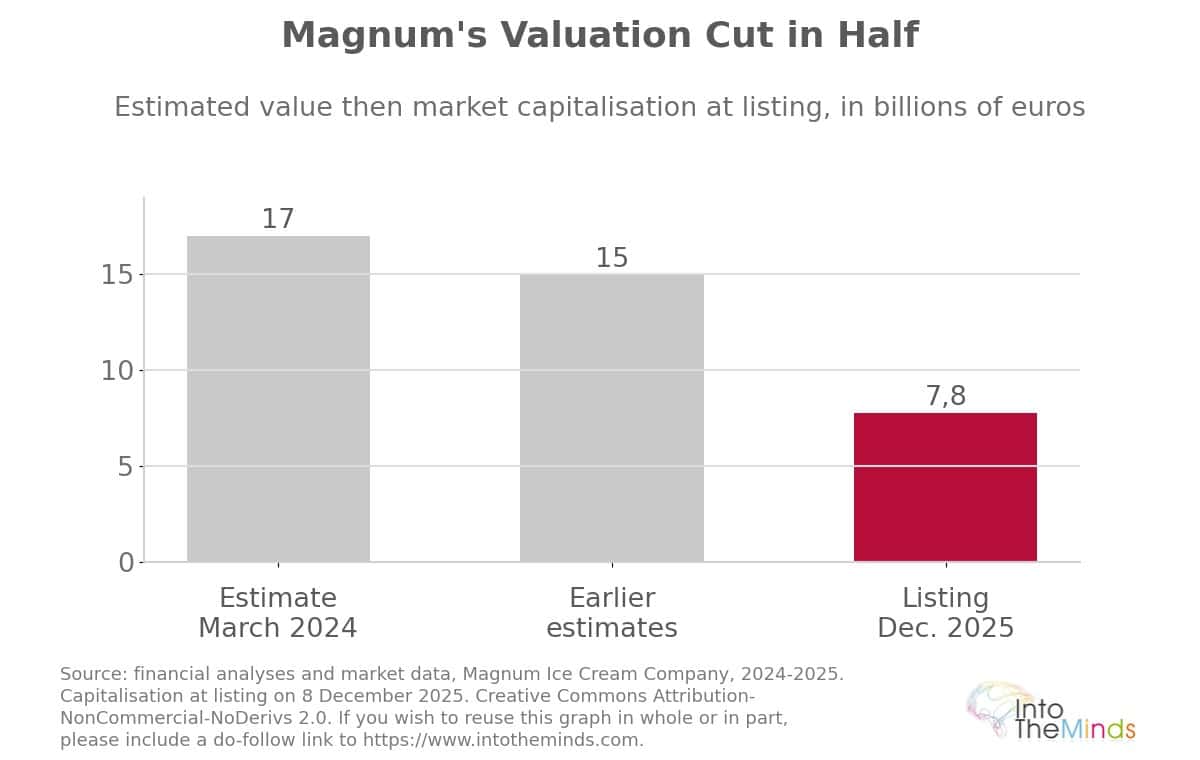
Magnum has been owned by Unilever since its launch. In March 2024, Unilever announced the separation of its ice cream division. Following restructuring announcements regarding Unilever’s ice cream business, Magnum’s structural future is evolving to strengthen its autonomy in the global market. Unilever retains a minority stake (around 20%) for a period of up to five years.
How can you analyze the marketing strategy of a brand like Magnum?
Analyzing Magnum’s marketing involves several tools: positioning analysis, marketing mix analysis (product, price, distribution, communication), measurement of brand awareness and market share, and campaign evaluation. For a FMCG brand, a B2C market research study helps quantify consumer perceptions, identify target segments, and measure communication effectiveness. IntoTheMinds supports companies in this type of analysis using methodologies tailored to the fast-moving consumer goods sector.
What is Magnum’s market share in France?
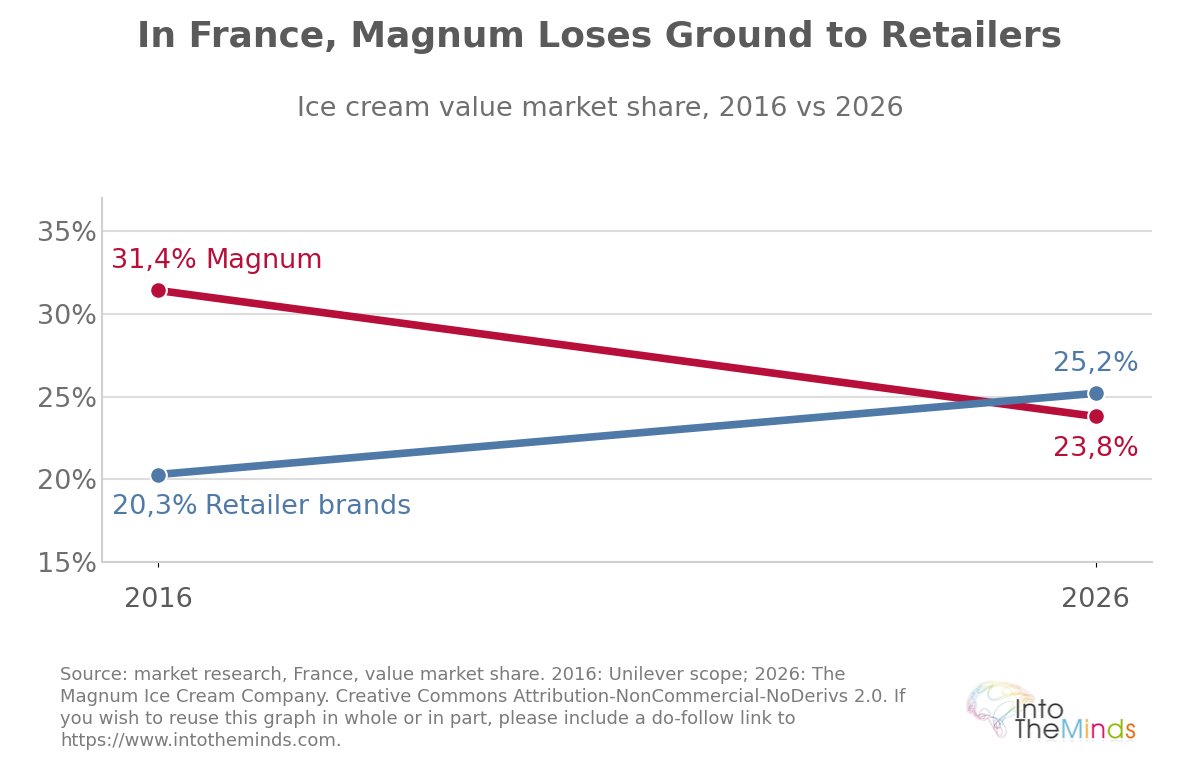
The Magnum Ice Cream Company held 23.8% market share by value in the French ice cream market (MAT P1 2026), making it the leading player ahead of private labels (25.2%) and Froneri (22.5%). During summer 2023, 6 Magnum products were in the top 10 best-selling ice creams, with Magnum Almond 8 sticks ranking first (€10.9 million). These figures illustrate the commercial strength of a long-term marketing strategy. To measure your own brand perception in a competitive market, IntoTheMinds offers customer satisfaction surveys and tailored opinion polls.