Why are automakers now selling options via subscription? What does this market look like, and what do customers think? Find all the answers in this market study based on the latest available data.

A heated steering wheel for $15 a month, 27 horsepower unlocked for €19 per month, autonomous driving billed at €99 every month. Automakers are adopting the subscription model for their options. All equipment is now installed as standard, and access to the functions is sold through a subscription. This shift turns every model into a source of recurring revenue throughout its entire lifetime. Our firm, drawing on its expertise in automotive market research, has examined this new “business”. We analyze it here in light of the pressure on automakers’ margins (see our in-depth analyses of Volkswagen, Porsche and BMW).
Contact the IntoTheMinds market research firm
Key takeaways
- $15 billion: global revenue from connected services and subscription-based options by 2030.
- $25 billion: annual subscription revenue targeted by General Motors by 2030.
- $85 per month: average willingness to pay estimated by General Motors CEO Mary Barra.
- $3,000: cumulative cost of a single $20-per-month option over the average 12-year lifespan of a car in the United States.
- €99 per month: Tesla’s Full Self-Driving in Europe since May 2026, compared with €7,500 previously as a one-off purchase, meaning more than 6 years of subscriptions to reach the same amount.
- €19 per month or €750 for life: unlocking 27 horsepower on the Volkswagen ID.3 in the United Kingdom since August 2025.
- 83%: share of U.S. owners of connected used vehicles not monetized by automakers in 2021.
- 68%: share of French consumers with at least one subscription at the beginning of 2026, with 15 to 25 subscriptions in total accounting for 2.5% to 8% of monthly household budgets.
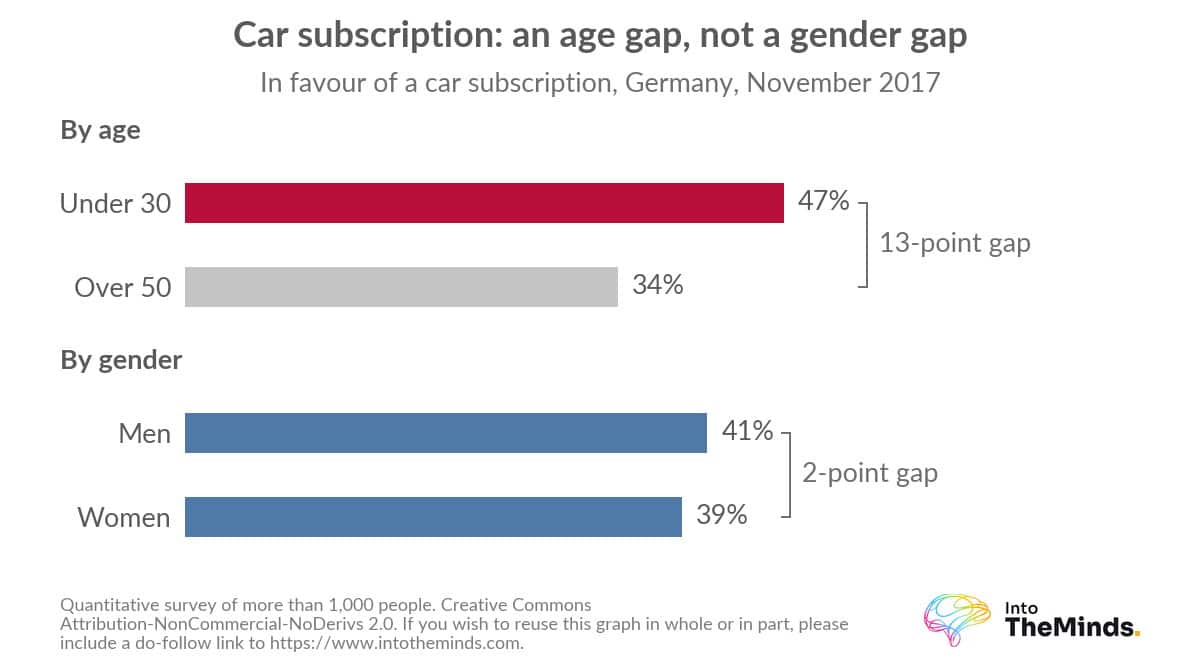
- 47% versus 34%: share of under-30s and over-50s in favor of a car subscription in Germany in November 2017.
- 3,000 owners: size of the class action against Tesla certified in California in September 2025, followed by a European campaign in April 2026.
What is a subscription-based option in the automotive industry?
The principle is simple to state. However, I would like to emphasize that the change in terms of the “business model”, as well as from an operational standpoint, is profound. Consider this. Rather than manufacturing each model to order according to the features selected by the buyer, brands are now installing all possible equipment on every vehicle they produce. The heated seat, autonomous-driving computer or restricted engine are physically present in the car as soon as it leaves the factory. What changes is access: a software key activates or deactivates the function depending on whether the buyer has subscribed to the corresponding package.
Rather than manufacturing each model to order, brands are now installing all possible equipment on every vehicle they produce.
This logic completely reverses the old model of paid features. Previously, a buyer who wanted a heated steering wheel had to order it before production. They paid for it once because it was included in the price of the new model. Today, the same function can be activated remotely, cancelled, and then reactivated years later, including by a second or third owner. For the manufacturer, the industrial benefit is immediate: producing a single version of the model reduces the complexity of assembly lines, wiring harnesses and spare-parts inventory management.
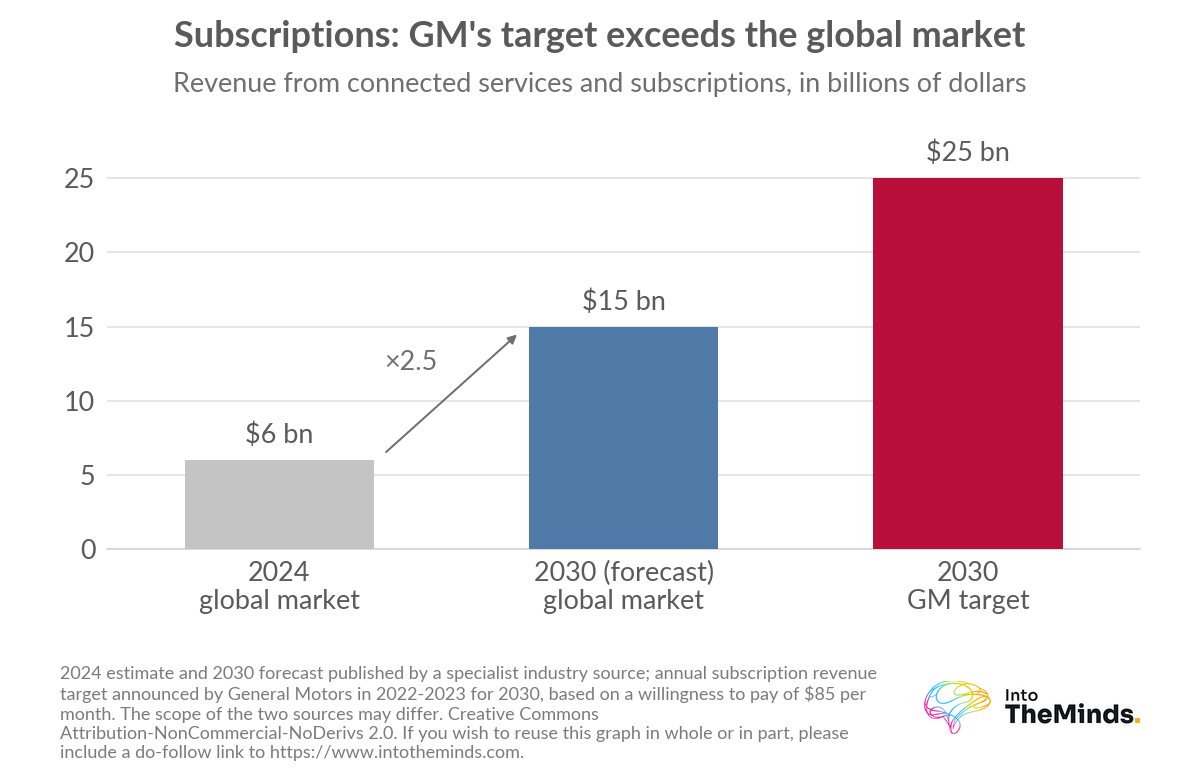
But the real source of value lies elsewhere. A single feature billed at $20 per month represents nearly $3,000 cumulatively over the average 12-year lifespan of a car in the United States. Multiplied across several tens of millions of vehicles in circulation, this mechanism explains why General Motors is targeting $25 billion in annual revenue from recurring paid subscriptions by 2030, based on an estimated willingness to pay of $85 per month according to its CEO Mary Barra.
A feature billed at $20 per month represents nearly $3,000 over the lifetime of a car.
A rapidly growing global market
Global figures confirm the scale of the movement. Global revenue from connected services and recurring paid subscriptions in the mobility sector was estimated at around $6 billion in 2024. Projected growth is substantial: $15 billion by 2030. This trend extends well beyond premium brands alone. All manufacturers now see it as a source of revenue.
The potential identified by brands does not stop with the new-car market. A survey conducted in 2021 among more than 2,000 U.S. owners estimated that 83% of owners of connected used cars had not yet generated any service revenue for the manufacturer. Logically, the opposite should be true since their vehicles contain exactly the same activatable hardware as a new model. The reason is remarkably simple (but counterintuitive in the age of Big Data). With each resale, the brand most often loses track of the vehicle and no longer knows who is driving it. Companies have stepped into the breach and cross-reference databases to automatically detect a change of ownership. In 2023, manufacturers representing around 65% of the global automotive market were testing or negotiating this type of service. Each resale thus becomes a new opportunity to sell the activation of a feature that is already installed.
The price of subscription-based options
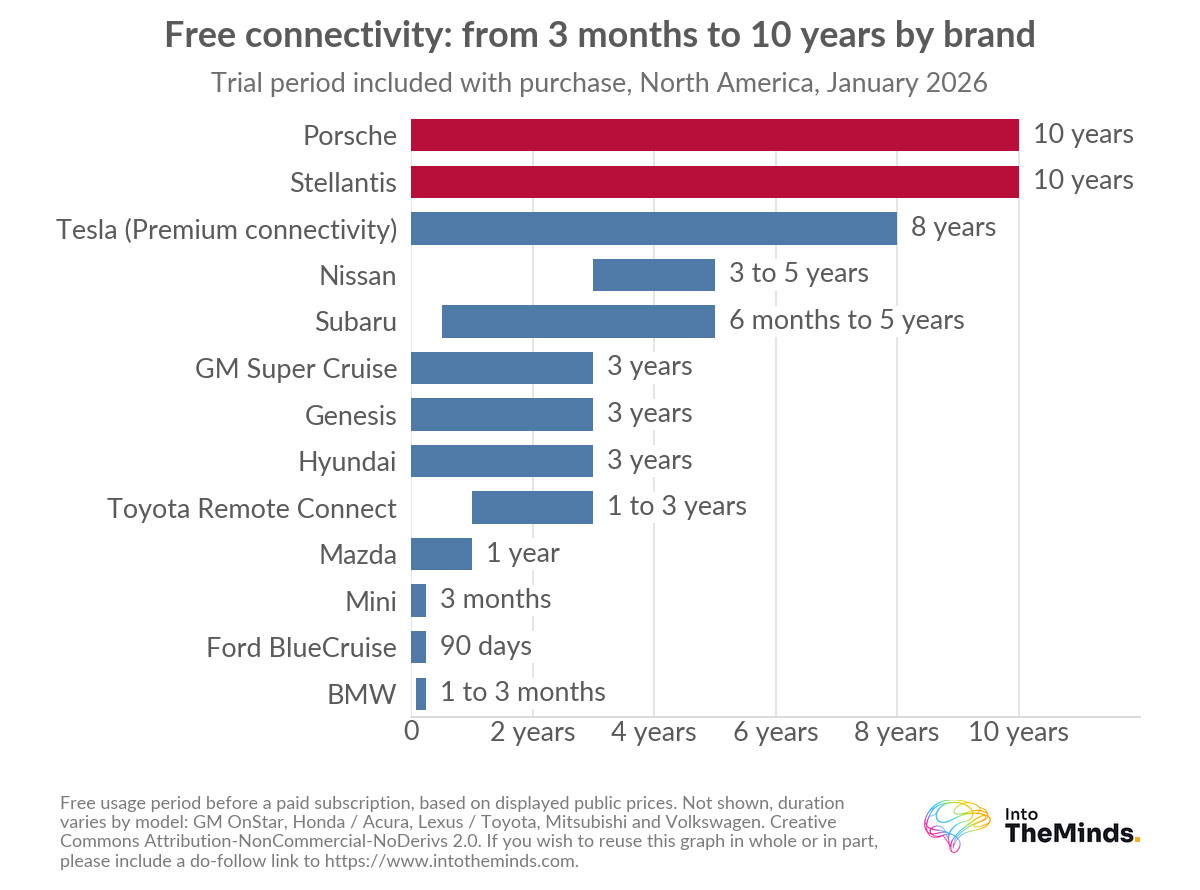
Amounts vary significantly depending on the brand, country and function involved. The table below brings together the prices of paid connected-service packages recorded in January 2026 on the North American market, where most major brands have already published a complete pricing schedule.
| Manufacturer | Application | Monthly price (USD) | Annual price (USD) | Trial period |
|---|---|---|---|---|
| BMW | My BMW / ConnectedDrive | 5 to 20 | 25 to 150 | 1 to 3 months |
| Ford (BlueCruise) | Ford app | 50 | 495 | 90 days |
| Genesis | Genesis Connected Services | 9.99 | 99 | 3 years |
| GM OnStar | myChevrolet, myGMC | 9.99 to 39.99 | by quotation | variable |
| Hyundai | Bluelink+ | 9.90 | 99 | 3 years |
| Nissan | Nissan Connect | 16.99 to 26.99 | by quotation | 3 to 5 years |
| Porsche | Porsche Connect | by quotation | 319 | 10 years |
| Volkswagen | myVW App | 9.99 | 110 | variable |
| Tesla | Premium Connectivity | 9.99 | 99 | 8 years |
The declining pricing logic is clear in this table: the longer the commitment, the lower the unit cost. BMW thus offers the same function for between $5 and $20 per month, but also as a lifetime package for between $149 and $650, an amount that becomes more attractive than monthly billing from the third or fourth year of use. This mechanism rewards long-term commitment, exactly as a video or music streaming subscription would.
Categories of subscription-based options
The functions offered through recurring subscriptions cover a broad spectrum. They all share one common feature: the hardware is already installed in the car before the buyer has paid anything. Three categories stand out in terms of perceived legitimacy and the underlying business model.
Driver assistance
Advanced driver-assistance systems are the category considered most justified by industry observers, as they require regular map and software updates:
- In the United States, GM Super Cruise is priced at $25 per month or $250 per year after three years included.
- Ford BlueCruise offers three different packages: $50 per month, $495 per year, or $2,495 as a one-off purchase. In Europe, the same function costs €24.99 per month or €280 per year.
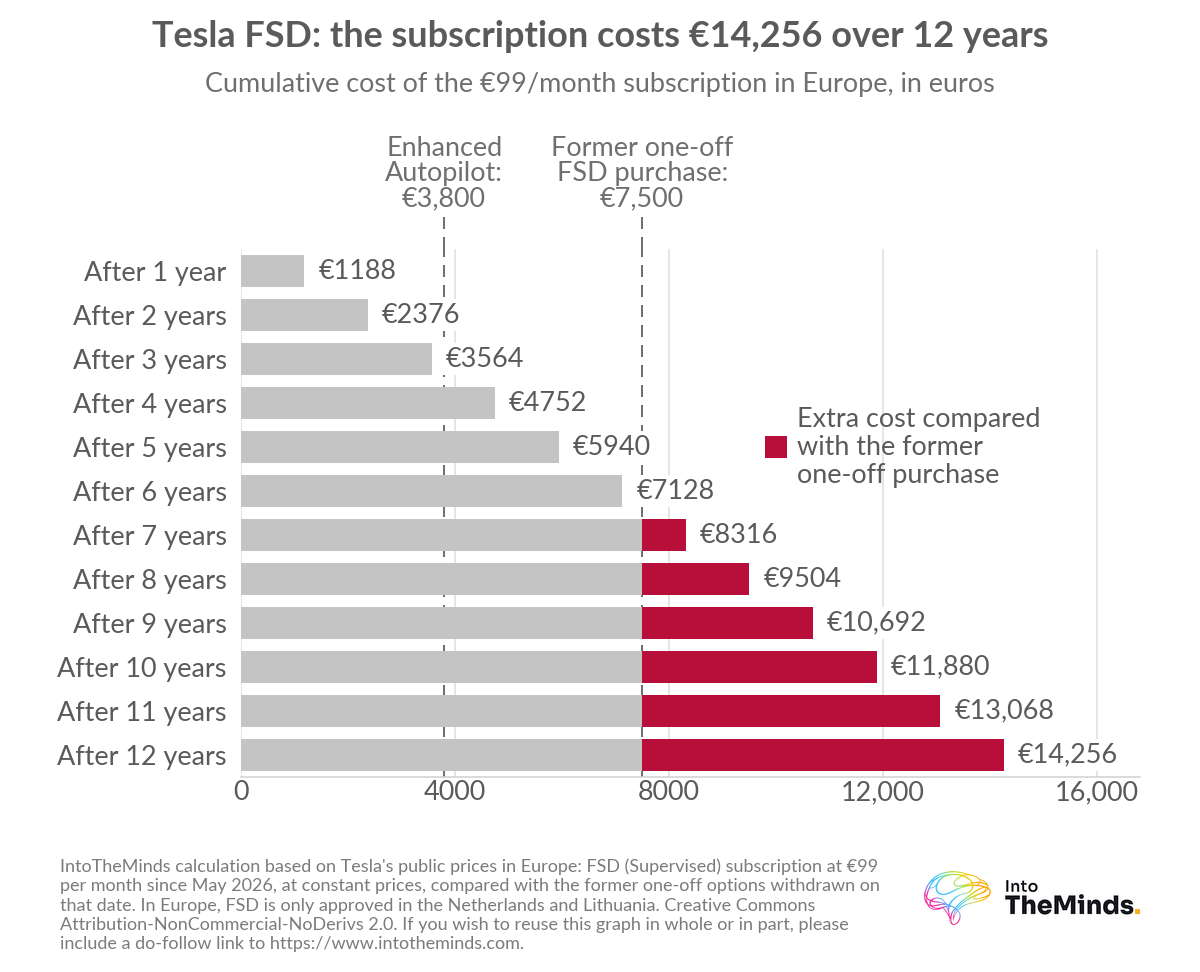
The Tesla case best illustrates this shift. The Full Self-Driving feature, known as Supervised, is offered by Tesla as a monthly subscription in certain markets. This package replaces options previously offered as a one-off payment:
- Enhanced Autopilot: €3,800
- Full FSD: €7,500.
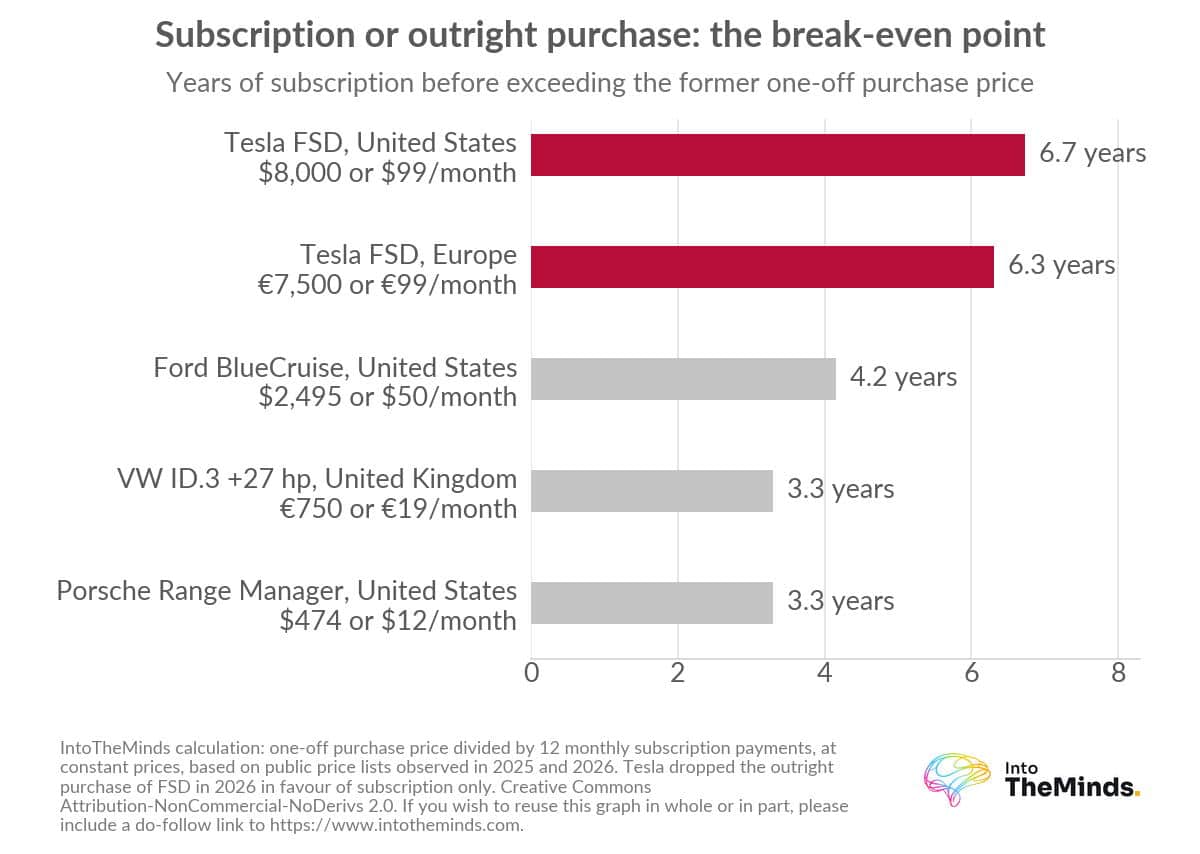
Thus, more than 6 years of continuous payments are required to reach the former one-off purchase price. In the United States, the $8,000 one-off purchase was due to disappear as of February 14, 2026, in favor of monthly billing only.
Performance
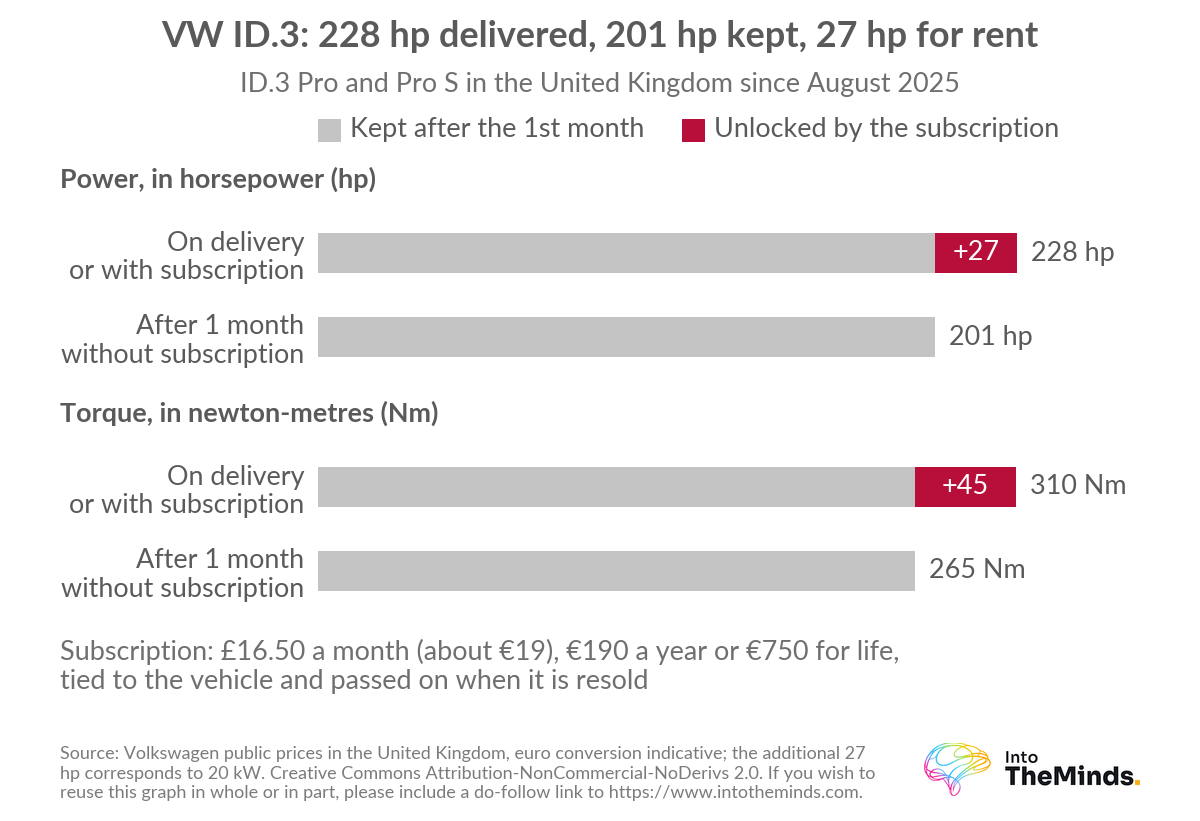
Unlocking an already-installed engine in exchange for a monthly payment is more divisive among motorists. Some manufacturers such as Volkswagen are testing, in certain markets, packages that allow additional engine power to be unlocked through a paid software update. These cars are delivered as standard with 228 horsepower, then limited to 201 horsepower after the first month of use. The additional 20 kW of power and 45 Newton-metres of torque costs
- £16.50 per month, or around €19
- €190 per year
- or €750 as a permanent package.
This service has a feature that few buyers anticipate: it is attached to the model itself, not to its owner. In the event of resale, the used-car buyer therefore inherits the feature if it has already been activated, or the restriction if the subscription has not been renewed. Polestar offers a comparable package on its Polestar 2. This model fundamentally changes the way a used car can be valued on the secondary market.
Comfort and connectivity
The third category encompasses comfort and connectivity features, often perceived by customers as the least acceptable. For remote start or the driving recorder, BMW charges, depending on the model:
- between $5 and $20 per month
- $25 to $150 per year
- $99 to $400 over three years
- or $149 to $650 as a lifetime package
The Bavarian manufacturer had already tried this approach and backed down. An Apple CarPlay subscription at $80 per year, launched in 2019, was discontinued as early as December of the same year. A heated-seat package costing €18 per month, tested in 2022 in the United Kingdom, Germany and South Korea, was also abandoned in September 2023.
Mercedes takes a similar approach with the Mercedes me app, which charges between €9 and €30 per month for vehicle geolocation depending on the level of service subscribed to. These amounts may seem modest individually, but they add up quickly when the same owner combines several paid packages on the same car.
Audi’s pricing model enabled it to convert 2 out of 3 buyers to a longer subscription after an initial trial.
Subscription or one-off purchase?
The profitability calculation almost always depends on the expected duration of use. Take Tesla’s Full Self-Driving in Europe as an example: at €99 per month, more than 6 years of continuous payments are required to reach the former one-off purchase price of €7,500. An owner who keeps the car for 3 or 4 years therefore benefits from the monthly package. A motorist planning to keep the same model for 8 or 10 years would, under the former system, have paid less overall.
Audi has in fact built part of its commercial strategy around this hesitation. The manufacturer offers a €2 trial period for 1 month before committing to a feature, a practice that enabled it to convert around 2 out of 3 buyers to a longer subscription after an initial trial. This data illustrates a point often overlooked by motorists: the low-cost trial is primarily used to demonstrate the actual usefulness of the service before offering a more advantageous annual or multi-year price.
Three criteria make it possible to assess whether a paid subscription for a feature is genuinely cost-effective for a given use:
- The expected ownership period of the model, compared with the break-even point between a recurring subscription and a one-off purchase
- The actual frequency of use of the function, for example a heated steering wheel used only 3 months a year
- The likelihood of resale: a subscription tied to the model, such as Volkswagen’s 27-horsepower upgrade, can be passed on to the next buyer
Consumer rejection
The reception of the subscription model remains mixed.
- BMW has backed down twice, first on CarPlay in 2019 and then on heated seats in 2023
- Ford tested another limit in 2026 by turning the front trunk, or “frunk”, of the Mustang Mach-E into a $495 paid feature on the U.S. model year, even though this equipment had previously been supplied as standard (I invite you to watch the video below).
On the Tesla market, the dispute is now taking a legal form:
- In the United States, a class action brought by a California owner who purchased his Model S for more than $100,000, including $8,000 for FSD, was granted class-action status in September 2025.
- In Europe, a Dutch motorist launched a campaign in April 2026 to organize an equivalent European legal action
Against this backdrop, regulatory pressure is mounting. A bill in the State of New York, passed by both chambers and awaiting the governor’s signature, would make it illegal to charge recurring subscription fees for functions relying solely on hardware already installed in the car. Similar bills have been introduced in New Jersey and Massachusetts. An exception is nevertheless provided for services requiring data or continuous connectivity, which would preserve systems such as Super Cruise or BlueCruise.
In the United States, a class action representing approximately 3,000 people is already challenging Tesla’s subscription model.
France, an already saturated market
France provides a particular context for assessing the future of these offers. At the beginning of 2026, 68% of French consumers have at least one recurring paid subscription, and the typical consumer has between 15 and 25, including microservices such as online storage subscriptions. These commitments account for between 2.5% and 8% of a household’s monthly budget. The psychological acceptance threshold is around €10 per month, which creates an optical illusion: a €9.99 package seems insignificant, but actually represents €120 per year.
The global recurring paid-subscription market, across all sectors, has multiplied by 7.5 over 10 years. Options in the entertainment and media sectors alone account for 55% of global volume. This model now extends well beyond video streaming: healthcare, education, accounting firms, and therefore mobility. Against this backdrop of saturation, a clear generational divide is emerging. Millennials and younger generations naturally embrace these recurring paid subscriptions, while baby boomers and Generation X more quickly experience a sense of being locked in and favor traditional ownership of their cars.
This generational reluctance is not unique to France: a study conducted in Germany as early as November 2017 among more than 1,000 people had already confirmed this divide
- 47% of under-30s were in favor of a recurring subscription for their mobility needs
- only 34% of over-50s approved of this option.
The growth of paid subscriptions is not limited to the vehicle itself: it is also reshaping the insurance landscape. In Germany, the insurance market generated €70.7 billion in premiums in 2022, with parts and labor costs rising by 7.6% that year. Volkswagen has set itself the objective of attaching 50% of the group’s internal-combustion vehicle buyers and 80% of its electric vehicle buyers to its insurance subsidiary, as part of a single package combining the vehicle, feature subscriptions and insurance.

FAQ: Your questions answered
How much does a subscription to car options cost?
Amounts vary significantly depending on the function and brand, generally between $5 and $50 per month. Heated steering wheels or seats tend to cost between €15 and €20 per month, while an advanced autonomous-driving system such as Tesla’s FSD reaches €99 per month in Europe.
Can a paid subscription option be deactivated?
Yes, most brands notify the user before the end of the subscription period, with no automatic renewal by default in most cases. The function is then simply deactivated remotely, without any need for a workshop visit.
Are subscriptions for automotive options legal?
They are currently legal in most countries, but the situation is evolving rapidly in the United States. A bill in New York State seeks to prohibit charges for services relying solely on hardware already installed, with similar legislation being prepared in other U.S. states.
Does the subscription follow the car or the owner when the vehicle is resold?
It depends on the brand. With Volkswagen, the package for unlocking 27 additional horsepower on the ID.3 is attached to the model and is therefore transferred to the used-car buyer. Other offers, particularly certain connectivity services, remain linked to the first owner’s account.
Is it better to buy an option outright or subscribe?
It all depends on how long you plan to keep the car. For Tesla’s FSD in Europe, more than 6 years of payments at €99 per month are required to exceed the former one-off purchase price of €7,500: the recurring subscription is therefore better suited to short-term use, while the one-off purchase is more suitable for long-term ownership.