BMW’s sales are being disrupted by a multitude of factors, notably Chinese competition and tariffs. Faced with these market shifts, the Bavarian brand is faring slightly better than its peers but must nonetheless adjust its strategy.
BMW’s strategy is going through an unprecedented period of tension since the Covid downturn. Its situation echoes the difficulties faced by other German carmakers such as Porsche or Volkswagen, which we have already covered. In the first quarter of 2026, BMW delivered approximately 566,000 vehicles (-3.5%), a decline that was nevertheless less pronounced than that of VW (-4%) and Mercedes (-6%). The group’s revenue reached record levels in recent years, driven by a strong premium strategy. However, margins have never been under such pressure, given how challenging the market has become. Analysts are closely monitoring the evolution of profitability, as the group has to navigate between massive investments and global economic volatility. What are the deeper drivers behind this reversal, and what prospects does BMW’s strategy offer for the years ahead? Our market research firm drew on its expertise in the automotive sector to provide an analysis based on the latest available figures.
Contact the IntoTheMinds market research agency
Key takeaways
- BMW Group remains the world’s leading premium carmaker by volume, with 2.20 million BMW-brand deliveries in 2024, ahead of Mercedes and Audi.
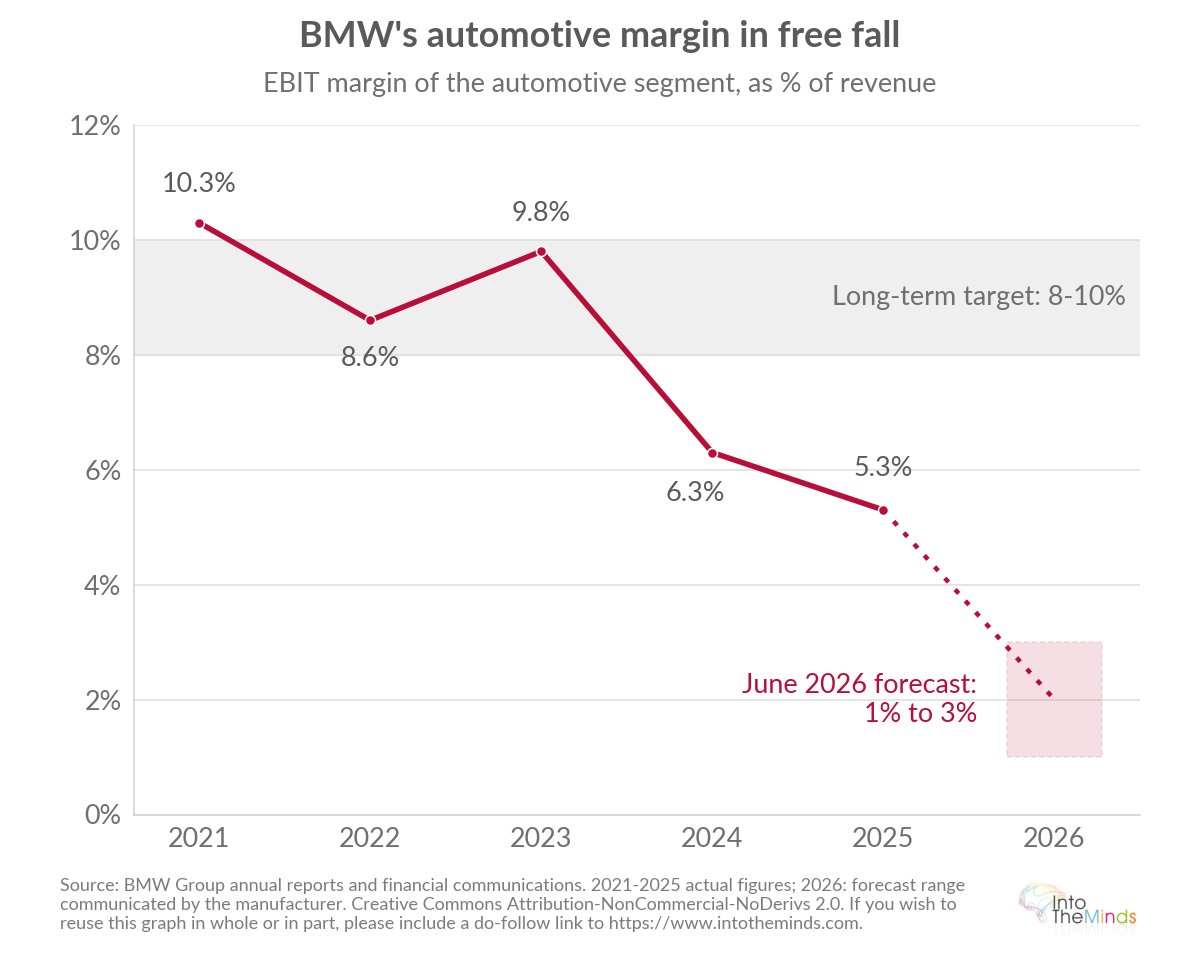
- Profitability has contracted sharply: automotive EBIT margin fell from 9.8% in 2023 to 5.3% in 2025, and a June 2026 profit warning announces a range of 1% to 3%.
- China represents a major strategic challenge: deliveries there are under significant pressure as local manufacturers gain ground. BMW is seeing its market share in the new-energy vehicle segment evolve in an ultra-competitive environment where domestic players are gaining traction.
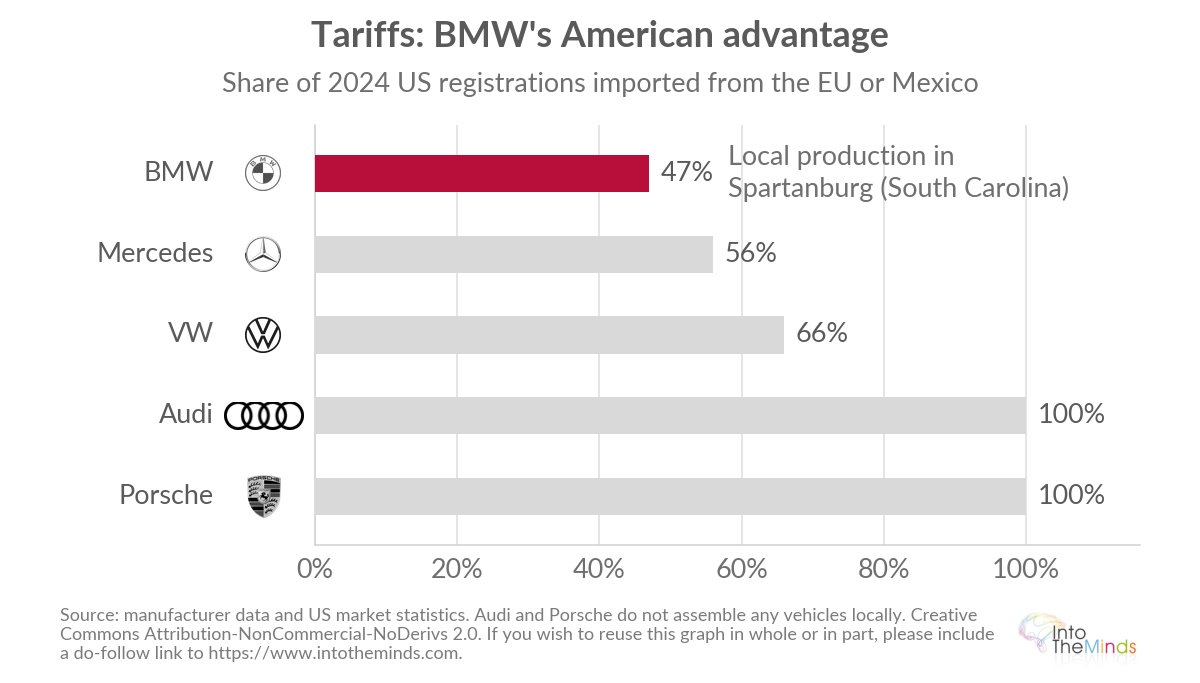
- The United States provides a strategic counterweight: BMW recorded a third consecutive record year there in 2025 with 388,897 sales (+4.7%), supported by the Spartanburg plant, the group’s largest production site: only 47% of BMWs registered in the United States in 2024 were imported from the EU or Mexico, the lowest tariff exposure among German carmakers.
- The Neue Klasse platform (iX3, i3) is the pivot of the recovery, with a strong order book for the iX3 in Europe and significant range gains for the new generation of electric vehicles compared with previous models.
- Europe is holding up and accelerating on electric vehicles: BMW’s electric sales there increased by +57% between January-August 2023 and January-August 2025, compared with a market increase of +20%.
The pillars of BMW’s strategy
BMW’s strategy is based on a value architecture that distinguishes the group from its direct competitors. Family ownership enables a long-term vision that other carmakers cannot always afford (one only has to observe the pressure on the management of Volkswagen and Porsche to see why). BMW’s strategy is also based on a doctrine of technological openness to different types of powertrains and on innovation.
Here are some figures that reflect these choices:
- R&D expenditure: €6.62 billion in 2022, €7.54 billion in 2023 (€7.76 billion according to the scope of the 2024 report), €9.05 billion in 2024
- Investments: €7.56 billion in 2023, €8.14 billion in 2024 (+7.7%)
- Long-term automotive EBIT margin target: 8-10%
- Automotive net cash at the end of 2025: €44.4 billion
- Electric share target by the end of the decade: at least 50% of sales
Electrification strategy
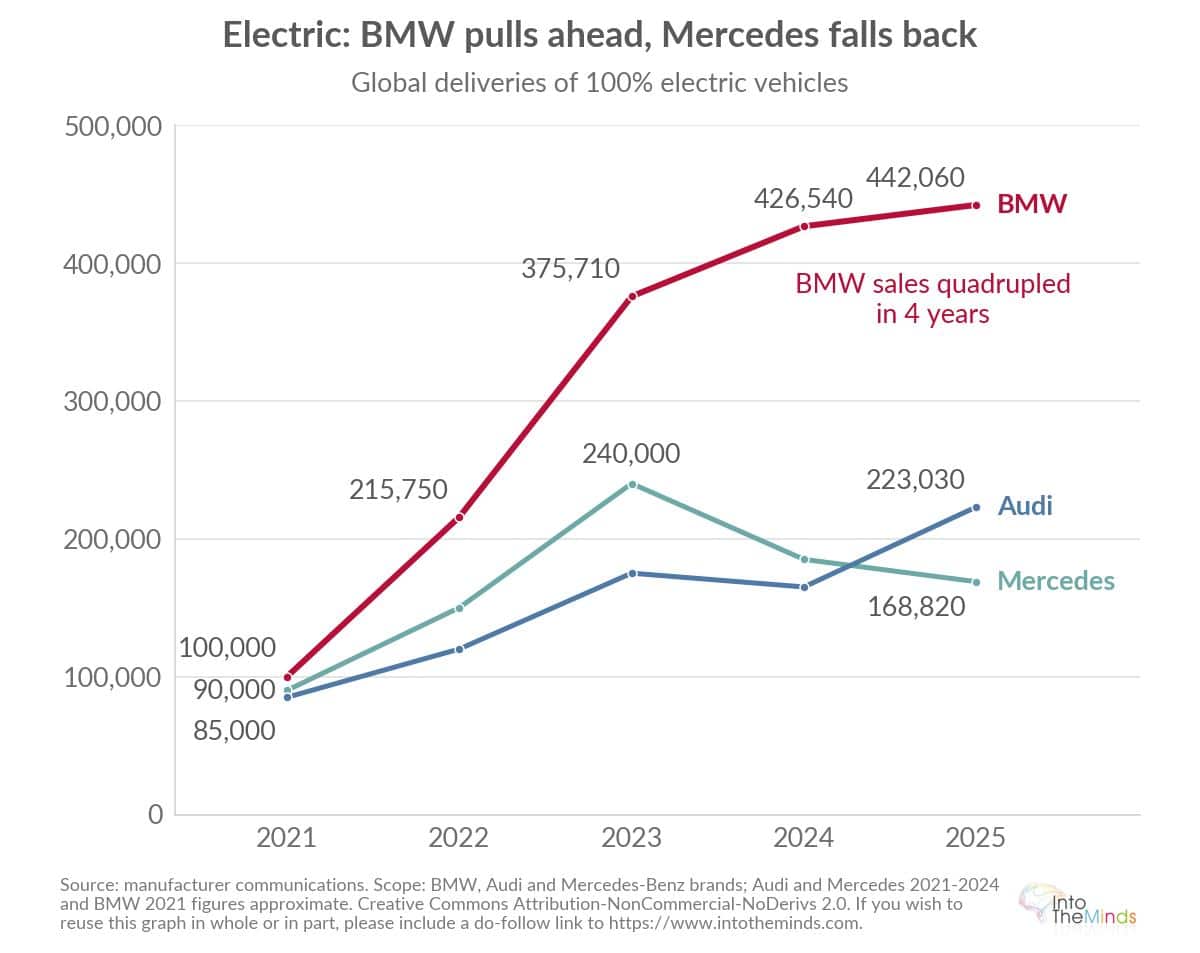
Electrification has been the guiding principle of BMW Group’s product strategy since 2021. This is of course quite logical given the expansion of the global electric vehicle market. Global all-electric sales increased from around 100,000 units in 2021 to 215,750 in 2022, then 375,710 in 2023 (+74%), 426,540 in 2024 (+13.5%) and 442,060 in 2025.
BMW therefore delivers roughly twice as many electric vehicles as Audi (223,030 in 2025) and more than 2.5 times as many as Mercedes (168,820 in 2025, down continuously from its peak of approximately 240,000 in 2023).
Neue Klasse: the pivot of the recovery
The Neue Klasse platform is BMW’s structural response to competitive pressure. The iX3 SUV, produced at the Hungarian plant in Debrecen (planned annual capacity of 150,000 vehicles), exceeded 50,000 orders in Europe as early as April 2026, above the group’s expectations. The CFO indicates that this model achieves margin parity with combustion-engine vehicles in certain European markets, which is a positive signal for future profitability.
The i3 sedan, unveiled in March 2026, pushes the technology even further:
- up to 900 km of range
- 400 kW charging power, allowing up to 400 km of range to be recovered in 10 minutes
- 30% gains in range and charging speed compared with the previous generation.
Its electronic architecture will equip all future models in the group. Production will begin in Munich in August 2026, and the European launch is scheduled for the second half of 2026.
The market signal is nevertheless ambiguous: in the first quarter of 2026, the group’s electric vehicle deliveries fell by 20% (87,500 units), while electric orders increased by 40%. Customers appear to be waiting for the new generation, a phenomenon already perceptible in the third quarter of 2025 (102,900 electric vehicle deliveries, -0.6%).
Emissions reduction and technological flexibility
The group maintains a multi-energy approach that enables it to adapt to regional regulations. While electric vehicles dominate in Europe, combustion engines and plug-in hybrids remain predominant in the United States following the expiration of federal incentives in autumn 2025. Hydrogen is the next horizon: BMW plans to commercialize a first fuel-cell vehicle in 2028, as part of a diversified energy mix strategy. By 2027, at least 40 models will be launched or renewed, across all powertrains. The table below shows deliveries of 100% electric vehicles from the three German premium manufacturers.
| Year | BMW (worldwide) | Audi | Mercedes | BMW electrified share |
|---|---|---|---|---|
| 2021 | ≈100,000 | ≈85,000 | ≈90,000 | n.a. |
| 2022 | 215,750 | ≈120,000 | ≈150,000 | n.a. |
| 2023 | 375,710 | ≈175,000 | ≈240,000 | 22.2% |
| 2024 | 426,540 | ≈165,000 | ≈185,000 | 24.2% |
| 2025 | 442,060 | 223,030 | 168,820 | 15.5% |
Evolution of 100% electric vehicle deliveries (BEV, Battery Electric Vehicle) at BMW, Audi and Mercedes. Note: last column: electrified shares (100% electric + hybrids) for 2023 and 2024; 100% electric share alone for 2025.
Between 2021 and 2022, BMW sacrificed volume in exchange for a jump in revenue per car. Since then, the price has been eroding at the same time as the margin.
Financial performance and results of BMW’s strategy
Between 2018 and 2023, BMW achieved one financial record after another. Revenue increased from €96.9 billion in 2018 to €155.5 billion in 2023 (+60% in 5 years), and net profitability peaked at 13.0% in 2022. The reversal began as early as 2023 in terms of profits, before affecting revenue. Profit before tax plunged from €23.5 billion (2022) to €17.1 billion (2023, -27%) and then €11.0 billion (2024, -36%).
A first warning, on September 10, 2024, had already lowered the 2024 automotive margin target from 8-10% to 6-7%; the June 2026 warning marks a significantly more severe step.
The mechanics of the reversal
The intersection of volumes, unit revenue and margin reveals the mechanics of the reversal. Between 2021 and 2022, BMW sacrificed volume in exchange for a jump in revenue per car, from €37,865 to €51,510. Since then, the price has eroded: €47,715 in 2025, at the same time as the margin, indicating that competitive pressure, particularly from China, is now affecting the product mix and prices.
The response involves cost discipline. Cost of sales declined from €125.8 billion in 2023 to €112.9 billion in 2025, driven by
- manufacturing (-9.4% between 2024 and 2025, from €75.7 billion to €68.6 billion)
- R&D charged to expenses (-10.4%, from €7.6 billion to €6.8 billion).
Two structural buffers remain: the anchor shareholding of the Klatten and Quandt families, and automotive net financial cash of €44.4 billion at the end of 2025.
Markets have penalized this trajectory: BMW shares lost 22% in 2024 while the DAX gained 19%, and then recovered only 7.7% between January 2025 and May 2026 compared with +20.1% for the index. The crisis extends beyond BMW alone: in 2025, BMW, Mercedes and the VW Group together generated only €24.9 billion in EBIT on €587.6 billion in revenue, corresponding to a weighted margin of 4.2%.
| Year | Group revenue (bn €) | Net income (bn €) | Automotive EBIT margin | Revenue/car (€) |
|---|---|---|---|---|
| 2021 | 111.2 | n.a. | 10.3% | 37,865 |
| 2022 | 142.6 | 18.6 | 8.6% | 51,510 |
| 2023 | 155.5 | 12.2 | 9.8% | ≈51,800 |
| 2024 | 142.4 | 7.29 | 6.3% | ≈51,000 |
| 2025 | 133.5 | 7.29 | 5.3% | 47,715 |
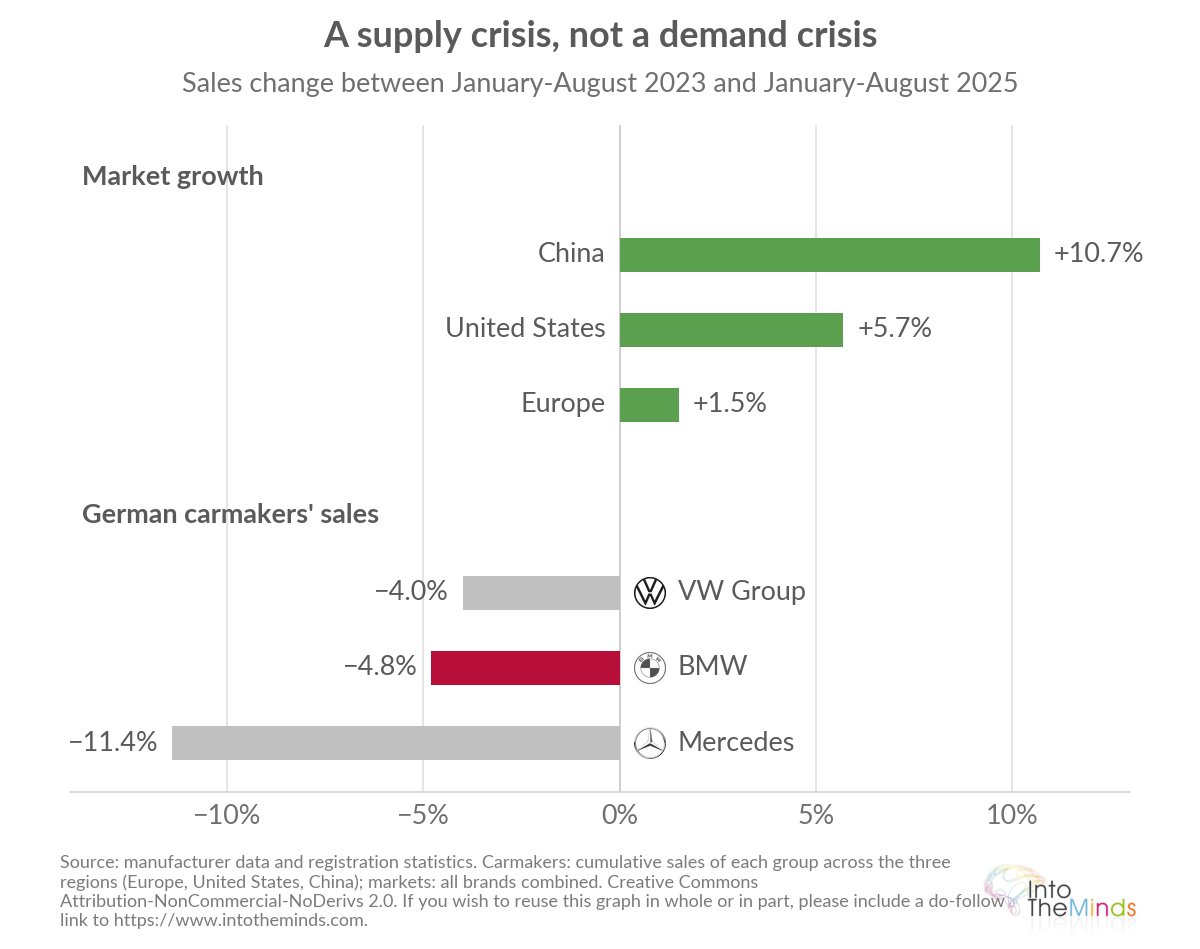
The crisis in BMW’s strategy is not a crisis of global demand: it is a geographically localized competitiveness crisis.
China and the United States: two opposing dynamics
The crisis in BMW’s strategy is not a crisis of global demand: it is a geographically localized competitiveness crisis. China and the United States illustrate two radically different trajectories, and reading them together is essential to understanding the group’s prospects.
China: from growth engine to epicenter of the crisis
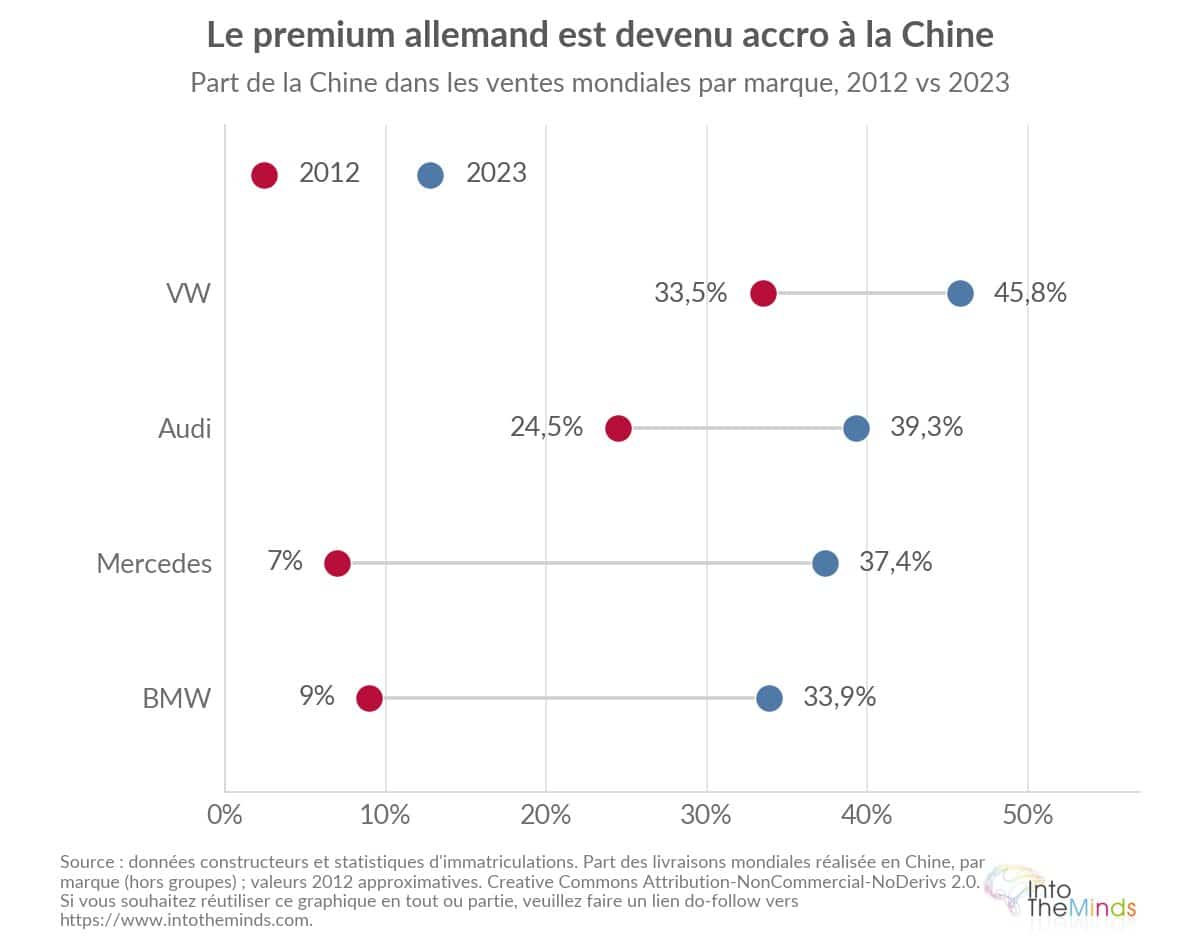
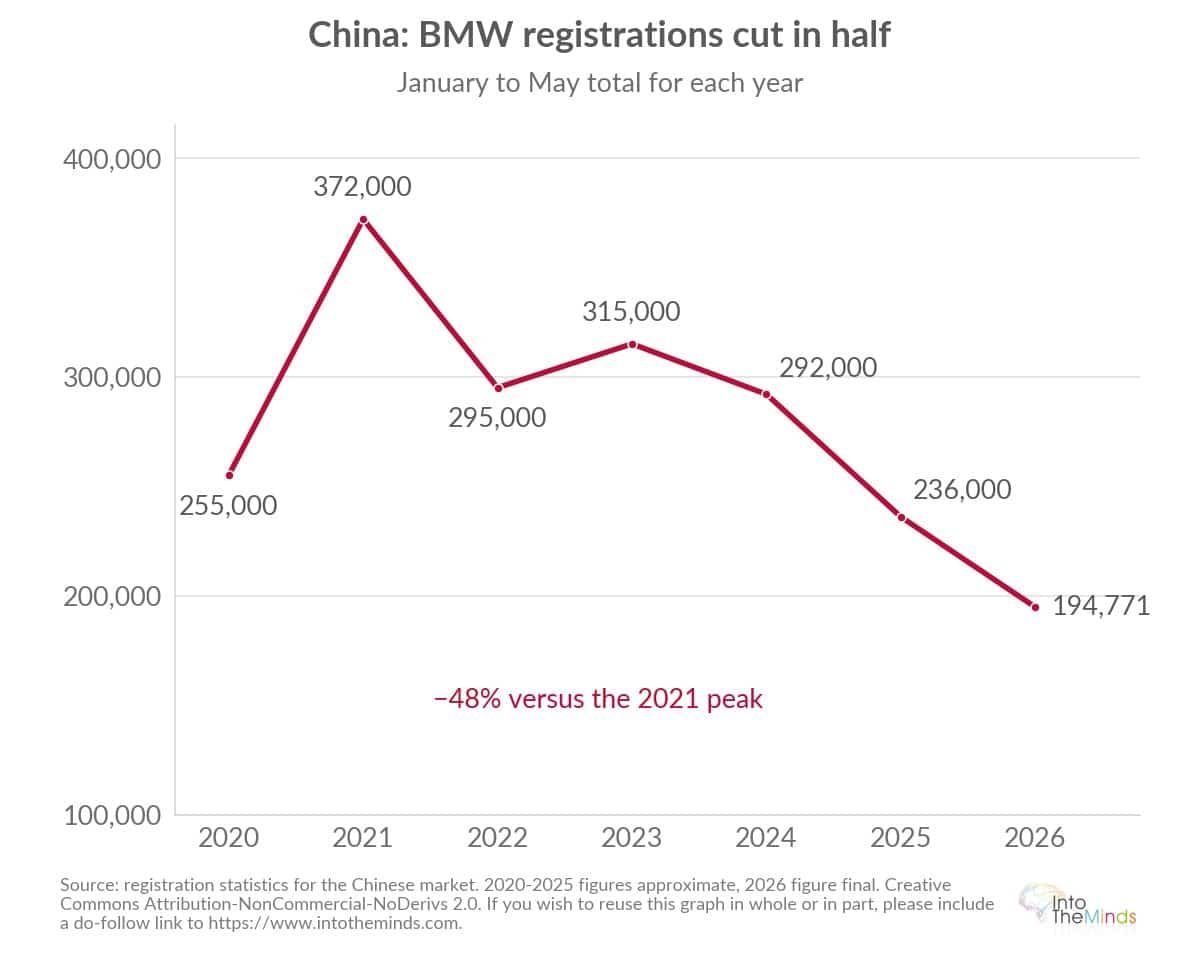
China’s share of global BMW brand sales increased from around 9% in 2012 to 33.9% in 2023. I discussed the Chinese nightmare for German carmakers in another article, and the term was justified. BMW sales in China have collapsed over four years: from approximately 846,000 deliveries (all powertrains) in 2021 to 626,000 in 2025, a decline of 26%. The BMW Brilliance joint venture illustrates the destruction of value: its profit after tax collapsed from approximately €3.0 billion in 2023 to just €0.27 billion in 2025.
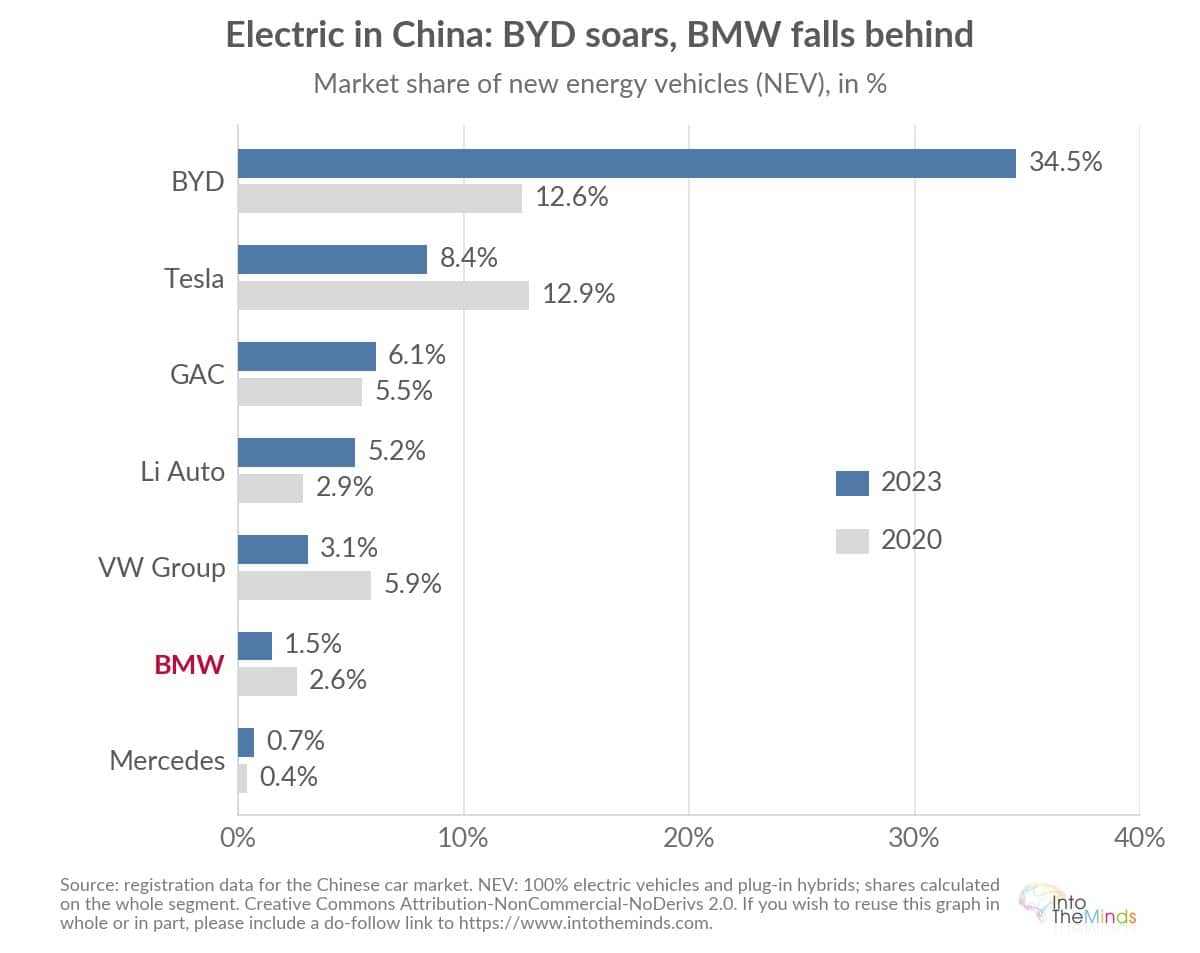
The root cause is the technological shift in the market. Between 2020 and 2023, combustion-engine vehicle registrations in China fell by 23% while electric vehicles surged by 440% and plug-in hybrids by 970%. In the new-energy vehicle segment, BMW’s share declined from 2.6% in 2020 to 1.5% in 2023, in contrast with BYD, which jumped from 12.6% to 34.5%. In the first half of 2023, the BMW iX recorded only 1,747 registrations in China’s premium segment, compared with 45,312 for the Li Auto L8.
Luxury is the segment hardest hit. Combined Chinese registrations of the S-Class, 7 Series and Cayenne fell to approximately 38,000 units in 2025, half the 2022 level. All of this is taking place amid an approximately 80% collapse in the premium and luxury market, aggravated by the 10% luxury tax introduced in 2025 for cars costing more than €108,000. The Maextro S800 sedan (a JAC-Huawei collaboration), launched in May 2025 at just over €88,000, has accumulated approximately 16,300 registrations, almost as many as the S-Class and 7 Series combined.
The United States: the pillar of resilience
The US market has become China’s strategic counterweight. BMW recorded a third consecutive record year there in 2025 with 388,897 sales (+4.7%), while Audi collapsed by 16% (164,942 units). The key is industrial: the Spartanburg plant (South Carolina), the largest site in the global network with 396,117 vehicles produced in 2024, means that only 47% of BMWs registered in the United States were imported from the EU or Mexico in 2024. This is the lowest tariff exposure among German carmakers. Audi, by contrast, imports 100% of the vehicles it sells in the United States.
The weak point in the US is electric vehicles: after federal incentives expired in autumn 2025, BMW’s electric vehicle registrations in the United States fell from 10,710 in the first quarter of 2024 to 4,960 in the first quarter of 2026, a decline of 54%.
The industrial footprint: re-Europeanization and the shift toward Neue Klasse
The geography of production reflects BMW’s strategic pivot within global automotive production. In 2024, German plants took over from Chinese sites, which were in decline: Regensburg jumped 44% to 342,521 vehicles, Leipzig by 31% to 246,195, and Dingolfing increased by 2.0% to 297,761. The Munich plant, modernized over four years, will assemble the new i3 from August 2026 and will produce only 100% electric vehicles from 2027.
In Europe, the electrification of corporate fleets in Germany positions BMW favorably: in the first quarter of 2025, 54% of its fleet registrations were electric (5,651 units), the fourth-highest rate in the market behind Skoda (66%), VW (56%) and Polestar (55%). Three models feature in the top 10 electric company cars in Germany: the iX1 (1,688 units, starting at €49,000), the i4 (1,497, starting at €58,000) and the i5 (1,275, starting at €70,000). Structural trends in the German market favor BMW’s portfolio: the share of SUVs in registrations rose from 21.4% in 2016 to 43.1% between January and September 2022.

FAQ: Your questions answered
What is BMW’s marketing strategy?
BMW Group’s marketing strategy is based on clear brand segmentation: BMW targets the mainstream premium segment, Mini the urban premium segment and Rolls-Royce the ultra-luxury segment. Each brand has a distinct identity and a renewed product range, with at least 40 models to be launched or renewed by 2027. Communication revolves around technological innovation (electrification, Neue Klasse) and environmental commitments. To analyze a brand’s positioning in your market, a brand awareness survey can be used to measure consumers’ actual perceptions.
What are BMW’s core values?
According to the group’s official communications, BMW Group structures its corporate culture around five values: openness, transparency, responsibility, trust and recognition. Openness is directly reflected in the multi-energy technology strategy (combustion engine, hybrid, electric, hydrogen). Responsibility is embodied in public targets for reducing emissions across the entire vehicle life cycle.
What is BMW’s strategy in response to Chinese competition?
Faced with the growing strength of Chinese carmakers (BYD, Li Auto, Zeekr), BMW is focusing on “Wertewettbewerb” (competition through value) rather than a price war. BMW’s strategy in China rejects massive discounts and bets on the digital experience inherited from Neue Klasse and technological openness (combustion and electric simultaneously). BMW’s share of the new-energy vehicle segment in China fell from 2.6% in 2020 to 1.5% in 2023, illustrating the scale of the challenge. To understand market dynamics in a competitive sector, a B2C market study can identify consumer expectations and winning positioning.
Is BMW in financial difficulty?
BMW is not facing an existential crisis, but it is going through a marked contraction phase. Automotive EBIT margin fell to 5.3% in 2025, and a warning issued on June 16, 2026 lowered the forecast automotive segment margin for fiscal 2026 to a range of 1% to 3% (from 4 to 6% previously), while the first half of 2026 ended with a margin of 3.6%, well below the long-term target of 8-10%. Automotive net cash remains solid at €44.4 billion at the end of 2025, and net income stabilized at around €7.29 billion in both 2024 and 2025 (+0.1%). An enhanced cost-saving program is due to be presented in autumn 2026 by the new CEO Milan Nedeljkovic.
How does BMW’s strategy compare with that of Mercedes and Audi?
BMW retains its leadership in global premium volumes (2.20 million deliveries in 2024, compared with 1.98 million for Mercedes and 1.67 million for Audi) and in electric vehicles in the West (442,060 electric vehicles delivered in 2025, compared with 223,030 for Audi and 168,820 for Mercedes). Regarding electric vehicles in Europe, BMW sales increased by 57% between January-August 2023 and January-August 2025, compared with 54% for the VW Group and only 12% for Mercedes. To analyze a company’s strategic positioning in a competitive sector, IntoTheMinds teams offer B2B market studies and opinion surveys tailored to sector-specific positioning challenges.
![Illustration of our post "Porsche: Strategy and Scenarios for Overcoming the Crisis [Analysis]"](/blog/app/uploads/porsche-taycan-carrera-911-120x90.jpg)