Retailtainment is a strategy that attracts and retains customers in stores. The benefits are numerous, but this strategy is not inexpensive to implement.
Traditional retail is going through a complicated period, to the point where we often hear about ‘re-enchanting retail’. The competition from e-commerce is particularly deadly for businesses that don’t know how to adapt. Faced with this reality, physical stores must rethink their approach to win back their customers. It’s in this context that retailtainment emerges as an interesting marketing strategy. Retailtainment combines commerce and entertainment to create memorable shopping experiences. To make this article concrete and useful, I’ve included many examples and video/photo illustrations. As always, if you have any questions, don’t hesitate to contact me.
Contact IntoTheMinds research firm
Key Takeaways
- Retailtainment combines retail and entertainment to transform shopping into an immersive experience
- This approach allows physical stores to differentiate themselves from online commerce
- Brands use technology, animation and scenography to engage their customers
- The main goal remains commercial: increase time spent in store and boost sales
- Success depends on consistency between the experience offered and brand identity
What exactly is retailtainment?
The term “retailtainment” comes from combining the English words “retail” and “entertainment”. This strategic approach involves integrating entertainment elements into the commercial environment to transform the traditional shopping experience.
Conceptualized in the 1990s (the exact date would be 1999) by American sociologist George Ritzer, retailtainment has taken on new dimensions with the rise of e-commerce. In France, this trend has particularly developed since 2020, when health restrictions accelerated the digitalization of shopping.
The goal of retailtainment goes beyond simply selling products. It’s about creating an immersive universe where the customer becomes an actor in their shopping experience. This strategy aims to stimulate the senses, evoke positive emotions and establish a lasting connection between brand and consumer. Retailtainment is therefore closely linked to customer experience through the mobilization of senses and emotions. This trend of staging is particularly popular among premium brands. This is of course explained by the financial resources needed for such operations, but not only. I believe there’s a natural tendency for “show” in the DNA of these brands that might be traced back to fashion shows. When Karl Lagerfeld passed away, I wrote an article about it and I remember being struck by the staging of his fashion shows. It was no longer just about presenting clothes but about theatricalizing fashion.
From a scientific research perspective, the retailtainment concept hasn’t been very successful. Only a few dozen articles are devoted to it, with low citation numbers. This concept is probably too “marketing”, and its boundaries with customer experience aren’t clear enough. As you read this article, you’ll likely question what this term really means.
Retailtainment contributes to the overall customer experience and addresses 4 contemporary commercial challenges.
Why are brands betting on retailtainment?
First, it must be said that the “retailtainment” concept isn’t an end goal for most companies my marketing consulting firm works with. Brands primarily want to attract and retain customers. Retailtainment is a possible approach that contributes to the overall customer experience and addresses several contemporary commercial challenges.
- Differentiation from online commerce: according to a survey of 1200 French consumers in 2024, 73% believe the in-store experience must provide added value impossible to get online.
- Increasing visit duration: I can’t stress enough that the longer a customer stays in a store, the higher the probability of purchase (remember Ikea’s store paths). A 20% increase in time spent in store translates on average to a 15% increase in average basket size.
- Customer retention: with customer acquisition costs being five times higher than retention costs according to 2024 industry analyses, retailers invest in memorable experiences to encourage repeat visits and increase customer loyalty. The effect on profits is proven.
- Attracting new generations: Millennials and Gen Z will eventually become the dominant customer base. For example, in France, these generations will represent 75% of consumers by 2030 according to INSEE. As you probably know, these generations prioritize experiences over material possessions.
Different forms of retailtainment in practice
Retailtainment comes in various forms, adapted to specific business sectors and commercial objectives.
Immersive technologies and augmented reality
Technology integration is one of the most popular approaches. In France, Sephora has deployed connected mirrors in 85% of its stores since 2022, allowing customers to virtually test cosmetic products. This innovation generated a 23% increase in conversion rates according to the retailer’s internal data.
IKEA France also uses augmented reality through its “IKEA Place” app, allowing customers to visualize furniture in their home environment. This feature helped reduce returns of bulky products by 30% in 2024.
In-store animations and events
Live animations represent another facet of retailtainment. Monoprix regularly organizes culinary workshops in dedicated spaces, attracting an average of 150 participants per session. These events generate 40% additional revenue on products presented during demonstrations. This recipe (excuse the pun 😉) is also used in shopping malls to retain customers. In France, the Les Quatre Temps shopping center in Paris’s La Défense district organized culinary workshops with multi-starred chef Thierry Marx.
In the DIY sector, Leroy Merlin offers practical training sessions that attract over 500,000 annual participants in France. These sessions help position the retailer as an expert while stimulating sales of tools and materials.
I’m also an unconditional fan of Le Bon Marché in Paris because their innovation potential is infinite. What other department store would think to use its space to produce a show? Yet that’s exactly what Le Bon Marché did with Babel (see video below). And that’s when you realize Parisian department stores are showcases for shopper entertainment. To me, they’re retailtainment venues by definition.
Gamification and interactive loyalty programs
Gamification turns shopping into a game. Decathlon launched a gamified loyalty program in 2023 where customers earn points by completing sports challenges. This initiative increased engagement of loyalty program members by 35%.
| Sector | Type of animation | Impact on sales | Frequency |
|---|---|---|---|
| Cosmetics | Makeup workshops | +25% | Weekly |
| Food | Tastings | +18% | Daily |
| DIY | Practical training | +40% | Monthly |
| Sports | Product testing | +30% | Bi-weekly |
| Fashion | Private fashion shows | +50% | Seasonal |
Some establishments have made gamification their trademark. I’ve already told you about Boulebar in Copenhagen. It’s a restaurant and bar but the concept revolves around petanque. Customers come primarily to play and be entertained.
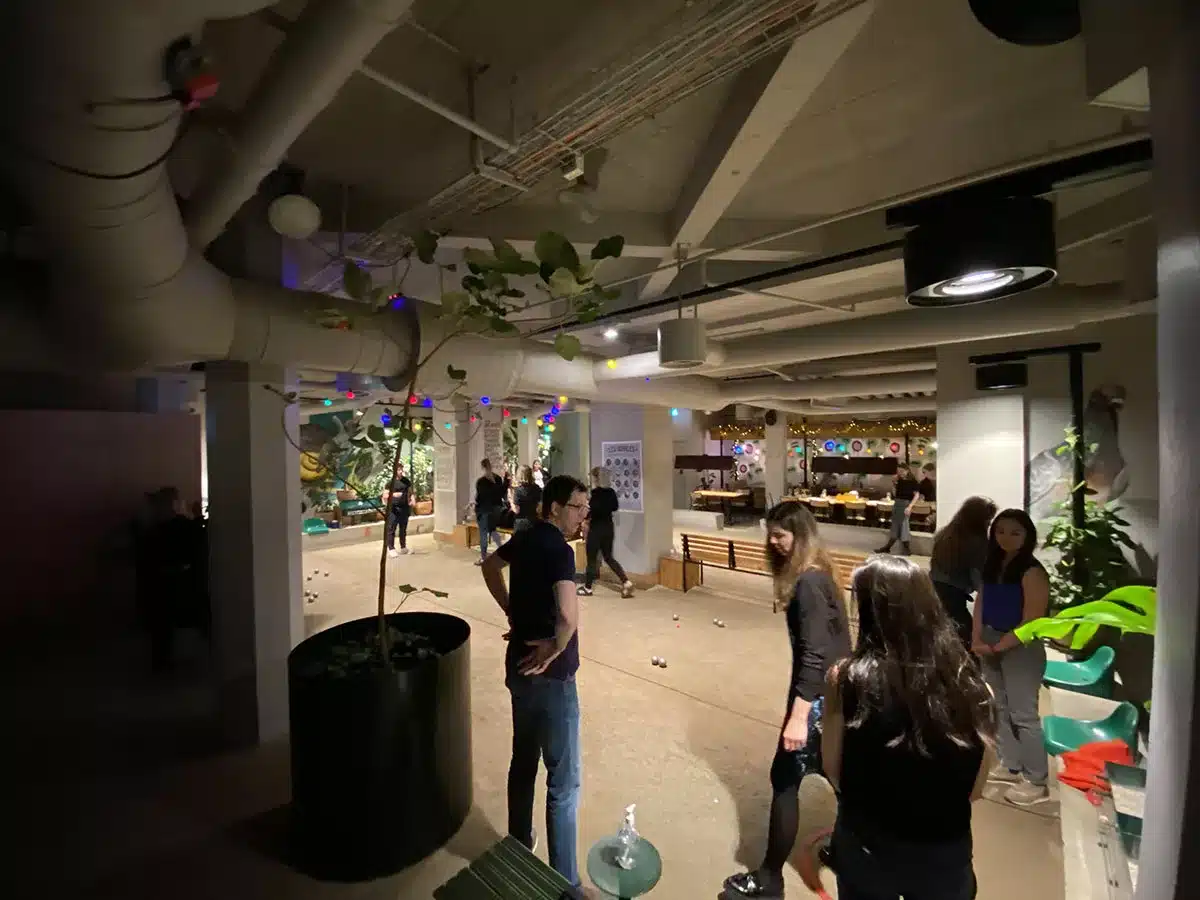
At Boulebar, customers entertain themselves by playing petanque. The main activity (dining) almost becomes secondary.
Examples of pioneering retailtainment brands
Several retailers stand out for their innovative approach to retailtainment. Nike has transformed its flagship stores into real experimentation grounds. The Champs-Élysées store, renovated in 2024, features a full-size basketball court where customers can test shoes. This initiative generated a 45% increase in average visit time. During my last visit in September 2025, an exhibition was visible that capitalized on Nike’s research and development.
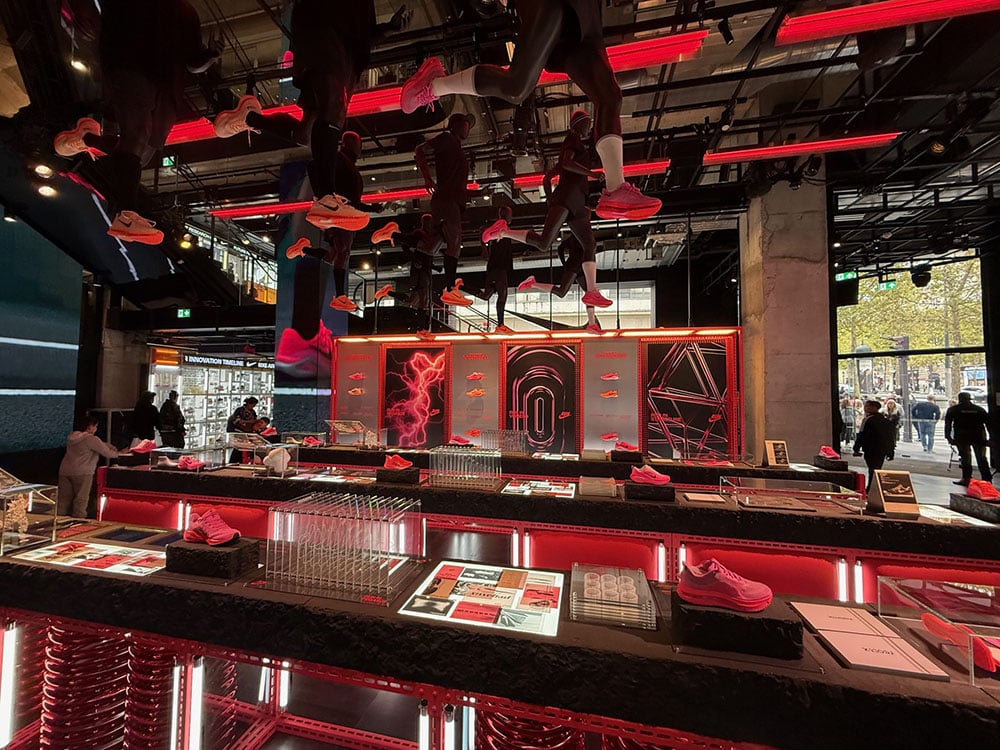
During my last visit to Nike’s Champs Elysées flagship store, an installation was visible celebrating R&D efforts for Nike’s latest model. I found its treatment particularly interesting because there was a museum-like dimension. Nike used graphic arts codes to enhance a product that is ultimately purely industrial. There were pencil sketches, figurines reminiscent of the Italian futurist movement.
Luxury brands are helped by their history and can mix education and entertainment in their flagship stores. Louis Vuitton is probably the brand that goes furthest in retailtainment. There are of course its windows, which are in themselves a source of wonder for shoppers. But recently Vuitton went even further by creating “Le Louis” in Shanghai. The 1600m² store is shaped like an ocean liner, and as you’ll see in the video below, this place is more a museum than a shop.
Apple maintains its position as a reference with Apple Stores designed as learning spaces. The “Today at Apple” sessions attract hundreds of daily participants in each French store. These free workshops strengthen brand attachment while demonstrating product capabilities.
In the toy sector, LEGO has created free building spaces in its stores. These play areas increase average visit time by 60% and stimulate impulse purchases. The retailer also organizes themed events that bring fan communities together, particularly kidults.
Starbucks Reserve Roastery perfectly illustrates the evolution of the retail concept. These premium spaces offer a complete sensory experience with visible roasting, guided tastings and coffee cocktails. The average spend per customer is 40% higher than in traditional stores. Still in the coffee domain, I analyzed in this article Nespresso’s strategy which relies notably on the “Nespresso House” to entertain customers and make them stay in this new type of store.
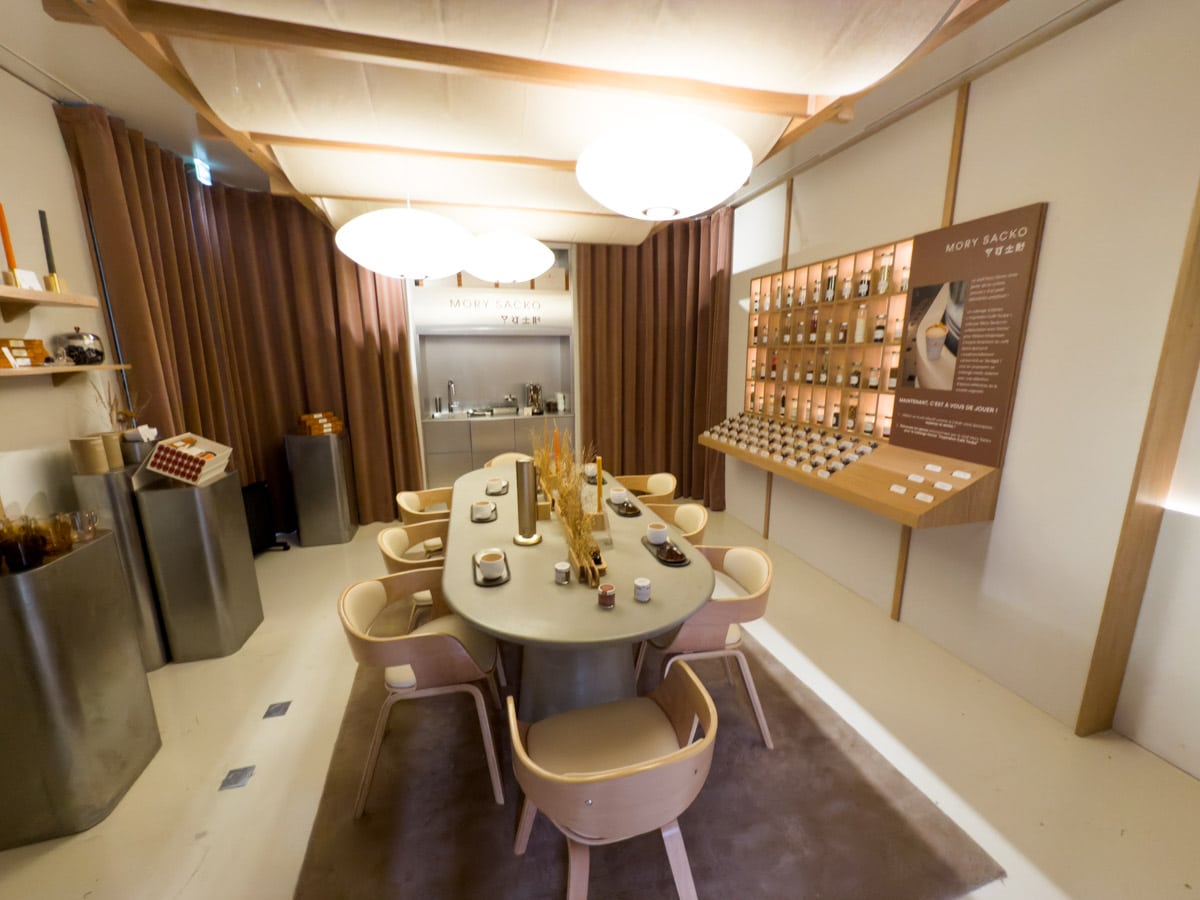
Nespresso House has a private space to test coffees, learn about spices and taste pastries.
Measurable benefits of retailtainment
Analysis of retailers practicing retailtainment reveals tangible benefits. According to data we’ve analyzed, stores incorporating entertainment elements record on average a 28% increase in sales per square meter.
Customer retention also improves significantly. Retailers offering immersive experiences observe a 22% higher retention rate than the sector average. This increased loyalty translates into a 35% higher Customer Lifetime Value (CLTV).
Impact on brand awareness constitutes another notable advantage. Retailtainment experiences generate 3.5 times more social media shares than traditional purchases, according to a 2024 brand mention analysis. This organic exposure represents advertising value estimated at 15% of traditional marketing budgets.
Challenges and limitations of this approach
Despite its advantages, retailtainment presents considerable challenges.
- Initial investment often represents a major obstacle. Implementing advanced technological experiences requires a budget 2 to 3 times higher than traditional layouts according to 2024 industry estimates.
- Staff training constitutes another challenge. Sales staff must develop new animation and advisory skills. This evolution requires training investment estimated at 15% additional compared to traditional programs.
- Consistency with brand identity remains crucial. The experiences offered must perfectly align with the retailer’s positioning to avoid consumer confusion. This requirement complicates the design and execution of retailtainment concepts.
- Finally, measuring return on investment can prove complex. Retailtainment benefits often manifest in the medium term, making immediate profitability evaluation difficult.
In my opinion, this type of strategy will remain the preserve of major brands. However, niche brands manage to create entertaining and memorable experiences. I invite you to consult my analysis of Kodawari restaurants.

FAQ: Everything about retailtainment
Is retailtainment suitable for all business sectors?
Retailtainment adapts to most sectors, but its application varies according to the nature of products sold. Experiential sectors like fashion, cosmetics or sports naturally lend themselves to it. Food retailers can integrate tastings or culinary workshops. Even technical sectors like electronics benefit from interactive demonstrations. The key lies in adapting the concept to the brand’s universe and customer expectations.
What budget should be planned to implement a retailtainment strategy?
Investment varies considerably depending on project scale. A simple approach based on animation can start at €5,000 to €10,000 per store. Advanced technological solutions require budgets of €50,000 to €200,000 depending on surface area and complexity. Staff training and equipment maintenance costs must also be planned. A prior cost-benefit analysis optimizes budget allocation.
How to measure the effectiveness of a retailtainment strategy?
Several indicators allow evaluation of retailtainment performance. Average visit time is a first indicator, followed by average basket size and conversion rate. Visit frequency and recommendation rate measure impact on retention. Social media mentions and customer reviews assess emotional engagement. A multi-criteria approach provides a complete view of strategy effectiveness.
Can retailtainment completely replace traditional sales?
Retailtainment complements traditional sales without replacing it. The goal remains commercial: selling products or services. Entertainment serves as a means to enhance customer experience and facilitate purchasing. A balance must be maintained between playful aspects and commercial effectiveness. The best strategies harmoniously integrate entertainment and sales advice to optimize overall store performance.
What are future retailtainment trends?
Artificial intelligence and personalization represent the main expected evolutions. Experiences will adapt in real time to individual customer preferences. Virtual and augmented reality will become more widespread to create even more immersive universes. Integration with digital platforms will enable continuity between in-store and online experiences. Sustainability will also influence concepts, with animations raising awareness about environmental issues.