In this article, I analyse the automatic checkout market in the retail sector. I review the latest figures for this market and also look ahead to the customer experience of the future.
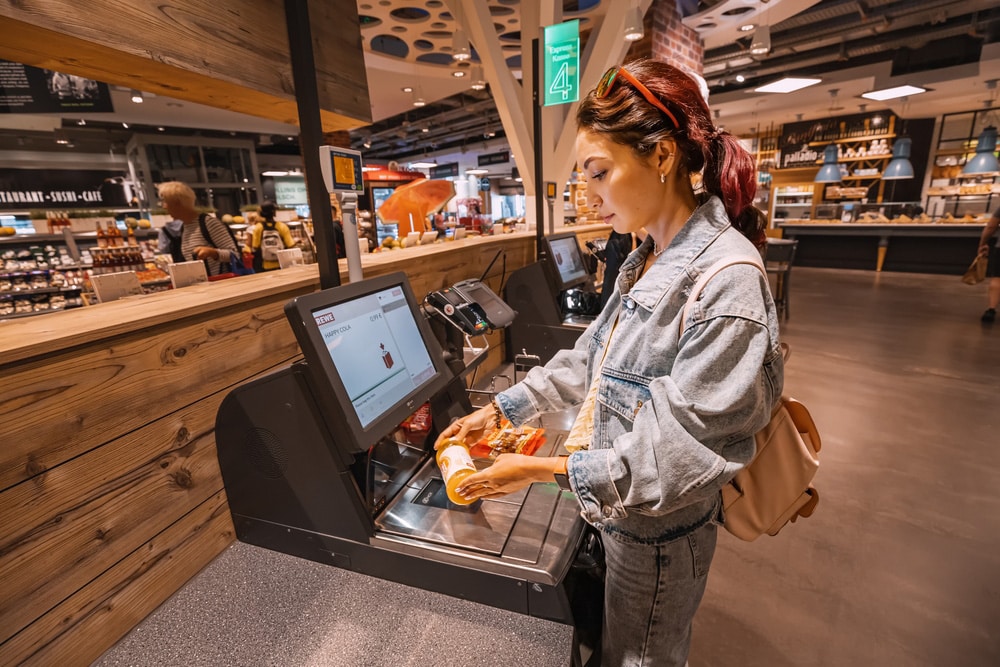
For more than 20 years, self-service checkouts have been gradually transforming the shopping experience in points of sale. What was once a simple technological promise has become a complex reality, mixing spectacular innovations and unexpected economic challenges. Between technological acceleration, profitability under pressure and new regulations, the self-service checkout sector is today going through a pivotal period that is redefining the future of retail. This analysis is based on the numerous market research studies we carry out in the retail sector in Europe.
Contact IntoTheMinds for your marketing studies
Key takeaways
- Self-checkout systems generate measurable productivity gains: +20% speed at Kiabi, +1.5% revenue
- In Belgium, 50% of Carrefour and Delhaize customers choose self-checkout
- In 2024, 71% of supermarkets and hypermarkets had self-checkouts
- The number of cashiers in France fell by 19% between 2009 and 2020
- Personnel costs represent 10 to 12% of a supermarket’s operating costs
- Theft leads to a revenue loss of 5% with self-checkouts compared to 1% with a traditional checkout
- Artificial intelligence is becoming essential to combat fraud and reduce errors from 3% to less than 1%
- Cashierless stores are struggling to find their economic balance, Amazon Go having closed 11 points of sale
- Hybrid solutions are imposing themselves: 75% of payments outside traditional checkout at Darty
- Political regulation is entering the debate with specific taxes such as in Liège (519€ per self-service checkout)
Self-checkouts arrived in Europe at the beginning of the 2000s and spread like wildfire. The advantages they offered had everything to please retailers: flexibility, availability and falling personnel costs. In France for example, the number of cashiers fell by 19% between 2009 and 2020. This generalised movement had moreover led many media to say that the cashier was on the way to extinction.
Concrete operational performances
In the non-food sector, the rise of RFID technology perfectly illustrates the ability of self-checkouts to generate measurable gains. The example of Kiabi is particularly revealing: the brand equipped more than 500 European stores with nearly 3,000 RFID readers, observing a 20% time gain per checkout. Even more impressive, this transformation has a direct impact on commercial performance with +1.5% revenue attributed to this modernisation.
At Decathlon, pioneer of the model, 100% of the assortment is now equipped with RFID chips since 2019. This generalisation allows almost instantaneous checkout and frees teams to focus on sales and customer advice. Checkout then becomes a formality of a few seconds, radically transforming the shopping experience.
In food, self-service checkouts respond to a growing demand for small baskets. Lidl illustrates this trend well with a cautious but determined approach. After a first test interrupted between 2020 and 2022 in 10 Belgian stores, the brand relaunched the system at the end of 2024 with three points of sale, despite persistent issues related to theft. This hesitation reveals a finding shared by the entire sector: customers favour autonomy, but its deployment requires sophisticated technological and human safeguards.
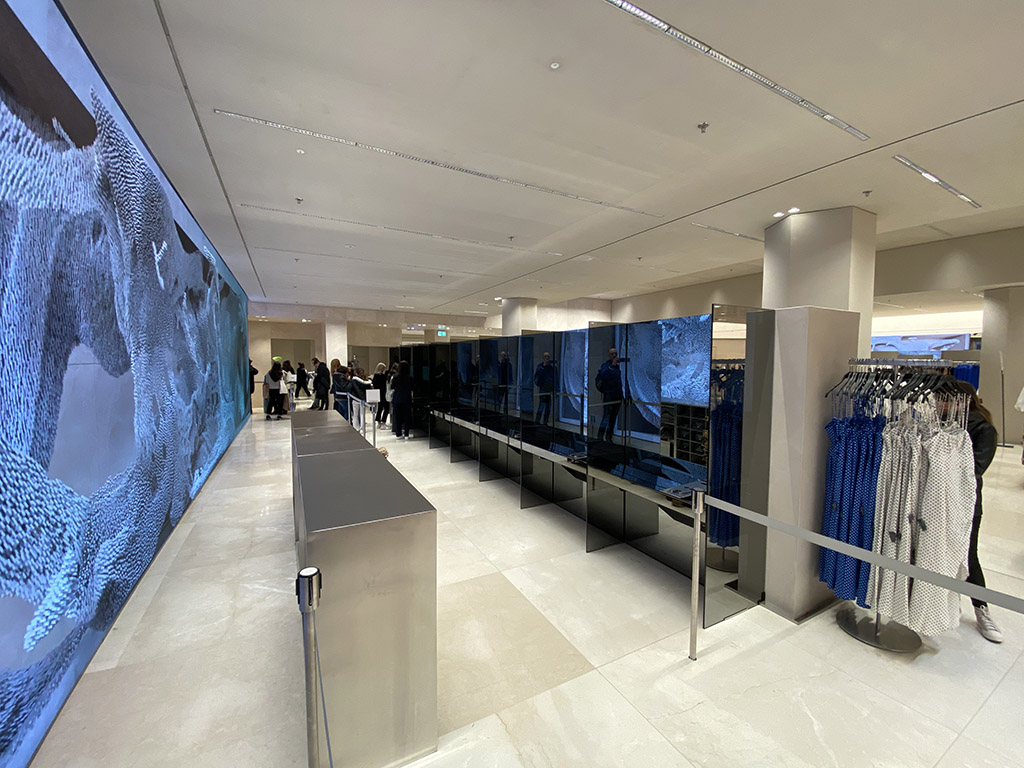
The Zara flagship store on the Champs-Elysées (Paris) integrates self-checkouts equipped with a scale.
The problem of fraud
A wave of withdrawals
The fate of self-checkouts changed when inflation entered our lives. Consumers needed to make savings to maintain their standard of living and theft became a national sport. Revenue loss is now estimated at around 5% on self-checkouts, compared to only 1% on traditional checkouts.
In the United States, Dollar General removed self-checkouts in 300 of its points of sale. Retailers will explain that it is customer experience that pushes them to uninstall self-service checkouts and return to a traditional checkout model. Do not believe them. In an industry where operating margin is low, 5% losses are simply unacceptable.
Remember that retailers are fighting to reduce losses and efforts focus on tenths of a percentage point. Losses of the order of 5% are simply disproportionate and can even threaten the business model. Fortunately, theft does not yet take the same proportions as in the United States where stores are vandalised in broad daylight. But methods to secure products that yesterday were in open access are multiplying. I thus saw this summer in an Italian supermarket a bottle of wine at €2.99 with an anti-theft device. Who could have imagined that a few years ago.
Artificial intelligence, remedy against fraud
Automation of checkout is mechanically accompanied by an increase in errors and fraud, which directly threaten the model’s profitability. Faced with this challenge, distributors are investing massively in artificial intelligence to secure their flows.
The results obtained at Intermarché and Netto with the Vynamic Smart Vision solution from Diebold Nixdorf are eloquent. In a pilot store, this technology made it possible to reduce manual staff interventions by 15% and drop the rate of erroneous transactions from 3% to less than 1%, i.e. a division by three. These figures show that AI is not only used to secure flows, but also to lighten operational load while maintaining a fluid customer experience.
This technological evolution transforms the role of in-store staff. Rather than constantly monitoring self-checkouts, employees can focus on customer support and resolving complex situations, creating real added value for the brand.
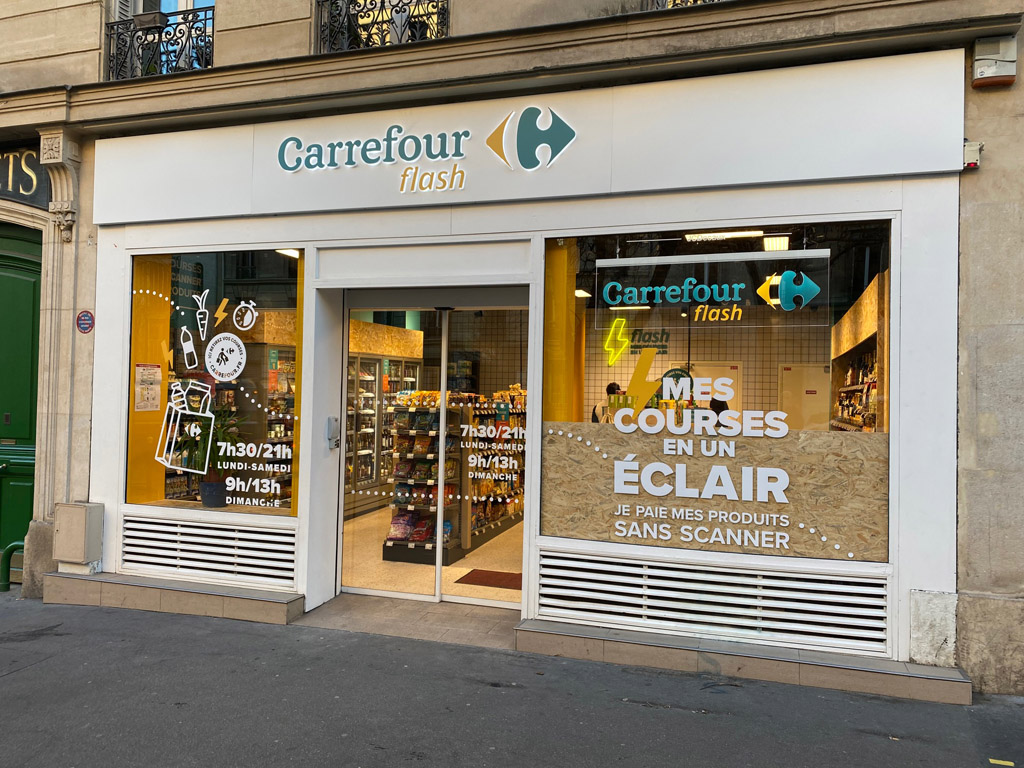
“Carrefour Flash” was a cashierless store set up by Carrefour in Paris. It allowed customers to shop autonomously and pay via self-checkouts.
Cashierless stores: what future?
Totally autonomous store formats, often presented as the logical culmination of self-checkouts, are nevertheless struggling to find their economic balance. Amazon Go, pioneer of the concept, is the most striking illustration. The American giant went from around thirty points of sale to only 17 stores still in operation, after 11 closures in 2023 and 2024.
This drastic reduction is explained by simple economic constraints: technologies work perfectly, but equipment costs and high rents in high-traffic areas make profitability difficult to achieve for convenience shopping. The economic model clashes with the reality of retail margins. Despite automation, it is moreover quite paradoxical that humans were still largely involved in payment processes. But this reality had to be kept quiet. Nearly 1,000 Indian workers were for example employed to verify 70% of “Just Walk Out” transactions. Its creator therefore did not fully trust its own technology.
Alternative models are nevertheless emerging, adapted to specific contexts. The Api network, without staff and implanted in rural areas, already has more than 65 units and aims for a hundred stores. This success proves that autonomous checkout can work when aligned with precise usage and an adapted local context, far from urban constraints and prohibitive rents.

The future: journeys and hybrid solutions
Faced with the limits of all-automatic solutions, many brands favour more pragmatic intermediate approaches. Mobile checkout, carried by seller tablets or smartphones, is gradually imposing itself as a credible alternative.
The figures speak for themselves: at Darty, 75% of payments are now made outside traditional checkout, while at Fnac, this rate reaches 23%. In certain high-traffic Salomon boutiques, up to 98% of payments are made without going through a classic checkout. These hybrid models allow absorbing attendance peaks while keeping physical checkouts for complex payments or cash.
In parallel, new experiments are appearing, such as biometric payment. Carrefour tested in 2024 the payment by palm of the hand in Paris, a technology already deployed in more than 500 Whole Foods stores in the United States via Amazon One (see this video that I shot). Acceptance by European consumers nevertheless remains to be confirmed, privacy issues being more sensitive on the Old Continent.
The RFID solution
An option like the RFID chip offers this security but its cost is high and is reserved for stores selling expensive items. Nespresso provided such a solution at one time.
RFID chips are today compatible with connected shopping trolleys. A perfect solution exists but it requires a significant investment in CAPEX (connected trolleys or connected checkouts with RFID readers) and OPEX (RFID tags) which in my opinion are prohibitive in a classic retail environment.
Combined scanner + journey control solution
Perhaps the future of self-checkout should be sought in the combination of existing solutions. One can for example imagine that the scanner used to scan one’s products during shopping could be combined with journey control in store.
This however requires individual tracking of the customer’s journey in store, which is not without raising some questions at GDPR level. Let us remember indeed that customer journey tracking as proposed for example by Amoobi is anonymised. It is not possible to re-identify one or the other customer afterwards.
Regulation enters the debate
The question of self-checkouts now goes beyond the purely technological framework to become a political and social issue. In Liège (Belgium), the decision to introduce a annual tax of 519€ per self-checkout, applicable from 2026 to 2031, marks a clear political will to compensate for the substitution of human work and support local commerce.
This tax, accompanied by penalties that can reach 200% in case of fraud, is strongly contested by professional federations. They see it as a brake on innovation and a distortion of competition with e-commerce, which benefits from total automation without specific tax constraint.
This Belgian initiative could set a precedent and influence other European communities facing the same issues of local employment and transformation of commerce. It illustrates the growing tension between technological innovation and preservation of social link in commercial spaces.
A strategic tool, not a universal solution
Self-checkouts therefore constitute neither an end in themselves, nor a universal recipe applicable to all contexts. Available data show that they can indeed improve performance, the customer experience and revenue, provided they are integrated into a hybrid ecosystem combining technology, intelligent control and human presence.
More than a brutal revolution, autonomous checkout is imposing itself as a progressive optimisation lever. Its success depends above all on the implantation context, store format and economic and social arbitrages made by distributors. The future therefore seems to belong to mixed solutions, capable of adapting to the specificities of each brand and each territory.
This nuanced evolution reflects a growing maturity of the sector, which is abandoning absolute technological promises to favour a pragmatic approach centred on real added value for customers and brands.

Frequently asked questions about self-checkouts
How much does installing a self-checkout cost?
The cost varies considerably depending on the type of equipment chosen. A basic self-checkout costs between 5000 and 10000€, while an advanced system can reach 30000€. Installation, staff training and maintenance costs must also be planned. Brands often opt for leasing solutions that allow spreading costs and including maintenance.
Do self-checkouts really replace staff?
Contrary to popular belief, self-checkouts do not necessarily eliminate jobs but transform staff missions. Employees refocus on customer support, equipment monitoring and managing complex situations. At Decathlon for example, automation allowed redeploying teams towards advice and sales.
What are the main problems encountered with self-checkouts?
The main challenges include fraud (facilitated shoplifting), scan errors, technical blockages and acceptance by certain customers. Artificial intelligence solutions significantly reduce these problems, but require significant investments. Staff training and customer support remain essential for successful deployment.
Are self-checkouts suitable for all types of commerce?
No, their relevance depends strongly on the context. They work well for small baskets, standardised products and high-traffic areas. On the other hand, they are less suitable for local shops, fresh products requiring weighing or customers unfamiliar with technology. Analysis of customer flow and average basket is crucial before any deployment.