The practice of requesting a tip when paying by card is becoming widespread. Our exclusive study reveals that consumers are increasingly fed up with this practice and that the consequences for retailers are significant.
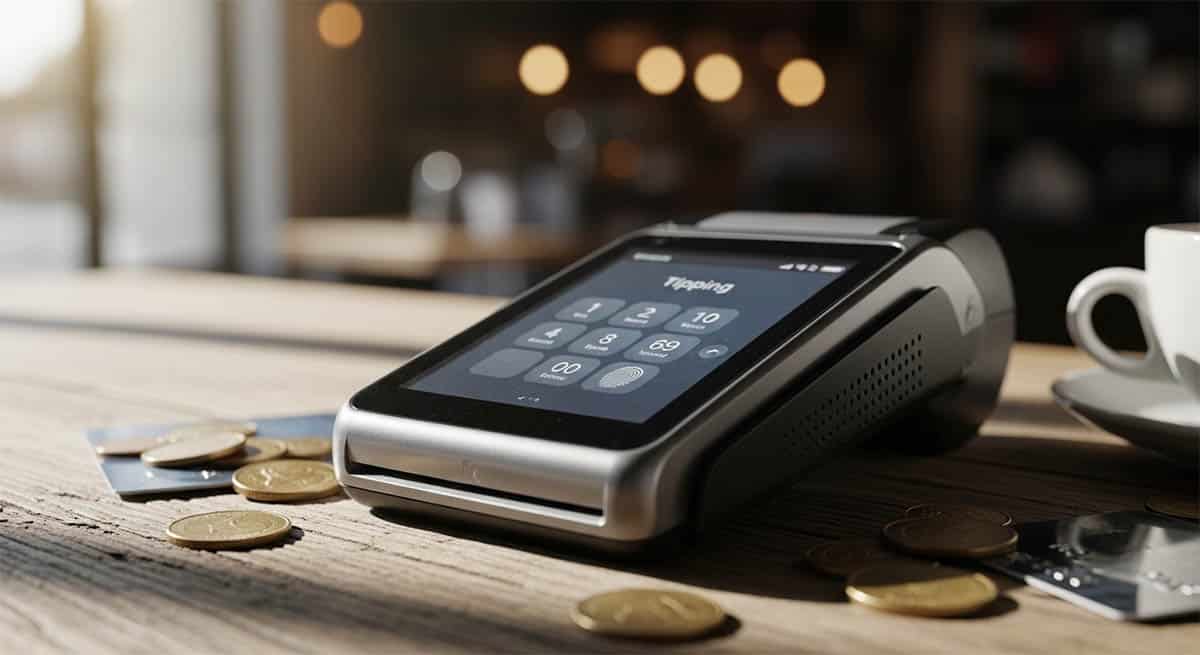
Card payments tipping has gradually become embedded in payment habits. 29% of consumers have been exposed at least 4 times in the last 6 months to a request for a tip via an electronic payment terminal, according to a study conducted by our survey institute. But this transformation following the disappearance of cash raises a fundamental question: at what point does systematic solicitation become counterproductive? This analysis provides a comprehensive overview of the situation. We also reveal the results of a study showing just how exhausted consumers are by this practice. You will see in particular that the pressure felt at the time of payment would lead 60% of customers to stop returning to a business that requests tips via payment terminals. If you want to learn more about the results or reuse them, feel free to contact us.
Contact the IntoTheMinds institute
Key takeaways
- In France, tipping frequency has increased significantly in recent years, driven by the widespread adoption of card payments.
- 81% of 18–24-year-olds have already left a tip reluctantly.
- 70% of consumers have been confronted with at least one tip request via a payment terminal in the last 6 months.
- 60% of customers feel pressured when a tip is requested on a payment terminal.
- 60% of consumers are willing to boycott businesses that request tips at the time of card payment.
- 54% of customers have already given in to a tip request to avoid discomfort.
- 50% of French people consider a tip request on a self-service terminal illegitimate and 49% for takeaway purchases.
- In the United States, 86% of Americans believe tipping culture has become “out of control” (2025), and 63% express at least one negative opinion on the subject.
- The generational divide is marked: only 43% of Gen Z Americans systematically leave a tip in restaurants, compared with 84% of Baby Boomers (2025).
- In Germany, activating the tipping function on payment terminals led to a noticeable increase in average tip amounts in the months following its introduction.
Deeply uneven cultural practices across the world
Tipping is not a universal practice. Germans (78%) and Americans (77%) report systematically leaving a tip in restaurants, followed by Britons (59%), Spaniards (47%), French (37%), Swedes (34%), Italians (27%), and Danes (24%). Depending on the context, the situation can vary dramatically, as shown in the chart below.
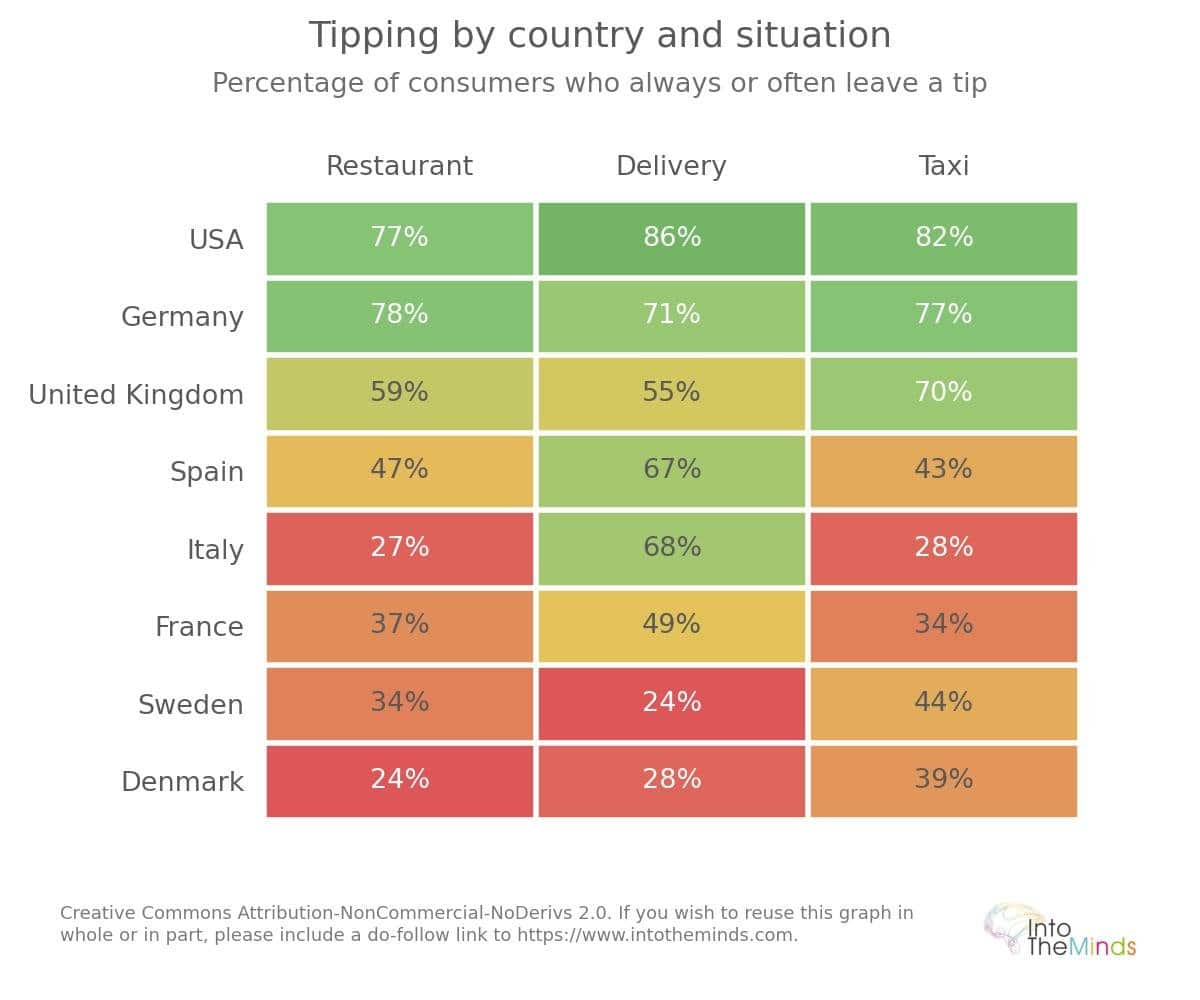
These figures reflect very different economic models:
- In the United States, tipping is a structural component of compensation. The American tipping economy was estimated in 2008 at around $44 billion, with a national average of 19% of the bill.
- In France, service has been included in the bill since 1987, making tipping a voluntary gesture rather than an economic necessity for employees.
Practices also vary by profession. The same 2023 survey shows that tips are more often given to bar and restaurant servers and hairdressers than to hotel staff or taxi drivers.
“Tipping fatigue”: a new phenomenon
Americans are the first to express frustration with tipping:
- 86% believe tipping culture has become “out of control”.
- 63% express at least one negative opinion on the subject, compared with 59% a year earlier.
The main grievances are:
- 41% believe companies should better compensate their employees (vs. 37% in 2024)
- 41% consider tipping culture to be “out of control” (vs. 35% in 2024)
- 38% are annoyed by pre-set amounts on screens (vs. 34% in 2024)
- 46% do not like suggested percentages on terminals, compared with only 13% who find them useful
It should be noted that in recent times, tipping has been requested in increasingly incongruous situations: for takeout and even via self-service machines. Social media is full of increasingly striking testimonies (see example below).
What sometimes shows where America has ended up is not long sociological analyses, but an airport kiosk. You buy a $4.50 bottle of water and are offered tip options of 18%, 20%, 22%. While in Japan tipping is almost considered an insult, here even the machine now requests a tip. pic.twitter.com/R9eeKhr58l
— Vedat Milor (@vedatmilor) May 6, 2026
The behavioral impact is measurable. In 2025, 27% of Americans say they leave less or no tip when faced with a pre-filled screen (vs. 25% in 2024), while only 11% say they leave more (vs. 14% in 2024). The amount of “non-essential” guilt-driven tips fell from $453 in 2024 to $283 in 2025. Meanwhile, the share of Americans leaving at least 20% in restaurants fell from 37% to 35%.
The generational divide reinforces this decline. In the United States in 2025:
| Generation | Systematic tipping in restaurants | Systematic tipping at hairdressers | Systematic tipping in taxis/ride-hailing |
|---|---|---|---|
| Gen Z | 43% | 25% | 23% |
| Millennials | 61% | N/A | N/A |
| Generation X | 83% | 67% | N/A |
| Baby Boomers | 84% | 71% | 61% |
A recent academic study published in International Journal of Hospitality Management shows the negative effect on customer satisfaction and customer experience of tipping requests in unusual contexts—especially when tips are requested before the service is delivered.
Tip amounts increase by 65% in the 6 months following activation of the function on the payment terminal
Digital tipping in Europe
Europe presents a mosaic of situations regarding the request for tips on payment terminals. Here is the situation as published in a September 2025 study:
- Germany: tipping via payment terminals is integrated into more than 30% of transactions, with an average amount of €3 to €4.
- Switzerland: frequency of 15 to 20%, with amounts often exceeding €5.
- United Kingdom: the “service charge” is often included in the bill, and tips via card represent no more than 3% of transactions.
- Belgium: ranks last with 2.6% of transactions involving tips and an average amount of €2.90.
The German example is particularly instructive regarding the effect of payment terminals. A German provider claimed 2,500 merchant users in June 2024 and observed a 65% increase in the amount of tips within six months after activating the tipping function on the payment terminal. A competitor reported a 12% increase in transactions with tips between August 2022 and August 2023. The most frequently selected percentage is 10%, and amounts rarely exceed €20. However, as in the United States, the multiplication of tipping prompts on payment terminals is beginning to seriously annoy consumers. Here too, complaints are multiplying on social media.
Guilt Tipping in Deutschland:
War gerade Eis essen. Am Kartenlesegerät kommt vor der Zahlung die Trinkgeldfrage: 5%, 10%, 15% oder individuell. Für einen Eisbecher zum Mitnehmen! Und jeder in der Schlange hinter dir sowie der Kassierer sieht auf dem Bildschirm was tippst.This… pic.twitter.com/cfTGPYOn5E
— LayoverFinance (@MuenzenMeister) May 3, 2026
These data illustrate a well-documented phenomenon in behavioral sciences: highlighting a default option on a screen steers consumer choice. In Germany, consumer associations and researchers explicitly describe these mechanisms as nudging. The difficulty in locating the “no tip” option pushes consumers toward a higher payment than they would have spontaneously chosen. These practices therefore raise ethical questions about customer relationship management for the businesses implementing them.
The request for tips on payment terminals can be seen as a form of nudge marketing. Giving is presented as the norm, and refusal as deviance.
France: catching up driven by digitalisation
France starts from a historically low level. In 2014, 16% of French people reported never leaving a tip, and only 15% did so automatically. The widespread adoption of card payments initially penalised service staff: between 2023 and 2025, contactless payments overtook cash in 2024 (48% of transactions vs 43%), and mobile payments increased by 61% between 2023 and 2024. The dematerialisation of tipping therefore accelerated.
This transition has nevertheless been accompanied by a rebound in digital tips. The average amount of card-based tips increased by 12% between 2023 and 2025, reaching €4.70, while their frequency jumped by 170% over the same period. In June 2025, 10.3% of French digital transactions included a tip, rising to 18% in Paris. In fine dining restaurants, 25% of customers left a tip, with amounts ranging between €20 and €37.
Tipping remains an economic pillar of the sector. According to a survey conducted in 2025 by the French hospitality industry association, 86% of employers consider it essential for their teams. On the employee side, 71% regularly receive tips, 83% see them as a key part of their income, and 41% would consider leaving the profession if tipping were taxed. A Parisian waiter interviewed reports around €50 in tips per day; some restaurateurs in tourist areas report significant cumulative amounts during peak season.
Results of the IntoTheMinds study
IntoTheMinds survey, May 2026 — 616 respondents (France)
France is not America. Tipping has always been a discretionary gesture, culturally associated with gratitude and never with obligation. We wanted to understand how European consumers in general, and French consumers in particular, experience the growing presence of tipping requests on payment terminals.
A diffusion too rapid to remain painless
The introduction of tipping requests on payment terminals in France happened without any real public debate. Our study shows that 67% of respondents have been exposed to this type of tipping request (please note that the chart below excludes, for readability reasons, the 3% of respondents who answered “I don’t know”).
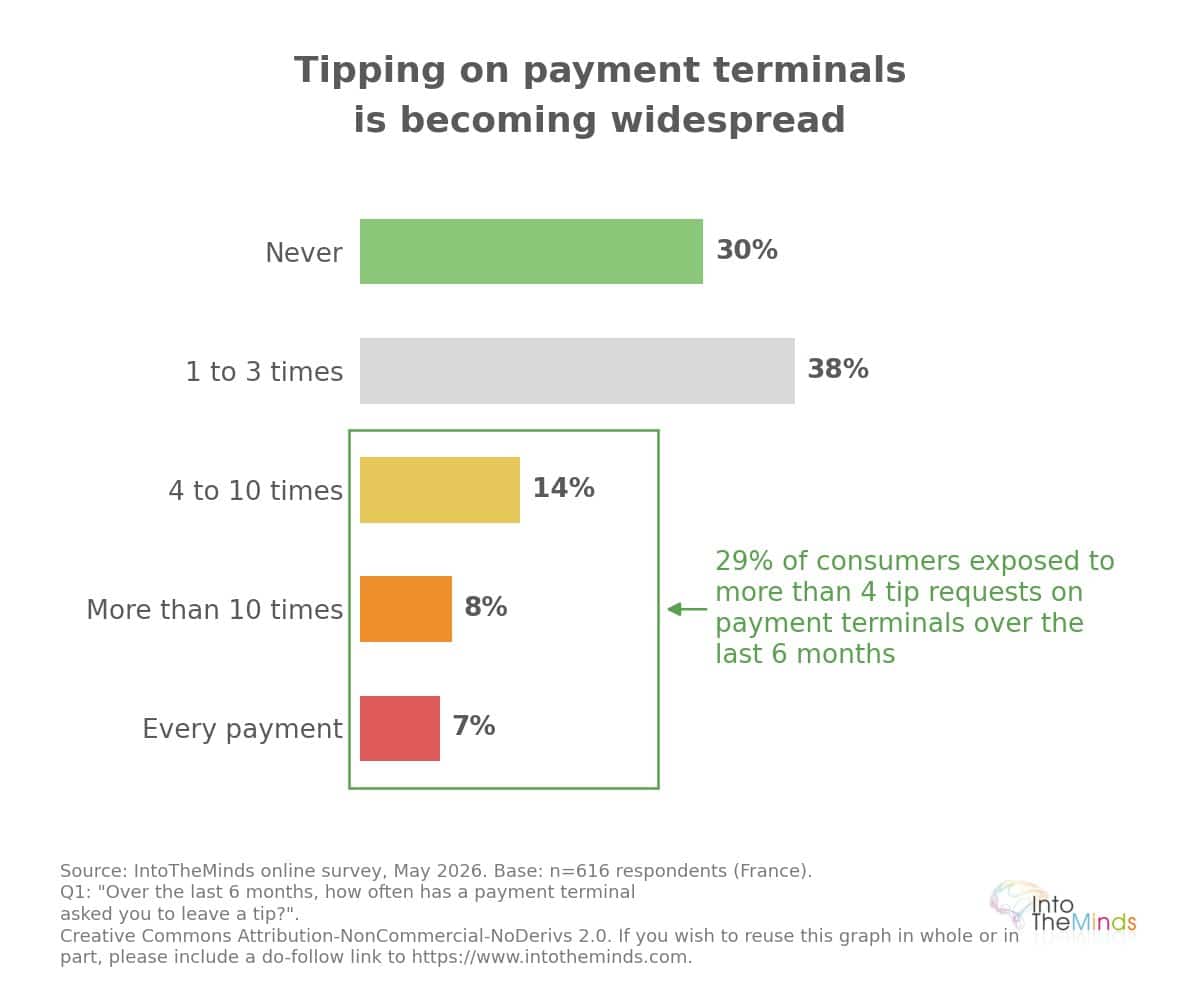
The question we will answer in the following paragraphs concerns the acceptance of this practice and its effects on consumer behaviour and decision-making.
The nudge turned against itself
Tip requests on payment terminals can be seen as a form of nudge marketing. Giving is presented as the norm, while refusing is framed as deviant behaviour. Offering pre-filled amounts, placing the 0% button at the bottom or in a less visible colour, displaying the screen facing the merchant — every design detail is intended to maximise the conversion rate. The rationale is obvious: this additional income helps retain employees in a context where younger workers are becoming less and less loyal to their employers (see our major study on Generation Z). The owner of a chain of bakeries in Paris explained it to me this way: “100% of the amounts are redistributed to employees net of charges and taxes, so it is a real supplement to help retain teams.”
But this practice puts consumers under pressure. Our study clearly shows that 60% of customers who experienced this situation perceived it as a form of coercion.
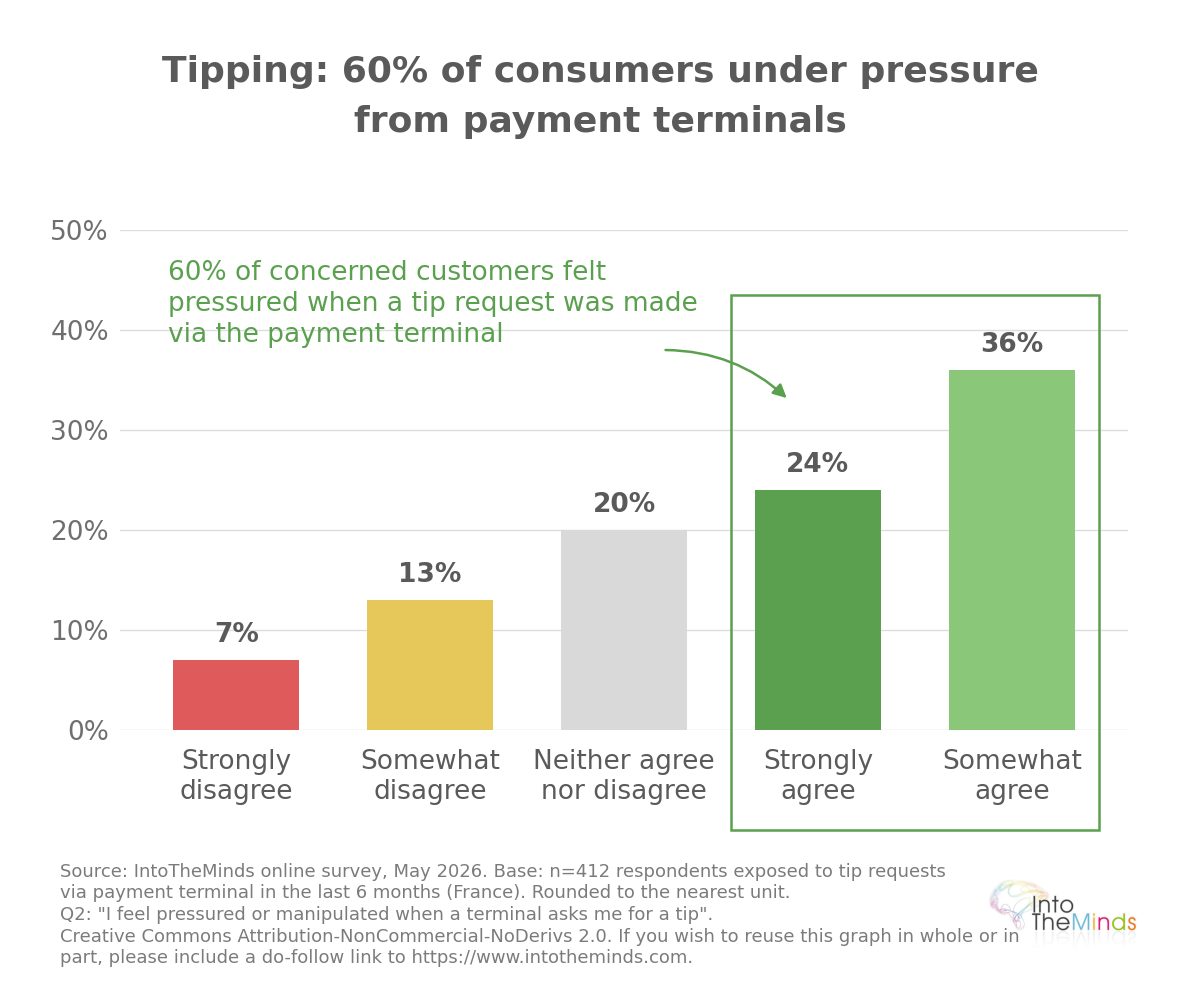
Ultimately, this mechanism works too well. A majority of exposed consumers end up paying, not out of generosity, but to avoid the social discomfort of refusing under someone’s gaze. Our results even show that this concerns the majority of customers, since 54% say they left a tip in order to avoid feeling uncomfortable in front of the employee.
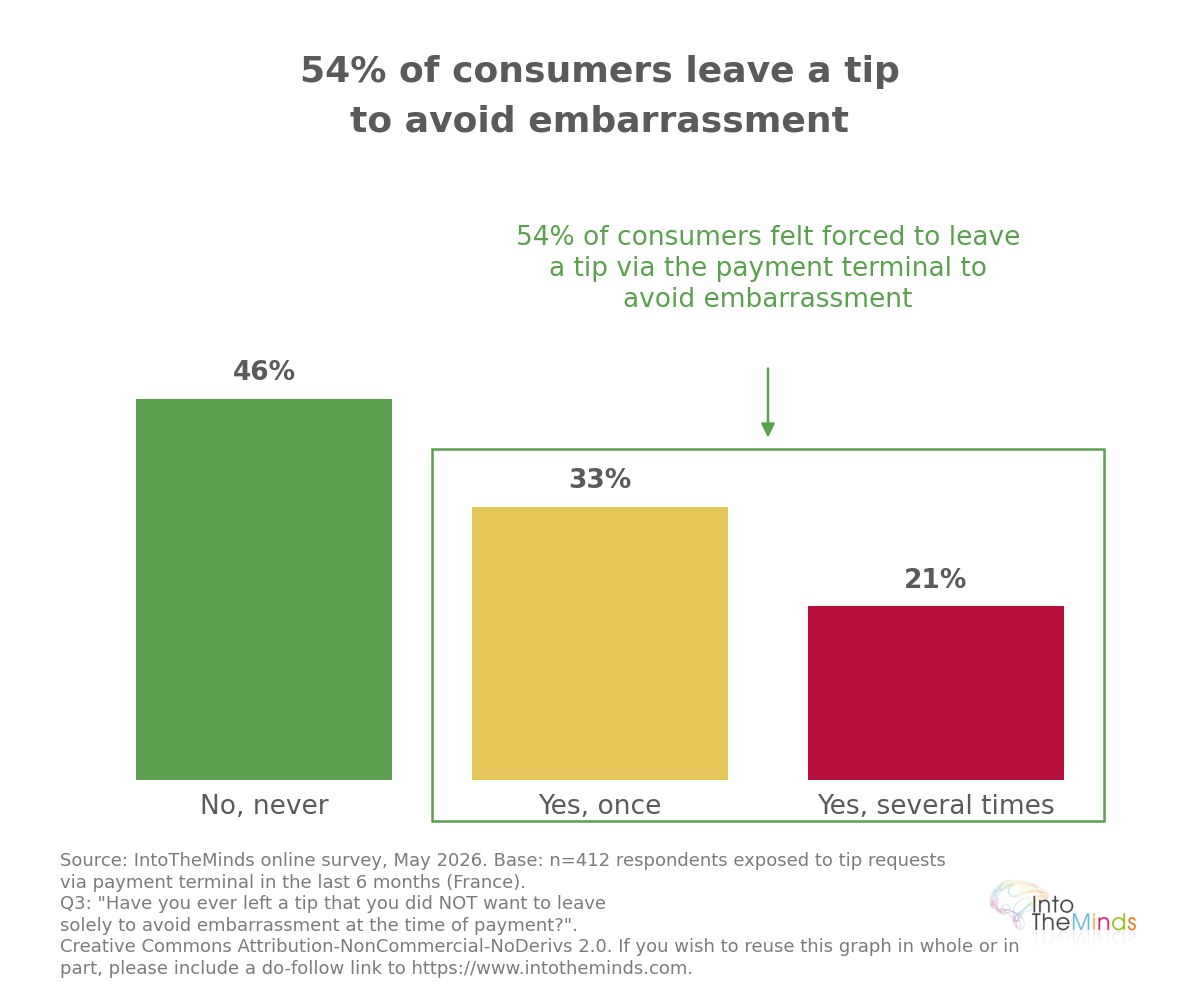
It is therefore no longer a tip: it is a disguised exit fee. And consumers, who are not fooled, eventually associate this feeling of manipulation not with the terminal itself, but with the establishment that chose to use it. Remember that it is up to the merchant to decide whether or not to activate the “tip” option on their payment terminal.
The generational divide reveals a paradox
One might expect young adults, who grew up with contactless payments and are used to digital interfaces, to be the least unsettled by these requests. The opposite is true. People aged 18-34 are the most likely to leave a tip reluctantly, far more than older generations. Our results, presented in the chart below, confirm findings from other studies. They show that 31% of 18-24 year-olds and 25-34 year-olds have repeatedly left a reluctant tip via a payment terminal.
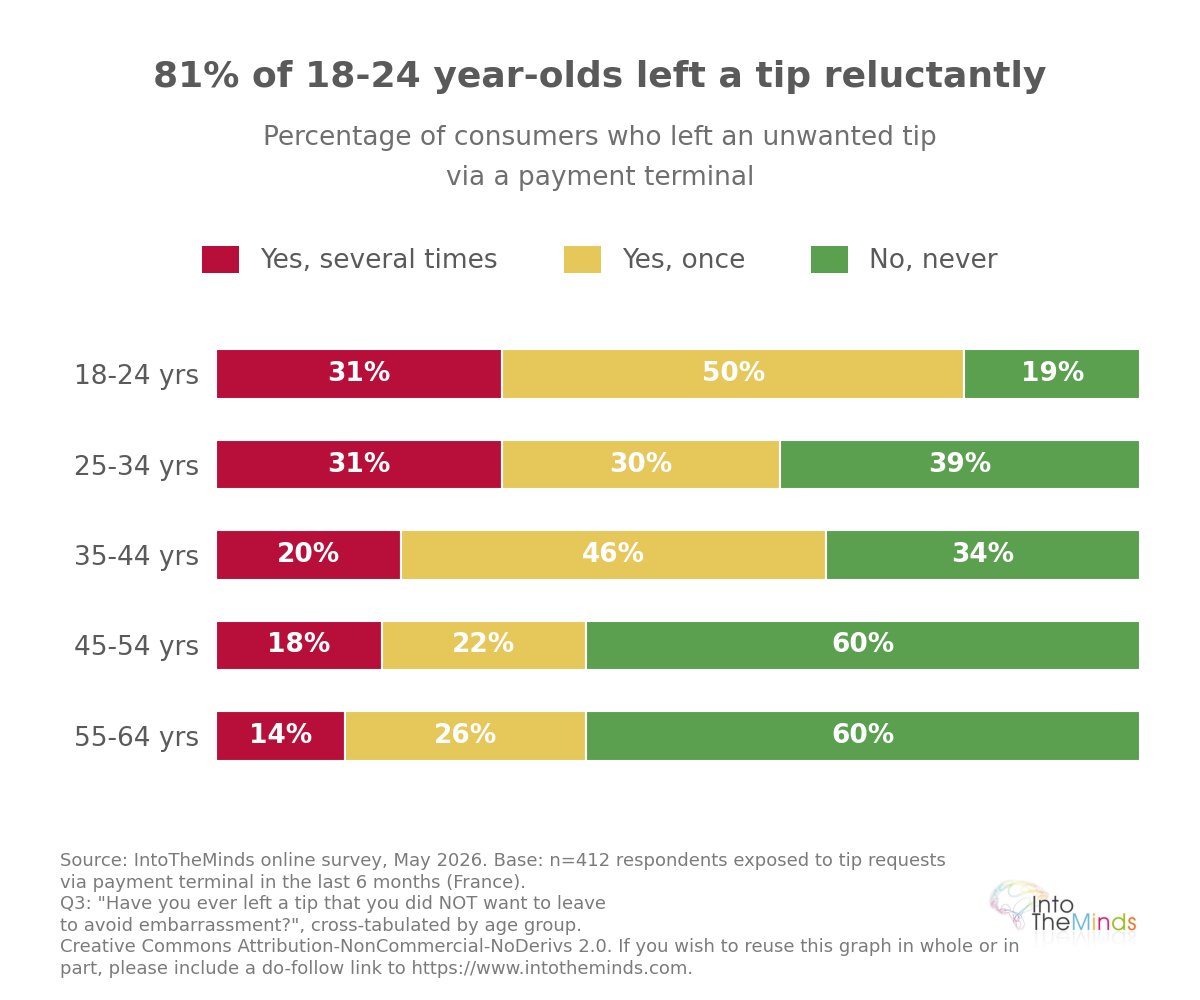
This paradox is explained less by technology than by social psychology. Young adults are also the ones with the most frequent interactions (deliveries, cafés, restaurants), and those for whom the gaze of others during a transaction still carries strong social meaning. Social pressure works particularly well on them because they have not yet developed the emotional distance that comes with age and allows people to refuse without feeling uncomfortable.
A message to merchants: while it may be easy to pressure your youngest customers into giving in, remember that in the long run this customer segment is also the most likely to build up resentment. Your short-term gains will turn into long-term losses. This provides a perfect transition to our next finding regarding boycotts.
Boycotts are a real issue
The question for a merchant adopting these systems is not “does it generate revenue?”. The answer is probably yes, marginally, in the short term. The real question is “what is the relational cost?”
The data on boycott intentions should be enough to reframe the calculation, since 60% of respondents say they are ready to boycott establishments that request tips through payment terminals. But beyond stated intentions, what is really at stake is the dynamics of the customer experience: a customer who leaves feeling manipulated will not always say so, and will not always leave a negative review. But they will return less often and recommend the establishment less frequently.
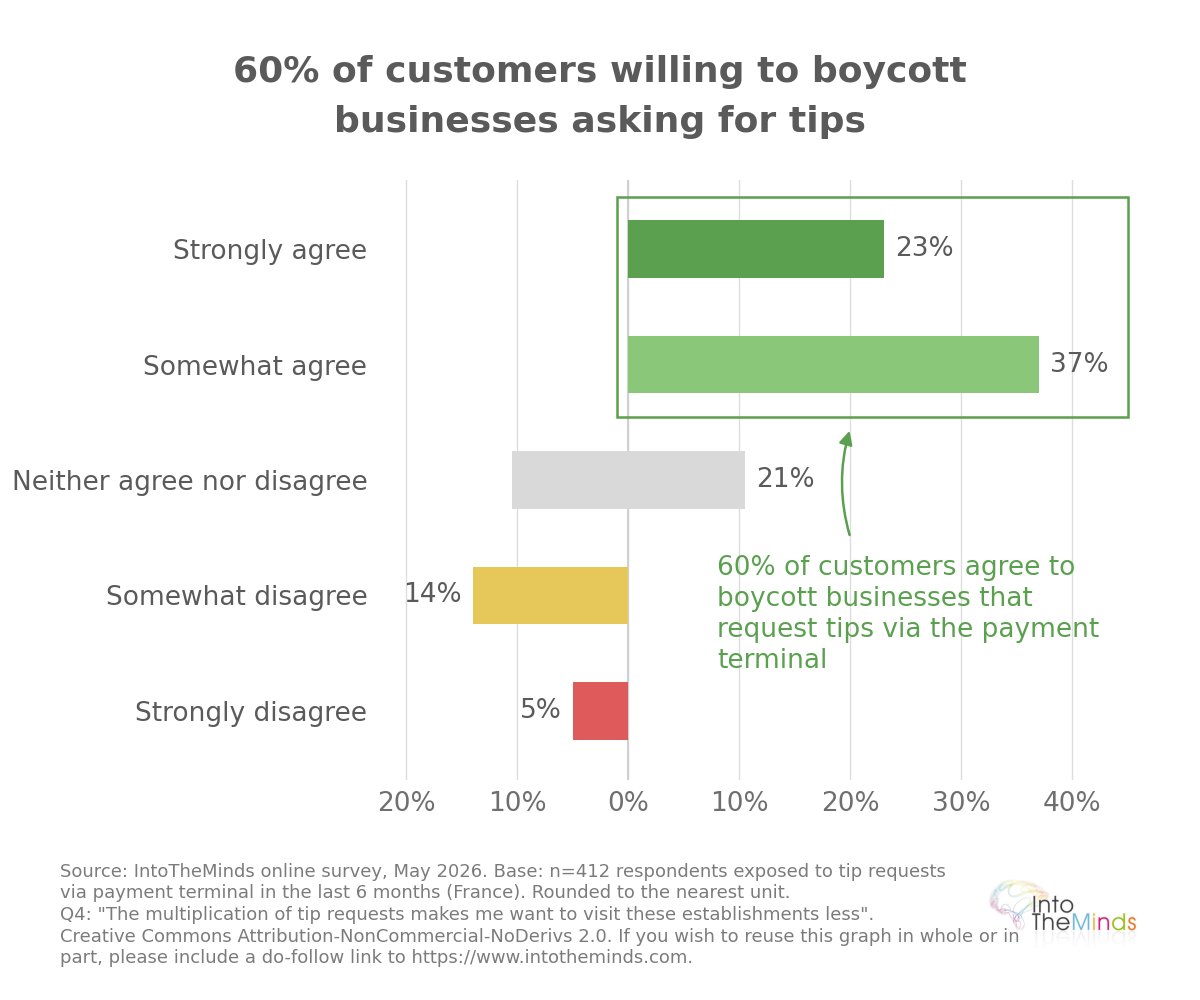
In sectors such as neighbourhood bakeries and cafés, where loyalty is built on personal contact and the quality of interpersonal relationships, the payment terminal can undo in a few weeks what a reputation took years to build.
Contexts perceived as illegitimate for requesting tips
The fact that bakeries and fast-food restaurants are widely considered illegitimate places to request tips is not insignificant. These two sectors share a common feature: transactions are brief, standardised, and the service provided is already included in the price. Culturally, tipping is reserved for interactions involving a visible form of care, personalisation, or effort.
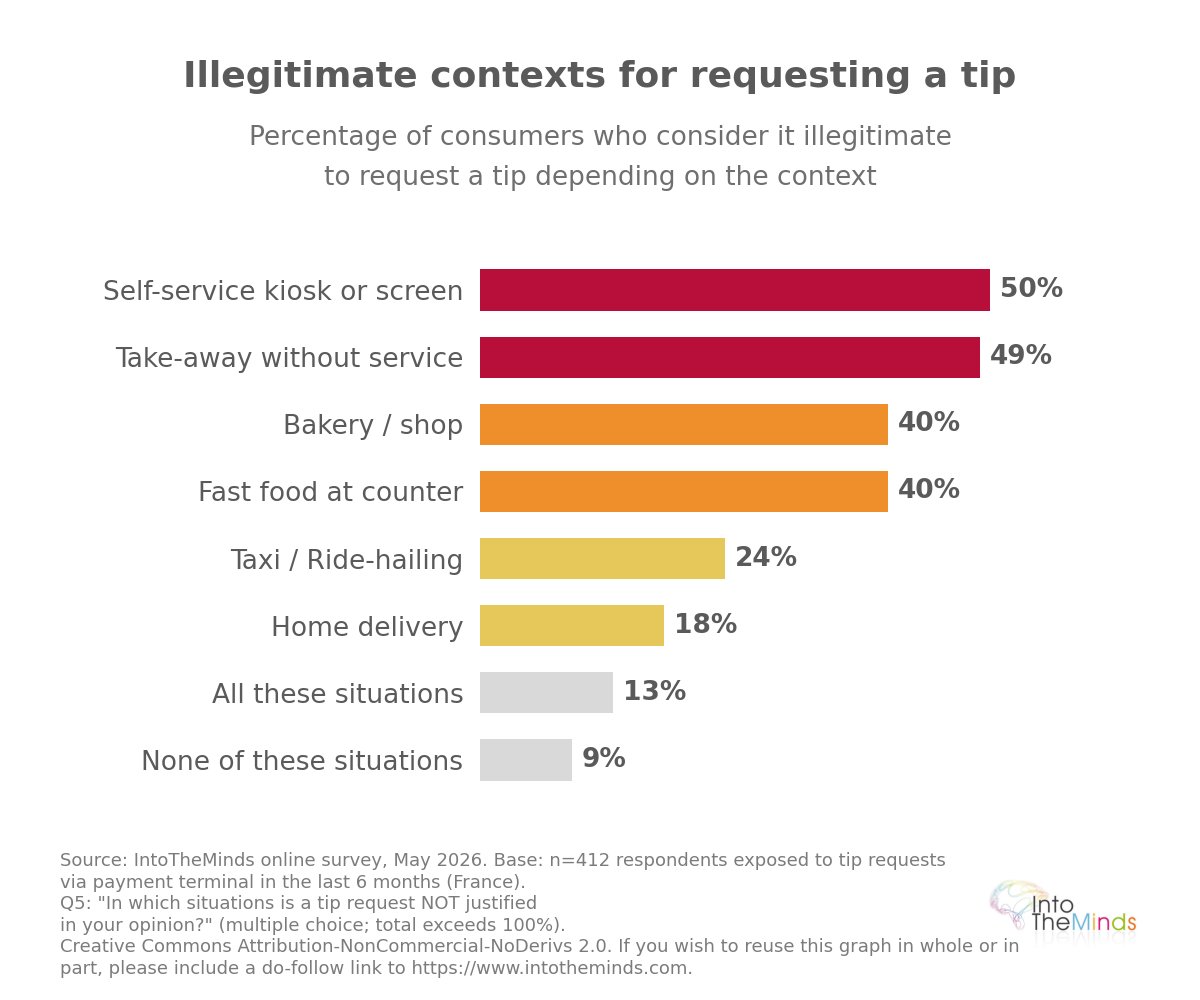
This implicit hierarchy of legitimacy reveals something important: consumers do not reject the principle of tipping itself, they reject its disconnection from the perceived value of the service provided. As long as tip requests are deployed indiscriminately, social friction will continue to grow.
Conclusions
The data from this survey paint a coherent picture: a practice imported without cultural adaptation, interfaces designed to circumvent consent, pressure distributed unevenly across age groups, and a commercial backlash that is beginning to take shape.
The question is no longer whether digital tipping will become established in France — it is already here. The question is whether industry players will have the foresight to regulate it before consumers themselves impose the penalty.
Source: IntoTheMinds online survey, May 2026. Total sample: n=616 respondents (France). Questions specific to individuals exposed to tip requests: n=412.

FAQ: the questions you are asking
How does tipping work on a payment terminal?
The electronic payment terminal (EFT-POS) displays, after validation of the main amount, a tipping suggestion in the form of percentages or fixed amounts. The customer selects the desired option or chooses not to add anything. The total amount is then charged in a single transaction. The configuration of this feature depends on the payment solution provider chosen by the merchant.
Are card-based tips subject to tax in France?
The 2022 Finance Law introduced a tax and social exemption for employees in direct contact with customers whose remuneration is below 1.6 times the minimum wage (approximately €2,000 net). This measure was initially set to expire on 31 December 2025. Beyond this threshold or after that date, tips are in principle subject to social security contributions and income tax under standard rules.
Does tipping on payment terminals really influence customer behaviour?
The data confirms it. In Germany, activating the tipping function on payment terminals led to a 65% increase in the average tip amount over the following six months. Research published in August 2025 in the International Journal of Hospitality Management documents the emotional effects of these mechanisms on consumers, particularly when the request occurs before service delivery. A market research study can help brands precisely measure the impact of these practices on customer satisfaction and purchasing behaviour.
Which sectors are most affected by card-based tipping in France?
The restaurant sector remains the benchmark, with average card tips of €4.70 in 2025 and peaks of €20–37 in fine dining. Food delivery platforms have also adopted this practice, with an average tip of €3.20 for one major player in 2021. Hotels, taxis, and personal services are affected to a lesser extent, according to available data. Customer satisfaction surveys are a useful tool to assess how these practices are perceived across each sector.
How can companies measure the impact of tipping requests on their brand image?
The multiplication of tipping prompts via payment terminals can generate fatigue or even irritation among certain customer segments, directly affecting customer loyalty. A targeted opinion survey or a customer satisfaction study allows companies to quantify this effect and adjust terminal configuration accordingly, taking into account generational differences documented in the available research.