
Europe enters 2026 with a rather turbulent consumer landscape. Our research firm has compiled the latest available statistics to project the 2026 consumption trends. The emerging picture reveals a continent where shopping habits are evolving under the influence of complex economic, technological, and societal factors, particularly related to uncertainties surrounding various global conflicts. This in-depth analysis examines the behavioral shifts of European consumers and provides strategic recommendations for marketing professionals.
Contact the IntoTheMinds Institute
Key Takeaways
- France shows the most pronounced pessimism with a net balance of spending intentions at -33 points for 2026, according to an international survey of 13,115 respondents
- Price-volume trade-offs become structural: in Germany and Switzerland, sales increased by +8% between 2022-2024 while volumes fell by -14%
- Retail concentration accelerates: the five largest retailers strengthen their grip across all European countries studied
- Proximity stores and drive-throughs emerge as growth drivers with projected growth of +5.3% and +5.7%, respectively, in France for 2026
- Innovation resumes but under immediate profitability constraints: it represents 1.1% of FMCG revenue in France in 2025
A European Context of Widespread but Varied Caution
The analysis of consumption intentions for 2026 reveals a Europe operating at multiple speeds. France stands out for particularly pronounced pessimism with a net balance at -33 points, well below its European neighbors. Germany shows -21 points, Italy -14 points, while the UK and the US are at -20 points. This French caution contrasts with China’s relative confidence (-8 points), highlighting the geographic specificities of current consumption trends.
This caution is explained by a tense economic context. Despite a record fast-moving consumer goods (FMCG) market of €140 billion in France in 2025 (+1.8% year-on-year), households maintain a high savings rate of 18.7%. This estimated savings stock of €6,400 billion represents a potential reservoir, but its activation remains uncertain.
Macroeconomic projections confirm this caution: French growth is expected to rise from 0.9% in 2025 to 1.1% in 2026, while goods consumption accelerates only modestly (+0.4% in Q4 2025 versus +0.1% previously). This moderate dynamic occurs within a context of a €69 billion trade deficit and public debt of €3,482.2 billion, over 117% of GDP.
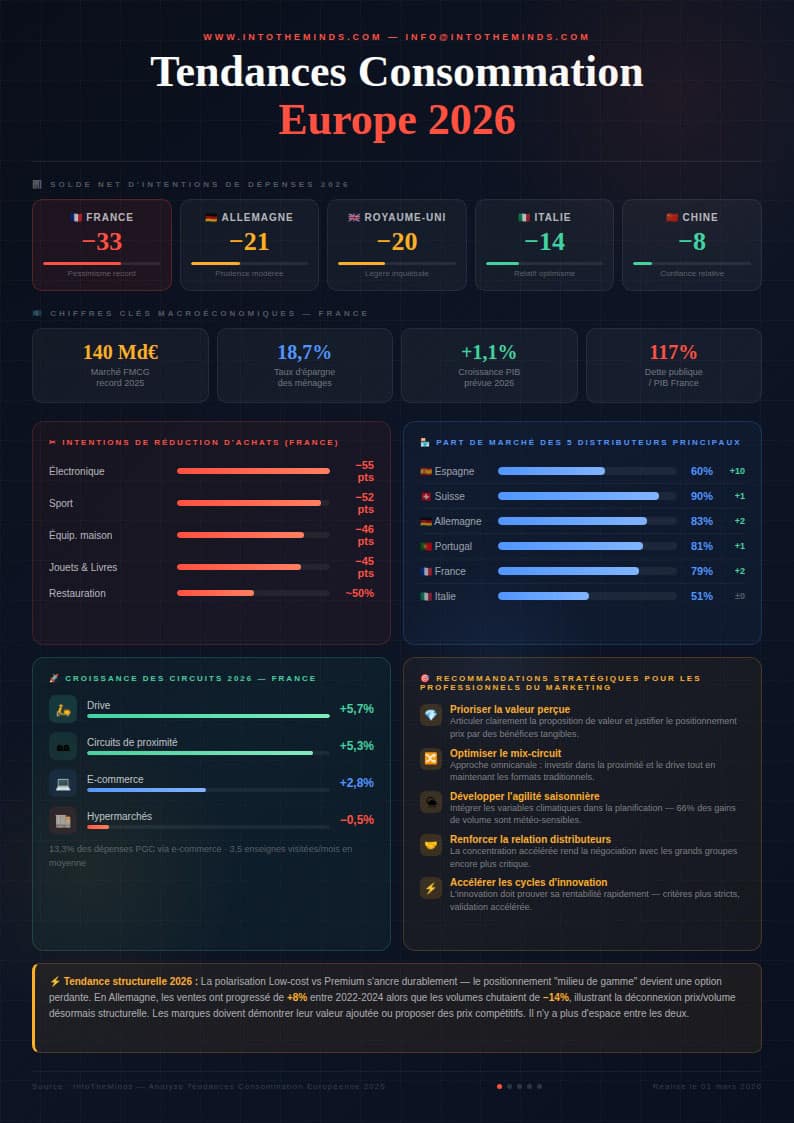
Our infographic summarizes the main elements of our 2026 consumption trends analysis, along with our recommendations for marketing specialists.
Evolution of Shopping Behaviors in 2026: Main Highlights
Trade-offs in Daily Spending
Consumption trends in 2026 are characterized by a growing polarization between purchases deemed essential and those considered non-essential. This dichotomy now structures European consumers’ strategies and redefines sectoral priorities. It therefore affects the positioning of companies. “Mid-range” positioning is a losing option in 2026. Consumers seek either low-cost or premium products, regardless of the sector.
In Germany, constant-price projections for 2026 illustrate this dynamic. The FMCG market is expected to reach €322 billion, up +1.25%. However, this growth masks mixed developments:
- Soft drinks up +2.7% (€26.7 billion)
- Care products up +2.3% (€22.7 billion)
- Alcoholic beverages down -0.5% (€21.8 billion), reinforcing the growth of the non-alcoholic segment
- Food, a safe-haven sector, maintains growth of +1.1% to reach €204.2 billion.
In France, this trade-off logic translates into plans for drastic reductions in non-essential purchases. Households plan to reduce spending on:
- Electronics (-55 points of intentions)
- Sports equipment (-52 points)
- Home equipment (-46 points)
- Toys and books (-45 points)
Even dining out, traditionally protected, is not immune: nearly half of households intend to cut these expenses, mainly due to dissatisfaction with value for money (60% of respondents). As shown in our restaurant market analysis, fast-food segments are gaining market share. Establishments like Kodawari, offering exceptional quality-experience-price ratios, are the main winners.
This polarization reflects a new maturity among European consumers, who now prioritize needs with increased rigor. Companies must demonstrate the added value of their products to justify their positioning in consumers’ baskets.
Price Hypersensitivity
Europe enters 2026 with a firmly established price sensitivity. This evolution is no longer a temporary reaction to inflation but a structural shift in purchasing habits. Consumers have not forgiven the hardships of shrinkflation and hold brands and retailers accountable.
In Germany, despite a slowdown in food inflation (1.2% for food and beverages versus 2.3% general inflation), the mindset remains cautious. The consumer climate index ranged between 95.2 in December 2025 and 96.02 in April 2025 (base January 2017=100), showing confidence that struggles to recover.
This price sensitivity drives several converging phenomena:
- Rise of private-label brands: forecasts indicate that over half of shelf space in Germany could be private-label by 2026.
- Promotions: in France, promotions already represent 21.9% of FMCG revenue in 2025, and 45% of households actively seek discounts. Shopping increasingly resembles a hunt for bargains.
- Second-hand market: the second-hand market continues to grow alongside the repair market. Consumers can no longer afford new items. The pre-owned and durable goods repair segment is poised to thrive.
This evolution redefines competitive strategies. Companies must rethink their value proposition with price as a central element of positioning. Polarizing offers between justified premium and accessible value becomes essential.
| Country | Net balance of intentions 2026 | Top 5 distributors market share 2023 | Top 5 distributors market share 2025 | Change |
|---|---|---|---|---|
| France | -33 points | 77% | 79% | +2 points |
| Germany | -21 points | 81% | 83% | +2 points |
| Switzerland | N/A | 89% | 90% | +1 point |
| Spain | N/A | 50% | 60% | +10 points |
| Portugal | N/A | 80% | 81% | +1 point |
| Italy | -14 points | 51% | 51% | Stable |
Impact Analysis on the Retail Sector
Accelerated Restructuring of Distribution Channels
Consumption trends in 2026 come with a profound transformation of distribution channels. Shopping behaviors fragment, favoring formats that combine accessibility and operational efficiency.
In France, this evolution translates into a remarkable rise in e-commerce, up +2.8% in 2025 to represent 13.3% of FMCG spending. This positions France as the second most digitalized market in Europe. At the same time, multi-store visits average 3.5 chains per month, showing increasing optimization of shopping journeys.
Consumers optimize their shopping journeys, visiting an average of 3.5 stores per month.
Projections for 2026 confirm this optimization trend. Proximity stores are expected to grow +5.3% and drive-throughs +5.7%, becoming main growth drivers. Conversely, hypermarkets continue to decline with an expected -0.5% drop. This restructuring reflects lifestyle changes and consumer expectations, favoring convenience and speed.
This shift also appears in working consumers’ food habits. During remote work, “pre-packaged meals bought from supermarkets” rose from 64% in 2023 to 72% in 2025, while meals outside the home fell from 36% to 28%. Even on-site, supermarkets maintain significant presence (45% in 2025), illustrating the embedding of these new behaviors.
European Retail Concentration Phase
Market share analysis shows increasing concentration in European retail. In seven studied countries, the market share of the top five retail groups rose between 2023 and 2025, reflecting an intensifying race for scale.
Spain shows the most dramatic growth, jumping from 50% to 60% market share for the top five distributors. France rises from 77% to 79%, Germany from 81% to 83%, Switzerland from 89% to 90%, and Portugal from 80% to 81%. Only Italy remains stable at 51%, confirming the fragmented nature of its market.
This concentration accompanies a race to negotiate and control costs in a context of margin pressure. Large retail groups leverage purchasing power to optimize supply conditions and offer competitive prices, strengthening competitive positions.
For brands, this requires adapting distribution and negotiation strategies. Relationships with major distributors become more critical, requiring differentiated approaches by market and format.
Category Dynamics
Consumption trends in 2026 reveal pronounced sectoral/category dynamics, where the search for nutritional value and climate conditions reshape purchasing priorities.
In France, ultra-fresh high-protein products show remarkable growth of +27%, while the “sports and protein” segment reaches €2.4 billion (+12%) in 2025. This trend illustrates the growing demand for nutritionally “efficient” products. Eggs perfectly symbolize this cost-benefit search with +40.2 million units sold annually.
Climate conditions also strongly influence consumption behaviors. In 2025, 66% of volume gains came from weather-sensitive categories, with dramatic increases: still water (+127 million consumer units), non-alcoholic soft drinks (+96.8 million), yogurts (+70.2 million). These “heat effects” embed part of 2026 trends in exogenous factors beyond purchasing power.
This context requires companies to integrate external variables into strategic planning and develop agility to adapt to seasonal and climatic fluctuations.
Innovation Under Constraint
After a cautious period, innovation resumes a measurable role in corporate strategies, but must quickly demonstrate commercial effectiveness. In France, innovation represents 1.1% of FMCG revenue in 2025, with launches up +16% and average revenue per innovation up +25%. This contrasts with the earlier phase of rationalization and declining innovation.
Social networks accelerate the emergence of rapid successes, but sustainability remains uncertain. The 2025 innovation ranking shows cumulative revenue (over six periods post-launch) reaching €12.97 million for the best performer, illustrating both potential and volatility.
This trend imposes a more rigorous innovation approach with stricter profitability criteria and accelerated validation cycles. Innovation becomes a balance between creativity and commercial pragmatism.
Offer Restructuring Driven by Financial Discipline
The year 2025 sets up 2026 with highly polarized expansion on “useful” formats and price trade-offs. In France, 130 expansion plans total over 2,000 potential openings in 2025, with restaurants representing 28% of projects.
Meanwhile, the market undergoes intense restructuring. Store movements accelerate with 1,084 stores rebranded in 2025, and capital transactions rise 75% year-on-year. This reflects rationalization of the commercial fabric and optimization of formats.
For 2026, the dominant idea is strategic sorting: format selection, promises, truly profitable tech investments, and a return to basics (inventory, cash, execution). This pragmatic approach reflects market maturity and the need for stricter resource management.

Strategic Recommendations for Marketing Professionals
Faced with these changes, several strategic directions are essential for marketing managers aiming to anticipate and capitalize on 2026 consumption trends.
Prioritize Perceived Value Over Volume
In a context of heightened price sensitivity, demonstrating added value is crucial. Brands must clearly articulate their value proposition and justify price positioning with tangible consumer benefits.
Optimize the Channel Mix
Fragmented shopping journeys require a sophisticated omnichannel approach. Investment in proximity stores and drive-throughs must be balanced with effective presence in traditional formats.
Develop Seasonal Agility
The growing impact of climatic factors on sales demands rapid adaptability. Companies must integrate these variables into planning and develop accelerated response mechanisms.
Strengthen Relationships with Major Retailers
European retail concentration makes negotiation with large groups even more critical. Differentiated approaches by market and format are essential.
Accelerate Innovation Cycles
Innovation must now prove profitability faster. Companies need accelerated validation processes and stricter performance criteria.
The year 2026 promises consolidation of new European consumption trends. Companies able to adapt to this behavioral shift and develop an integrated strategic approach will gain a sustainable competitive advantage.

Frequently Asked Questions
Why does France show more pronounced pessimism than its European neighbors?
France indeed has the most degraded net balance of spending intentions (-33 points) according to the international survey conducted in September-October 2025. This caution is explained by several converging factors: a high savings rate maintained at 18.7%, public debt exceeding 117% of GDP, and a trade deficit of €69 billion in 2025. French consumers appear particularly sensitive to economic uncertainty despite a record FMCG market of €140 billion.
How can the simultaneous increase in sales and decrease in volumes be explained?
This apparent paradox perfectly illustrates inflation’s impact on consumer behavior. In Germany and Switzerland, sales increased by +8% between 2022-2024 while volumes fell by -14%. This dynamic shows that value growth was entirely driven by price increases, not demand. Consumers buy less but pay more, explaining why 2026 is seen as a year of “normalization” with the price lever largely exhausted.
Which sectors best withstand consumer caution?
Analysis of German projections for 2026 reveals a clear hierarchy. Soft drinks (+2.7%) and care products (+2.3%) perform best, while alcoholic beverages decline (-0.5%). In France, ultra-fresh high-protein products grow +27%, and the “sports and protein” segment reaches €2.4 billion (+12%). These sectors benefit from the growing demand for nutritionally efficient products and prioritization of well-being.
Will European retail concentration continue?
All indicators point to an acceleration of this trend. Spain illustrates this with a dramatic jump from 50% to 60% market share for the top five distributors between 2023 and 2025. This concentration follows economic logic: cost optimization, strengthened negotiation power, and ability to offer competitive prices in a context of heightened price sensitivity. Companies must adapt distribution strategies to this new competitive environment.
How do social networks influence consumption trends?
Social networks accelerate the emergence of rapid commercial successes, particularly in innovation. In France, innovation launches increase +16% with average revenue per innovation up +25%. However, the sustainability of these performances remains uncertain. The 2025 innovation ranking shows cumulative revenues up to €12.97 million for the top performer, but this volatility requires a more rigorous innovation approach with accelerated validation cycles.