In this article, I analyse Nespresso’s marketing strategy for dealing with an increasingly competitive coffee market. Since losing its monopoly on coffee pods, Nespresso has been engaged in a battle to defend its margins. This battle involves moving upmarket, with Maison Nespresso as a visible symbol of this strategy.

The coffee market is undergoing a profound transformation. Since its patent entered the public domain in 2011, Nespresso has been particularly under pressure. On one hand, competitors are not hesitating to cut prices to capture market share. On the other hand, it faces a global coffee market under strain due to rising raw material prices. In this context, the analysis of Nespresso’s strategy and the coffee market in general reveals how a premium brand can maintain its dominant position in the face of contemporary challenges.
Contact IntoTheMinds for your market analyses
Key takeaways
- The coffee market is growing in value (+5.7%) but declining in volume (-1.1%), a sign of structural inflation
- Nespresso achieved €6.8 billion in global revenue in 2024 with organic growth of +2.2%
- The decision time in the coffee aisle has reduced to an average of 30 seconds
- Compatible Nespresso capsule market in France: €600m and 25% of the coffee aisle in supermarkets
- Coffee purchasing behaviours vary by age:
- 38% of under-34s seek a stimulating effect
- 56% of those 55 and over prioritise taste pleasure
- 39% see coffee as a break
- 30% of 16-25 year olds do not consume hot coffee, and 60% of them have already prepared cold coffee at home
- The coffee bean market is growing strongly as the price of pods becomes too high in a context of strained purchasing power
- +13.7% in volume
- 18% of volumes
- 15% of value
- 22% of purchasing households, a figure doubled in 4 years
- The “Maison Nespresso” in Paris illustrates the brand’s experiential strategy to attract younger generations
- The brand is evolving from a product model to an experience model to counter competition from coffee beans
The coffee market in structural mutation
The competitive environment in which Nespresso’s strategy evolves has become considerably more complex. Sector data reveals a paradox: while coffee revenue is growing by 5.7%, volumes consumed are declining by 1.1%. This dichotomy reflects the impact of inflation on purchasing behaviours.
Consumption habits are segmented by generation. Those under 34 primarily seek the stimulating effect of coffee (38%), while those over 55 prioritise taste pleasure (56%). This diversification of expectations forces brands like Nespresso to adapt their communication and product offering.
The decision time in the aisle has reduced to an average of 30 seconds, reinforcing the importance of offer readability and price-promise consistency. In this context, Nespresso’s marketing strategy is under pressure. Nespresso has of course relied on loyalty and data collection to defend its market share. But this is no longer sufficient. We are witnessing the affirmation of a premium positioning that directly opposes the “low cost” strategy of its competitors.
The coffee bean market is growing
Data from market research institutes reveals a major trend directly impacting Nespresso’s strategy: the spectacular rise of coffee beans. With a 13.7% increase in volume, this segment now represents 18% of volumes for 15% of value. Even more significant, 22% of French households buy coffee beans, a figure that has doubled in four years.
This dynamic is explained by a substantial economic advantage: the cost of coffee beans remains 30% lower than capsules for equivalent consumption. Faced with this competitive pressure, Nespresso’s approach is to strengthen the perceived value of its ecosystem rather than engage in a price war.
Meanwhile, traditional formats are experiencing a notable decline. Ground coffee is losing 6.7% of its sales, while soft pods are dropping 5.5%. This redistribution of market share forces Nespresso to constantly justify the relevance of its capsule-based economic model.
Cold coffee: new conquest territory
An emerging trend is reshaping the market contours: 30% of 16-25 year olds do not consume hot coffee, and 60% of them have already prepared cold coffee at home. This behavioural evolution opens new opportunities for Nespresso’s strategy, which is developing systems and capsules adapted to these new uses.
The strategic challenge is to capture this young clientele without cannibalising the traditional offer. The brand is experimenting with nomadic formats and recipes inspired by coffee shops to meet this growing demand for functional and refreshing coffee.
Nespresso’s financial performance
Nespresso’s financial results demonstrate the resilience of its strategy. With €6.8 billion in global revenue in 2024, the brand shows organic growth of 2.2%, exceeding the published growth of 0.1%. This performance is remarkable in a context where activity is judged “low dynamic” in Western Europe.
In France, compatible Nespresso capsules in mass distribution generate €660m in revenue, representing about 25% of the coffee aisle. This data illustrates the scale of the ecosystem created around the brand, well beyond its own direct sales.
The network of 50 French boutiques (including 15 in partnership) constitutes a strategic pillar for capturing value outside mass distribution and strengthening the direct relationship with customers. Although boutique and e-commerce sales are not communicated separately, they remain central to Nespresso’s economic model.
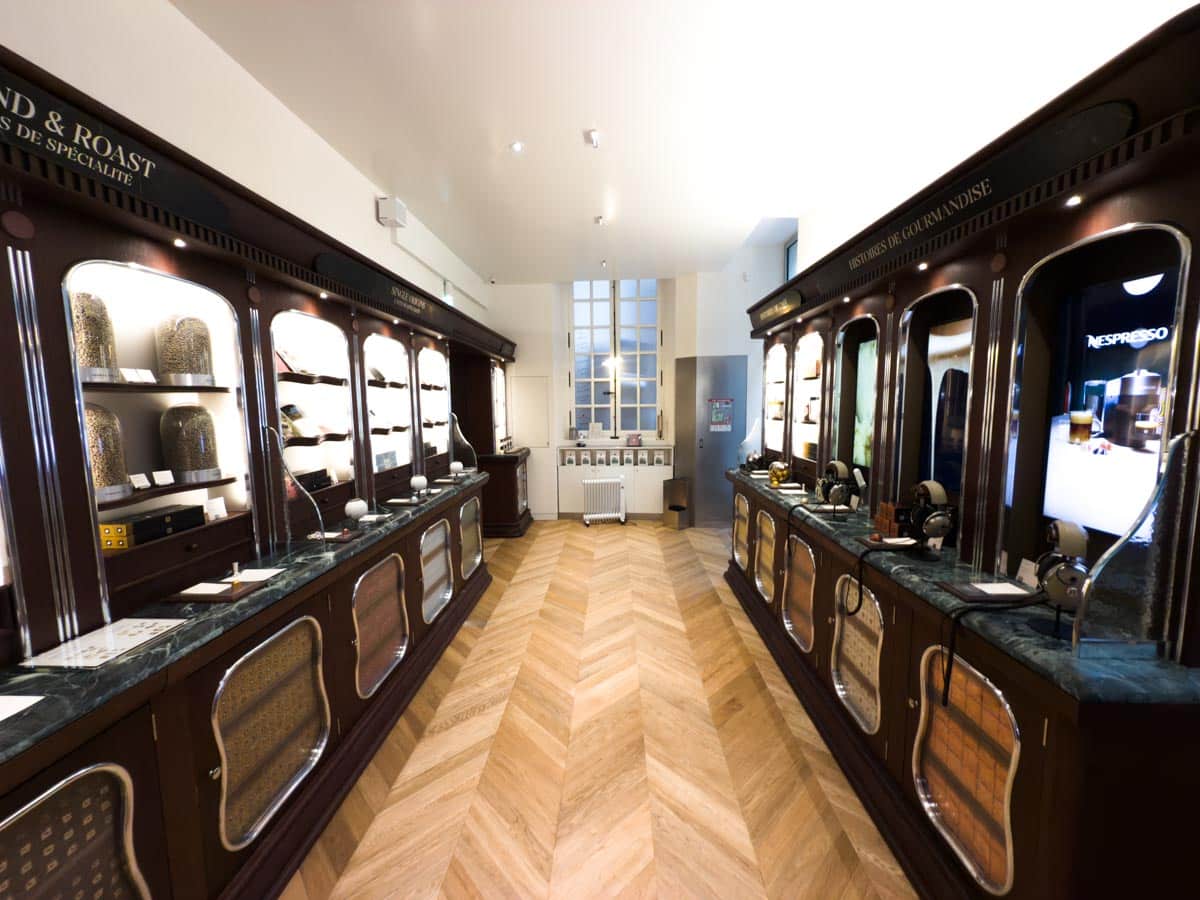
The Maison Nespresso is a new concept opened in October 2025 by Nespresso in the historic Marais district in Paris (address: 47, rue Vieille du Temple, 75001 Paris). It is a hybrid place offering a premium experience around coffee. In this photo (which I took on 22 December 2025), you can see various devices that enhance the customer experience: headphones to listen to atmospheres related to each coffee, olfactory devices to appreciate the nuances of each coffee. The use of green marble, dark woods, contributes to this upscale positioning.
The Maison Nespresso: premium laboratory
The opening of the Maison Nespresso in the Marais district in Paris perfectly illustrates the brand’s strategic evolution. Located in a 17th-century private mansion, this 200 m² concept store accessible to the public (of which only 15 m² dedicated to coffee) employs 23 staff to offer a complete immersive experience.
With an espresso at €2.90, the objective is not direct profitability but brand value generation. Tastings, barista workshops and master classes create an emotional link with consumers, particularly young adults sensitive to out-of-home coffee experiences.
The marketing of exclusive coffee beans (a world exclusive) demonstrates Nespresso’s innovation capacity to respond to new market expectations. The success of this initiative is already measurable: the post announcing the opening generated the best reach in the brand’s history in France.
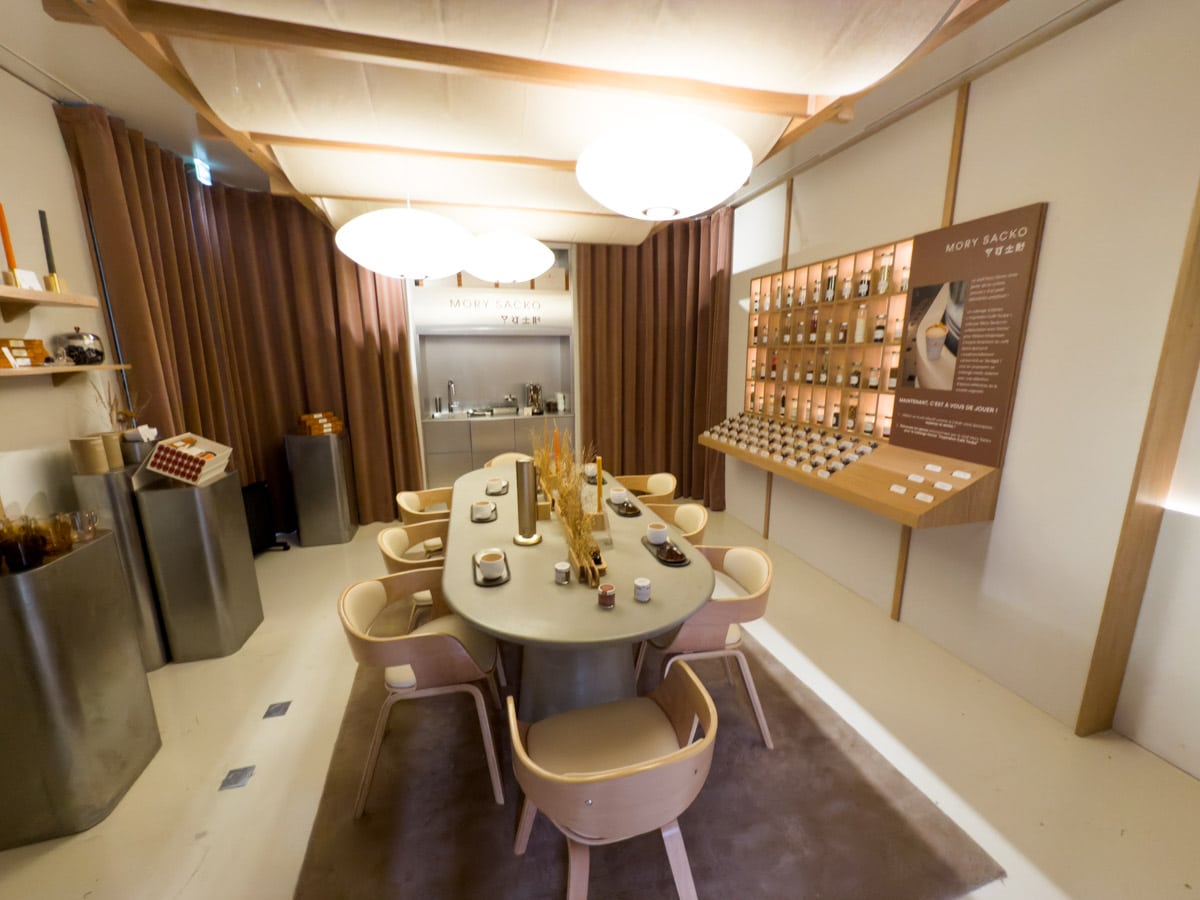
The Maison Nespresso has a reception area for tasting coffees and pastries. I had the pleasure of being invited (Thank you to Laura and Max for their kindness) and discovering the entire experience around the brand. Once again, there is clearly a desire to move upscale by offering a premium and personalised service. The least we can say is that it is very successful.
Omnichannel strategy: combining digital and physical
Nespresso’s overall marketing approach revolves around 4 strategic axes
- Strengthening the “premium” character of the brand: this is reflected in the customer experience in boutiques. These have become real brand theatres, integrating design, storytelling and culinary collaborations to create a memorable experience. Note also the semantics used by the brand: the “Maison” Nespresso refers to luxury codes since this is the term particularly used by luxury groups to talk about their brands.
- Reconnecting with younger generations: Nespresso draws inspiration from coffee shop codes, which is evident in the “Maison Nespresso” that has just opened in Paris. Nespresso offers milky drinks, take-away formats and positions itself against competition with energy drinks. This strategy aims to rejuvenate the customer base without losing the brand’s premium DNA.
- Innovation and sustainability: supported by Nestlé, develops compostable pods and reduces carbon footprint to justify higher unit prices. This approach responds to growing consumer environmental concerns.
- Communication strategy: it combines high GRP campaigns, massive tastings and digital influence strategies to recruit and rejuvenate customers. This 360° approach maximises brand visibility at all touchpoints.
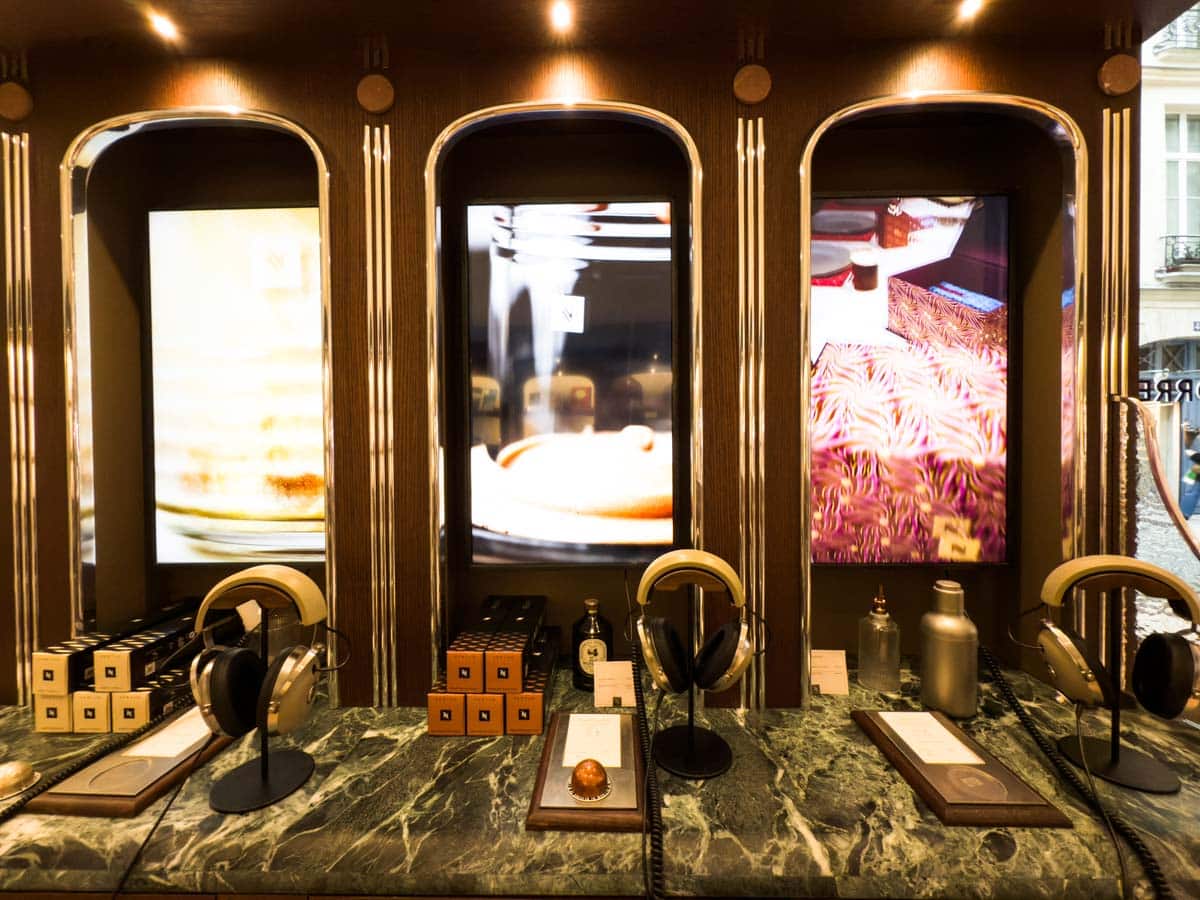
The strengthening of Nespresso’s premium character is clearly visible in this photo. Not only does the brand fully play the experience card by offering an acoustic immersion in the coffee universe, but there is also an interesting use of high-end materials. Note the green marble, dark wood, leather on the audio headphones. You are no longer really in a coffee shop. You are in the brand universe that tends towards luxury.
Challenges and evolution prospects
The strategic analysis reveals that Nespresso is evolving from a product model to an experience-brand model in a structurally inflationary market losing volumes. The brand faces three major challenges:
- the growing compatibility of systems, which erodes its initial monopolistic position
- the rise of coffee beans
- the emergence of new uses such as cold and functional coffee.
The Maison Nespresso acts as an emotional flagship, a differentiation tool and a usage laboratory intended to maintain the desirability of a historically premium model. This experiential strategy allows justifying a high price positioning through superior perceived value.
The future challenge is to maintain the balance between innovation and tradition, between accessibility and exclusivity, to preserve leadership while adapting to changing consumer behaviours.
Frequently asked questions about Nespresso’s strategy
How does Nespresso maintain its position against competition from compatible capsules?
The strategy relies on differentiation through experience rather than product alone. Nespresso relies on its boutique network, premium services and constant innovation to justify a higher price. The brand ecosystem (machines, accessories, customer experience) creates a barrier to entry that compatible capsule manufacturers struggle to reproduce.
What is the impact of sustainable development on marketing strategy?
Sustainable development is becoming a central sales argument to justify premium prices. Nespresso develops compostable capsules and communicates on reducing its carbon footprint. This approach responds to the expectations of consumers aware of environmental issues, particularly among younger generations.
Why is Nespresso investing in concept stores like the Maison Nespresso?
These spaces serve as experience laboratories and differentiation tools. They allow creating an emotional link with consumers, testing new concepts and justifying premium positioning through a unique experience. The objective is not direct profitability but long-term brand value generation.
How is the brand adapting to new coffee consumption habits?
Nespresso is developing systems adapted to cold coffee and new functional uses to capture young customers. The brand draws inspiration from coffee shop codes with milky drinks and nomadic formats, while preserving its premium DNA. This adaptation allows rejuvenating the customer base without cannibalising the traditional offer.
What is the place of digital in Nespresso’s omnichannel strategy?
Digital complements the physical experience without replacing it. Nespresso uses influence and social networks to recruit new customers, particularly younger generations. E-commerce integrates into a fluid customer journey combining boutiques, website and mobile app to maximise customer lifetime value.