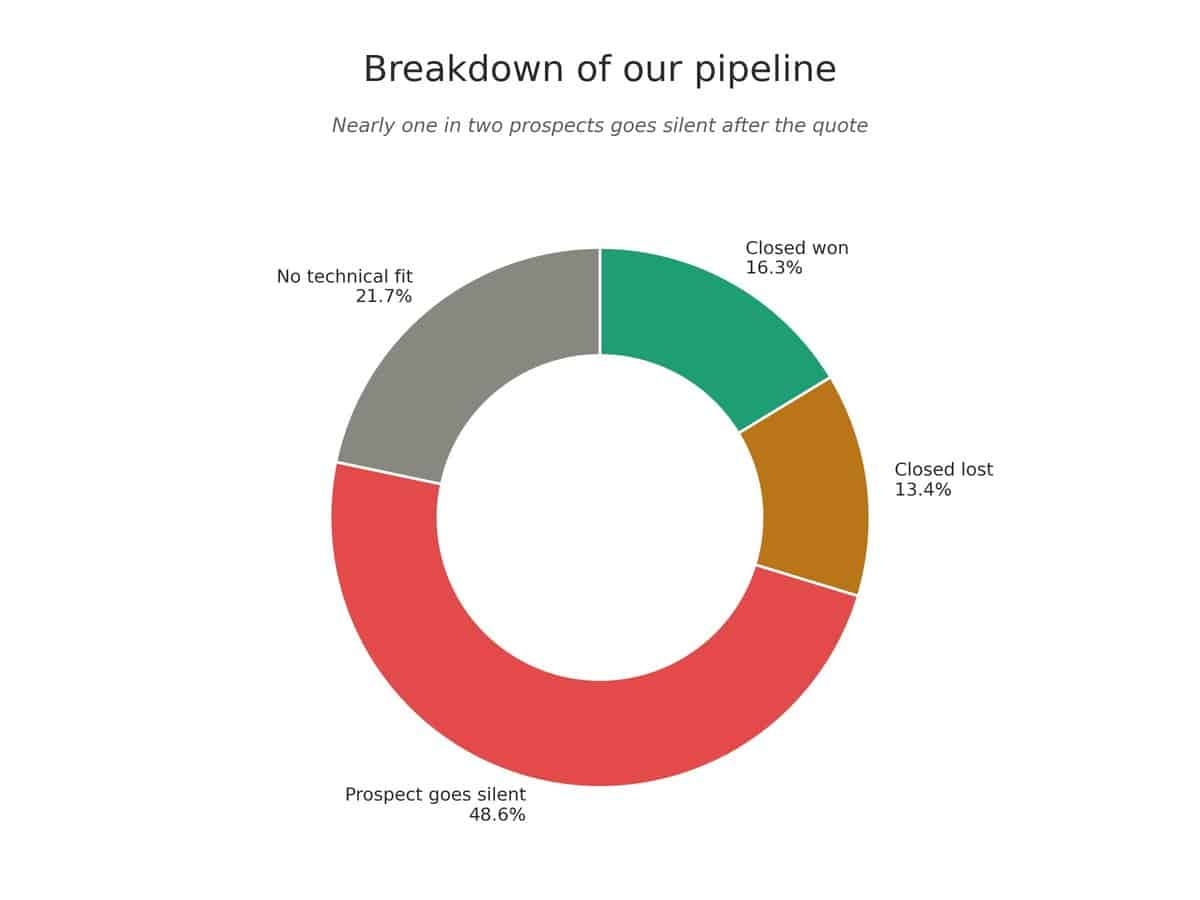
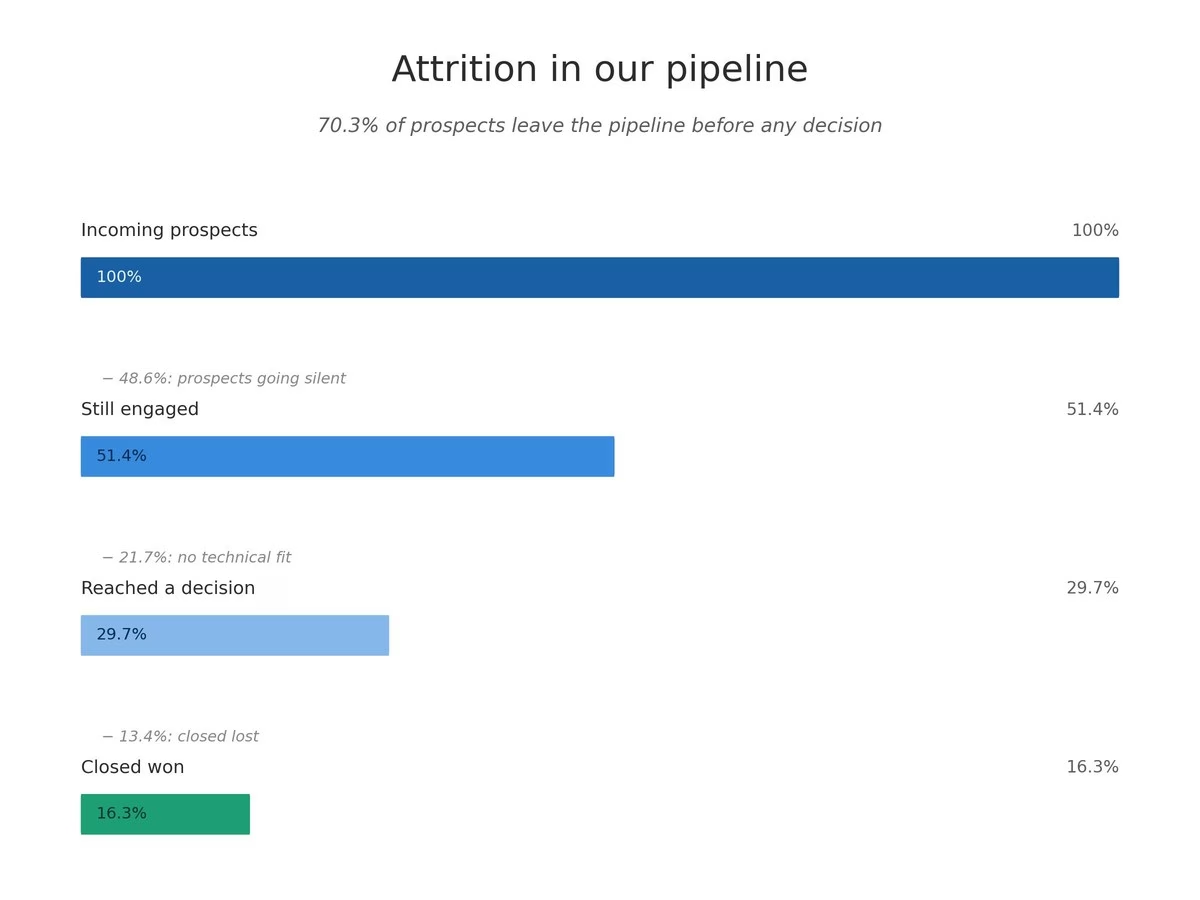
48.6% of our prospects never get back to us after receiving a quote. This isn’t a particularly high percentage, but it makes me wonder about the signs that help distinguish a good prospect from a bad one.

In 2025, 48.6% of prospects who contacted us to conduct market research never got back to us after receiving the quote. This is not exceptional. According to a report by HubSpot, 61% of B2B leads passed on to sales teams are never converted. Naturally, this led me to reflect on lead qualification and to focus my attention on the prospects that are truly worth the effort. Why? Because every quote written, every hour invested in a prospect who will never buy represents a direct cost to your margin. In this article, I share my thoughts on the signals that indicate a bad prospect.
Contact IntoTheMinds for your marketing needs
Key takeaways
- A qualified prospect meets specific criteria: identified budget, decision-making authority, genuine need, and a defined timeline.
- Between 50% and 70% of B2B service leads are not qualified when they first contact a provider.
- 4 behavioral signals help identify a prospect who will not convert: unjustified urgency, lack of budget framing, silence after receiving a quote, and lack of courtesy in communications.
- The BANT, MEDDIC, and CHAMP frameworks provide systematic qualification grids, but each has limitations depending on the context.
- In 2026, a new risk has emerged: AI-generated briefs, often well written but lacking any real commitment.
Lead qualification is an economic issue
Framing the qualification question in terms of gut feeling or “bad impressions” is a mistake. The real issue is financial.
According to HubSpot’s 2026 data, the average B2B lead conversion rate ranges between 2% and 5% depending on the industry. In other words, out of 100 inbound contacts, between 95 and 98 will never become clients. Fortunately for us, our rate is above 16%. What is certain, however, is that each quote represents an average of 6 hours of work. Sometimes it is even more because for certain specific market research projects, we provide a free technical pre-study beforehand in order to size the sample correctly. Out of 100 requests per year, if 65% come from unqualified prospects, that amounts to nearly 400 hours spent annually on contacts that will never lead anywhere.
When calculated based on the hourly cost of a senior consultant, this represents a direct loss that very few service companies have precisely quantified. Yet this is the first step: treating lead qualification as a cost line, not as a subjective filter.
| Indicator | Reference value in B2B in 2026 |
|---|---|
| Lead → client conversion rate | 2% to 5% |
| Share of unqualified leads | 50% to 70% |
| Average time spent per unconverted quote | 3 to 6 hours |
| Average B2B customer acquisition cost | €1,000 to €5,000 depending on the sector |
Lead qualification therefore protects your margin, but it also protects the quality of the work delivered to the clients who truly deserve your full attention.
The 4 signals of a bad prospect
These 4 signals are not theories. They stem from direct observation of hundreds of B2B sales processes across sectors as varied as consulting, market research, technology services, and training. Each one can be identified from the very first exchanges, long before a quote is submitted.
Unjustified urgency for the quote
“Can you send me a proposal by tomorrow morning?” This sentence, spoken during the very first contact, is a warning sign. Not because urgency is impossible, but because unjustified urgency generally reveals the absence of a real project. Curiously, we receive this kind of request from other market research firms, particularly those based in India. We never follow up on them.
A serious B2B buyer knows that drafting a quality proposal takes time. If they demand a response within less than 24 hours for a complex project, two scenarios generally arise:
- either they are massively consulting several providers to obtain price benchmarks without any intention of buying
- or they have not yet defined their needs and are using your proposals to help formulate them.
In both cases, the conversion rate is extremely low. I am not saying I have never signed a contract with a rushed buyer, but it is exceedingly rare. Generally, B2B service sales cycles average between 3 and 6 months for significant contracts. A prospect asking for a quote within 24 hours for a project of this scale is statistically not engaged in a mature purchasing process.
The operational advice: ask a simple question in return. “What is the reason behind this urgency?” A real buyer will provide a precise answer. An unqualified prospect will respond vaguely, or not respond at all.
The absence of budget framing
The BANT framework (Budget, Authority, Need, Timeline) has remained the most widely cited commercial qualification framework since the 1960s. Its first letter, B for Budget, is no coincidence. Without an identified budget allocation, no serious commercial conversation can move forward. In the image below, you can see some of the 200 business opportunities (“leads”) sent to us by the Sortlist platform. You will notice that we systematically reject all projects for which no budget is specified (or where the budget is too low according to the budgets required to conduct market research).
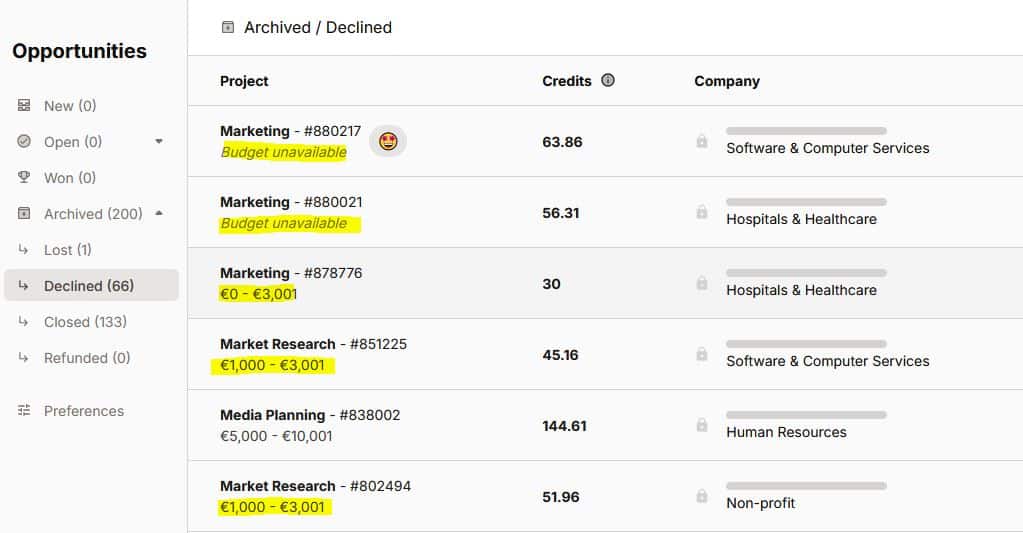
Overview of our Sortlist dashboard. Out of 200 leads sent to us, we purchased only one, which shows how demanding we are regarding lead qualification criteria. Budget is a decisive criterion. As you can see in yellow, budgets are often insufficient to conduct market research worthy of the name.
Yet, 72% of B2B buyers avoid disclosing their budget during the discovery phase, fearing they will be “capped” in the proposals they receive. This behavior is understandable, but it creates an information asymmetry that penalizes both parties.
A prospect who categorically refuses any discussion about the budget, even within broad ranges, sends a clear signal: either they have no allocated budget, or the project has not yet been validated internally. In both cases, you are not dealing with a qualified lead in the strict sense of the term.
The best practice is to introduce the budget question indirectly during the scoping call: “To propose an approach adapted to your needs, could you give me a range, even an approximate one?” A serious prospect will cooperate, at least partially.
Silence after the quote and the 12-hour rule
You submitted a carefully prepared proposal. Two days pass. Then a week. Complete silence.
This behavior is one of the most reliable predictors of non-conversion. Data on B2B sales cycles shows that prospects who acknowledge receipt of a quote within 12 hours of receiving it have a significantly higher conversion rate than those who remain silent for more than 48 hours. Even a simple acknowledgment such as “received, thank you” distinguishes an engaged buyer from a prospect collecting quotes without any firm intention.
This signal is all the more revealing because it requires zero effort from the prospect. Replying “received, thank you” takes 10 seconds. When that message never comes, it means the commitment simply does not exist.
 Lack of courtesy in interactions
This fourth signal is the least “quantifiable” of the four, but it is probably the most decisive in the long term. A prospect who does not greet, who sends emails without polite phrasing, who abruptly cuts exchanges without explanation, or cancels calls at the last minute without apologizing: these behaviors reveal an unbalanced relationship from the outset.
The correlation between the quality of pre-contractual exchanges and the quality of the post-signature client relationship is strong. A client who behaves disrespectfully during the prospecting phase will, in the vast majority of cases, be difficult to manage once the contract is signed. This is not a moral judgment, but an empirical observation.
Beyond work comfort, this has real economic consequences: “difficult” clients consume more resources, generate more disputes, and rarely produce recommendations. Their customer lifetime value is structurally lower than that of a respectful client, even at equivalent contract levels.
How to systematize prospect qualification
Identifying warning signals after the fact is useful. Anticipating them through a structured process seems to me far more effective. Prospect qualification can and should be industrialized, provided the right methodological framework is chosen.
The BANT framework and its limits in 2026
The BANT framework (Budget, Authority, Need, Timeline) has structured sales qualification for decades. It was one of the first things I learned when I started entrepreneurship (which does not mean I applied it). Its advantage is simplicity: there are only four binary criteria. Its drawback is rigidity, and it must be said that it is not easy to ask these four questions to a prospect. I find these criteria can be devaluing if you are not speaking directly to the decision-maker.
In any case, the BANT model is increasingly less applicable. The reason is that in 2026 B2B purchasing cycles have become more complex, more collective, and longer. My experience is that the single decision-maker controlling budget, need, and timeline has become rare, especially in large organizations. B2B purchasing decisions involve on average 6 to 10 stakeholders in companies with more than 100 employees.
Moreover, what I have often observed is that people contacting us for a market research project have no idea of the budget to allocate. This may explain the requests I receive via Sortlist (see screenshot above).
Two alternative frameworks: MEDDIC and CHAMP
Two alternatives deserve the attention of B2B service sales teams:
- MEDDIC (Metrics, Economic Buyer, Decision Criteria, Decision Process, Identify Pain, Champion): more suited to complex sales and long cycles. It forces the salesperson to identify an internal “champion” within the prospect organization, which is often decisive in intellectual service sales.
- CHAMP (Challenges, Authority, Money, Prioritization): a modernized version of BANT that places the prospect’s business challenges before budget considerations. More suitable for a consultative approach.
At IntoTheMinds, our practice has gradually moved closer to CHAMP: understanding the real problem of the potential client first, before discussing budget, leads to more honest exchanges and better-calibrated proposals.
Practical qualification tools
Systematization relies on three complementary tools:
- Pre-brief form: a questionnaire of 8 to 12 questions sent before any discovery call. It filters out prospects who do not take the time to respond (a strong negative signal) and structures the conversation for those who engage.
- Scoping call: maximum 30 minutes, with a standardized question grid covering the four CHAMP dimensions. Its objective is not to sell, but to qualify. As far as we are concerned, if we cannot conduct a scoping interview with a new prospect, we do not prepare an offer.
- CRM scoring: assigning a numerical score to each prospect based on qualification criteria, with a minimum threshold below which no proposal is written.
The specific case of AI-generated briefs in 2026
A new phenomenon has complicated prospect qualification since 2025–2026: briefs written using generative AI tools. These documents are often well structured, use precise professional vocabulary, and appear to come from informed buyers. However, they frequently conceal a project that is still embryonic or even non-existent. More importantly, they reveal the prospect’s inability to evaluate your proposal.
If you want to commission a market research study, I can only refer you to my advice on writing a briefing document. At least that way, you will have all the cards in hand.
The signals of an unqualified AI-generated brief are specific:
- lack of company-specific internal data
- generic formulations interchangeable across sectors
- inability of the contact person to answer precise questions during the scoping meeting
- phrases (and often formatting) clearly suggesting generative AI use
Without generalizing, these briefs are often produced by junior profiles who do not fully master the subject. The rule is simple: a brief, no matter how well written, never replaces a human qualification conversation.
Prospect qualification checklist
- Has the prospect identified a budget range, even approximately?
- Is the contact person a decision-maker or an intermediary?
- Is the need clearly articulated with internal data?
- Is there a defined decision timeline?
- Has the prospect completed the pre-brief form?
- Is the requested deadline for the proposal reasonable?
- Are initial exchanges respectful and responsive?
- Does the brief contain company-specific (non-generic) information?
The politeness–seriousness correlation
Patterns repeat with a regularity that begins to resemble an empirical law. The clients who have signed the most successful contracts, the richest collaborations, and the mandates renewed year after year almost all share the same behaviors during the prospecting phase: they respond quickly, ask precise questions, and respect their interlocutors’ time.
This is not a coincidence. The way a prospect treats a potential service provider before signing is revealing of their organizational culture, their maturity in purchasing intellectual services, and their ability to engage in a productive working relationship. When a prospect once replied to me, “I have a lot of things to do and you will answer as soon as possible,” believe me, my willingness to work with them quickly disappeared.
Also keep in mind that the hidden cost of bad clients goes far beyond time lost on a proposal. A difficult client mobilizes cognitive energy that is no longer available for good clients. It generates decision fatigue in teams, creates negative biases toward future prospects, and progressively degrades the quality of deliverables. To the point where one sometimes has to ask how to get rid of troublesome clients.
I will end this article by opening the door to you 😀. If you want to structure your sales approach with solid data about your target market, our B2B market research studies can help you identify the most qualified prospect segments and those most likely to convert in your industry.

FAQ: the questions you are asking
How do you qualify a B2B prospect?
Qualifying a B2B prospect means assessing whether they meet the conditions required for conversion: an identified budget, decision-making authority, a real need, and a defined timeline. The BANT framework remains a reference, but approaches such as CHAMP or MEDDIC are better suited to complex sales in 2026. A pre-brief form and a structured discovery call make it possible to collect this information before investing time in a proposal.
What are the essential criteria for qualifying a prospect?
The most decisive prospect qualification criteria are: the presence of an allocated budget or estimated budget range, identification of the real decision-maker, a clearly articulated need supported by specific internal data, and a defined decision timeline. To these rational criteria are added behavioural signals: responsiveness in exchanges, quality of answers in the pre-brief, and courtesy in communication.
What is the difference between an MQL and an SQL?
An MQL (Marketing Qualified Lead) is a prospect who has shown interest in your content or offers without yet expressing a firm purchase intent. An SQL (Sales Qualified Lead) is a prospect who has been evaluated by the sales team and meets the qualification criteria: budget, authority, need, and timeline. The transition from MQL to SQL marks the point at which the prospect deserves direct sales investment.
How do you quickly detect an unqualified prospect?
Four signals help identify an unqualified prospect early on: a request for a quote with unjustified urgency, a complete lack of budget framing despite questions asked, silence within 12 to 48 hours after sending a proposal, and a lack of courtesy or responsiveness in communication. These signals are not infallible, but their combination is a very reliable indicator of non-conversion.
Which tool should you use to qualify B2B prospects?
A CRM with a scoring system is the foundation for industrialising prospect qualification: each lead receives a score based on BANT or CHAMP criteria, and only prospects above a defined threshold receive a commercial proposal. In addition, a pre-brief form and a structured interview guide for the discovery call help systematically collect the necessary information. For companies that want to go further in understanding their target market, a B2B market study helps identify high-conversion potential segments.
Is prospect qualification different in B2C?
In B2C, qualification criteria are less formal, but the principle remains the same: identifying potential customers whose profile matches your offer and who have real purchase intent. The tools differ (behavioural scoring on-site, socio-demographic segmentation, customer journey analysis), but the objective is identical: focusing sales and marketing resources on the most likely converting prospects. IntoTheMinds also conducts B2C market studies to help companies better target their potential customers.