“Shadow AI” is a reality in companies. Employees use generative AI on a daily basis, and our study shows that this usage is largely unregulated. However, any framework put in place requires careful consideration, as it shapes your company’s appeal and can influence your recruitment efforts.

Generative AI is present in every company. It has entered them without making a noise. Our market research institute conducted a survey in France among 500 people who use generative AI at work, showing that 57.2% of them use personal accounts and that 18% pay for their subscription out of their own pocket. Our study also reveals a phenomenon of anxiety: 43.6% fear that their colleagues will notice that they have used AI. These figures measure the extent of a form of usage that is largely invisible to IT departments. This is shadow AI, as we called it several years ago in this article. But our study also reveals a generational divide in how these tools are used, financed, and how employees react to employer rules. For HR departments, understanding this divide is important. It shows that AI policy is becoming a recruitment, retention and training issue.
Contact the IntoTheMinds research firm
Key takeaways
- Shadow AI is the norm: 57.2% of users rely exclusively on personal accounts for their work, and 72.8% use at least one.
- Banning it does not reduce shadow AI; it drives it underground: 69.2% of employees subject to a ban still use a personal account, and 56.9% fear being detected.
- A written policy alone changes nothing: 74.7% of users remain exclusively on their personal accounts, compared with 75.7% in companies that have done nothing. With an official tool and training, the proportion falls to 19.1%.
- All generations embrace it (79% to 82% complete their tasks faster), but personal investment collapses with age: 28% of 18-24-year-olds pay for a subscription, compared with 4% of 55-65-year-olds.
- Those aged 25-34 are the most exposed generation: 67% use AI daily, 59% fear their colleagues’ judgment, and 46% would look for another job if their company banned AI.
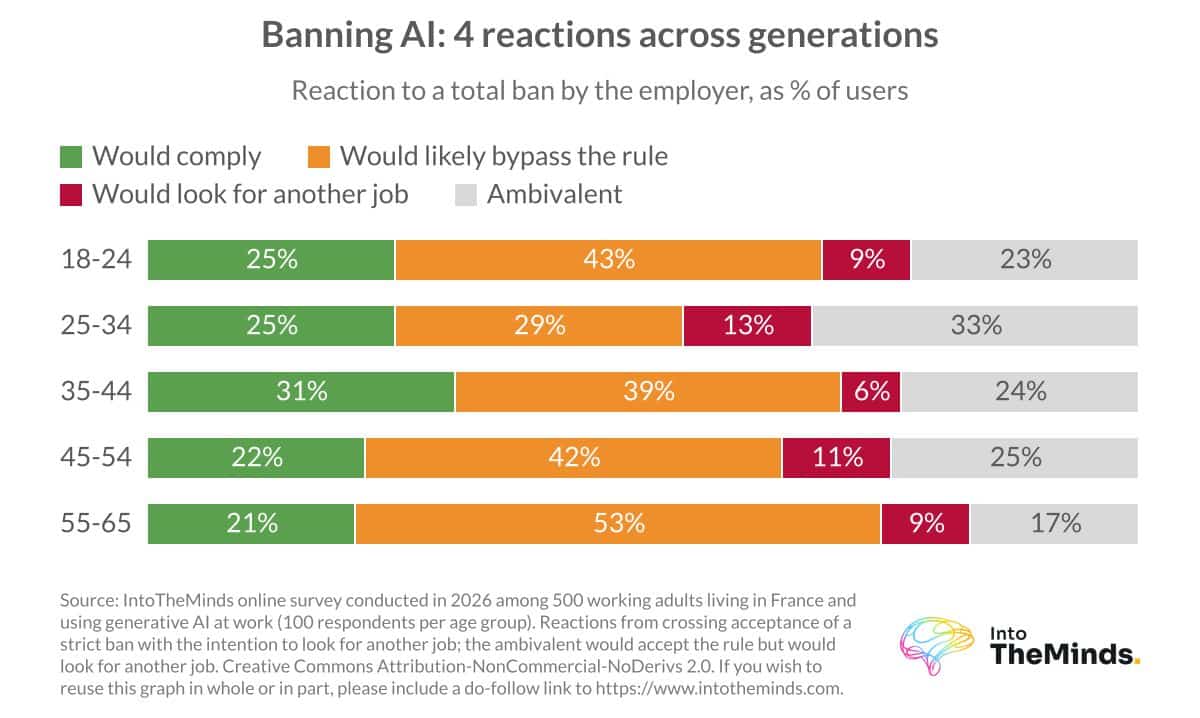
- When faced with a ban, younger employees would look to leave while older employees would circumvent it: 53% of 55-65-year-olds reject the rule without considering leaving their job.
- 61.4% of users at least sometimes use the time saved for personal activities, compared with 71% to 72% before age 35 and 51% to 54% after age 45.
Contact the IntoTheMinds institute
Individual use comes before corporate adoption
The gap between individual use and official use is already apparent in public statistics. In the study Economy and Society in the Digital Age published by INSEE in 2025, 10% of French companies reported using artificial intelligence in 2024, compared with 33% of people aged 12 and over for professional or personal use. The same publication already identifies a strong age gradient: 58% of 18-24-year-olds used AI in 2024, compared with 25% of 40-59-year-olds.
Our survey sheds light on what happens in this gap:
- How employees who use generative AI at work equip themselves
- What they gain from using AI
- How do they react to the framework set by their employer?
The data concerns France, but the mechanisms extend beyond the French context. The same consumer tools dominate across Europe, and the same tensions between individual use and corporate policy are likely to be found there as well.
57.2% of professional generative AI users rely exclusively on personal accounts.
Shadow AI: the majority of employees equip themselves
Shadow IT referred to employees installing software without IT management’s approval. Shadow AI refers to the use of AI (generative AI) tools within a company without the company regulating their use. Unsurprisingly, our study shows that the majority of employees are concerned by this practice:
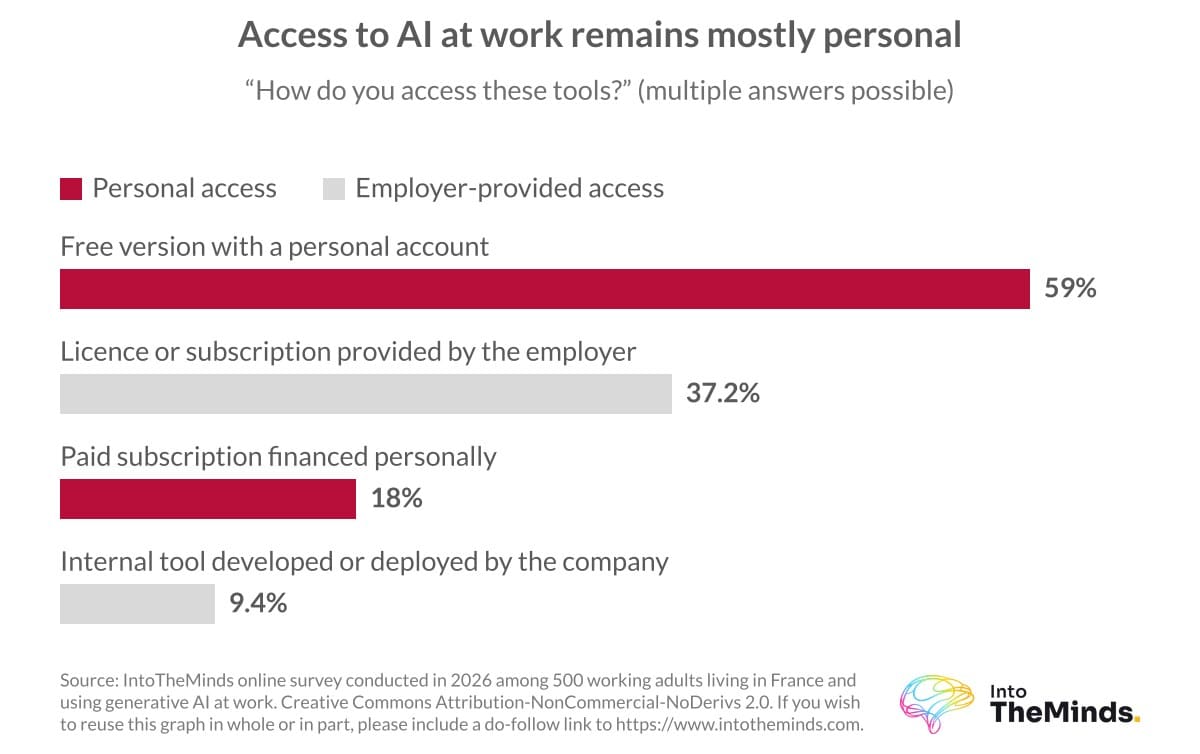
- 59% access generative AI through the free version of a personal account
- 18% pay for a subscription themselves
- only 37.2% have a license provided by their employer
- 9.4% use a tool developed or deployed by their company.
| Access mode (France, 2026) | Share of users |
|---|---|
| Personal accounts only (free or paid) | 57.2% |
| Official access only (employer license or internal tool) | 27.2% |
| Both | 15.6% |
Practices vary considerably depending on company size:
- in organizations with 2 to 10 employees, 67.3% of users are fully engaged in shadow AI
- there is 70.8% shadow AI in companies with 11 to 50 employees.
- the figure falls to 47.6% in companies with 501 to 1000 employees
- but rises again to 55.8% in groups with more than 5000 employees.
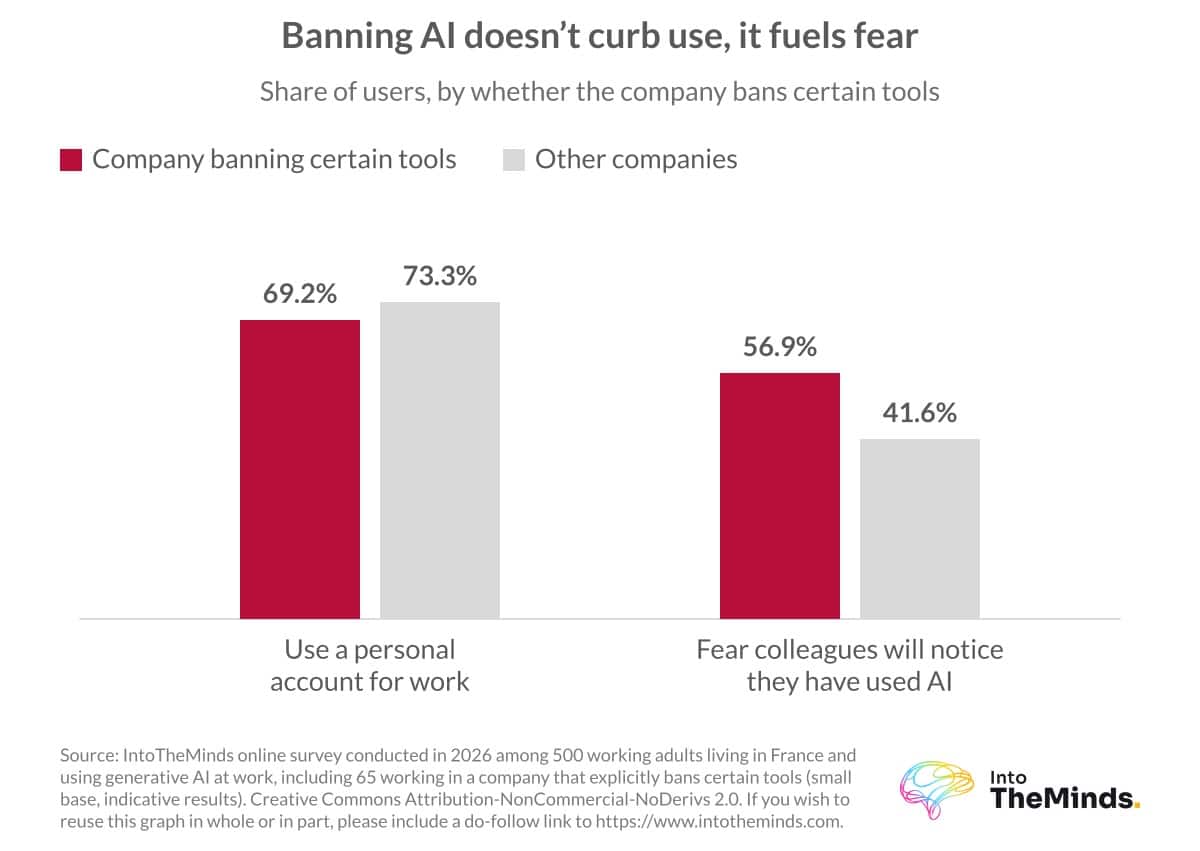
A ban does not reduce the phenomenon. 13% of respondents work in a company that bans certain tools, and 69.2% of them nevertheless use a personal account, a proportion close to the average (72.8%). However, when a company bans the use of generative AI, the visibility of its use is affected. Employees are then 56.9% likely to fear that their colleagues will notice that they have used AI, compared with 41.6% elsewhere. Another paradox is that providing a tool is no longer enough. We note that even in companies that report providing official access, 59.1% of users continue to use a personal account.
Even in companies that report providing official access, 59.1% of users continue to use a personal account.
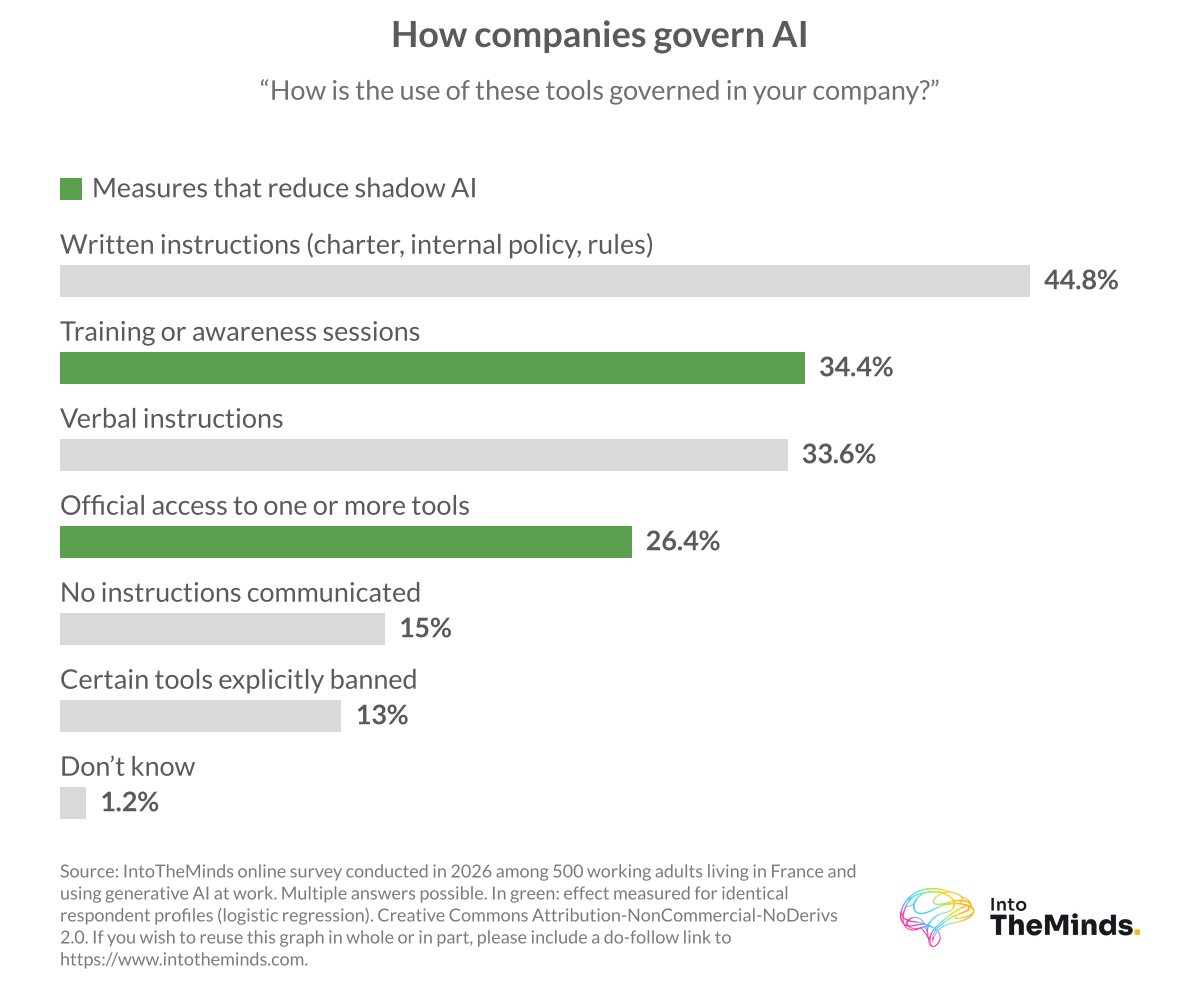
What really reduces shadow AI? To find out, we classified respondents according to what their company had implemented:
- nothing at all
- a simple written policy
- training
- an official tool
- an official tool combined with training.
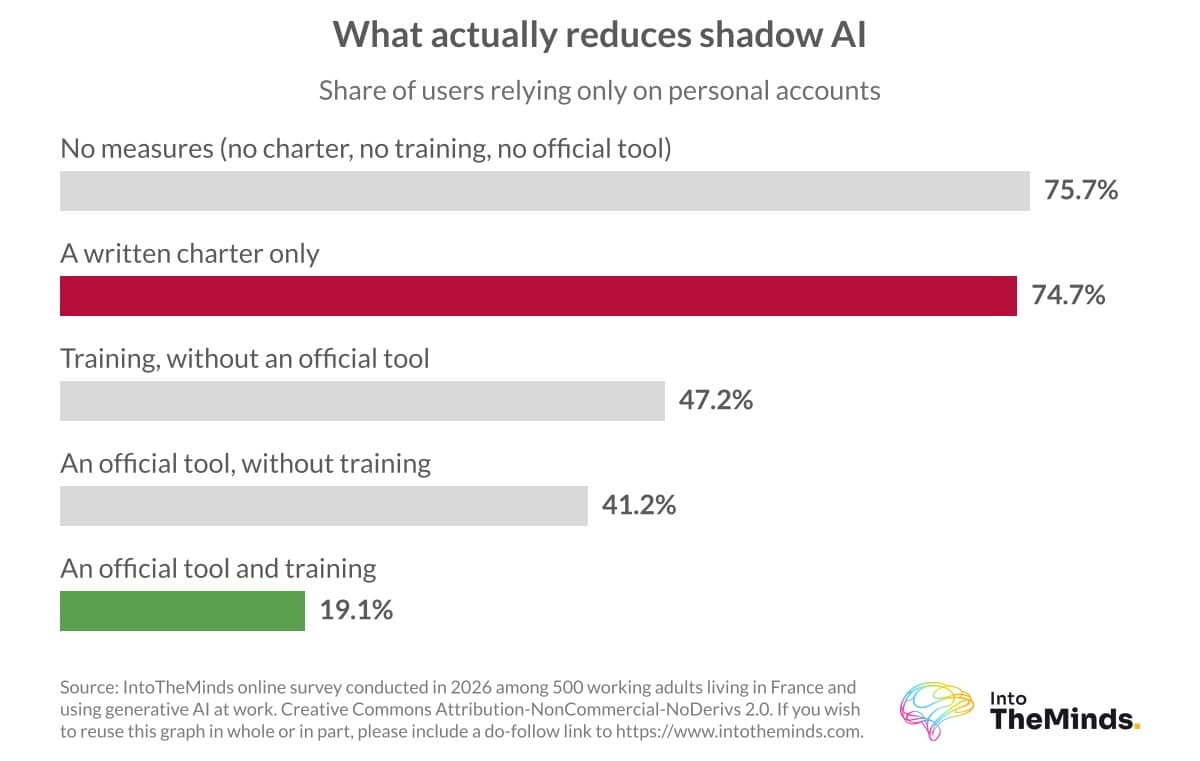
For each situation, the table below shows the share of users who rely exclusively on personal accounts.
| What the company has implemented (France, 2026) | Users exclusively on personal accounts |
|---|---|
| Nothing (no policy, training or official tool) | 75.7% |
| A written policy only | 74.7% |
| Training, without an official tool | 47.2% |
| An official tool, without training | 41.2% |
| An official tool and training | 19.1% |
The conclusions are clear:
- A written policy alone changes nothing: 74.7% of users remain fully engaged in shadow AI, compared with 75.7% in companies that have done nothing.
- Training brings this share down to 47.2%, while an official tool brings it down to 41.2%.
- Combining the two brings it down to 19.1%.
The result holds when comparing employees with identical profiles (same age, same gender, same company size, same role, same intensity of use): the official tool and training remain the only two factors that clearly reduce shadow AI, while the written policy has no significant effect.
Shadow AI is also psychological. 43.6% of users fear that their colleagues will notice their use of AI. Quite logically, we observe a difference depending on the tools used:
- This concern affects 51.4% of those who rely exclusively on personal accounts
- only 30.1% of those who use only official access feel this anxiety
We can therefore say that the tool provided by the company legitimizes its use.
Finally, 61.4% of respondents say that they sometimes use the time saved through AI for personal activities: part of the productivity gains is captured by the employee.
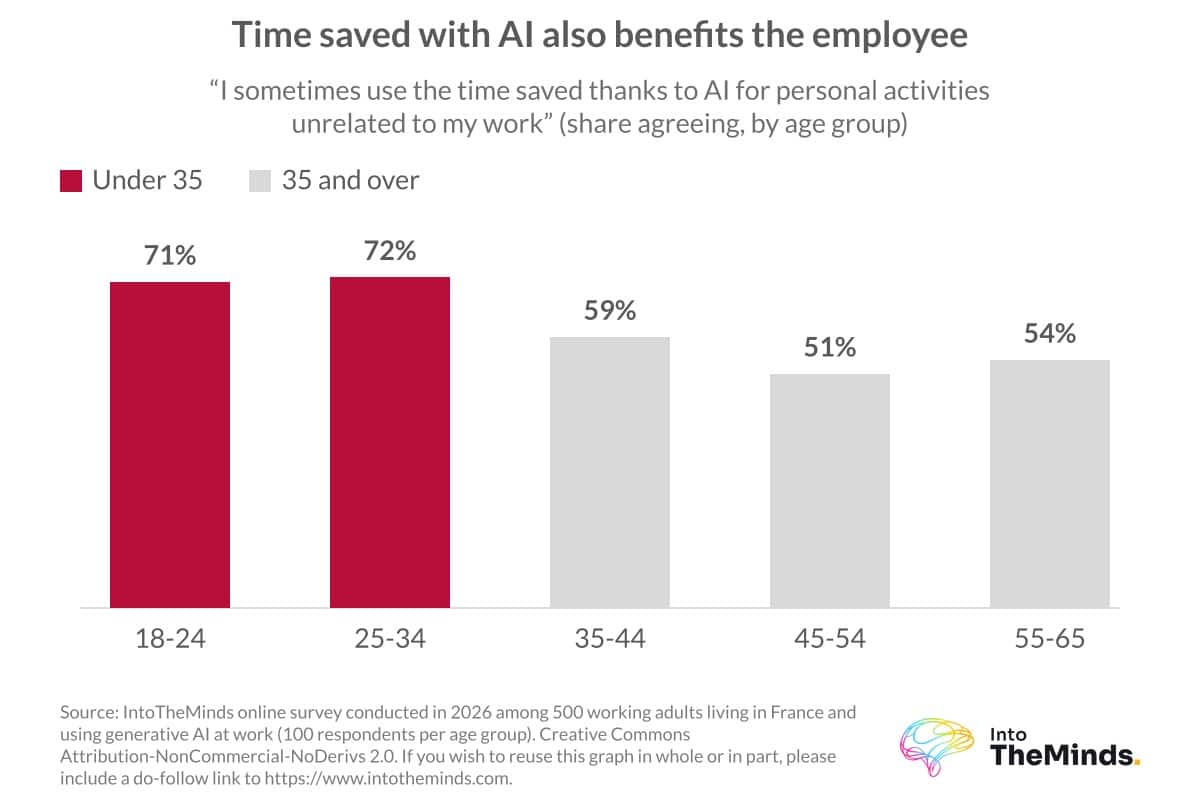
61.4% of respondents say that they sometimes use the time saved through AI for personal activities.
The generational divide in the use of AI at work
Age makes no difference to adoption: between 79% and 82% of users in each age group say they complete their tasks faster, and between 63% and 71% consider AI’s results better than what they would have produced themselves. Everything else diverges, and not always linearly.
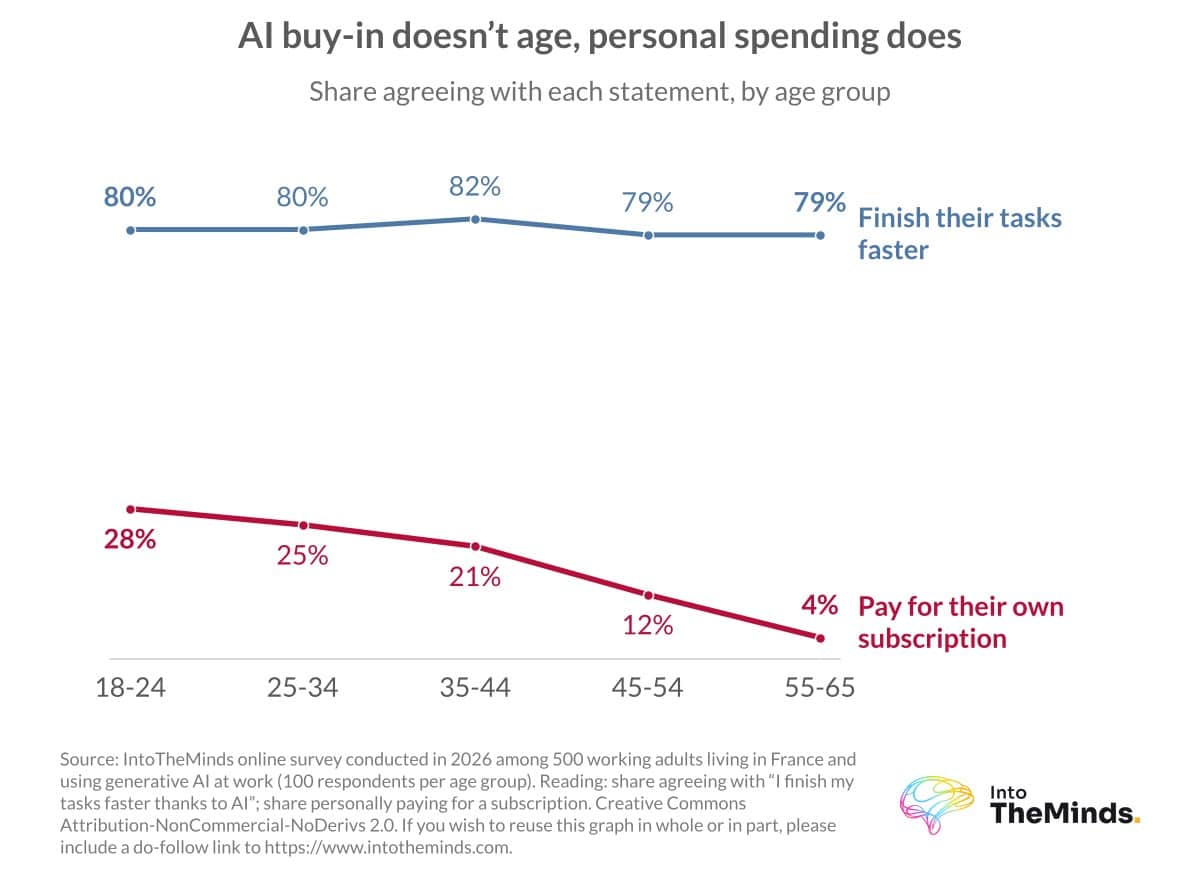
| Indicator (France, 2026) | 18-24 | 25-34 | 35-44 | 45-54 | 55-65 |
|---|---|---|---|---|---|
| Complete their tasks faster | 80% | 80% | 82% | 79% | 79% |
| Daily use of at least one tool | 52% | 67% | 47% | 51% | 44% |
| Average number of tools used | 2.5 | 2.6 | 2.1 | 1.9 | 1.5 |
| Personally paid subscription | 28% | 25% | 21% | 12% | 4% |
| Personal account used at work | 81% | 74% | 76% | 70% | 63% |
| License provided by employer | 34% | 45% | 32% | 40% | 35% |
| Written instructions received | 58% | 48% | 37% | 43% | 38% |
| Fear colleagues’ judgment | 44% | 59% | 45% | 35% | 35% |
| Sometimes use time saved for personal purposes | 71% | 72% | 59% | 51% | 54% |
| Would look for another job if AI were banned | 32% | 46% | 30% | 36% | 26% |
The differences between those under 35 and those over 35 are statistically significant at the 5% threshold for personal subscriptions, number of tools, daily use, written instructions, fear of colleagues and personal use of time saved. With 100 respondents per age group, differences between two neighboring groups should be interpreted as trends.
Age has no effect on willingness to use generative AI. Between 79% and 82% of users in each age group say they complete their tasks faster thanks to AI.
18-24: informed but not equipped
The youngest employees are those whom the company has spoken to the most and given the least. 58% have received written instructions, the highest proportion, but only 38% have official access, the lowest. As a result, 81% use a personal account for work and 28% pay for their subscription themselves. They are also explorers: 54% use at least one tool such as Claude, Perplexity or Mistral, compared with 12% of 55-65-year-olds, and they use AI for data analysis (47%), brainstorming (28%) or programming (27%). Yet they remain open to regulation: 75% would accept a single tool imposed by the company, the highest rate among all generations.
25-34: the pivotal generation, under pressure
Those aged 25-34 combine the extremes. They are the most intensive users (67% daily use), the best equipped by their employer (45% licenses), the best trained (42%) and the most closely regulated. According to the survey, only 8% have received no instructions. Despite this framework, it does not reassure them. Indeed, 59% fear that their colleagues will notice that they have used AI, and 46% would look for another job if their company banned AI.
35-44: the pivotal generation
Daily use drops from 67% among 25-34-year-olds to 47% among 35-44-year-olds. But confidence remains intact: 82% say they complete their tasks faster, the highest rate. However, in our sample, 35-44-year-olds are also the group with the fewest employer licenses (32%), the fewest recipients of written instructions (37%) and the most likely to be governed by simple verbal instructions (43%). This is logically the group where full shadow AI is most widespread (63%). The paradox is that this generation is the most willing to follow a clear rule: faced with a ban, 31% would comply without seeking to leave, the highest rate among all age groups.
45-65: equipped, pragmatic, but under-converted
The image of older employees being behind the curve does not stand up to the figures. 55-65-year-olds are just as likely to have official access as 25-34-year-olds (48% versus 47%) and report the same time savings (79%). Their relationship with AI is simply more restrained: 1.5 tools on average, almost never personally paid for (4%), and use focused on information processing (60% for information searches, 54% for document summarization) rather than creation (9% for brainstorming). It is also more relaxed: only 35% fear their colleagues’ judgment.
Their shortfall is a shortfall in taking action, which in fact begins at age 35. Claude is known by 73% of people over 35, compared with 80% of those under 35. But among those who know it, 19% of people over 35 use it, compared with 48% of those under 35. The same pattern applies to Perplexity (11% versus 30%) and Gemini (44% versus 61%).
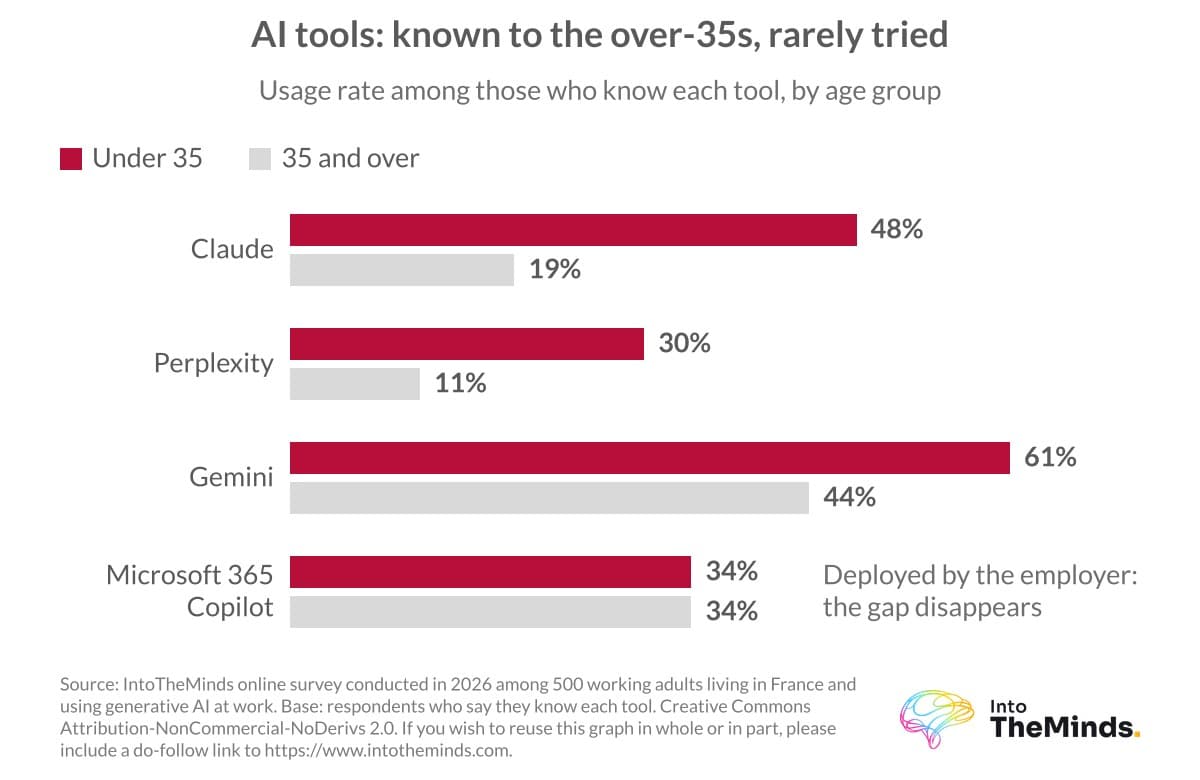
What age does not explain
The statistical analysis simultaneously takes into account age, gender, company size, managerial status, intensity of use and the different forms of regulation. Once these factors are controlled for, age no longer has a significant effect on shadow AI. Without official access, 67% of those under 35 and 65% of those over 35 rely exclusively on personal accounts. With official access, the proportion falls to 33% in both groups. Shadow AI depends on equipment, not on generation.
Age does, however, retain its own effect on personal investment: with the same profile and intensity of use, the older the employee, the less likely they are to pay for their own subscription. This effect combines with gender. Before age 35, 36.8% of men pay for a subscription, compared with 18.6% of women; after age 35, the gap narrows (14.1% versus 10.2%).
34% of users would look for another job if their company banned AI, and 46% of 25-34-year-olds.
HR implications: talent, recruitment and impostor syndrome
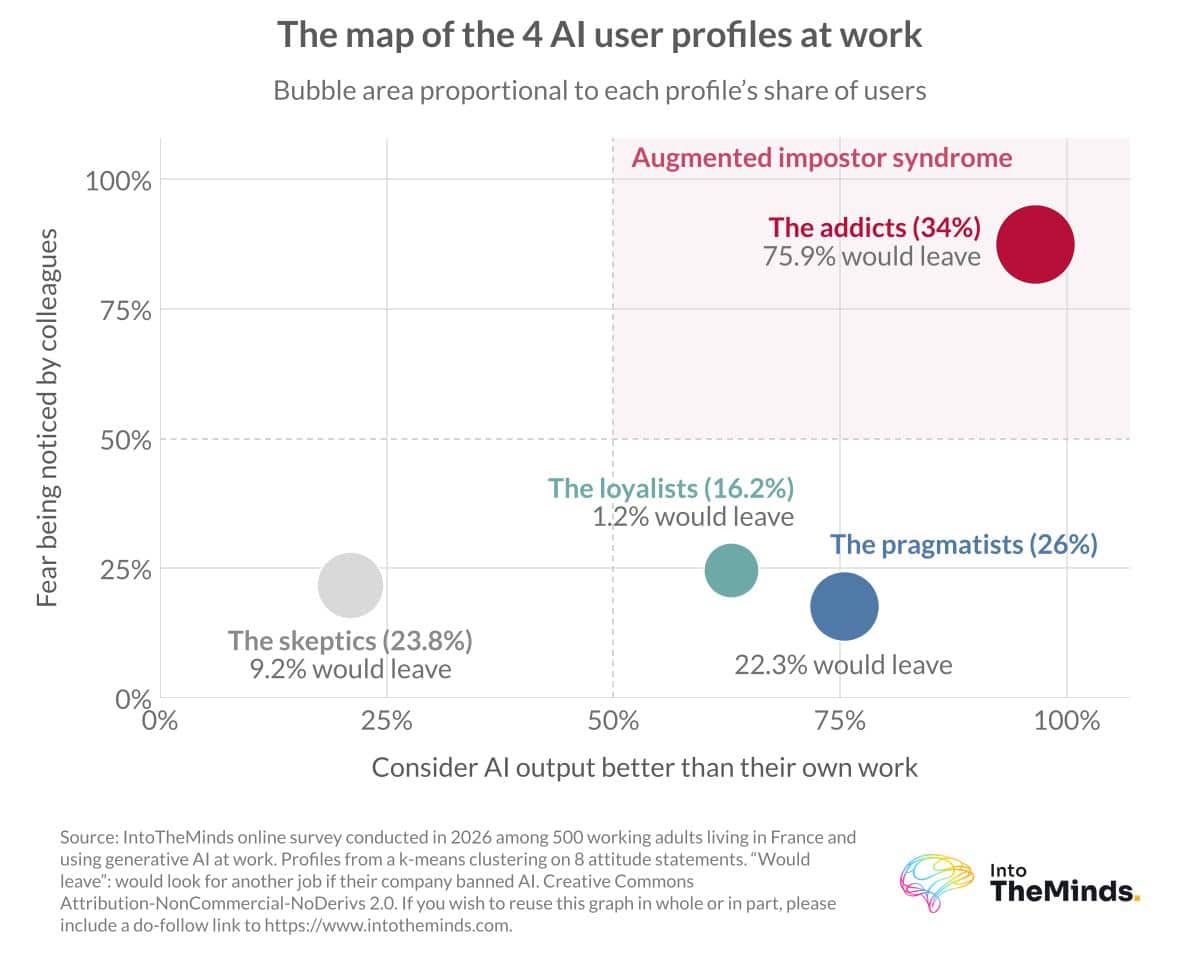
We analyzed the personas and present a summary map below. Everything starts from the observation that 35.6% of users exhibit what could be called an enhanced impostor syndrome. Users feel that AI does a better job than they do and fear that their colleagues will notice. Among those who exhibit impostor syndrome, two-thirds would look for another job if AI tools were banned.
Segmentation of respondents according to their attitudes reveals four profiles:
- The addicts (34%): 96.5% consider AI better than themselves, 87.6% fear their colleagues’ judgment, and 75.9% would look for another job if it were banned. They represent 47% of 25-34-year-olds and 25% of 55-65-year-olds. This profile, which agrees with almost all statements, may partly reflect acquiescence bias.
- The pragmatists (26%): those who most often report time savings (96.9%), are not very anxious (17.7%), but only 4.6% would accept a ban. They increase from 19% of 25-34-year-olds to 30% of 45-65-year-olds.
- The skeptics (23.8%): only 37.8% complete their tasks faster and 21% consider AI better than themselves.
- The loyalists (16.2%): 97.5% would accept a single imposed tool and only 1.2% would look for another job if AI were banned.
The increase in pragmatists with age, at the expense of addicts, summarizes the generational perspective: getting older does not make people skeptical; it makes them pragmatic. Acceptance remains, while fear and dependence diminish.
The functions most exposed are also the most difficult to recruit for: the intention to look for another job if AI were banned reaches 43% among technicians, 40% among sales staff and 39% among management positions, compared with 15% of administrative staff.
AI is finally becoming a recruitment criterion. 58.2% of users say that a company’s AI policy would influence their decision to accept a position, compared with 66% of 25-34-year-olds and 47% of 55-65-year-olds. Conversely, a single tool imposed by the company is accepted by 68.6% of users, and by 75% of 18-24-year-olds.
5 tips for HR
Comply with the legal framework
The European Artificial Intelligence Act has required companies using AI systems, since February 2025, to take measures to ensure a sufficient level of AI literacy among their staff. Training is therefore no longer merely a lever for efficiency; it is an obligation.
It is also important to incorporate the conditions for using generative AI into the company’s internal regulations. You can also create a specific IT policy to be attached to them.
Choose a tool that matches actual usage
Start from your employees’ actual uses rather than from a catalogue. Ask employees about their needs and then make your choice. Keep in mind that a tool that is less powerful than those employees pay for themselves will not eliminate personal accounts.
When choosing a generative AI tool, pay particular attention to the following criteria:
- hosting location
- contractual commitment not to use your data to train models
- GDPR compliance and data processing agreement
- access management.
Set a usage framework rather than a ban
Specify in the internal regulations or IT policy:
- approved tools
- authorized data
- the requirement for human review.
Prohibit entering information that identifies individuals or sensitive business data, rather than banning AI itself. Explicitly address the issue of personal accounts: the policy must state what may pass through them.
Train and support each generation differently
Training not only reduces shadow AI; it also improves performance. There is therefore no debate about whether it is necessary.
Prioritize practical workshops based on real use cases, with differentiated support. The table below summarizes some survey results and proposes concrete actions.
| Generation | What it lacks | Priority HR lever |
|---|---|---|
| 18-24 | The tool: 58% have written rules, 38% official access | Equip them with a single tool they accept |
| 25-34 | Legitimacy: 59% fear their colleagues’ judgment | Recognize AI as a skill and make it a recruitment argument |
| 35-44 | Written framework and tool: 37% written rules, 32% licenses | Write the rule and provide the license |
| 45-65 | Experimentation: tools are known but rarely tried | Concrete use cases and time to test beyond the provided tool |
Measure usage and address the question of time saved
Measure actual usage through anonymous surveys rather than through reports from managers.
Employees who hide their use from their colleagues also hide it from management. Then ask openly about time saved. The company can accept it as an implicit trade-off, reinvest it in new assignments or share it. What the company can no longer do is ignore the use of generative AI.
Methodology
Quantitative online survey conducted by IntoTheMinds in 2026 among 500 working people residing in France and using at least one generative AI tool in a professional context. Sample constructed using quotas: 100 respondents per age group (18-24, 25-34, 35-44, 45-54 and 55-65), gender parity, all company sizes and 45 sectors represented. Agreement percentages combine the answers “strongly agree” and “somewhat agree”. Differences between generations were tested using a chi-square test at the 5% threshold. “Identical profile” comparisons come from logistic regressions controlling for age, gender, company size, role and intensity of use, and the four profiles come from a k-means classification based on the eight attitude statements. The margin of error is approximately 4 points for the overall sample and approximately 10 points per age group. Since the sample consists exclusively of users, the results describe the practices of employees who have adopted generative AI, not the adoption rate among the working population.

FAQ: Your questions answered
What is shadow AI in the workplace?
Shadow AI refers to the use of generative AI tools by employees outside the framework provided by their company, most often using personal accounts. Our survey conducted in France in 2026 shows that 57.2% of users rely exclusively on personal accounts. The main risk concerns data confidentiality.
Should generative AI be banned at work?
No. A ban does not eliminate usage; it makes it invisible: 69.2% of employees subject to a ban still use a personal account, and 34% of users would look for another job if their company banned AI. A clear usage framework, an official tool and training produce better results.
Do younger employees use AI differently from their older colleagues?
They use it just as much, but not in the same way. All generations report the same time savings (79% to 82%). Those under 35 use more tools (2.5 versus 1.85), are more likely to pay for their subscription themselves (28% of 18-24-year-olds versus 4% of 55-65-year-olds) and are more concerned about their colleagues’ judgment. Those over 35 know the same tools but try them much less often.
How can shadow AI be reduced?
By providing an official tool and training employees. In companies that have done nothing, 75.7% of users rely exclusively on personal accounts. With an official tool and training, the proportion falls to 19.1%. A written policy alone changes nothing (74.7%).
How can you measure employees’ actual use of AI?
Use an anonymous survey rather than reports from managers. 43.6% of users fear that their colleagues will notice that they use AI, which distorts any identifiable self-reported measurement. Our B2B market research service can conduct this type of internal survey.



![Illustration of our post "Remote work: are employees cheating? [Survey]"](/blog/app/uploads/telework3-120x120.png)