This exclusive market study by IntoTheMinds reveals the extent to which employees have become dependent on generative AI. As you will see, this dependence triggers reactions that can impact company operations—factors that human resources managers must take into account.
Do your employees use artificial intelligence every day? Then a ban would cost you dearly. Our survey conducted in France among 500 working adults who use generative AI at work (other results are available here) shows that 80% of them complete their tasks faster thanks to the tool. However, 61.4% sometimes spend this saved time on personal activities. And among those who use it several times a day, 49.1% would look for another job if their company banned AI. These figures provide an initial measure of AI dependency at work. It is usually discussed in terms of lost skills or mental health risks; our study approaches it from another angle—that of attachment to the tool and the cost of removing it. Our market research agency, drawing on its experience in human resources and innovation, analyzed these responses in detail to offer you a clear interpretation.
Contact the IntoTheMinds institute
Key takeaways
- In France (2026), 52.2% of users use AI every day and 67.6% judge that it produces a better result than they would.
- 34% of users would look for another job if their company banned AI. This rate rises to 49.1% among those who use it several times a day.
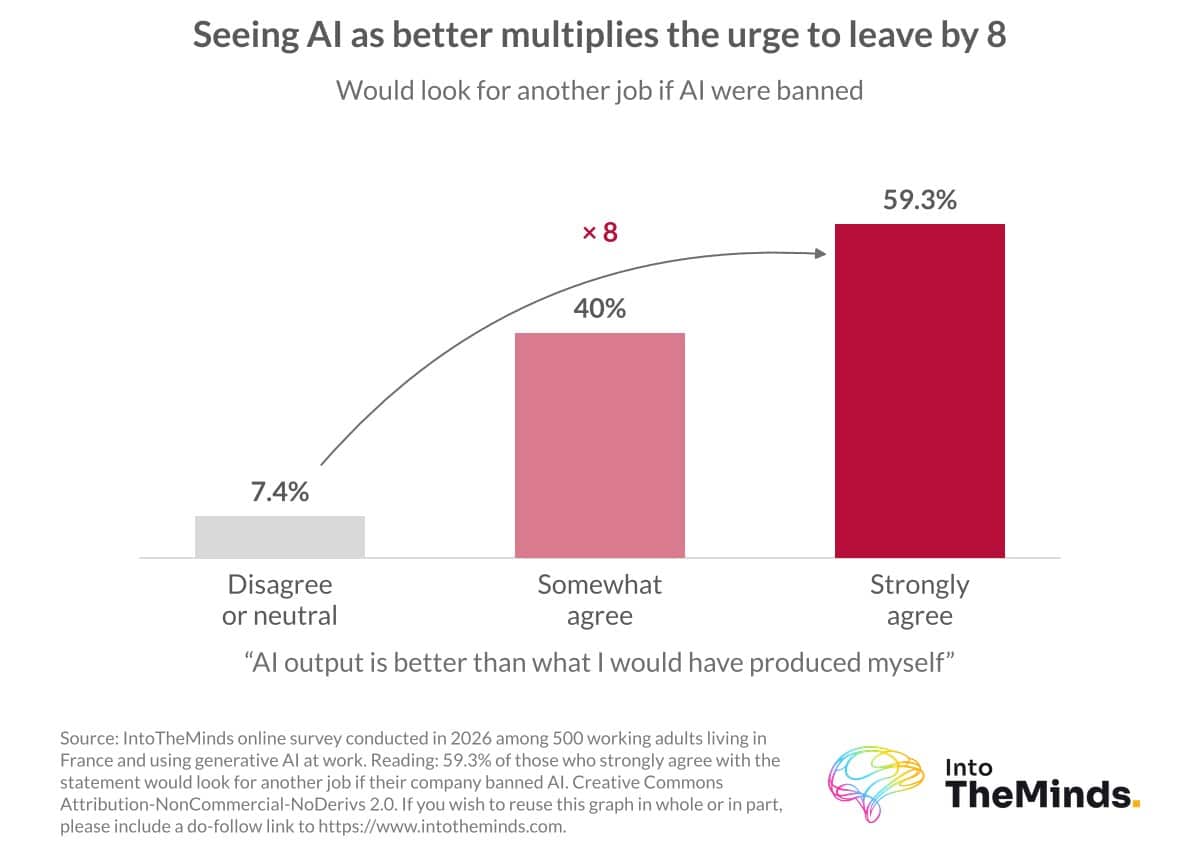
- The most influential factor is the feeling that AI performs better than oneself: 59.3% of employees who are fully convinced of this would look for another job, compared to 7.4% of those who do not think so.
- 30% of users combine daily use, the feeling that AI does better than them, and saved time kept for themselves. They alone represent 57.6% of employees ready to leave.
- Charters, training, and official tools do not change how saved time is used. A ban worsens it: 90.7% of affected employees keep part of it for themselves, compared to 64.5% elsewhere.
AI dependency: 3 unmistakable signs
Artificial intelligence is quickly settling into professional practices: writing, document synthesis, data analysis, decision support. What was an auxiliary tool can then become a crutch. We conducted a survey among workplace AI users, highlighting 3 signs that help recognize this attachment even before talking about turnover risk.
- Frequency: 52.2% of users use at least one AI tool every day, and 21.2% several times a day.
- Perceived superiority: 67.6% believe that AI produces a better result than what they would have produced themselves in the same timeframe, including 23.6% who fully agree. This feeling is shared across all generations, between 63% and 71% depending on age.
- Time kept for oneself: 61.4% of respondents sometimes use the time saved thanks to AI for breaks, personal errands, or social media.
Taken individually, none of these signs is alarming. It is their accumulation that shifts usage into attachment, as we will see.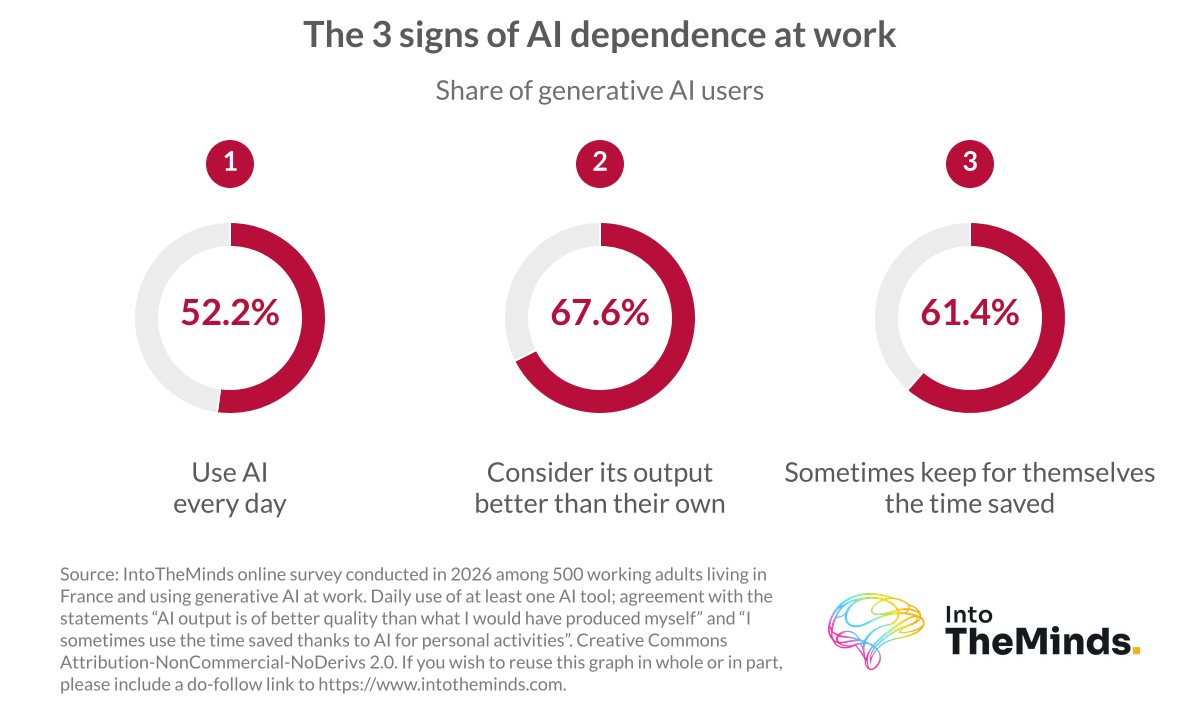
49.1% of employees who use AI several times a day would look for another job if it were banned.
Up to 49% of employees ready to leave if AI is banned
This figure is the most striking finding of our study, but it needs to be read precisely. It does not apply to all employees: it concerns the most intensive users, namely the most advanced members of your teams.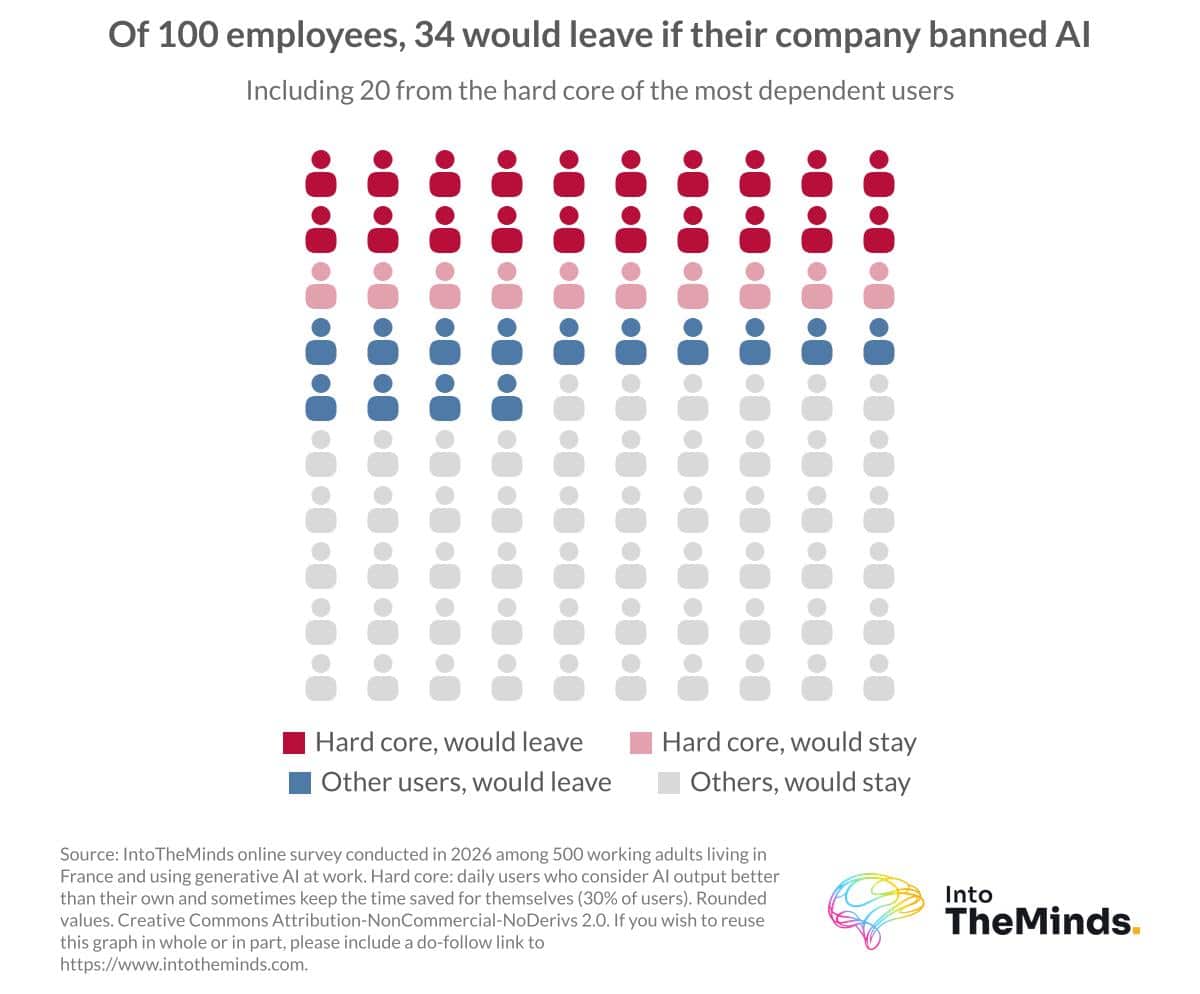
The more AI is used, the more people refuse to be deprived of it
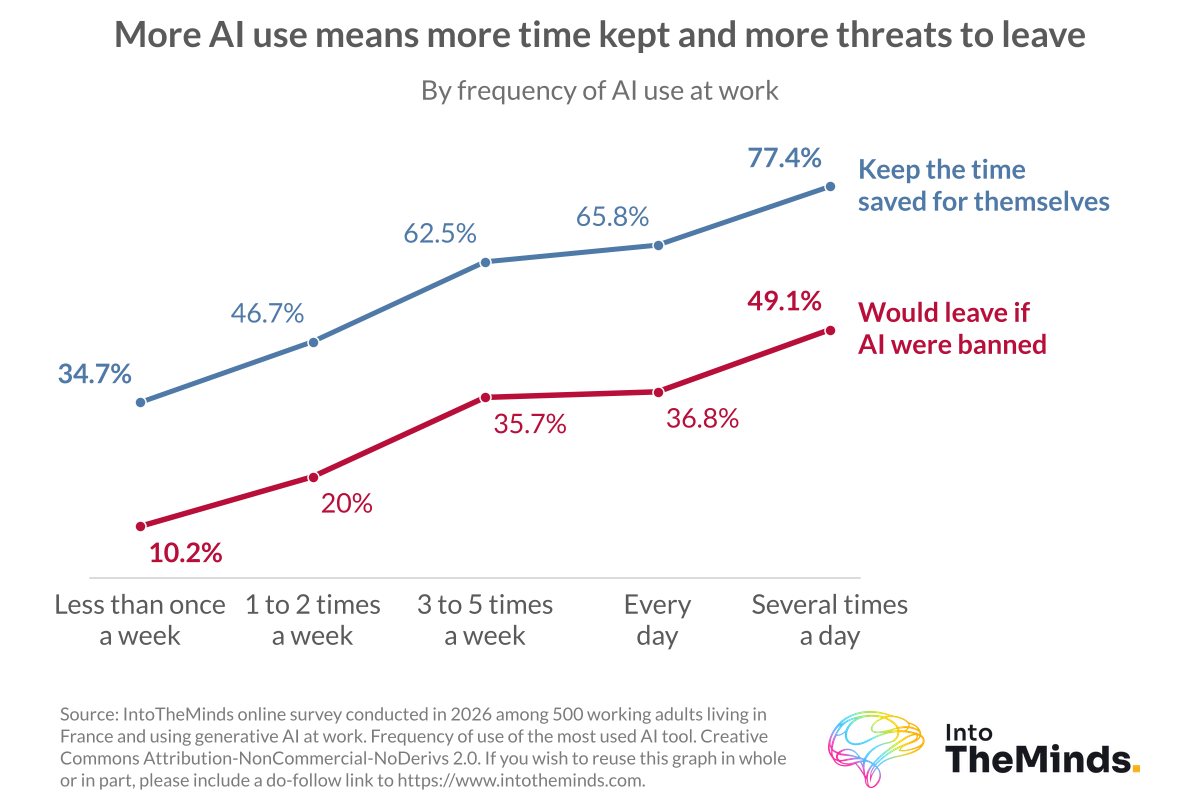
Across all surveyed users, 34% would look for another job if their company banned AI, including 11.8% without hesitation. But this rate increases at each usage frequency tier. The table below reads line by line: for each usage frequency, it indicates the share of employees who sometimes keep the saved time for themselves, and the share of those who would look for another job in case of a ban.
| How often the employee uses AI | Sometimes use saved time for themselves | Would look for another job if AI were banned |
|---|---|---|
| Less than once a week | 34.7% | 10.2% |
| 1 to 2 times a week | 46.7% | 20% |
| 3 to 5 times a week | 62.5% | 35.7% |
| Every day | 65.8% | 36.8% |
| Several times a day | 77.4% | 49.1% |
Among multi-daily users, 26.4% would even look for another job without the slightest hesitation. This effect is not a matter of age: it is found among younger workers as well as older colleagues. Among those under 35, 45.4% of daily AI users would consider leaving, compared to 29.6% of less frequent users. Among those over 35, these rates are 38.7% and 23.4%. Usage intensity is what matters, not generation.
A ban is accepted in principle, not in practice
49.2% of users state that they would accept working for a company that strictly bans AI. Yet, 24.4% say both that they would accept it and that they would look for another job if their own employer banned it. This contradiction reaches 35.8% among multi-daily users. Here lies the whole paradox: adherence to rules fades when faced with habit.
Outright refusal is a different phenomenon. 26.8% of users explicitly reject the idea of working for a company that bans AI. This refusal increases with the number of tasks entrusted to AI: 17.1% among those delegating one or two tasks, 36.6% among those delegating five or more. These employees refuse the ban out of concern for efficiency, which does not necessarily mean they would leave.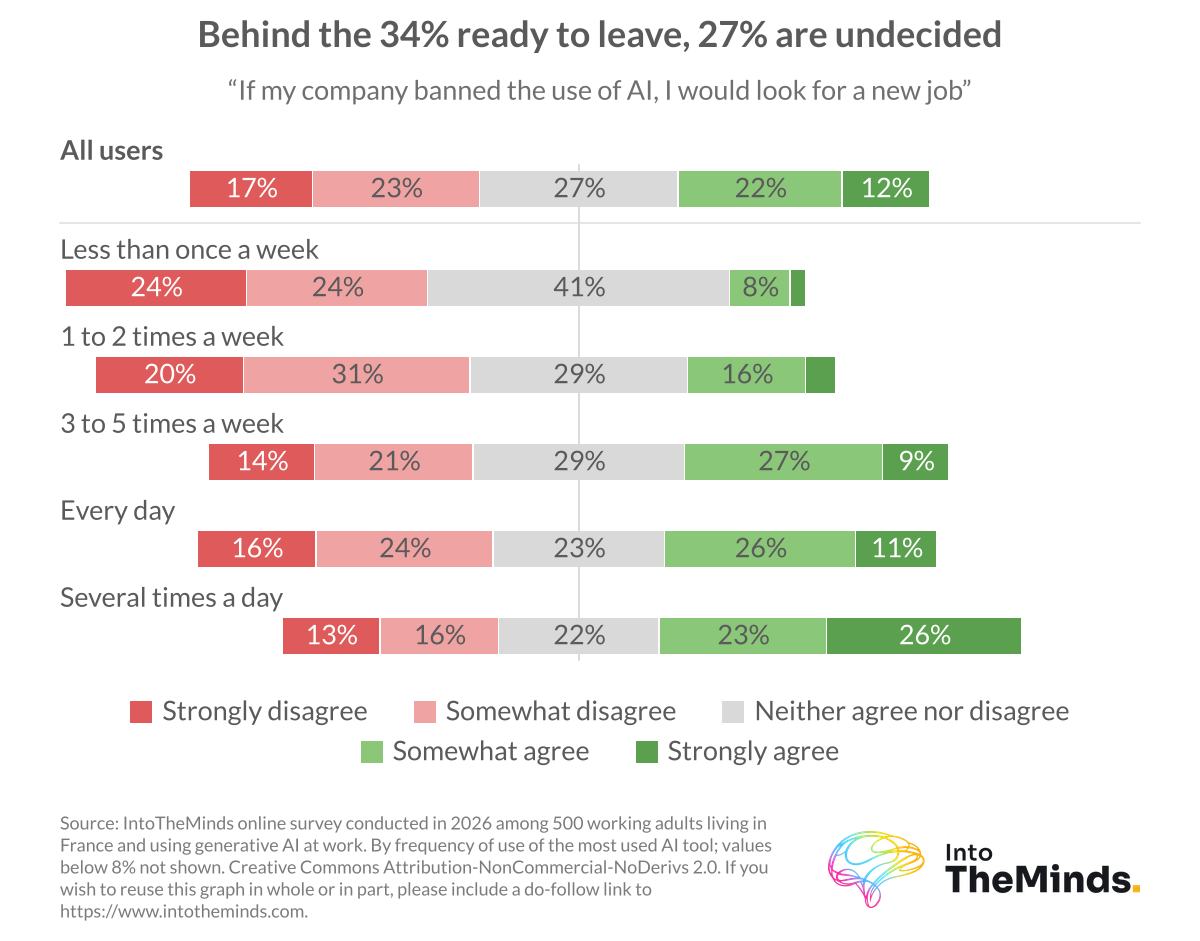
Time saved by AI does not benefit the company
The title is slightly provocative, and I own up to it 😉. What I mean by this is that AI delivers on its productivity promise. The problem is that the benefit does not always go to the employer. And this finding sheds light on the mechanism of dependency.
In our study, 80% of users state that they complete their tasks faster. This figure is remarkably stable across age groups, between 79% and 82%. However, 68% of those who save time spend part of it on their personal life. Only 16% of all users save time and report not using it for themselves. Responses vary by profile:
- among those saving time, 10% of 18–24 year olds report not using it for themselves, compared to 32.9% of 55–65 year olds. Older generations consider this time more as belonging to the employer;
- men are more likely than women to use part of this time for themselves (66.4% vs. 56.4%).
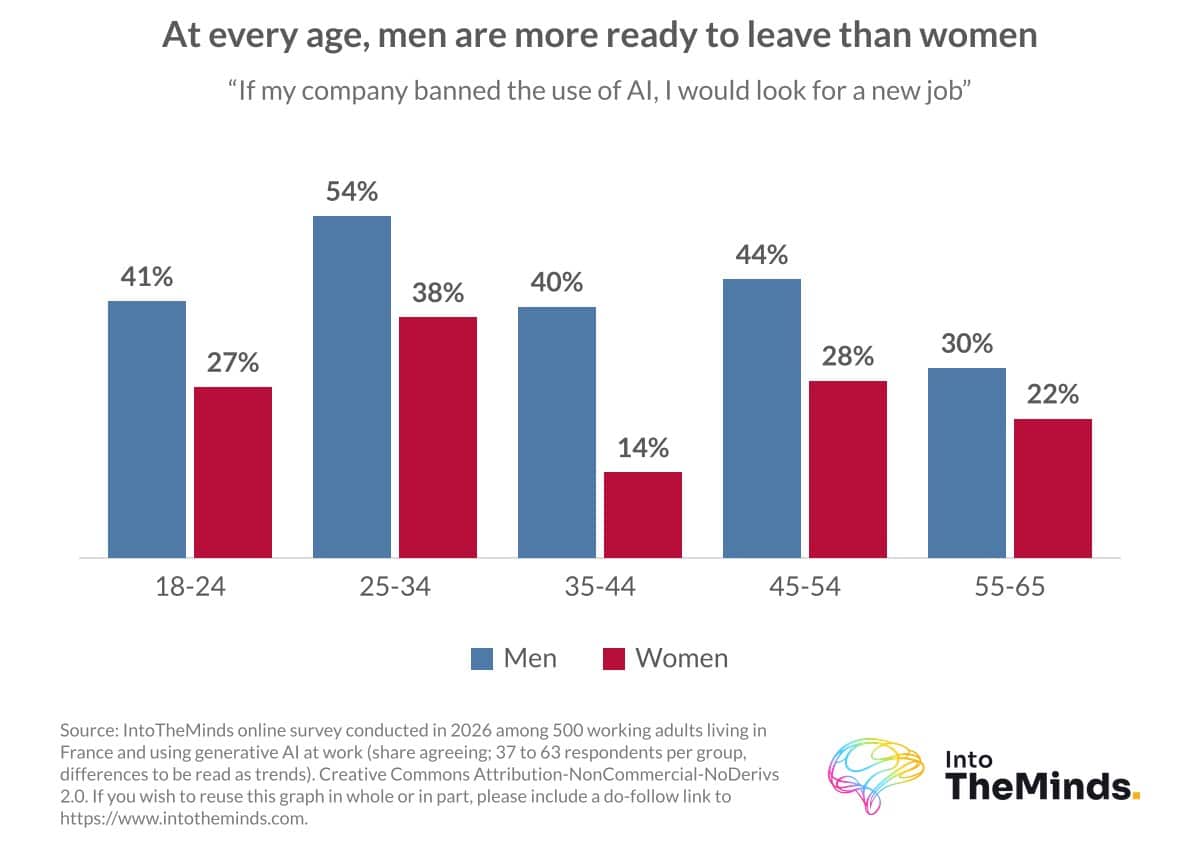
A clarification is needed: the question measures whether employees ever use this time for themselves, not the exact percentage of saved time diverted. Part of this gain can be reinvested into work. But a majority of employees do not consider time freed up by AI as automatically belonging to the employer.
When AI performs better than oneself, people no longer want to do without it
Of all factors studied, the perception of the tool has the strongest weight on the intention to leave. Here is what the data shows.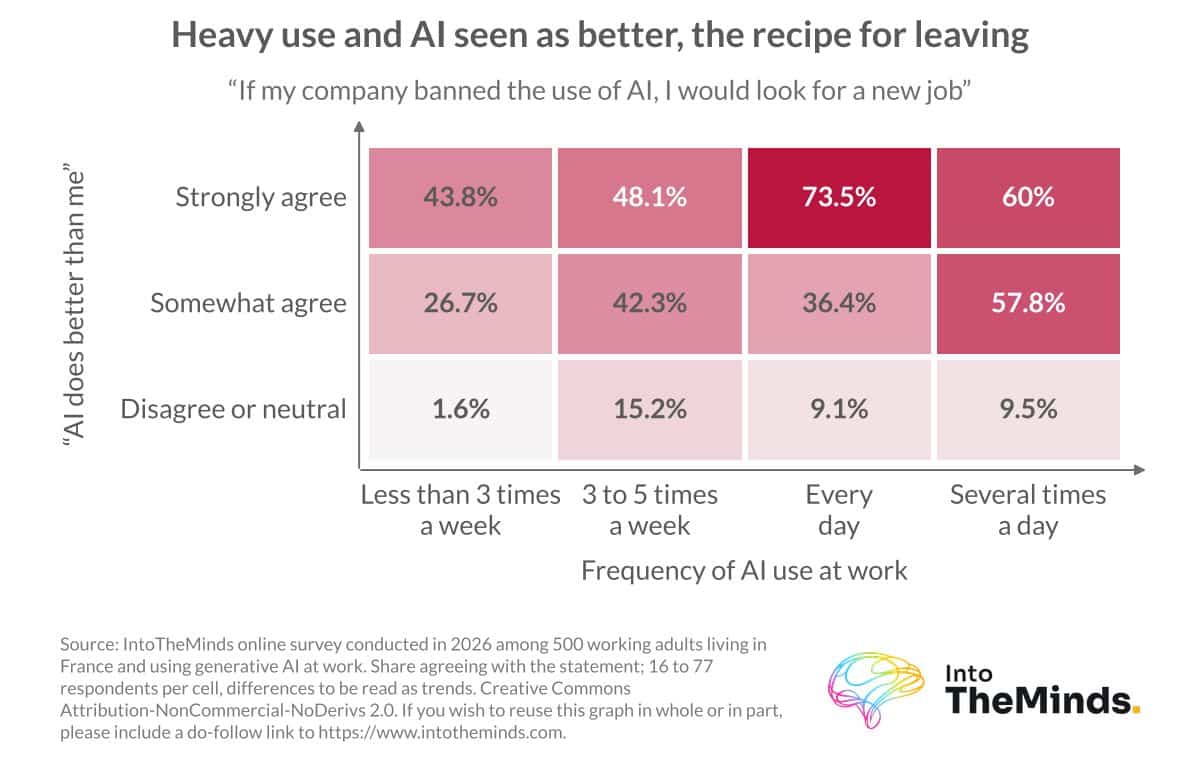
Returning to AI-free work: a step backward
The table below classifies employees based on their response to the statement “AI results are better than what I would have produced myself.” For each group, it indicates the share of those who would look for another job in case of a ban.
| “AI results are better than mine” | Would look for another job if AI were banned |
|---|---|
| Disagree or no opinion | 7.4% |
| Somewhat agree | 40% |
| Strongly agree | 59.3% |
When people feel a machine produces better results than themselves, going back feels unacceptable. Yet this judgment deserves scrutiny: AI answers appear convincing, but they can be inaccurate, outdated, or out of context. The perception that AI does better can therefore rest partly on an illusion of competence, and that is where the real risk lies.
Delegating more does not increase turnover risk
One might think that the more tasks an employee delegates to AI, the more attached they become. That is not the case. The intention to leave is similar among those delegating one or two tasks (37.7%) and those delegating five or more (35%). Those who delegate emails and reports to AI are even less likely to consider leaving (28% vs. 40.7%). Attachment does not stem from the breadth of delegation, but from usage frequency and the feeling that AI performs better than oneself.
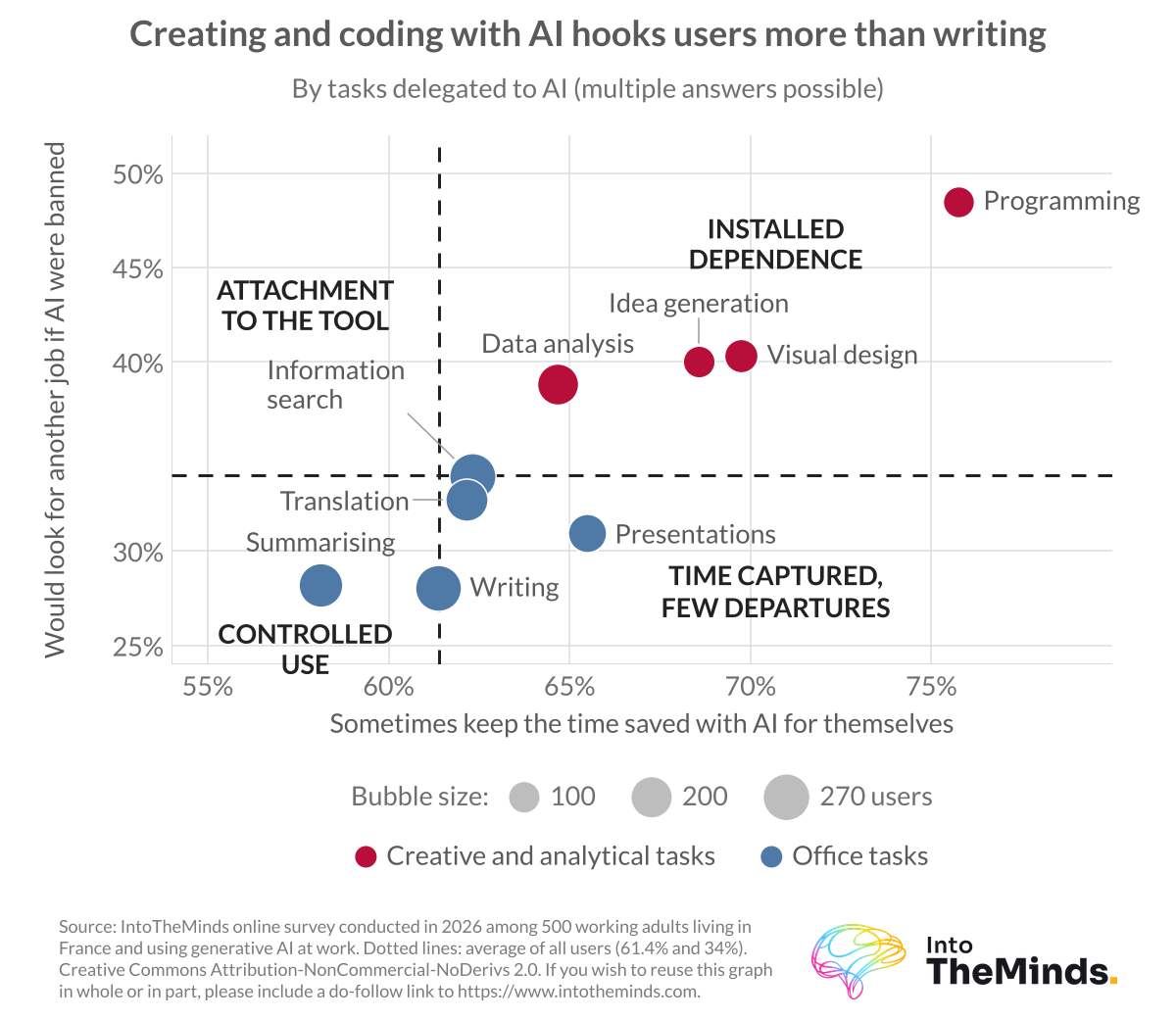
The hard core: daily use, perceived superiority, and kept time
These phenomena reinforce each other. Employees who keep part of the saved time for themselves are 48.2% likely to consider leaving in case of a ban, compared to 11.4% of others. Viewed from another angle, 87.1% of employees ready to leave belong to this group.
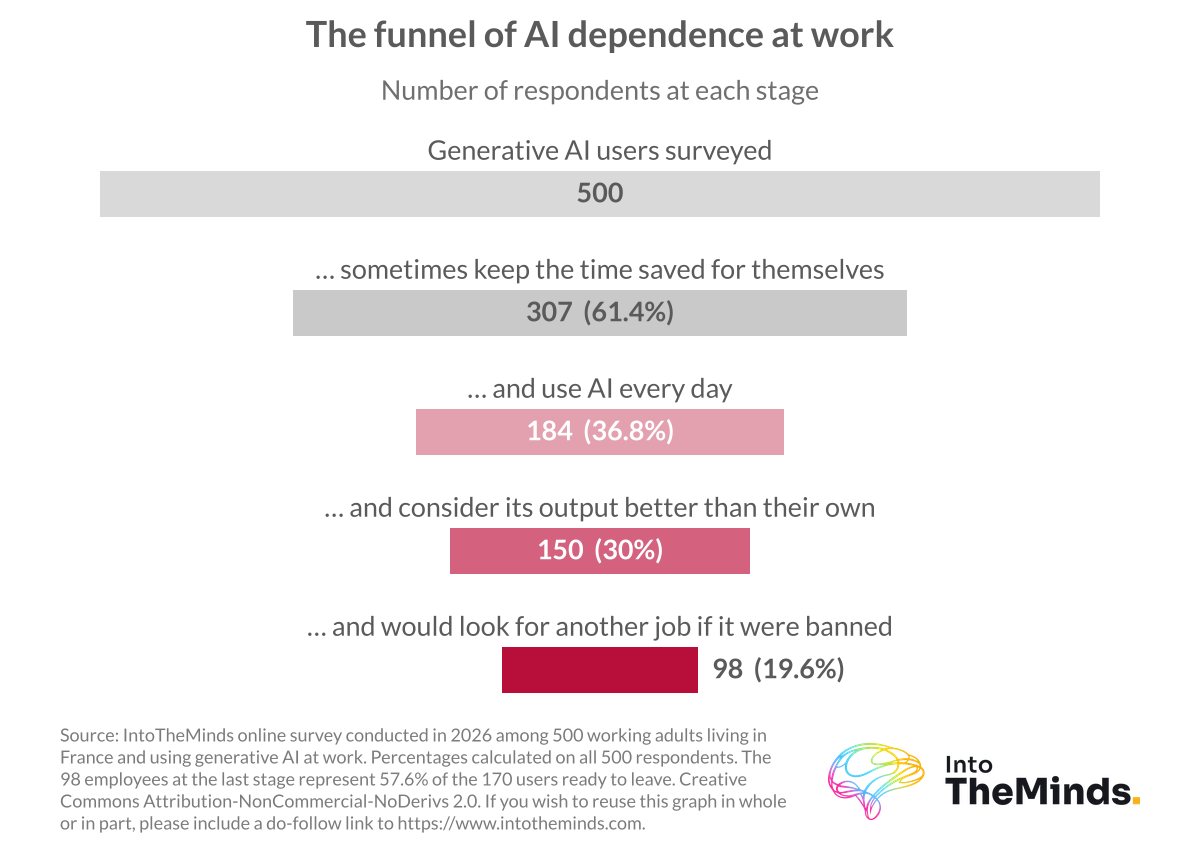
The table below combines the two most decisive criteria: the feeling that AI performs better than oneself and personal use of saved time.
| Employee profile | Share of users | Would look for another job if AI were banned |
|---|---|---|
| Judges AI better than themselves and keeps part of saved time for themselves | 49% | 58.8% |
| Judges AI better than themselves but does not keep saved time for themselves | 18.6% | 15.1% |
| Does not judge AI better than themselves | 32.4% | 7.4% |
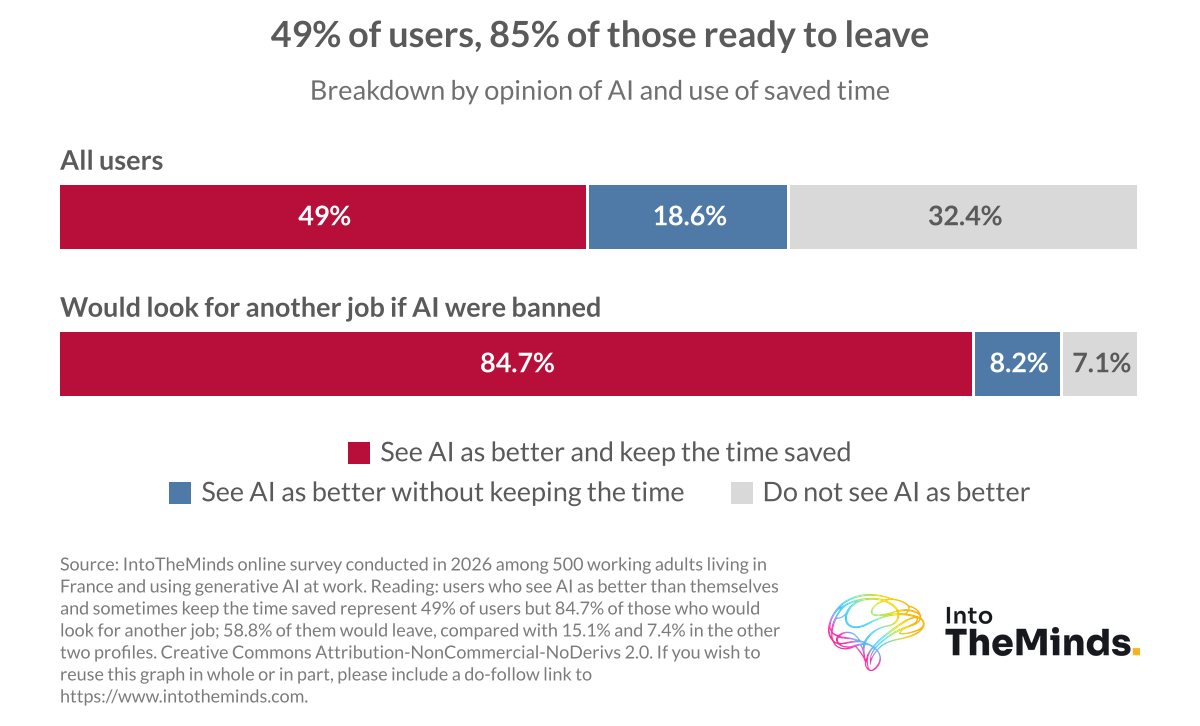
If we add daily usage, a hard core emerges: 30% of users combine the three signs described above. 65.3% of them would look for another job in case of a ban, compared to 20.6% of other users. On their own, they account for 57.6% of employees ready to leave. This core affects 40% of 25–34 year olds, compared to 20% of 55–65 year olds. However, controlling for profile, age has no standalone effect: younger workers are more likely to consider leaving because they more frequently combine these three signs, not because they are young.
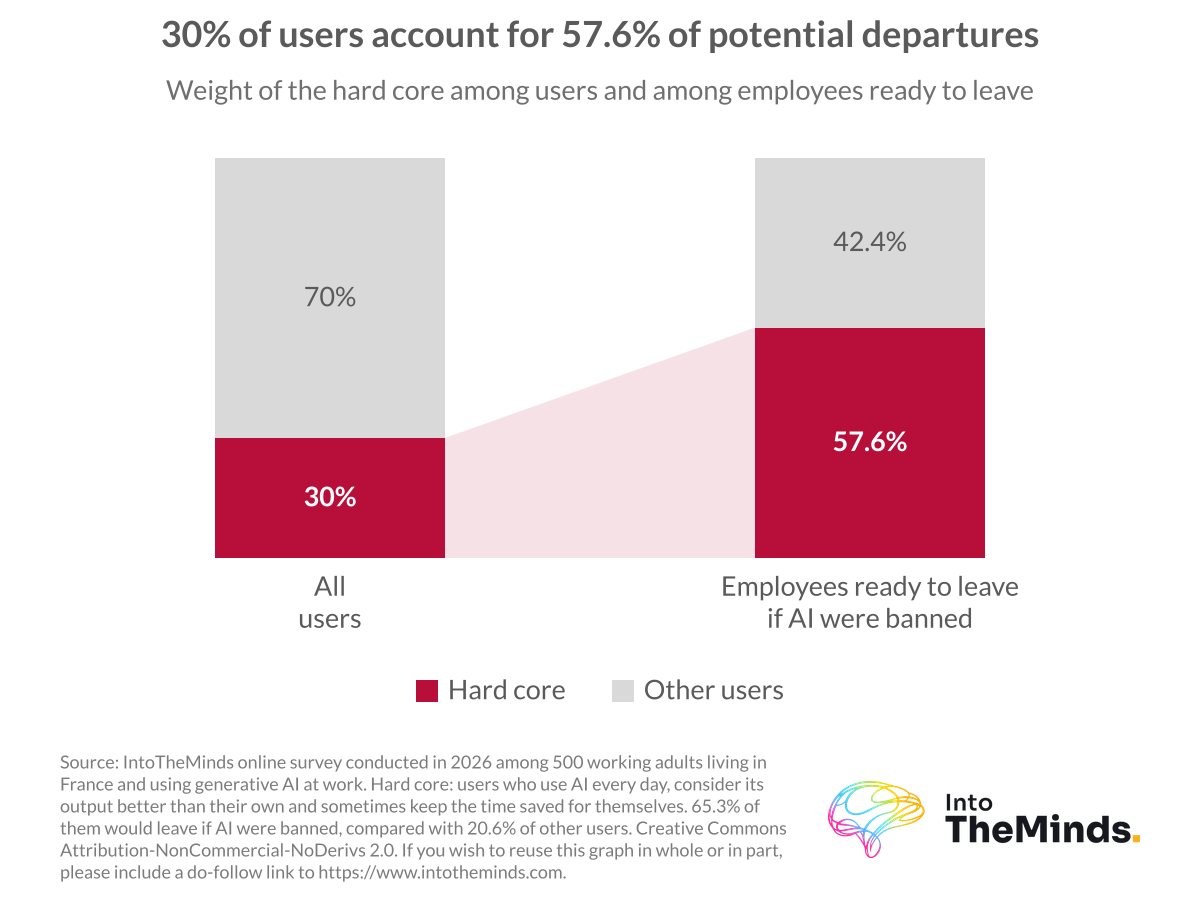
A hard core concentrated in specific roles
This hard core represents 41.4% of executive leadership employees, 38.9% of procurement employees, and 35.8% of sales reps, compared to 12.1% of administrative staff. Professions with the highest autonomy over their schedule are also the most attached to the tool.
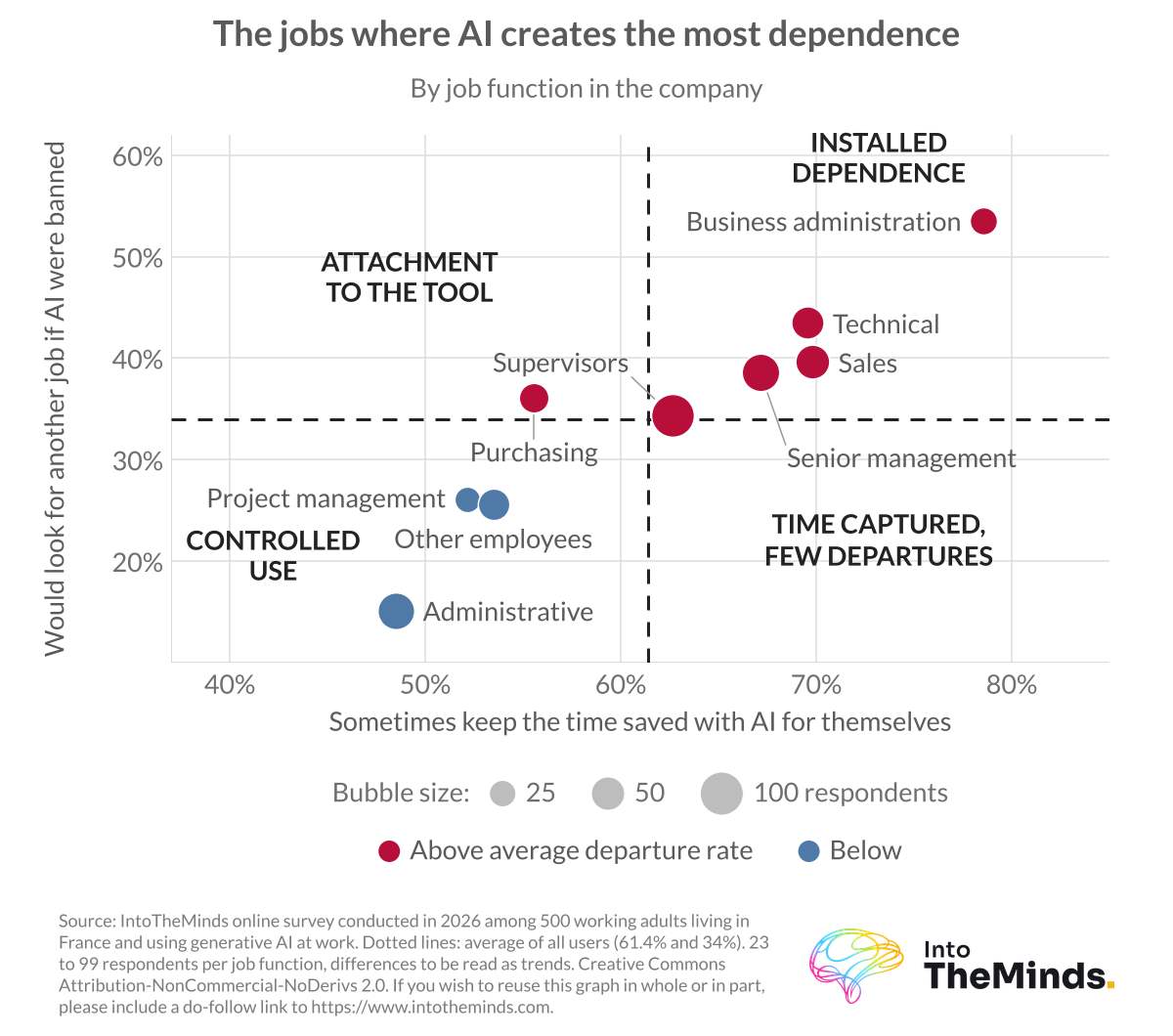
In companies that ban certain tools, 90.7% of employees who save time keep part of it for themselves.
Banning AI drives underground usage and pushes employees away
Faced with these risks, a ban seems like a simple response. The figures show that it produces the opposite effect.
Underground use drives up time kept for oneself
In companies that ban certain tools, 90.7% of employees who save time keep part of it for themselves, compared to 64.5% elsewhere. The logic is simple: a gain obtained by bypassing a rule cannot be displayed, and a gain nobody sees has no reason to be handed back. The fear of being caught works the same way: 78.9% of employees who fear colleagues will notice their AI usage keep this time for themselves, compared to 47.9% of others. This point aligns with our analysis of Shadow AI and underground usage: secrecy prevents any oversight.
AI policy weighs on employer choice
58.2% of users state that a company’s AI policy would weigh on their decision to accept a job offer, rising to 72.6% among those who keep part of saved time for themselves. A ban not only causes staff to leave, it deters candidates from joining. In the job market, AI is becoming a recruitment argument.
For HR managers, this is a new variable to consider. Ultimately, it becomes almost beneficial to specify the company’s AI policy in job postings.
Dependency and skill loss: what the study does not say
Our survey is a snapshot at a given moment. It does not allow us to observe whether employees exert less effort than before or whether they are losing skills. Yet this is one of the most frequent concerns regarding workplace AI dependency: that by constantly delegating, people eventually lose the ability to perform tasks themselves. What our data shows is strong attachment to the tool among a significant portion of users, and a clear reluctance to step back. Measuring skill evolution would require tracking the same employees over time.
Human resources MUST guide employees in using the time saved thanks to AI.
Limiting AI dependency without taking the tool away from employees
Here are the 3 levers we recommend, based on the gap between corporate measures and actual usage.
1. Make saved time an explicit topic
We compared companies according to the measures they implemented. The table below indicates, for each measure, the share of employees spending part of time saved via AI on personal activities. The calculation includes only employees reporting time gains.
| Measure taken by the company | Employees keeping time when company has not taken this measure | Employees keeping time when company has taken this measure | Is the difference statistically significant? (chi-square test) |
|---|---|---|---|
| A written charter | 64.8% | 71.7% | Not significant |
| Training or awareness session | 67.1% | 69.5% | Not significant |
| An official AI tool provided to employees | 66.7% | 71.3% | Not significant |
| Banning certain AI tools | 64.5% | 90.7% | Significant |
Whether a company drafted a charter, trained employees, or provided an official tool, between 69.5% and 71.7% of employees keep part of saved time for themselves, no less than elsewhere. These measures frame tools and data, but none dictates what employees should do with freed-up time. Only bans change the equation, and for the worse. Companies must therefore address this topic directly: reinvesting this time into new missions or skill building, adjusting targets and organization, or openly accepting it as a trade-off. Involving teams in this choice yields better results.
I believe this is an absolutely fundamental takeaway from this study. Human resources MUST guide employees in using the time saved thanks to AI.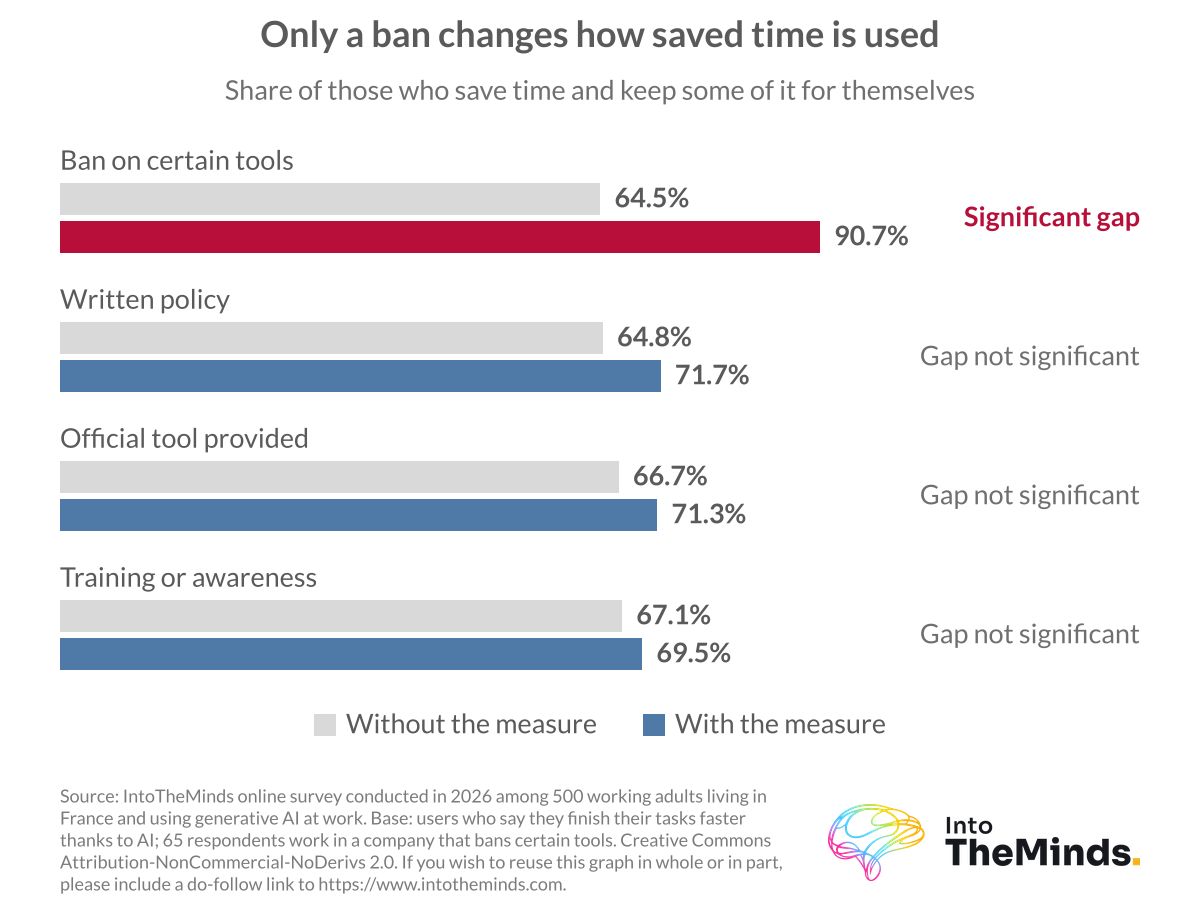
2. Make actual usage visible rather than banning it
Recognized usage can be discussed, measured, and redirected. Underground usage, however, remains hidden and can never be debated.
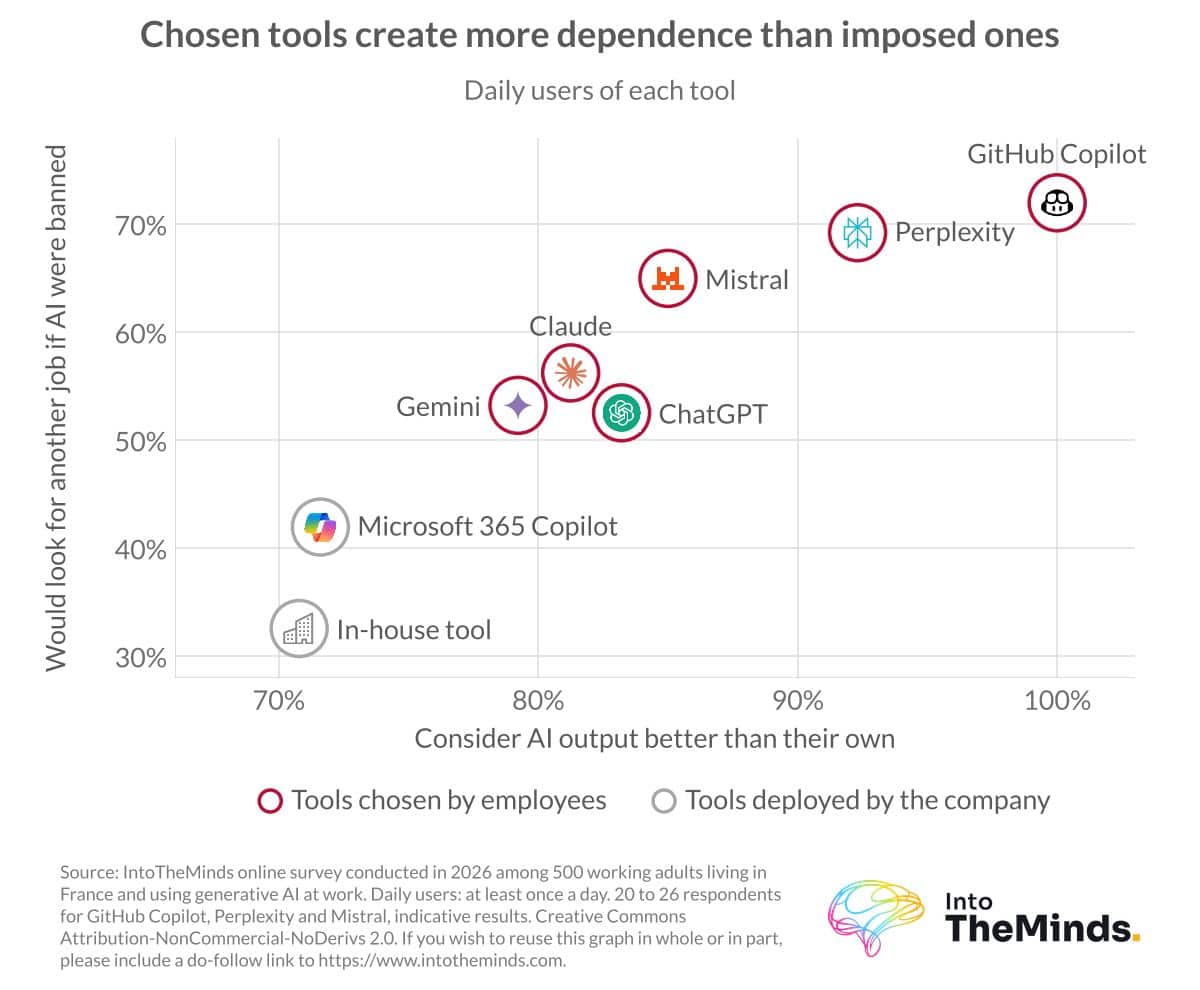
A single tool chosen by the company is accepted by 68.6% of users: this is a far better-received alternative than a ban. Start by measuring actual usage through anonymous surveys, since employees hiding from colleagues are also hiding from management.
3. Maintain review and human expertise
Reserve AI for repetitive or low-value-add tasks (rephrasing, synthesis, first drafts) and preserve strategy, reasoning, and decision-making for human teams. Enforce systematic review before publishing. Since February 2025, training in critical AI literacy is also a mandatory requirement under Article 4 of the European Artificial Intelligence Act. Target as a priority the hard core of 30% most attached users: AI policy must be built and tested with them first.

FAQ: questions you may ask
What are the signs of AI dependency at work?
Three signs stand out: daily use, the feeling that AI performs better than oneself, and saved time kept for oneself. In France in 2026, 30% of users combine these three signs. They account for 57.6% of employees ready to leave in case of a ban.
How many employees would leave their company if AI were banned?
34% of users would look for another job, according to our IntoTheMinds survey conducted in France in 2026. This rate reaches 49.1% among multi-daily users and 59.3% among those who are fully convinced that AI performs better than them.
Can a company limit AI dependency without banning it?
Yes, by legitimizing usage rather than prohibiting it. A single official tool is accepted by 68.6% of users, and human review preserves expertise. A B2B market research study among your teams helps calibrate this policy.