Black Friday is an unmissable event in the retail sector. It is a huge market, and in this article I will provide you with the latest figures and an analysis of the outlook for this market.

Black Friday, imported from the United States, has become a major commercial phenomenon in Europe. Born in the streets of Philadelphia, this promotional event conquered Europe in the 2010s to become today an unmissable event in the retail calendar. The market studies that we carry out for our clients testify to the anchoring of Black Friday in consumption habits but also to little visible mutations. In this in-depth article, I reveal to you the latest European statistics on Black Friday and analyse these changes, particularly the cannibalisation of Christmas purchases and the impact of artificial intelligence.
Contact IntoTheMinds for your marketing studies
Black Friday figures
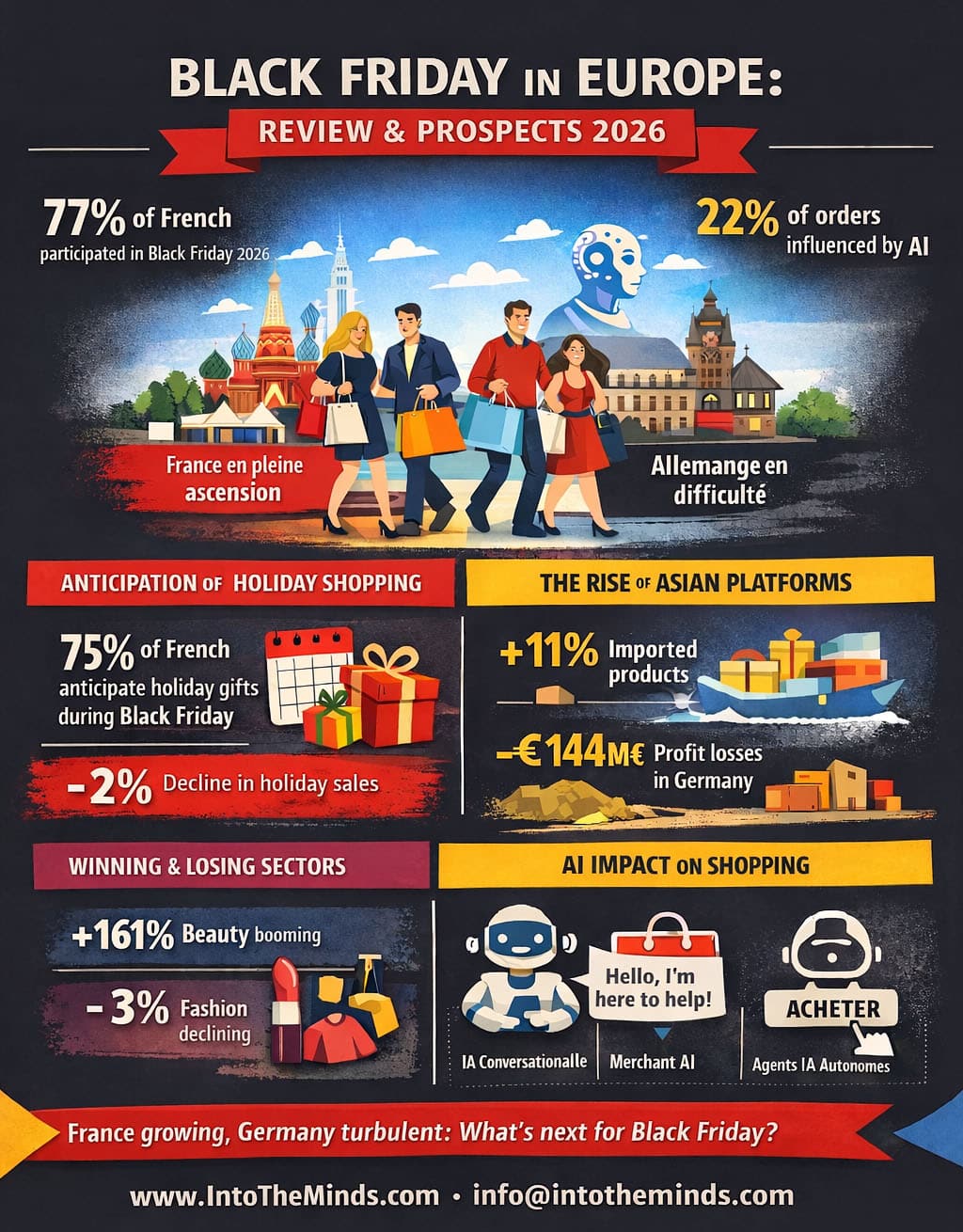
- Artificial intelligence influences 22% of global orders during Black Friday
- 77% of French people participated in Black Friday 2025, confirming its definitive anchoring
- 9.8%: growth in e-commerce sales in France during Black Friday 2025 compared to 2024
- 7%: share of Black Friday in annual e-commerce revenue in France
- 62%: share of major French brands offering Black Friday deals throughout November 2025
- 9%: increase in physical store sales in France during Black Friday
- 12 million: number of visitors to shopping centres in France on Black Friday Saturday
- 29 million: cumulative attendance at shopping centres in France over the Black Friday weekend and the following one
- +314%: progression in sales of wet & dry vacuums during Black Friday
- +137%: increase in airfryer sales during Black Friday
- €419m: fashion spending during Black Friday in France in 2024
- €5.8 billion: revenue from Black Friday and Cyber Monday 2025 in Germany
- -2%: anticipated decline in Black Friday 2025 revenue in Germany compared to 2024
- €298: average budget planned by German consumers for Black Friday 2025
- -7%: decline in average Black Friday budget in Germany year-on-year
- 45%: share of Black Friday budget devoted to Amazon by German consumers not buying on Asian platforms
- 38%: Amazon share among German consumers also buying on Asian platforms
- 3.3%: average share of Black Friday budget spent on Asian platforms by German consumers
- 11%: increase in imported product offerings in Europe around Black Friday 2025
- €144m: estimated profit losses for German distributors over 30 days around Black Friday
- 10.4%: average gross margin in German retail during the Black Friday period
Black Friday 2025: France resists, Germany falters
The comparative analysis between France and Germany reveals a significant divergence. While the French e-commerce market maintains positive dynamics with 9.8% growth in 2025, Germany is going through an unprecedented period of turbulence.
The Handelsverband Deutschland projects revenue of €5.8 billion for Black Friday and Cyber Monday 2025, a contraction of 2% compared to the previous year. This decline occurs paradoxically while volumes remain high, signalling a structural change in purchasing behaviour.
The average budget per consumer perfectly illustrates this European dichotomy. In Germany, it stands at €298, down 7% year-on-year. In France, it continues to rise to €345, testifying to maintained confidence in the promotional event.
This difference is explained by distinct economic and cultural factors. Germany is facing stagnant purchasing power and intensified international competition, particularly visible with the emergence of Asian platforms. France, on the other hand, benefits from strong in-store attendance growth and better resistance to deflationary pressures.
The nature of Black Friday is changing
Beyond the figures, it is the very nature of Black Friday that is evolving. The event is gradually losing its impulsive character to become a budget planning tool. This transformation is observed particularly in France, where 72% of consumers now consider the period as an opportunity to “shop smart”.
Electronics and fashion remain the most sought-after categories, but their hierarchy is changing. Beauty emerges as the big winner of 2025, with a 161% increase in average daily sales between October and Black Week. This performance is explained by the sector’s perfect fit with new consumption codes: accessible products, strong perceived value and obvious gift dimension.
More thoughtful purchases
In France, consumption is becoming more selective. Here are some figures that testify to this. French consumers buy as often as before (4.4 purchases on average), but reduce volumes (-3%) while maintaining value (+0.4%). This evolution undoubtedly translates that consumers prioritise quality over quantity, utility over impulse.
In Germany, this rationalisation goes further. A significant share of consumers declare wanting to consume more consciously, and nearly half of those reducing their budget invoke a desire for sobriety rather than immediate financial constraints. This trend perhaps foreshadows the future evolution of the French market.
Anticipation of Christmas purchases
Black Friday now has an impact on Christmas sales. Customers indeed anticipate Christmas purchases, which mechanically deprives retailers of revenue during the end-of-year holiday period. Thus, 75% of French consumers declare voluntarily postponing certain purchases to take advantage of Black Friday promotions. At European level, 44% of consumers wait for specific promotional events to buy their gifts.
What is important to understand is that this anticipation does not translate into a net destruction of Christmas revenue. On the other hand, there is a temporal redistribution of sales. The latter can be to the detriment of national retailers because of cannibalisation by Asian platforms in particular.
An important aspect of the shift from Christmas to Black Friday is the economic cost for participating brands. Sales shifted to Black Friday are indeed made with high discounts, between 30 and 50%. This degrades overall profitability of the Christmas cycle.
In Germany, this dynamic is even more marked. We observe a 2% decline in Black Friday revenue and the gross margin falls to 10.4% against about 16% outside promotional periods.

The offensive of Asian platforms
The German market reveals the extent of the challenge posed by low-price Asian platforms. Although their share of Black Friday budget remains limited to 3.3%, their impact is disproportionate because it is substitutive spending, not additional.
Transactional data show that German consumers who buy on these platforms drastically reduce their budget allocated to historical players. Amazon’s share in their Black Friday budget drops from 45% to 38%, illustrating direct cannibalisation of established market shares.
This dynamic is accompanied by a massive supply shock. Around Black Friday 2025, the offer of imported products to Europe increases by 11%, mainly from China. Imported volumes explode:
- +58% for bedding textiles
- +46% for toys
- +41% for small electrical appliances.
The consequences on profitability are immediate. In Germany, estimated profit losses for distributors reach €144m over a 30-day horizon around the event. The average gross margin falls to 10.4%, against 10.8% a year earlier, far from the 16% observed outside promotional periods.
Electronics concentrate €57m in profit losses, followed by clothing (€49m) and furniture (€28m). This sectoral distribution reveals the particular vulnerability of categories traditionally driving Black Friday.

Impact of artificial intelligence on Black Friday
A silent technological revolution accompanies these commercial mutations. In 2025, around 22% of global orders during the Black Friday season are influenced by artificial intelligence tools. This proportion could reach 15 to 20% of global e-commerce traffic in the next three years. In this section, I will deliberately address somewhat technical aspects because the very nature of the technologies at work is also changing. We are indeed moving from classic use of recommendation algorithms, to predominant use of LLMs.
We can distinguish 3 major types of artificial intelligence that now influence purchases during Black Friday.
General conversational AI
The first type corresponds to general conversational AI. They intervene upstream of the purchase journey. Tools like ChatGPT, Gemini or Perplexity are increasingly used as a starting point for product research to express needs, make comparisons, and choose the best products (at the best price of course 😉).
These public AI play a prescriber role and guide the purchase decision.
AI integrated into merchant sites
The second type groups AI integrated into merchant sites. They are designed to improve the customer experience on the site and optimise conversion. These are shopping assistants, recommendation engines or intelligent searches integrated directly into the site. Amazon, Zalando or Otto rely on these technologies to guide the customer. Amazon’s assistant is called Rufus (see below) and you will note that it has been given a first name to anthropomorphise it. In other words, we seek to make these assistants “human”.

Rufus is an AI assistant integrated into Amazon that will guide purchases.
AI agents
The third type corresponds to transactional AI agents. This is perhaps the deepest rupture because it implies that the AI is entirely in control. In other words, the consumer delegates the purchase act to artificial intelligence.
This type of application is still far from predominant. It is rather an experimentation phase made accessible in certain environments. For example, OpenAI offers a solution that allows an AI agent to communicate on your behalf with e-commerce sites and make purchases. A technical description is available here. Such a system obviously presents non-negligible barriers to use. The end customer must indeed place trust in these systems which seems far from acquired to me.

Winning and losing sectors
Sectoral analysis reveals clear winners and losers in this transformation of the European Black Friday. Beauty imposes itself as the most dynamic sector, driven by its natural compatibility with Christmas purchases and its resistance to deflationary pressures.
Sephora dominates the French ranking, but the hierarchy evolves according to moments. Nocibé takes the lead during Cyber Monday, while Erborian and YesStyle record the strongest progressions. This volatility illustrates the growing importance of tactical activation versus simple notoriety.
Conversely, fashion is going through a deep crisis. The sector shows -3% in value sales and -5% in volume in France, despite an overall stable market. The symbolic fall of Shein, which falls to 9th place after several years of domination, crystallises this transformation.
This tumble is explained by the dilution of the promotional effect in a sector saturated with private sales and permanent promotions. Vinted retains first place, confirming that second hand has become the fashion reflex, including during promotion periods on new.
High-tech maintains its central position with +3% in value sales, but reveals a major qualitative evolution. The average basket progresses by 46% compared to October, signalling that consumers now wait for Black Week to trigger expensive and thoughtful purchases rather than impulsive gadgets.
Amazon still largely dominates, but Temu gains up to three places during Cyber Monday, illustrating the rise of new players. Rakuten shows remarkable performance with sales 12 times higher than October, ahead of traditional brands like Fnac, Darty and Boulanger.

Prospects for Black Friday 2026
The signals observed in 2025 outline the contours of a deeply transformed Black Friday 2026. The event will retain its status as a commercial highlight, but in a more complex and fragmented environment.
France should maintain its positive dynamics, driven by the definitive anchoring of the event in consumption habits and its successful transformation into the antechamber of Christmas purchases. The average budget could progress moderately, supported by more selective but better targeted consumption.
Germany appears as a laboratory of coming tensions. Without rapid regulatory evolution on imported flows and without upscaling of the offer, pressure on margins should intensify. The German market foreshadows a generalisation of budget arbitrages, price war and competitive polarisation.
Artificial intelligence will accelerate the transformation of purchase journeys. Projections indicate that between 15 and 20% of e-commerce traffic could shift to conversational agents by 2026, profoundly modifying balances between players.
Asian platforms will continue their progression, particularly in Germany where their substitutive impact could amplify. This competitive pressure will force European players to rethink their economic models, favouring added value over simple price competitiveness.
Beauty should confirm its status as a driving sector, benefiting from the transformation of Black Friday into a gift purchase period. Fashion, on the other hand, will have to reinvent its promotional codes to regain attractiveness in a saturated environment.
Physical retail, particularly in Germany, will undergo increasing pressure. Nearly 50% of consumers buying on Asian platforms declare reducing their in-store purchases, aggravating the difficulties of a sector already weakened by high fixed costs. The tax on small Chinese packages could change the game but it is unfortunately not adopted in a generalised way in Europe.

Frequently asked questions about the evolution of Black Friday
Can Black Friday disappear in Europe?
No, because it is well anchored in consumption habits. Nevertheless, the figures show that the underlying dynamic tends to change. The event thus loses its impulsive character to become a budget planning tool. In France, 77% of consumers still participate, but 62% of purchases are now destined for Christmas gifts. This evolution ensures its sustainability while modifying its nature.
Why does Germany resist less well than France?
Germany accumulates several unfavourable factors: stagnant purchasing power, increased pressure from Asian platforms (3.3% of Black Friday budget), and margin erosion (10.4% against 16% outside promotions). France benefits from better resistance thanks to increased in-store attendance and an average budget that still progresses.
How does artificial intelligence change the game?
AI already influences 22% of global orders during Black Friday. By 2026, 15 to 20% of e-commerce traffic could shift to conversational agents. This evolution threatens intermediary players and redistributes cards between brands, distributors and platforms.
Which sectors will pull through in 2026?
Beauty imposes itself as the big winner (+161% average daily sales in 2025), thanks to its fit with gift purchases. High-tech maintains its position with heavier baskets (+46%). Fashion, on the other hand, suffers from dilution of the promotional effect and must reinvent its codes.
Will Asian platforms dominate the European market?
Their impact exceeds their apparent market share (3.3% in Germany). They create a substitutive effect that reduces budgets allocated to historical players. Amazon loses 7 points of budget share among consumers who also use these platforms. Without reaction, this erosion could accelerate.