While the alcohol market is in decline, the non-alcoholic market is showing impressive growth. In this article, we analyse the latest statistics to provide you with an overview of the trends in the different market segments.

The non-alcoholic beverages market is experiencing exceptional growth in Europe and worldwide. Consumption habits are changing profoundly, redefining the beverage industry. Between technological innovation and societal change, let’s discover together the drivers of this profound mutation that is disrupting established codes.
Contact IntoTheMinds for your market studies
Key takeaways
- The non-alcoholic beverages market shows annual growth of 9% between 2023 and 2026
- Annual growth of non-alcoholic beer is +5.4% in value and +3.9% in volume
- In Germany, 700 million litres of non-alcoholic beer were produced in 2024, and the volume has more than doubled in 20 years
- In France, the non-alcoholic beer market represented €238m in 2024
- On the French market, the non-alcoholic blonde beer segment is growing by +11% in volume
- 32% of French people now consume no-low beverages
- 51% of 18-25 year olds consume non-alcoholic beverages
- Non-alcoholic beer represents 5% of the total beer market in France
- Non-alcoholic wine represents only 1% in market share but is growing by 21.5% in value and 12.7% in volume
- Non-alcoholic sparkling beverages represent 60% of the segment’s value
- Non-alcoholic sparkling wines sell on average 6.8% more expensive than their alcoholic equivalents
- Non-alcoholic spirits show growth of more than 6% in value
A structural shift in the relationship with alcohol
We are witnessing a profound transformation of mentalities. The phenomenon goes far beyond fashion effects or economic conditions. Surveys indicate that 71% of consumers have heard of Dry January, and above all, 47% of participants declare having permanently reduced their alcohol consumption after the event. Societal pressure around reducing alcohol consumption therefore seems to have lasting effects. And for the health of our fellow citizens, this is obviously good news.
What is interesting is to note that this evolution particularly affects younger generations. 41% of new participants in Dry January 2025 are under 35 years old. Abstinence or reduction of alcohol is thus becoming a socially legitimate behaviour, even valued, including in urban and cultural circles.
Scientific discourse reinforces this trend. Health authorities, from the WHO to the Deutsche Gesellschaft für Ernährung, now converge on the idea that only a zero consumption level is without risk. This message finds growing echo in society. This is reflected in alcohol consumption (declining) and in the growth of the non-alcoholic segment. In marketing, this is called the “no-low” market.
47% of Dry January participants declare having permanently reduced their alcohol consumption after the event.
Non-alcoholic beer dominates the “no-low” market
Non-alcoholic beer constitutes the most mature and structuring segment of this mutation. In France, sales reached around €238 million in 2024, with growth of 5.4% in value and 3.9% in volume, in a overall declining beer market. In Germany, nearly 700 million litres of non-alcoholic beers were produced in 2024, more than double the volume of twenty years ago. Professionals estimate that one in ten beers produced in Germany will soon be non-alcoholic.
The segment now represents around 5% of the total beer market. Internal evolution reveals an interesting trend: flavoured non-alcoholic beers are stagnating, while non-alcoholic blondes are growing by more than 11% in volume and value. This shift shows that growth is driven by products that faithfully reproduce traditional taste codes.
Non-alcoholic wine shows promising dynamics
Although its weight remains limited, non-alcoholic wine shows encouraging signals. In France, it represents only around 1% of the wine market in volume, but its sales grew by 12.7% in volume and 21.5% in value year-on-year, reaching around €36 million in revenue. Even prestigious wine estates are getting involved because they have recognised the potential of this market. The most striking example of 2025 is undoubtedly Château Sigalas-Rabaud, a Grand Cru Classé from the Sauternes region, which surprised the entire market by announcing in October 2025 the preparation of a non-alcoholic wine. As explained by Laure de Lambert Compeyrot, it is the company Moderato that handled the de-alcoholisation operation by carrying out vacuum distillation at 30 degrees in a column.
If we examine the other segments of the market, we note that non-alcoholic sparkling beverages concentrate nearly 60% of the segment’s value, with growth of nearly 14%. Non-alcoholic still wines are growing by more than 30% in value. This growth is largely outside promotions, with promotional rates lower than those of conventional wines.
Average prices are also increasing, with a rise of more than 6% for non-alcoholic still and sparkling wines. These performances are explained by major technological advances, particularly the generalisation of low-temperature vacuum distillation, but also by the structuring of an industrial sector.
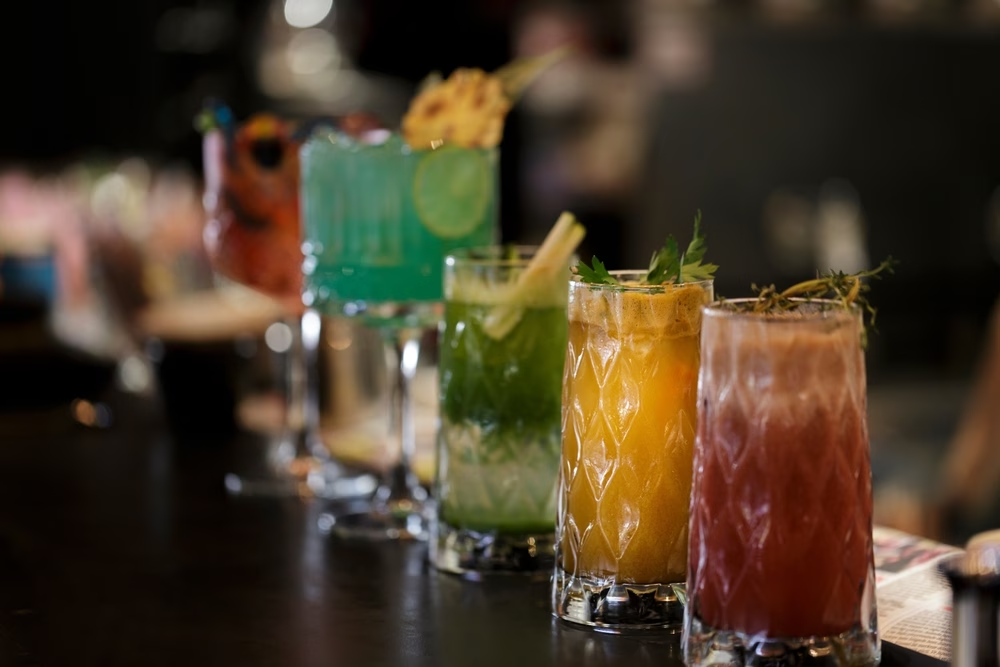
Among 18-25 year olds, cocktails constitute the first entry point into no-low for 63% of consumers.
Spirits and cocktails: the emergence of a new segment
Aperitifs, cocktails and non-alcoholic spirits are evolving on a different but convergent trajectory. Their revenue remains modest, around €58 million in France, but they show growth of more than 6% in value.
Non-alcoholic cocktails represent around 25% of the category’s volumes, while sparkling ones weigh nearly 40%. Figures from market research firms show that among 18-25 year olds, cocktails constitute the first entry point into no-low for 63% of consumers.
After disappointing beginnings, the category now benefits from a coordinated offensive by brands and distributors, with a strong emphasis on taste, uses and in-store education.
Integration into the luxury and sport universe
A major symbolic turning point is observed with the integration of non-alcoholic into the universes of luxury, sport and major events. The arrival of premium non-alcoholic beverages on international competition podiums and in VIP spaces marks a strong cultural rupture. Who would have thought, for example, that non-alcoholic sparkling wine (fake Champagne therefore) would be served in First Class on Air France airline.
This evolution accompanies a confirmed global trend by international data: in the United States, the non-alcoholic beverages market grew by 24% in value in 2024 to reach nearly $200 million. The most optimistic projections estimate that the global market could reach $40 billion by 2033.
These evolutions show that non-alcoholic is no longer associated with constraint or marginality, but becomes compatible with celebration, prestige and performance.
On social networks, there is an increase of more than 20% in searches related to “non-alcoholic” themes in the United States.
Gen Z, driver of change
The analysis of Gen Z behaviours sheds light on the broadening of the phenomenon. Data from monitoring on social networks (a desk research technique) show strong progression in conversations around low-alcohol, sugar-free or functional beverages, with an increase of more than 20% in searches related to these themes in the United States.
This generation drinks less alcohol, but expects more meaning, benefits and coherence from the beverages they consume. Non-alcoholic thus fits into a broader ecosystem of beverages perceived as useful, adapted to specific moments and compatible with a lifestyle focused on health, performance and well-being.
In this perspective, the central question is no longer so much the presence or absence of alcohol as the use value and symbolic value of the beverage in a given context. In other words, consuming a non-alcoholic beverage now sends a positive signal about oneself. Here again, we can only rejoice for health.
Contact us to analyse your market
Towards a mature and diversified market
The non-alcoholic beverages market is no longer content with being a punctual alternative. It imposes itself as an autonomous economic category, driven by structural demand and an increasingly sophisticated offer. Technological advances, evolution of mentalities and commitment of industrial players converge to draw a promising future for this sector in full mutation.
Perhaps it would be too much to speak of a paradigm shift, but this evolution redefines our relationship with beverages and opens new perspectives for more conscious and diversified consumption. In conclusion, we could therefore say that the non-alcoholic beverages market is no longer a niche phenomenon, but a deep trend that is durably transforming the beverage industry. From a strategic point of view, it would therefore be a mistake not to invest in it now.

Frequently asked questions
Why is the non-alcoholic beverages market experiencing such growth?
Several factors explain this growth. First, the evolution of mentalities with growing health awareness. New generations adopt a healthier lifestyle and seek alternatives to alcoholic beverages. Then, technological advances now allow offering quality products that faithfully reproduce traditional flavours. Finally, the phenomenon of “alcohol flexitarianism” is developing, where consumers alternate between periods of consumption and abstinence.
What are the most promising segments of the market?
Non-alcoholic beer remains the most mature segment with 5% of the total beer market in France. Non-alcoholic wine shows the strongest growth with +21.5% in value, even if its weight remains limited. Non-alcoholic spirits and cocktails emerge as a new promising segment, particularly appreciated by young consumers. Sparkling beverages concentrate an important share of value in each category.
How are brands adapting to this trend?
Brands are investing massively in research and development to improve de-alcoholisation processes and create new recipes. They are developing premium ranges to position themselves on the luxury market. Distribution is also organising itself with the emergence of specialised non-alcoholic wine merchants and the integration of these products into traditional circuits. Brands are also betting on education to introduce these new alternatives to consumers. The example of Château Sigalas Rabaud analysed in this article is particularly interesting.
What future for this market in France?
Prospects are very positive with expected growth of 9% per year between 2023 and 2026. The market should continue to structure and diversify itself, with the arrival of new players and the development of innovative products. Integration into catering and hospitality will accelerate. In the long term, non-alcoholic beverages could represent a significant share of the total beverage market, durably transforming French consumption habits.