In this article, we analyze the dynamics of the sake market. Based on the most recent statistics, we show that the market is operating at two speeds, and is nevertheless finding growth drivers abroad.

The sake market is going through a rather complicated period. In Japan, this millennia-old beverage faces a structural decline in domestic consumption, while internationally it is experiencing remarkable growth. This analysis examines the current dynamics of this sector in transition, between contraction of the Japanese market and global expansion. Our marketing research firm used statistics from the past 10 years for this analysis.
Key takeaways
- Sake’s share of the Japanese alcoholic beverage market fell from 70% to 5% since 1945
- Japanese exports represent less than 10% of total sales but are growing rapidly
- France ranks 9th worldwide among importers and 1st in Europe
- 3%: share of Japanese sake production exported in 2016
- 60: number of countries to which Japanese sake was exported in 2016
- $87M: value of Japanese sake exports in 2012
- $590M: value of Japanese sake exports in 2020
- <10%: share of exports in total Japanese sake sales in 2025
- -14%: decline in Japanese sake exports year-on-year (2024-2025)
- 5%: sake’s market share in Japan’s alcoholic beverage market (2024)
- 32: average number of sake breweries closing each year in Japan since the 1973 peak
- +65%: increase in the volume of sake imported into France between 2019 and 2021
- 12%: share of French spirits consumers declaring in 2022 that they bought sake during the previous 12 months
- 20%: share of French consumers declaring they drink sake with a meal in 2022
- +5 points: increase in the share of sake buyers in France between 2019 and 2022
A Japanese domestic market in structural decline
The state of the Japanese market reveals worrying trends for this traditional industry. Sake’s share of the alcoholic beverage market in Japan has fallen from more than 70% after World War II to just 5% in 2024. This drastic drop is accompanied by a 70% reduction in consumption since the 1970s, with the current level representing one third of the peak reached in 1973. In this respect, Japan follows trends observed in other countries: people are consuming fewer alcoholic beverages and the “No/Low” segment continues to grow.
This contraction directly affects the industry’s production structure. The number of breweries has fallen from 30,000 at the end of the 19th century to 1,300 in 2025, with an average of 32 closures per year since 1973. In 2016, Japanese production reached 606,000 kilolitres, of which only 3% were exported to 60 countries.
| Period | Sake share in the Japanese market | Number of breweries | Consumption trend |
|---|---|---|---|
| After 1945 | More than 70% | 5,000 | Historic peak |
| 1973 | – | – | Maximum reached |
| 2019 | – | 1,300 | -70% vs 1970s |
| 2024 | 5% | 1,300 | 1/3 of the 1973 peak |
Exports as a strategic lifeline
Paradoxically, international markets now represent a lifeline for the sake industry. Japanese exports increased from $87 million in 2012 to $590 million in 2020. However, they still represent less than 10% of total sales in 2025 and have even declined by 14% recently, reaching €255 million, notably due to the slowdown in China.
This internationalisation strategy is accompanied by innovations in distribution formats. In 2023, Kura One launched a global subscription for 180ml canned sake available in more than 100 countries. The offer includes 21 Japanese brands with boxes of three to four cans for around €25, thereby reducing the entry price and logistics costs.
The inclusion of sake brewing on UNESCO’s intangible cultural heritage list in 2024 could amplify this trend. Some players expect an effect similar to that observed for washoku, whose number of restaurants worldwide reportedly rose from 55,000 to 187,000 in ten years after its inscription in 2013.
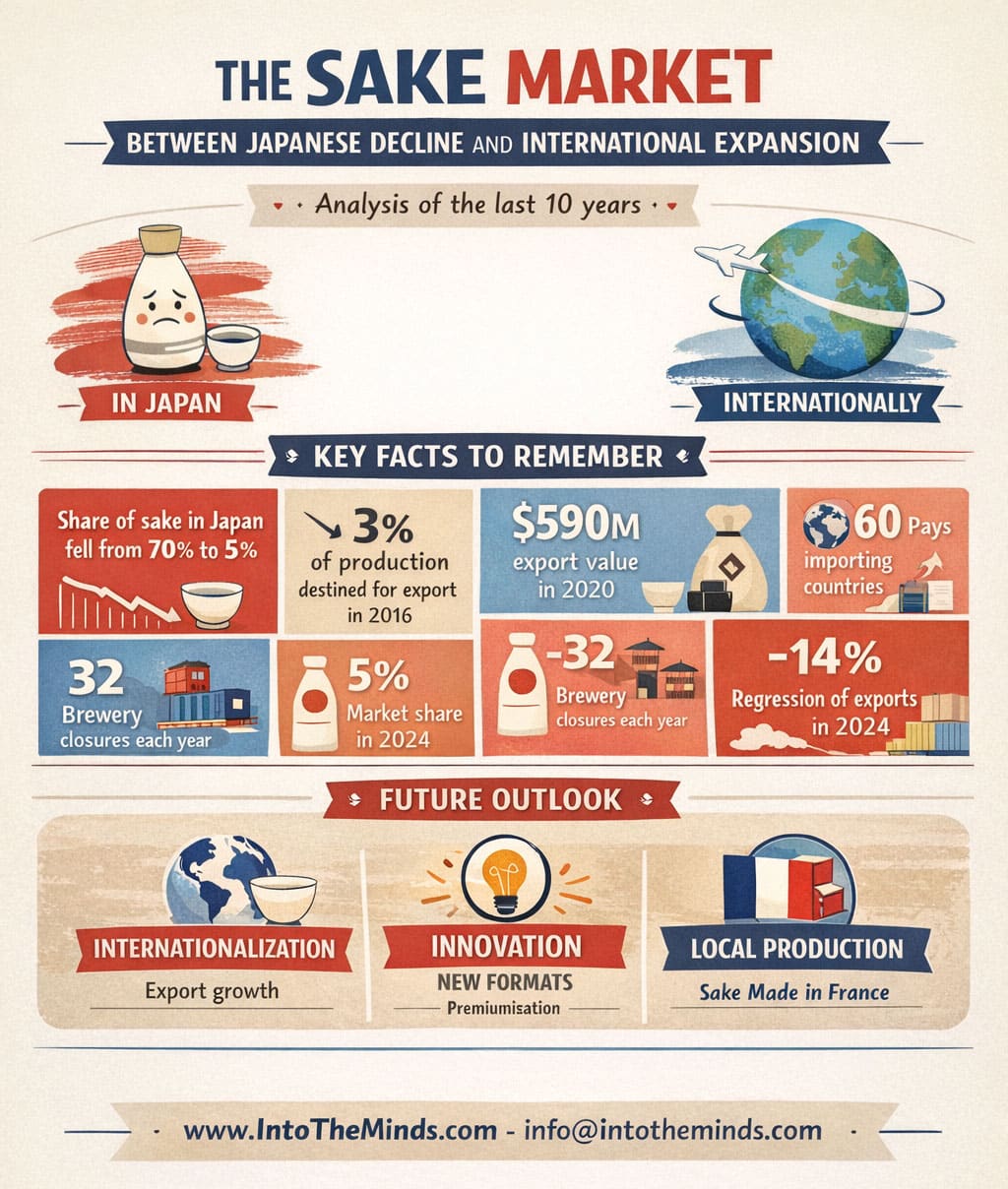
This infographic on the sake market is based on the figures and statistics contained in this article.
France: a European laboratory for the sake market
France perfectly illustrates this positive international dynamic of the sake market. The French market for sake imported from Japan grew from €816,000 in 2013 to €2.2 million in 2019. In 2021, 438,363 litres were imported, representing an increase of 65% compared with 2019. This growth even accelerated with a 3.91-fold increase in imported volume in less than ten years.
In specialised French retail, sales jumped by 127.9% in 2021 to reach €3.77 million, after a 42% decline during lockdowns. France now ranks 9th worldwide among importers of Japanese sake and 1st in Europe, ahead of the three largest global markets (China, the United States, Hong Kong), which represent around €216 million in purchases.
Changes in consumption habits accompany this growth in the French market. According to a survey conducted in July 2022 among 600 spirits buyers in France, 24% say they buy their spirits online, up 5 points compared with 2021. For sake specifically, 12% of French consumers say they bought it during the previous 12 months in 2022, a 5-point increase since 2019, and 20% drink it with a meal.
Innovation and premiumisation transform the offer
Premiumisation is a major development axis for the sake market. This beverage generally contains between 12 and 18 degrees of alcohol, placing it close to wine in terms of positioning. Quality segmentation is based on rice polishing: ginjo (≥60%) and daiginjo (≥50%). Although 80% of sake is intended to be consumed within 18 months, differentiation strategies are emerging with aged cuvées or original maturation methods.
The development of e-commerce and specialised distribution channels offers new opportunities for market access. Entry prices are decreasing with cuvées starting at €16, junmai from €20, and French references between €23 and €50. This strategy allows producers to reach a younger and broader customer base, contributing to the democratisation of this traditional beverage.
The promising emergence of local production
The emergence of local French production marks a new stage in the evolution of the sake market. Since 2019, French breweries have been developing on the national territory. In 2024, a French brewery reports annual production of 50,000 litres, equivalent to 60,000 to 80,000 bottles, with revenue of €900,000 in 2023. Although modest compared with Japanese production, this local output plays a key role in normalising the product within French gastronomy.
This trend is part of a broader process of production internationalisation. Companies such as Hakkaisan have been producing in the United States since 2016, while Dassai has been developing a “made in USA” sake for three years in order to bring production closer to target markets and remove logistical constraints.
Future outlook: between challenges and opportunities
The future outlook for the sake market revolves around several strategic axes. Internationalisation is becoming a necessity to compensate for the contraction of the Japanese domestic market. This transformation is accompanied by innovations in formats, qualitative premiumisation, and the emergence of local productions that contribute to democratising this millennia-old beverage among new audiences.
The sake market thus illustrates a striking paradox between domestic decline and international expansion. While Japan faces a structural erosion in consumption, foreign markets, particularly European ones, offer promising growth prospects for this traditional industry seeking renewal.

Frequently asked questions about the sake market
Why is the sake market declining in Japan?
The decline of the Japanese market can be explained by several structural factors. Sake’s share of alcoholic beverages fell from 70% after 1945 to only 5% in 2024. This decrease results from changing consumption habits, competition from other alcoholic beverages, and societal changes. Consumption has fallen by 70% since the 1970s and now represents only one third of the 1973 peak.
What is the situation of the sake market in France?
France represents a dynamic market for sake, ranking 9th worldwide among importers and 1st in Europe. French imports increased from €816,000 in 2013 to €2.2 million in 2019. In 2021, 438,363 litres were imported, representing an increase of 65% compared with 2019. Sales in specialised distribution jumped by 127.9% in 2021 to reach €3.77 million.
How is sake production evolving outside Japan?
International sake production is expanding to meet growing demand. Breweries are being established in the United States (Hakkaisan since 2016, Dassai for three years) and in France (50,000 litres of annual production for a French brewery in 2024). This relocation aims to bring production closer to target markets and reduce logistical constraints while democratising access to the product.
What innovations exist in the sake sector?
Innovation focuses on formats and distribution. Since 2023, Kura One has offered a global subscription for 180ml canned sake available in more than 100 countries with 21 Japanese brands. Entry prices are decreasing with cuvées starting at €16. Premiumisation is also developing with premium sakes (ginjo, daiginjo) and original maturation methods to differentiate the offer.




![Illustration of our post "In-store digital: customers want efficiency [Survey]"](/blog/app/uploads/flagship-store-lacoste-paris-champs-elysees-14-120x90.jpg)