The frozen food brand Picard follows a very inspiring… and successful strategy. Growth is on track thanks to marketing built around six key areas. We decode them for you, drawing on numerous recent market statistics.
The French frozen food market is undergoing a period of profound transformation. With a turnover of €6.2 billion in France at the end of October 2023, this sector is experiencing contrasting developments that are redefining the rules of the game. In this shifting context, Picard stands out as a particularly insightful case study for understanding new dynamics in food marketing. Our marketing consulting firm therefore provides an in-depth analysis in this article.
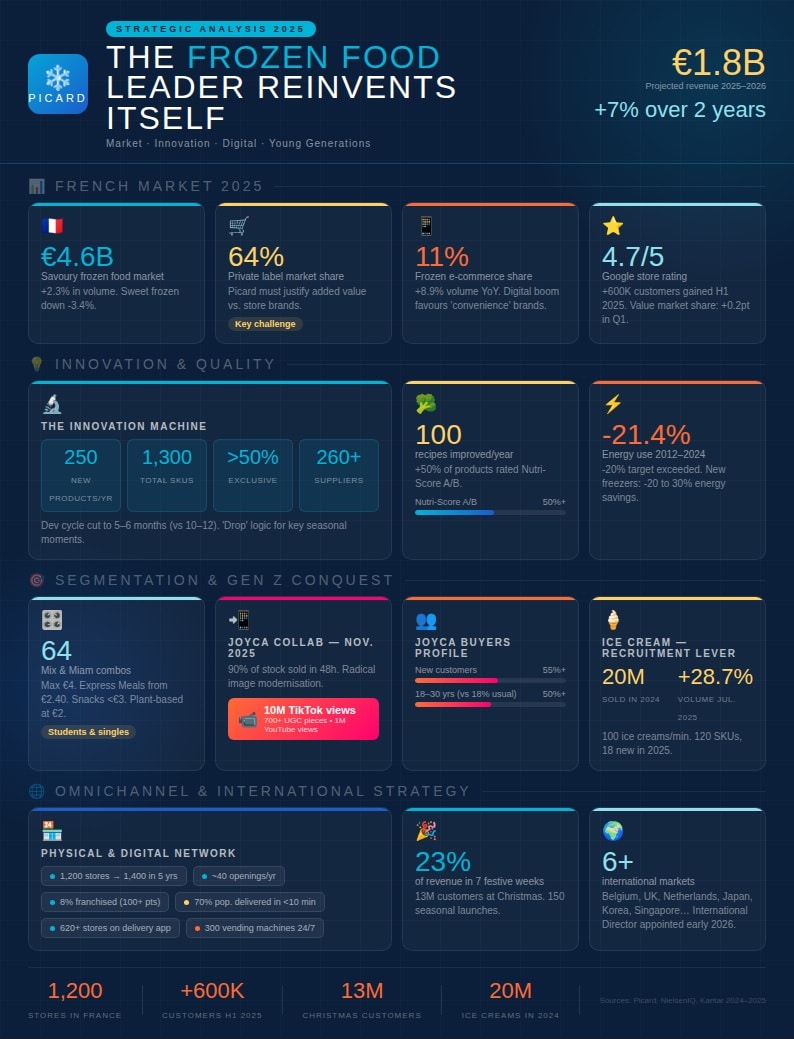
The brand specializing in frozen products has developed a unique marketing approach that transcends traditional sector norms. With projected revenue of €1.8 billion for the 2025–2026 fiscal year and 7% growth over two years, Picard demonstrates that a well-orchestrated marketing strategy can transform the perception of an entire product category.
Key Takeaways
- Picard structures its marketing around three pillars: industrial innovation (250 new products per year), fine usage segmentation, and an omnichannel shopping experience
- The brand prioritizes customer acquisition with +600,000 new customers in the first half of 2025, rather than simply pursuing market share
- Seasonal peaks account for 23% of annual turnover over just 7 weeks (year-end holidays)
- The digital strategy targets 7% of turnover versus 5% currently, with 70% of the French population covered by rapid delivery
- €1.8B: projected 2025–2026 revenue
- +7%: growth over the past two years
- 1,200 stores with an average of 40 openings per year
- 1,400: target number of stores in the next five years
- 8% of stores operate as franchises
The European Context
To understand Picard’s marketing strategy, it is first necessary to analyze the environment in which the brand operates. The European frozen food market is gradually emerging from a particularly turbulent period. After a long phase of decline, the sector experienced a temporary 9% rebound during the health crisis, followed by another cycle of decrease between 2021 and 2024.
In 2025, signs of recovery are emerging, but unevenly. France shows lower volume dynamics than Italy, Spain, and the Netherlands, while outperforming the United Kingdom, which remains in decline. This uneven recovery directly influences the strategic choices of sector players.
A particularly structural trend concerns the redistribution of sales channels. E-commerce now represents 11% of the frozen category’s revenue in France (12.3% for savory frozen products), with volume sales growing +8.9% year-on-year. This evolution favors brands capable of orchestrating a “convenience + availability” promise, making the purchase immediate and reassuring.
If you’re not familiar with Picard, here is a fun video of a Quebecois discovering the brand and sharing his impressions:
The French Market Dynamics
As a French brand, it makes sense to focus on its national market. The 2025 recovery is mainly seen in the savory segment, which recorded +2.3% in volume by the end of April 2025, generating €4.6 billion in revenue in France. In contrast, the sweet frozen segment declined by -3.4% in volume, valued at €1.7 billion. This dichotomy reflects consumer shifts toward simpler products (vegetables, potatoes) over prepared solutions.
Inflation had a profound impact on the previous period. Savory frozen products recorded -2% in volume but +14.8% in revenue (€4.4 billion) for the rolling period ending in October 2023, with inflation reaching 11.9% that month. These pricing pressures have permanently altered consumer behavior and expectations.
In this context, competition intensifies along three main axes:
- Price and perceived cost, prompting the sector to diversify formats, promotions, and anti-waste solutions.
- Image and trust, with an increased need for transparency on origin, traceability, and nutritional quality.
- Innovation, after a phase where the market largely renovated existing products rather than truly innovating.
Private label brands (PLBs) maintain a dominant position with 64% of total frozen volumes in France in 2025. This reality forces specialized brands like Picard to justify added value through differentiation rather than simple price alignment.
Picard’s Strategy: 6 Key Axes
1. Positioning: desirable specialist rather than discounter
Faced with these sector challenges, Picard has developed a marketing strategy based on a coherent triptych:
- industrial-paced innovation
- fine segmentation of consumption moments
- seamless shopping experience combining physical proximity, services, and digital
The brand claims the status of specialized leader and projects €1.8 billion in revenue for fiscal 2025–2026 (ending March), with 7% growth over two years. This performance is supported by a service promise reflected in a 4.7/5 average Google rating for in-store experience.
A particularly interesting aspect of Picard’s marketing strategy lies in its ability to recruit new customers at scale without necessarily converting these gains immediately into market share. Across the extended FMCG-FLS and traditional fresh product perimeter, Picard gained 220,000 new customers in Q1 2025, achieving a market share of 0.9% (+0.2 points). In H1 2025, traffic grew with +600,000 new customers, including +130,000 in Q2 alone, while market share ranged between 0.8% and 0.7%.
This approach suggests an acquisition and frequency strategy aimed primarily at broadening the customer base, even when competitive conditions make immediate market share gains harder to realize.
2. Innovation as a driver of desirability and agility
Picard has made innovation a true brand signature. The company develops 250 new products per year from a total assortment of approximately 1,300 references. This system fuels a “drop” commercial logic, particularly during peak periods, accelerating the pace to match emerging trends.
Under standard conditions, product development takes 10–12 months, but this timeline can be halved for key and limited references. The goal goes beyond simply adding new products: more than 50% of the 2025 offer consists of exclusive items.
This innovation strategy also protects the business model against cost shocks (oil, cocoa) by adapting recipes while maintaining clear value propositions. Picard relies on long-term supplier relationships (over 260 suppliers, including six partners for more than 40 years), sharing risks and securing volumes.
3. Usage segmentation: personalize, portion, simplify
Picard’s marketing relies on highly operational segmentation of consumption occasions. The brand develops individualized meal offerings, snacking, small portions, and “build-your-own” solutions, particularly suited to students and single-person households.
The Mix & Miam range illustrates this approach with a personalization system offering 64 combinations for under €4. Express menus include 300 recipes from €2.40, complemented by sweet and savory snacks under €3. Picard also relaunched quick plant-based menus at €2, balancing accessibility with sustainability goals.
This approach addresses two realities in the French market: smaller household sizes and more fragmented consumption patterns, along with persistent perceptions of frozen food being expensive. Picard emphasizes value not only through quality but also via usage economy (waste reduction, adapted portions, quick solutions) and formats that make the psychological price more acceptable.
4. Acquiring young consumers: a priority
The collaboration with influencer Joyca, launched on November 3, 2025, exemplifies a Generation Z acquisition strategy combining product scarcity, social buzz, and commercial conversion. Within 48 hours, 90% of stock was sold. Over 55% of buyers were new customers, and 18–30-year-olds represented more than half of purchasers, compared to the usual 18%.
Digital activation exceeded expectations, with over 700 user-generated pieces of content, 10 million TikTok views for the top 25 videos, and 1 million YouTube views. This campaign goes beyond immediate sales: it modernizes the brand image, positioning a “heritage” brand as compatible with the cultural codes of under-30s.
5. Omnichannel strategy: physical + digital proximity
Picard develops an ambitious “physical + digital” proximity promise. The brand opened its 1,200th store in April 2025, maintaining about 40 openings per year, with the goal of reaching 1,400 stores in the next five years in France.
Franchising is growing, with 8% of stores (just over 100 outlets) already franchised. By 2025–2026, one-third of new openings are expected to be franchises, accelerating territorial rollout.
Digitally, an exclusive delivery partnership covers 70% of the French population with under-10-minute delivery from store departure. By June 2024, over 620 stores were available across 360+ towns, offering 400 references at an average price of €3.50.
Automated distribution complements this network with 300 machines in Q1 2025, available 24/7, offering 17 references with a monthly-renewed menu. This strategy lowers the “cost of access” to the brand, multiplies consumption occasions, and captures non-standard usage.
6. Seasons as a marketing driver: holidays and ice cream
Picard uses seasonal peaks as a structuring marketing device. Year-end holidays account for 23% of annual turnover over just 7 weeks, with 13 million customers and 150 dedicated new products, including 50 exclusive innovations.
Summer plays a similar role through ice cream, an ideal lever for recruitment and visibility. Picard sold 20 million ice creams in 2024, averaging 100 per minute. By the end of July 2025, 16.5 million ice creams and sorbets had been sold, up +28.7% year-on-year. The offer includes 120 private-label references, with 18 new for the 2025 season.
Summer 2024 was a record, with over 8 million units sold, 2 million ice cream buyers, and +28% growth in new customers for the segment compared to the previous year, generating +21% revenue growth in August.
Credibility of the Promise: Nutrition and Energy Performance
Picard emphasizes “quality + responsibility” with quantified proof. A survey of 1,510 French respondents highlighted strong expectations for seasonality (68%), local products (57% expect brands to commit to local agriculture), and concrete environmental action (83% according to a 2022 study).
The brand links these expectations to tangible assortment proof: over 50% of products are Nutri-Score A or B (600 references), and 100 product compositions are improved annually.
Operationally, energy strategy also serves as a brand message. Picard targeted -20% energy consumption between 2012–2025, achieving -21.4% by end of 2024. Freezers account for 50% of store electricity; upgrading to next-gen equipment saves 20–30%. Nighttime temperature control (-23°C to -21°C) adds an average 8% savings.
International Expansion: Structuring Growth Beyond France
Beyond France, Picard has pursued a more assertive international agenda since early 2026 with the appointment of an international director. The brand is present in Belgium and Luxembourg (~20 stores) and via partnerships in European and Asian markets (UK, Netherlands, Japan, Korea, Taiwan, Singapore).
The first countries to develop are likely the UK and broader Europe. Internationalization is strategic, transforming Picard into an exportable platform where innovation, digital, and logistics expertise become marketing as well as operational assets.
Key Lessons for the Future of Food Marketing
Analyzing Picard’s marketing strategy reveals structural trends for the French food sector. The brand shows it is possible to transform a traditionally functional product category into a universe of desire and experience.
This transformation relies on an integrated marketing approach combining product innovation, fine usage segmentation, omnichannel customer experience, and modern communication. Recruiting new customers at scale while maintaining profitability illustrates the effectiveness of this approach in a mature, competitive market.
The move toward a platform strategy—combining physical retail, digital, and international presence—likely foreshadows the future model for specialized food brands. In a context where French consumers increasingly arbitrate their purchases, Picard proves that a well-orchestrated marketing strategy can create sustainable value.

Frequently Asked Questions About Picard’s Marketing Strategy
How does Picard differentiate itself from competitors in the frozen food market?
Picard positions itself as a desirable specialist rather than a discounter. The brand focuses on innovation with 250 new products per year, a premium customer experience (4.7/5 on Google), and an omnichannel strategy. Unlike mass retailers offering frozen products as a complement, Picard makes this specialization its core business and differentiating strength.
What is Picard’s digital strategy and its objectives?
Picard aims for 7% of revenue via digital versus 5% currently. The brand develops rapid delivery (70% of the population within 10 minutes), vending machines (300 units in Q1 2025), and partnerships with delivery platforms. The goal is to reduce the “cost of access” to the brand and multiply consumption occasions.
How does Picard adapt its marketing to younger consumers?
Picard collaborates with influencers like Joyca, recruiting 55% new customers at the November 2025 launch. 18–30-year-olds accounted for over half of buyers versus 18% normally. Picard also leverages TikTok and Instagram to modernize its image and reach this audience with platform-specific content.
What role do seasonal peaks play in Picard’s strategy?
Seasons are a structuring marketing driver. Year-end holidays concentrate 23% of annual turnover over 7 weeks, with 13 million customers and 150 new products. Summer ice cream sales recruit massively: 2 million buyers in 2024, with +28% new customers recruited in August compared to the previous year.
How does Picard incorporate sustainability into its marketing?
Picard pursues a “quality + responsibility” approach with concrete evidence: 50% of products rated Nutri-Score A or B, 100 product improvements annually, and -21.4% energy consumption between 2012–2024. This meets French consumer expectations: 68% associate good nutrition with seasonal products, and 83% expect brands to act concretely for the planet.

![Illustration of our post "Pricing: strategies, techniques, examples [Guide 2025]"](/blog/app/uploads/pricing-120x90.jpg)