The pet food market is growing. In this article, we identify the underlying growth drivers, analyze figures from several countries, and analyze the future of the market.

The companion animal food market (“petfood”) has entered a period of intense transformations over the past decade. These transformations result from technological innovations, changes in pet owners’ behaviors and the reconfiguration of distribution channels during and after Covid. As a market research firm, we have studied the petfood market several times. We have compiled the latest figures and statistics and provide you with an analysis that explores the trends shaping today’s animal nutrition universe, from purchasing habits to innovation strategies, including the explosive growth of online commerce.
Contact IntoTheMinds for your market research studies
Petfood: key statistics to remember
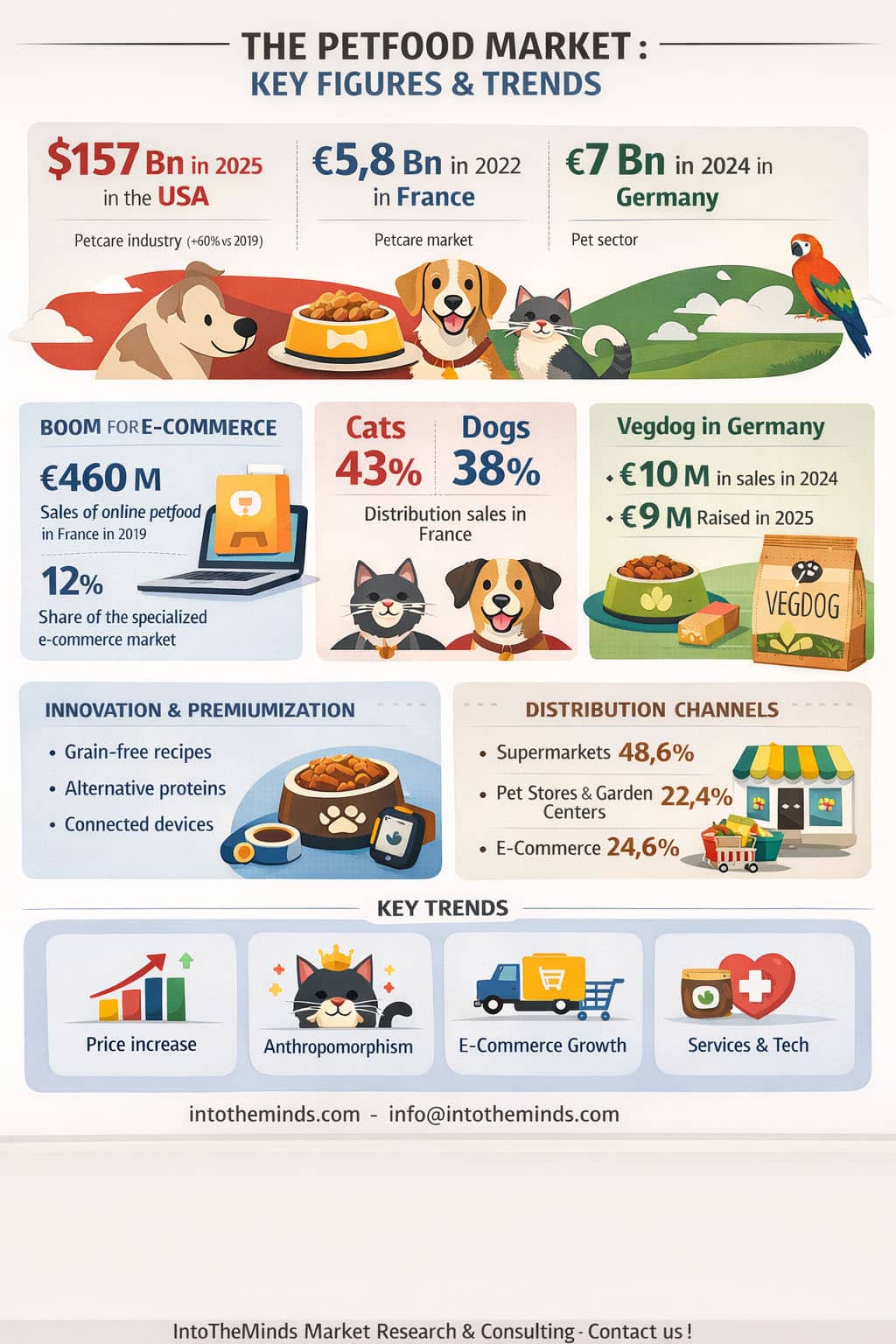
- 157 billion dollars: estimated revenue of the pet industry in the United States in 2025, up more than 60% from 2019
- 66 billion dollars: share of food and treats in the American petcare market
- 5.8 billion euros: revenue of the French pet market in 2022, up 7% in value
- 5.4 billion euros: revenue of petfood and petcare in France in 2021, up 8.5% year-over-year and 16% from 2019
- 3.3 billion euros: revenue of petfood in France in 2019, all channels combined
- 7 billion euros: total revenue of the pet sector in Germany in 2024, according to the Zentralverband Zoologischer Fachbetriebe and the Industrieverband Heimtierbedarf, driven notably by cat growth
- 2.3 billion euros: revenue of cat food in Germany in physical retail in 2024, up 3.5% year-over-year
- 1.8 billion euros: revenue of dog food in Germany in 2024, slight decline in traditional channels
- 460 million euros: estimated revenue of petfood e-commerce in France in 2019 (excluding drive)
- 12%: market share of specialized e-commerce in petfood sales in France
- 15%: share of e-commerce in pet product purchases in France at the beginning of the 2020s
- In France, cats represent 43% of petfood sales versus 38% for dogs
- 9 million euros: amount raised by the German brand Vegdog in 2025
- 10 million euros: revenue achieved by Vegdog in 2024
- 60%: share of Vegdog sales made online
Petfood: a resilient market that carries significant weight
The petfood industry stands out as one of the most resilient economic sectors currently. In France for example, petcare revenue jumped from 4.7 billion in 2017 to 5.7 billion euros in 2024, representing a progression of more than 20% in seven years. This exceptional dynamic is explained by several converging factors.
First, the constant increase in the number of domestic animals. France now counts 26.3 million cats and dogs, making the country the leading European market for animal food. These two species capture the bulk of the sector’s economic value, representing more than 80% of total revenue.
France has 26.3 million cats and dogs. It is the leading European market for animal food.
Next, the profound transformation of the relationship between owners and their animals. The 2020 health crisis particularly accelerated this trend: nearly 70% of owners declared having grown closer to their companion during this period. This emotional proximity directly translates into spending, with a notable upmarket shift in the products purchased.
Germany follows a similar trajectory, with spending exceeding 7 billion euros in 2024. The feline segment plays a driving role there, generating 2.3 billion euros in sales in physical commerce, up 3.5%. Canine food reaches 1.8 billion euros, although some traditional channels are experiencing a slight decline.
In the United States, the scale changes radically. The American pet market should reach 157 billion dollars in 2025, representing a more than 60% increase from 2019. Food and treats represent 66 billion dollars, but services, health and premium products display the most spectacular growth.
 thropomorphism, a key purchasing driver
Sector growth no longer relies solely on the increase in the number of animals but on the fundamental evolution of owners’ behavior. In France, the cat has become central in the petfood economy. Cats represent 43% of sales versus 38% for dogs. This feline predominance reflects societal changes, notably urbanization and lifestyle evolution. Moreover, pet owners tend to treat the animal as a full member of the household, as an extension of themselves. It is this anthropomorphization that encourages owners to take better care than before of their companion’s diet and health.
Feeding thus becomes an emotional act as much as a functional one. Sales of snacks and treats for animals progressed by more than 20% in value in specialized channels in 2020. Cat meal portions displayed increases close to 10%, while some historic segments, such as cans or large bags of kibble, declined sharply.
This transformation manifests through a growing search for personalized and superior-quality products. Owners no longer hesitate to invest in premium, organic or grain-free foods, mirroring their own nutritional requirements.
In 2021, petfood revenue in grocery stores reached 2.16 billion euros, up 3.6% year-over-year. This growth is driven by the upmarket shift in recipes far more than by volume increase, confirming the market’s premiumization trend.
To convince you of the anthropomorphization phenomenon, look at social networks and the staging of companion animals. They become stars.
Distribution channel specifics
The structure of distribution channels is also undergoing accelerated recomposition. Grocery stores, although remaining dominant with 48.6% market share in 2024, see their growth slowing in the face of emerging new players.
Pet stores and garden centers now represent 22.4% of the market and constitute the real growth engine. In 2021, their revenue progressed by nearly 24% year-over-year and nearly 50% over two years, driven by network extension and a very favorable commercial dynamic. Even in 2022, despite an inflationary context, these channels figured among the few to display double-digit value growth.
This performance is explained by their capacity to offer a differentiated customer experience, with personalized advice and a more extensive range of premium products. Owners find the expertise and support they seek for their animals’ well-being.
Veterinarians and breeders, although representing only 4.4% of the market, retain significant influence on consumer choices, particularly for therapeutic foods and high-nutritional-quality products.

E-commerce, new pillar of growth
Online commerce constitutes the most striking revolution in the sector. It represented 24.6% of sales in 2024 and experienced explosive growth. It progressed from barely 1% market share ten years ago (about 50 million euros) to nearly 460 million euros excluding drive as early as 2019.
This progression is explained by the alignment between petfood characteristics and the advantages of online commerce. Purchase recurrence, product weight and the possibility of home delivery perfectly meet pet owners’ expectations. Drive effectively complements this setup, representing about 3% of dog food sales and more than 4% for cats.
The online market is dominated by a few structuring players. Zooplus concentrates nearly half of e-petfood sales in France, with estimated revenue at 200 million euros and average monthly traffic of 4.6 million visits. This concentration illustrates the importance of economies of scale in this sector.
E-commerce also enables strong promotional intensity. Price differences observed on the same product can exceed 25%, allowing consumers to save on average between 18 and 20 euros on a bag of kibble depending on the merchant site. This price transparency transforms purchasing habits and pushes the entire sector toward greater competitiveness.
Zooplus concentrates 50% of online petfood sales in France, with estimated revenue of 200 million euros and average monthly traffic of 4.6 million visits.
Innovation and premiumization, drivers of differentiation
Innovation constitutes a key lever of differentiation on an increasingly competitive market. In 2021, although innovations represented just over 1% of petfood revenue in grocery stores, each launch generated on average more than 500,000 euros in revenue, a level higher than the previous year.
Innovations concentrate mainly on the cat segment, particularly on wet food and treats. This focus responds to the specific expectations of feline owners, who seek ever more refined products adapted to their companions’ tastes. At Websummit 2025, we were able for example to meet a Swiss startup that marketed an automatic cat feeding device on the Nespresso model.

The Swiss startup i-kitty, present at Websummit 2025 in Lisbon, presented its automatic feeding device for cats. The novelty is that it involves wet food (better for cats’ health). From a strategic point of view, i-kitty drew inspiration from Nespresso’s business model. The food refills are indeed patented and only this machine can open them.
Premiumization dominates product launches. Grain-free recipes, single-protein, rich in animal proteins or enriched with functional benefits constitute the bulk of novelties. This trend reflects owners’ desire to offer their animals food as qualitative as their own.
Alternative proteins constitute a particularly promising development axis. A French brand specialized in insect proteins sold 150 tons of kibble and treats in a single year, achieving about 30% of its revenue from exports. In Germany, Vegdog, a plant-based petfood player, exceeded 10 million euros in annual revenue and raised nearly 9 million euros to finance its international expansion.
Innovation now extends beyond the product to integrate technology. Connected objects for animals are seeing growing adoption. GPS collars and animal health monitoring devices already count more than 1.6 million paying subscribers and generate about 150 million euros in recurring annual revenues. These technologies open the way to more personalized feeding, integrating nutrition, prevention and health monitoring.
GPS collars and animal health monitoring devices already count more than 1.6 million paying subscribers and generate about 150 million euros in recurring annual revenues.
Future prospects: between maturity and potential
The petfood market is entering a phase of volume maturity but retains strong potential for value growth. The main drivers of this dynamic are:
- price increases
- recipe premiumization
- e-commerce growth
- development of associated services
Tensions are nevertheless appearing, notably in the United States, where inflation and rising veterinary costs weigh on certain households. The market tends to polarize between very price-sensitive consumers and others ready to invest in ultra-premium products and services. Any product launch must therefore be accompanied by a pricing study.
This polarization creates new opportunities for players capable of offering differentiated offers. Emerging brands such as Ultra Premium Direct, Elmut, Tomojo or Ziggy capitalize on this trend by betting on high-end positioning and alternative distribution strategies.
French production benefits from considerable assets: a developed industrial fabric, abundance of co-products (beef, poultry, cereals) and facilitation of partnerships with accessible entry thresholds (about 15 tons minimum). These elements favor the emergence of new “Made in France” brands responding to growing demands for traceability and quality.
In this context, petfood asserts itself as a hybrid market at the crossroads of food, health, technology and services. This convergence, carried by an ever-stronger relationship between owners and their companion animals, outlines the contours of a sector in full mutation, rich in opportunities for innovative players.

Frequently asked questions
What is the current size of the French petfood market?
The French companion animal food market reached 5.7 billion euros in 2024, with constant progression over several years. This growth is driven by 26.3 million cats and dogs, which represent the bulk of the sector’s value. France thus constitutes the leading European market for petfood.
How are the distribution channels distributed?
In 2024, supermarkets and hypermarkets retain first place with 48.6% market share. E-commerce now occupies second position with 24.6%, followed by pet stores and garden centers (22.4%). Veterinarians and breeders represent 4.4% of the market. This distribution is rapidly evolving in favor of digital and specialized channels.
What are the main innovation trends in the sector?
Innovation concentrates on several axes: premiumization with grain-free and single-protein recipes, development of alternative proteins (insects, plant-based), recipe personalization thanks to digital, and integration of connected objects for animal health monitoring. These innovations respond to the growing anthropomorphization of the relationship with companion animals.
Why is e-commerce so successful in petfood?
E-commerce responds very well to petfood constraints: purchase recurrence, product weight making delivery attractive, and the possibility to easily compare prices. Price differences can exceed 25% between different sites, enabling substantial savings. Moreover, subscription formulas create appreciated revenue recurrence for new market players.
What challenges await the market in the coming years?
The main challenge lies in the growing polarization between price-sensitive consumers and those ready to invest in premium. Inflation and rising veterinary costs create tensions, particularly in the United States. Players must also adapt to the rapid evolution of distribution channels and growing expectations regarding traceability and sustainability.