In this article, I examine Panini’s marketing strategy and analyze its evolution over the past few years. Panini has successfully modernized, reached new target audiences, and ensured the long-term viability of its business, which was launched in 1961.
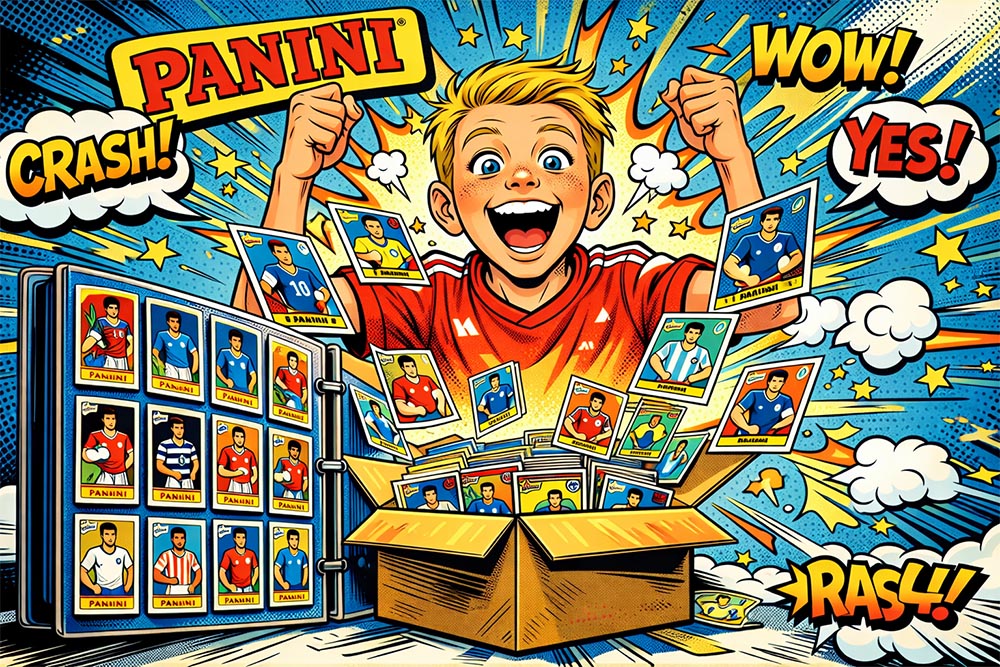
In doing some sorting at my parents’ house a few weeks ago, I came across a treasure: a few Panini stickers from my youth. Among them, the holy grail: my Michel Platini sticker from the 1986 World Cup. Forty years have passed and Panini is still here, thanks to a marketing strategy that spans generations. That’s what led me to take a closer look at the Panini phenomenon and write this article. Incidentally, it also aligns quite well with the expertise of our marketing consulting firm 😉. In short, if you’d like to discuss it, the comments are open and the contact form is available.
Key takeaways
- Panini built its strategy around the collection experience rather than the product itself
- Diversification of licenses (manga, video games) now complements its historic football focus
- Digital extends the physical experience without replacing it
- Mass partnerships amplify traditional distribution
- France represents a marketing innovation laboratory for the group
The foundations of a unique marketing approach
Panini’s marketing strategy is based on a fundamental principle: turning the act of purchase into a social ritual. As early as 1961 in Italy, and from 1976 in France, the company understood that its real product was not the sticker itself, but the collection experience it generates. As an anecdote, this exchange experience has even been the basis for very serious mathematical research.
This marketing approach stands out through several elements:
- the creation of an exchange ecosystem where each sticker becomes an object of desire and negotiation. The rarity of certain stickers is an integral part of the model, which has led some researchers to study its statistical distribution.
- emotional identification with players and teams, turning each collection into a journey
- a community dimension that brings collectors together around a shared passion.
I believe nostalgia also plays a role for collectors belonging to the kidult segment. There may also be a financial element because, as you may know, these collectibles have gained significant value over time. To convince yourself, I invite you to watch the video above. Apparently, some people invest huge sums in their collections.
French figures perfectly illustrate this success: 66.5% of adults reported having owned Panini stickers, and 8.8% were still collecting them. This remarkable penetration shows that Panini’s marketing strategy goes far beyond children and reaches multiple generations.
66.5% of adults reported having owned Panini stickers, and 8.8% were still collecting them.
The geographical and temporal evolution of the strategy
Panini very early on designed its marketing strategy on an international scale. In 2010, the company claimed 150 million stickers sold worldwide, with a presence not only in Europe but also in Mexico, Brazil, and Russia. This geographical expansion is the result of a marketing strategy that adapts to local cultural specificities while maintaining its core fundamentals.
In France, this adaptation translated into impressive figures:
- €75.7 million in revenue in 2014
- a distribution network of 18,000 newsagents
- 5,000 retail outlets in mass distribution in 2016.
This massive infrastructure reflects a marketing strategy focused on proximity and accessibility.
| Period | Strategic evolution | Key markets | Marketing innovation |
|---|---|---|---|
| 1961-1976 | Concept creation in Italy | Italy, then Europe | Calciatori album, collection ritual |
| 1976-2010 | International expansion | France, Latin America, Russia | Adaptation to local leagues |
| 2010-2018 | Complementary digitalization | China, Asia | Mobile apps, social media |
| 2018-2022 | License diversification | Global markets | Manga, video games, NFTs |
Diversification beyond football
In the collective imagination, Panini is associated with football. In my time, it was actually the only sport covered, although I discovered while preparing this article that Panini had been producing NBA cards since the 1990s. However, I place the major turning point between 2018 and 2020. During this period, Panini expanded its portfolio toward licenses from manga and video games. This diversification followed a clear marketing logic: reduce dependence on a single universe and broaden the target beyond childhood.
Dragon Ball Z in 2018 marked the beginning of this new era, followed by Fortnite, Minecraft, Super Mario, then Naruto and One Piece in 2022. This marketing strategy enabled Panini to reach different communities, including adult audiences passionate about these universes. The collection thus becomes a cross-functional marketing platform, applicable to various cultural passions.
This evolution is accompanied by an adaptation of the distribution strategy. In France, the e-commerce site already accounted for 5% of revenue in 2016, signaling the gradual integration of digital into a still largely physical model.
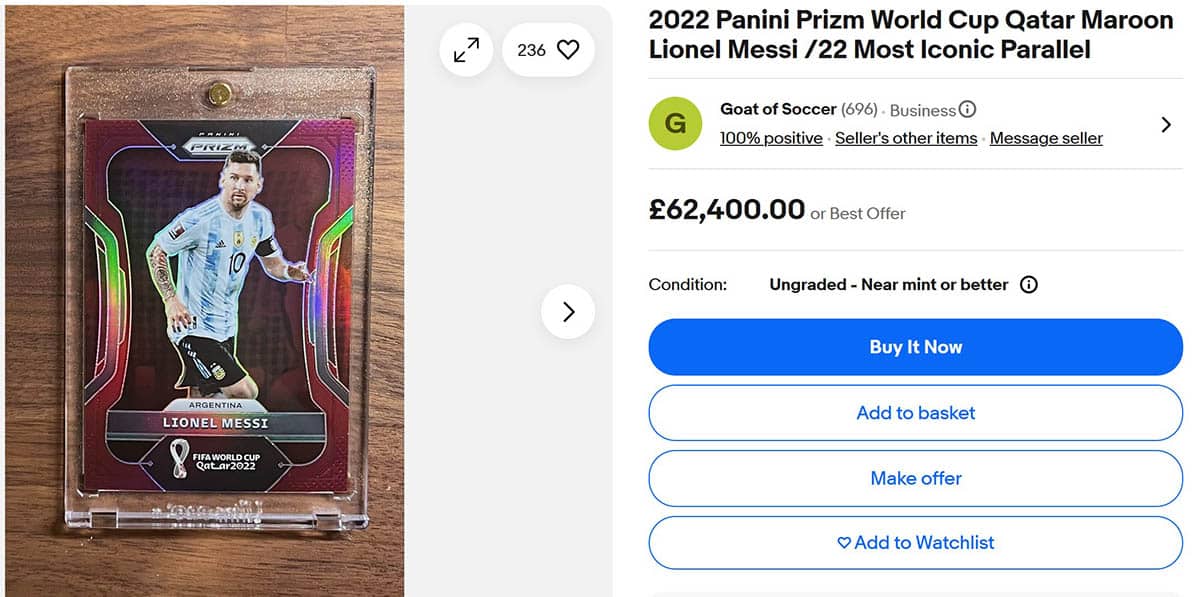
Panini stickers are not only collectibles but also investment assets. This card, issued in 22 copies for the 2022 World Cup in Qatar, was the most expensive listed on Ebay.co.uk at the time of publication of this article.
Digital innovation serving the traditional experience
Panini’s digital marketing strategy stands out for its complementary rather than substitutive approach. As early as 2016 in France, the company clearly stated its intention to use digital as an extension of the physical collection experience, not a replacement. It is important to emphasize this complementarity as it is a fundamental element. Panini understood very early that its marketing foundation was based on physical stickers. This is its DNA, and preserving it is a core objective.
This philosophy translates into several concrete tools:
- mobile applications to track missing stickers
- virtual collections
- sharing duplicates on social media (an excellent way to strengthen the community aspect)
- personalization via My Panini
Digital thus becomes an accelerator of relationships and community engagement.
Expansion in China perfectly illustrates this strategy. In 2018, the partnership with Tencent to launch the FIFA World Cup Trading H5 App achieved more than 2 million downloads in Europe and the United States, placing the app in the global top 10 free sports apps. This success demonstrates Panini’s ability to adapt its collection model to local digital platforms.
The arrival of NFTs in 2022 marked another step. In France, Panini launched a collection of 420 NFT stickers dedicated to French football, with digital packs of 7 cards sold at $5 each. In the United States, prices ranged from $20 to $99 depending on the sport, reflecting a value-based segmentation strategy. With hindsight, we know NFTs were short-lived. Nevertheless, Panini cannot be blamed for following the trend and investing in it.
Partnerships: amplifiers of the marketing strategy
Euro 2016 in France is a textbook case of Panini’s marketing activation strategy. The company deployed a 360° system combining official licenses, distribution, personalization, brand partnerships, and event presence. The official 96-page album with 680 stickers was complemented by a trading card collection of 459 cards, creating multiple levels of engagement.
The partnership with Coca-Cola France illustrates this approach (see video above). Panini distributed 11 exclusive stickers on the back of 140 million bottles, while also offering physical activations such as a mobile photo booth. This strategy made the brand omnipresent in consumption moments, far beyond its traditional channels.
Distribution extended to schools (2,700 partners mobilized for Euro 2016), SNCF trains, amateur clubs, and corporate partnerships. This approach transforms collections into true mass-market systems capable of simultaneously occupying retail outlets, transit locations, and event spaces.
France: a marketing innovation laboratory
What I also observe is that France plays a specific role in Panini’s global marketing strategy. As early as 2014, the data already showed it: during the World Cup in Brazil, 27.3% of French adults had bought stickers for their household or as gifts, and 6.2% collected themselves. Among men aged 18 to 34, this proportion reached 14.9%.
These figures demonstrate that Panini knows how to turn a global sporting event into a national demand peak, including among adult segments. At this point, you are likely convinced of the importance of kidults in the toy sector. To continue this reflection, keep in mind that success is not only about football’s popularity. It also lies in how the brand activates its community, particularly through the internet and social media.
France also serves as a testing ground for personalization and channel hybridization. Activations in supermarkets, virtual albums, and personalized stickers show that Panini operates a comprehensive marketing approach there, at the intersection of product, retail, digital, and events.
Contemporary challenges and strategic adaptation
Panini’s marketing strategy has faced new challenges since 2022. The loss of the UEFA Euro 2024 license and other European national competitions until 2028 weakens a historic pillar: the association between major official competitions and collections.
This evolution explains the strengthening of efforts in digital, NFTs, license diversification, and targeting new audiences. The marketing strategy is evolving from a model historically dominated by major football licenses toward a more diversified, more digital, and more segmented portfolio.
Football remains a major driver but is no longer the sole center of gravity. Panini now leverages its core competence—transforming a license into a collection experience—to apply it to new content, channels, and geographical areas.

What does the future of Panini look like?
The evolution of Panini’s marketing strategy between 2014 and 2022 reveals a clear trajectory. The company remains faithful to its foundation—physical collection, exchange, rarity, social connection—while progressively enriching its model.
Geographically, Panini combines historic European markets, a strong presence in France, an established footprint in Latin America and Russia, and growing ambitions in Asia. From a marketing perspective, it blends the power of licenses, mass distribution, brand partnerships, community engagement, personalization, and digital innovation.
Panini’s strength lies less in selling stickers than in creating a collection ecosystem. Its marketing strategy is based on the ability to ritualize purchasing, organize exchanges, create scarcity, and reignite desire with each new license or major competition. To preserve this position, the company must constantly reinvent its formats and areas of expression while maintaining the essence of its unique marketing DNA.

Frequently asked questions about Panini’s marketing strategy
How does Panini maintain collector interest across generations?
Panini relies on nostalgia and intergenerational transmission. Parents who collected in their youth often introduce their children, creating a natural renewal cycle. The brand also maintains this dynamic by regularly reactivating collections during major sporting events, reaching former collectors who have become adults.
Why has Panini diversified its licenses beyond football?
This diversification addresses several strategic challenges. First, reducing dependence on a single universe amid increasing competition for sports licenses. Second, expanding the target to adult audiences passionate about manga and video games. Finally, adapting to the evolving cultural consumption of younger generations, who are no longer limited to sports.
How is digital transforming the Panini collection experience?
Digital at Panini does not replace the physical experience but enhances it. Applications allow users to manage their collection, identify missing stickers, exchange with other collectors, and access exclusive content. NFTs add a layer of digital scarcity, while social media facilitates exchanges between enthusiasts worldwide.
What is the key to the success of Panini’s marketing partnerships?
Panini excels at making its collections omnipresent without being intrusive. Partnerships with brands like Coca-Cola or institutions such as schools create natural touchpoints with consumers. This strategy turns every consumption moment into an opportunity for discovery or collection, significantly amplifying marketing reach.
![Illustration of our post "ChatGPT: its answers are very similar [exclusive research]"](/blog/app/uploads/chatGPT-brain-cerveau-120x90.jpg)