Nutella’s marketing strategy deserved a specific analysis because it is particularly successful. Communication remains a differentiating factor. In this article, I offer a complete analysis, based in particular on the latest market figures and statistics.
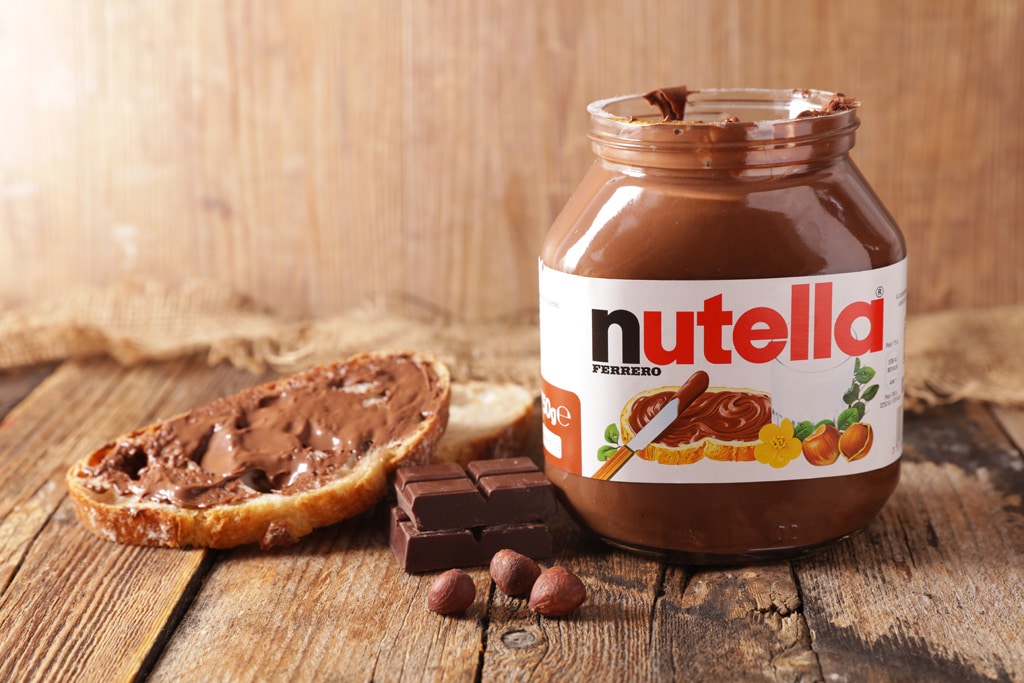
How did a spread born in post-war Italy become one of the most powerful brands in the world? Nutella’s marketing strategy deserves a closer look. Since 2020, the Ferrero group has developed a unique approach that challenges traditional codes in the food sector. This strategy is based on a paradox: innovate little, but innovate strongly. Each launch becomes a carefully orchestrated event, while the brand maintains constant advertising pressure to preserve its leadership.
This approach is even more relevant as the economic context toughens. In 2025, raw materials reach historic price levels, turning marketing into a genuine tool for price justification. Drawing on our experience in market research, we offer you an in-depth analysis of Nutella’s strategy today.
Contact the IntoTheMinds marketing consultancy
Key Takeaways
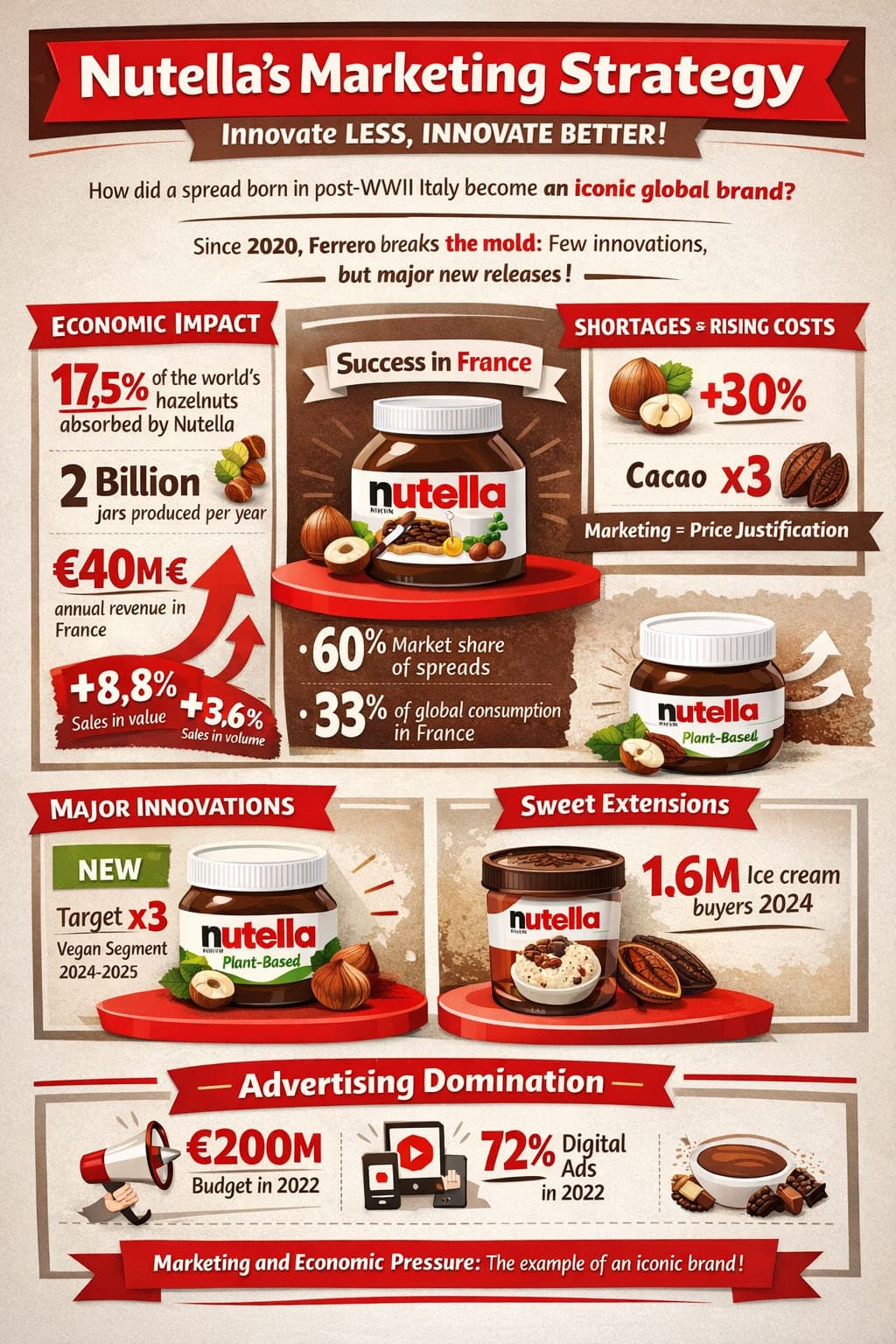
- 25%: This is the estimated share of Turkey’s hazelnut harvest absorbed globally by Ferrero in 2025. Turkey itself represents 70% of global production. Therefore, Nutella production absorbs approximately 17.5% of the world’s hazelnut production.
- 2 billion: Number of Nutella jars produced annually (600,000 jars/day) at the Villers-Écalles factory in France
- 60%: Nutella’s market share by volume in the spread category in France in 2024
- 33% of global production is consumed in France
- +8.8%: Growth in Nutella’s sales value in France between 2023 and 2024
- +3.6%: Growth in Nutella’s sales volume in France between 2023 and 2024
- 400M€: Nutella’s annual revenue in France in 2024
- Ferrero’s advertising investments reached 200M€ in 2022, with 72% dedicated to native digital content
- Raw material prices (hazelnuts +30%, cocoa x3) are redefining pricing strategy
- 72%: Share of advertising videos specifically designed for digital in 2022, compared to 52% in 2019
- x3: Ferrero’s stated goal of tripling the plant-based spread segment between 2024 and 2025
- 1.6 million: Number of Nutella ice cream tub buyers in Europe during the 2024 ice cream season
Raw Material Tensions Redefine Marketing
Nutella’s marketing approach cannot be understood without analyzing the supply constraints facing the brand. Turkey, which supplies up to 70% of global hazelnut production depending on the season, is experiencing a major crisis. In 2025, Turkish production drops by 33% to 520,000 tons, a direct consequence of late frosts linked to climate disruptions.
Nutella production absorbs approximately 17.5% of the world’s hazelnut production
This situation has led to a wholesale price increase of over 30% since April 2025. Meanwhile, cocoa prices have tripled between 2024 and 2025 (which also creates tension in the chocolate market). For Ferrero, the world’s largest hazelnut buyer with about 25% of Turkey’s harvest, these tensions transform marketing into a tool for economic storytelling.
The marketing strategy must now justify price increases while preserving the brand’s accessibility. This constraint in terms of pricing pushes Nutella to communicate more about quality and taste consistency, despite agricultural market volatility. Investment in geographical diversification of supplies (Italy, USA, Chile) indirectly fuels this communication about value chain control.
Innovation Remains Rare at Nutella
Unlike practices in the food industry, Nutella’s marketing strategy is not based on frequent launches of new products. Until 2024, the brand had stood out for its extreme caution in product segmentation. This restraint is a strategic pillar: each extension must appear as an event, not an opportunistic variation.
Nutella Plant-Based
In September 2024, Nutella took a step forward with the launch of Nutella Plant-Based in France, Italy, and Belgium. This first major segmentation of the recipe in sixty years replaces skimmed milk powder (8.7% of the formula) with chickpea and rice syrup powder. The innovation results from five years of research and development. The lid is green to ensure consumers notice the difference. One can’t help but think that beyond ecological aspects, this recipe aims to restore Nutella’s reputation, tarnished by the hydrogenated palm oil scandal.
The stated marketing goal is to triple the plant-based spread segment, which represented 6.7M€ in revenue in 2024 with a 4% increase. The pricing strategy illustrates the logic of inclusive recruitment, maintaining price proximity with the original recipe. This approach targets not only vegan consumers but also flexitarians reducing their consumption of animal products.
In just 13 weeks, the Nutella ice cream tub captured 13.1% market share by value
Nutella Ice Cream
Nutella’s marketing strategy is no longer limited to traditional breakfast. In June 2024, the brand diversified its consumption occasions with the launch of the Nutella ice cream tub in Europe. This innovation allows Nutella to enter the impulse and dessert market while maintaining the brand’s taste identity.
The results exceeded expectations. In 13 weeks, the product generated 13M€ in revenue and captured 13.1% market share by value in the ice cream tub segment. The peak reached 18.2% during the last week of the 2024 ice cream season, with a penetration rate of 5.5%, representing 1.6 million buyers.
This performance positions the ice cream tub as the top innovation of the 2024 ice cream season in Europe. In marketing terms, Nutella demonstrates its ability to transfer its brand equity to other categories without dilution, while maintaining a coherent pricing strategy aligned with the market average.
A Communication Strategy Based on Advertising Dominance
Communication is the central pillar of Nutella’s marketing strategy. In 2022, the Ferrero group invested nearly 200M€ gross in advertising, with 174M€ dedicated to sweet groceries. This advertising intensity explicitly aims to maintain a share of voice higher than the market share, a logic endorsed by the group.
The shift to digital is accelerating. In 2022, 72% of new advertising videos were specifically designed for the web, compared to 52% in 2019. This transformation allows Nutella to reach younger audiences via social networks, influencer partnerships, and event activations, while renewing its discourse without questioning its historical codes.
Television remains the priority mass medium for traditional family campaigns. This multichannel approach enables the brand to maintain its presence across all generations, from children to parents, adapting formats and messages to the specificities of each platform.
The French Market: Industrial Pillar and Strategic Laboratory
France holds a central position in Nutella’s global marketing strategy. The Villers-Écalles factory in Normandy produces over 2 billion jars annually, representing nearly 33% of global production. This industrial concentration makes the French market a strategic laboratory for marketing innovations.
The French factory is responsible for 33% of Nutella’s global production
In 2024, Nutella crossed a symbolic threshold by dropping below 60% market share by volume in the spread category in France, while maintaining around 70% in chocolate spreads. This evolution reflects less a decline than a market restructuring, marked by the rise of organic, praline, and peanut alternatives. Competition from the Nocciolata brand, in particular, is making its presence felt. The parent company, Rigoni di Asiago, enjoys growing success capitalizing on “palm oil-free” positioning, which deserves a dedicated article on this blog 😉.
Despite this relative erosion, Nutella continues to grow with +8.8% in value and +3.6% in volume between 2023 and 2024. The 60,000 tons sold annually generate nearly 400M€ in revenue in France. This dynamic occurs in a tense social context: in 2024, 8% of French consumers declare skipping breakfast for financial reasons, compared to 4% in 2016.
Future Prospects for Marketing Strategy
Analysis of the latest figures reveals a marketing strategy in transition. Nutella is evolving from an extensive conquest logic to a leadership defense through differentiation. This transition relies on three main levers:
- event-driven innovation
- diversification of consumption occasions
- value chain control
Consumption Moments
Nutella remains closely associated with breakfast, a key consumption moment in Western Europe. In France, nearly 7 out of 10 people declare having breakfast daily in 2023. Spreads constitute, between 2023 and 2024, the main driver of volume growth in this category.
Between 2022 and 2024, spread volumes grew by over 4% in French supermarkets, closely linked to the post-Covid period and the need for reassurance that boosted Comfort Food. This growth occurs paradoxically in a tenser social context, where budgetary trade-offs intensify. Nutella’s marketing strategy must therefore reconcile accessibility and rising production costs.
The brand positions itself as an accessible pleasure, capable of resisting budgetary trade-offs. This approach requires fine-tuned communication on perceived value, highlighting ingredient quality and taste experience to justify a slightly higher price positioning than alternatives.
Value Chain Control
Raw material tensions reinforce the importance of marketing in price justification. Communication becomes a tool for economic education, explaining supply constraints while highlighting quality investments. This transparent approach strengthens consumer trust in an inflationary context.
For IntoTheMinds, this evolution illustrates how iconic brands adapt their marketing strategies to new sectoral challenges. The balance between innovation and tradition, accessibility and quality, constitutes a particularly rich study model for understanding contemporary food marketing transformations.

Frequently Asked Questions About Nutella’s Marketing Strategy
Why Does Nutella Launch So Few New Products?
Nutella’s marketing strategy prioritizes innovation rarity to preserve the impact of each launch. Unlike brands that multiply references, Nutella makes each new product a media event. This approach avoids brand commoditization and maintains consumer attention. The launch of Nutella Plant-Based in 2024, the first major segmentation in 60 years, perfectly illustrates this logic.
How Does Nutella Justify Its Price Increases?
Nutella’s communication relies on transparency regarding supply constraints. With a 33% drop in Turkish hazelnut production in 2025 and cocoa prices tripling, the brand explains raw material tensions. This economic pedagogy, rare in the food industry, maintains price acceptability while valuing the product’s consistent quality.
What Is the Share of Digital in the Communication Strategy?
Digital now represents 72% of Nutella’s new advertising videos, compared to 52% in 2019. This evolution allows reaching younger generations via social networks and influencer partnerships. However, television remains the priority for family campaigns. This multichannel approach optimizes coverage across all targets, from children to parents.
Why Is Nutella’s Market Share Declining in France?
The drop below 60% market share in France in 2024 reflects market restructuring rather than Nutella’s decline. The rise of organic, praline, and peanut alternatives diversifies the offer. Paradoxically, Nutella continues to grow in value (+8.8%) and volume (+3.6%), demonstrating that this relative erosion does not affect the brand’s commercial momentum.

![Illustration of our post "Dark stores: statistical analysis and outlook [Study]"](/blog/app/uploads/dark-store-120x120.jpg)