Less than 20% of the quote requests we receive include specifications. I’ve analyzed hundreds of market research specifications and share my recommendations in this article.

Our market research firm receives several hundred requests every year. Fewer than 20% of these requests are accompanied by a detailed brief outlining the study to be conducted. Most of the time, we receive “business” requests: “Our company wants to measure its brand awareness in France,” “we want to measure customer satisfaction,” “we want to assess our international growth potential.” The firm must then translate this request into a methodology, which naturally complicates the comparability of proposals for non-specialists. Which method is the most suitable? Who should you trust?
I therefore advocate for the drafting of a detailed brief when external market research is required. To assist you, I have reviewed hundreds of these briefs to analyze them (thank you, AI). This allowed me to identify recurring mistakes and propose a structured brief template for your market research.
Remember, according to a survey conducted in 2023 among 150 French companies, 68% of poorly framed research projects exceed their initial budget by more than 30%. I firmly believe that a well-designed market research brief will help you avoid costly misunderstandings, structure strategic thinking, and facilitate the selection of the optimal provider.
Key Takeaways
- Clearly define the decision problem: Distinguish the research topic from the managerial decision to be informed
- Define the methodology without error: Specify whether the approach should be confirmatory or exploratory
- Specify the evaluation criteria for proposals: Indicate how the best offer will be chosen to eliminate less serious market research firms
- Prioritize objectives: Separate essential questions from secondary ones
- Define the scope: Geography, targets, languages, timeframe, and possible exclusions
- Detail expected deliverables: Format, level of analysis, and final use of results
- Plan the timeline: Include internal validation times and fieldwork constraints
Why I Believe a Detailed Brief is Essential
Preparing a detailed brief for external market research addresses several critical issues. This document structures strategic thinking upfront and forces teams to clarify their actual needs, prioritize their goals, and anticipate how the results will be used.
This framing phase often reveals inconsistencies in the initial request or conflicting objectives between different departments. It also helps avoid costly misunderstandings between the client and the specialized market research provider.
A well-crafted brief also facilitates the comparison of provider proposals. It allows for the evaluation of proposals based on objective criteria and selects the most appropriate methodological approach for the identified challenges. Too often, the lack of a clear basis for comparison hampers decision-making.
Here’s an anecdote that illustrates this issue. A few weeks ago, a private bank contacted us. They wanted to conduct a brand awareness study in Belgium targeting individuals with over €1 million in cash to invest within the next 12 months. You’ll agree that such profiles are not common. We conducted a preliminary study to determine the sample size and concluded that we could gather a sample of 385 individuals. We lost the project because a competitor proposed a sample of 1,000 individuals. Without a detailed brief, the competitor offered a standard proposal without conducting a preliminary study to determine if the sample was feasible. The client, not fully understanding the subject, chose the offer that seemed most advantageous—the one with the largest number of respondents.
The lack of a clear basis for comparison hampers decision-making.

The Most Common Mistakes in Market Research Briefs
Strategic Framing Errors
The confusion between topic and problem is the most common mistake. Many documents indicate a general theme (“customer satisfaction,” “brand image,” “sustainability”) without specifying the decision the study should inform. This imprecision leads to descriptive research that is difficult to act upon.
Vague objectives are another major pitfall. Formulations like “better understand” or “assess perception” are insufficient if not translated into precise and measurable research questions.
The piling up of objectives in a single study is also problematic. Some briefs aim to simultaneously measure awareness, image, satisfaction, usage, and barriers without clear prioritization. This approach dilutes the study’s effectiveness and significantly increases costs. Others accumulate objectives that are impossible to achieve with the given methodology and/or timeframe (see the example in the following paragraph).
| Type of Error | Manifestation | Impact | Solution |
|---|---|---|---|
| Confusion between topic and problem | General theme without a decision to inform | Descriptive study with little actionable insight | Specify the managerial decision |
| Vague objectives | “Better understand,” “assess” | Unclear questionnaire, imprecise results | Formulate measurable questions |
| Piling up objectives | Multiple dimensions without prioritization | Overly long questionnaire, budget overrun | Prioritize objectives |
| Imposed methodology | Predetermined data collection method | Suboptimal solution | Let the provider propose the methodology |
Methodology Selection Errors
Imposing a methodology without justification is one of the most frequent mistakes I observe. Some organizations immediately dictate the data collection method or sample size without explaining why this choice is the most appropriate.
Confusion between exploratory and confirmatory phases leads to inconsistent methodological designs. A good brief clearly distinguishes what serves to explore, what serves to measure, and what serves to test. In this regard, I note a glaring lack of understanding in marketing departments, which often confuse confirmatory and exploratory methodologies. This is particularly true when the brief imposes a qualitative study. Focus groups are too often imposed in exploratory contexts when they are confirmatory methods. I recommend reviewing this analysis of the differences between qualitative interviews (exploratory) and focus groups (confirmatory).
The arbitrary fixation of sample sizes, unrelated to the desired statistical precision or subgroups to analyze, compromises the quality of the results. Conversely, some requests for detailed subgroup analyses do not account for the corresponding sample size.
Here is a concrete example of a mistake found in a brief received for market research in France and Belgium. The study objectives were defined as follows:
The primary objective of the project is to produce realistic, substantiated, and quantified hypotheses regarding the target market, enabling: 1) Validation of the economic potential of the activity, 2) Structuring of revenue forecasts, 3) Sizing of investments and costs, 4) Input for financial plan assumptions (business plan).
The issue is that the imposed methodology is “Qualitative interviews with end-users and potential expert interviews and/or sector stakeholders.”
A qualitative approach cannot address the imposed business objectives. A quantitative approach would have been necessary. Any serious professional would declare the brief unfeasible.

The Ideal Structure of a Market Research Brief
The Executive Summary
This one-page section should answer five fundamental questions:
- What is the context?
- What decision needs to be informed?
- What is the purpose of the study?
- What is the target population?
- What is the timeline?
This summary allows providers to quickly understand the challenge and assess their ability to meet the request. It also serves as an excellent synthesis exercise for the client.
Context and Challenges
Describe the organization, the current situation, the trigger for the study, and any constraints related to comparability with previous studies. This section helps providers understand the environment in which the request is made.
Mention any previous studies, their main conclusions, and the reasons motivating this new research. This context avoids redundancy and guides methodological recommendations. For customer satisfaction studies, specify which constructs need to be measured to ensure continuity with previous years’ measurements.
The Decision Problem
This is the most frequently missing yet most important section. It must clearly explain the managerial decision the study should inform: Should the brand be repositioned? Should the offer be modified? Should the communication strategy be revised? Should investment priorities be redefined?
In my opinion, understanding the type of decision the company wants to make with the data from the market research will allow me to respond much more precisely and effectively to the brief. This is where IntoTheMinds stands out, as in addition to our technical expertise, we have several “business” expertise areas that our competitors lack.
This clarification transforms a simple data collection into a true decision-making tool. It also guides methodological choices and the angle of result analysis.
Study Objectives
Divide this section into:
- primary objective
- secondary objectives
- questions the study must answer
This prioritization guides methodological and budgetary decisions.
Formulate precise, testable, and measurable questions. For example: “Which criteria weigh most in the choice of a provider?” or “What is the spontaneous and aided awareness of our brand?” It is not necessary to specify how to measure the constructs as this should be part of your evaluation of providers. If a firm does not discuss the questions and scales it will use to measure the different constructs (e.g., “awareness”), you should start questioning their seriousness.

Technical and Methodological Specifications
Study Scope
Specify geography, targets, languages, observation period, and possible exclusions. Also indicate desired comparability with previous waves if the study is part of a tracking program.
This delineation prevents scope creep during the project and allows providers to accurately assess feasibility and costs.
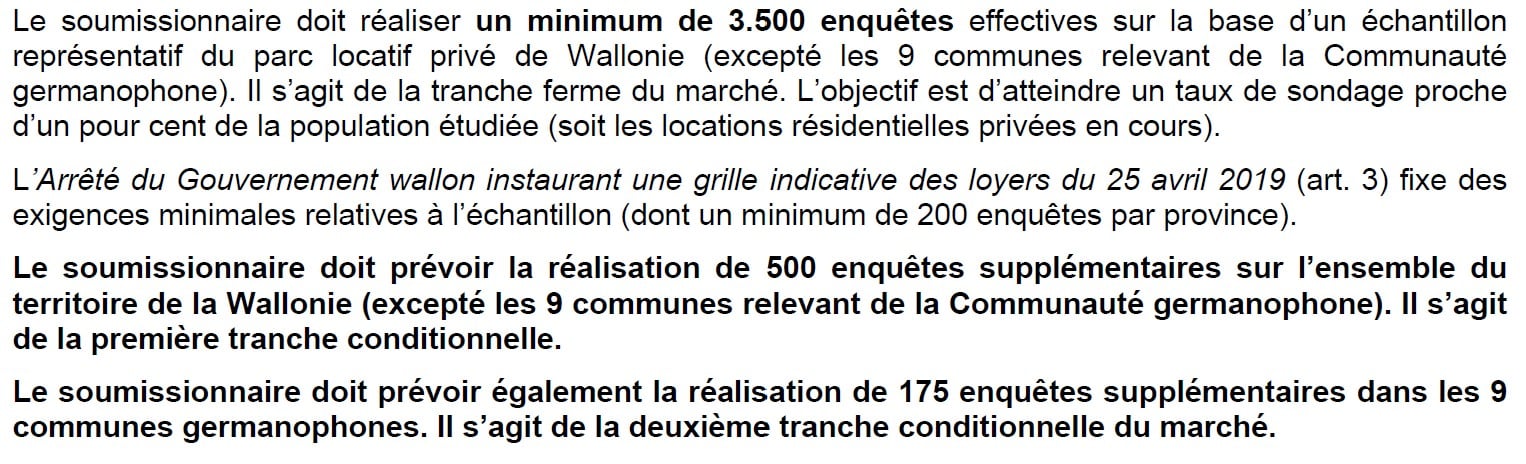
Sampling definition in a brief for quantitative market research in Belgium.
Sample and Recruitment
Detail the target, quotas or stratification, minimum size, subgroups to analyze, recruitment method, and fieldwork constraints. This section allows providers to assess feasibility and collection costs.
Avoid setting arbitrary sample sizes. Instead, specify the desired statistical precision and planned analyses. The provider can then optimize the sample size.
In this regard, it is important to be realistic, both in terms of feasibility and budget. Too often, the requests we receive are unrealistic. Here’s another anecdote. A few weeks ago, we were contacted by a French company wanting to conduct a brand awareness study. Their target: CEOs of CAC40 companies. Needless to say, this study will never happen, as contacting the heads of France’s 40 largest companies is unfeasible.
Questionnaire and Data Collection Tools
Specify who drafts and who validates the questionnaire, expected duration, required languages, questions comparable to previous waves, and pretest modalities.
This clarification avoids misunderstandings about responsibilities and allows for anticipating validation timelines. The pretest, often neglected, deserves particular attention to ensure the quality of collected data.

Governance and Project Management
Roles and Responsibilities
Clearly define who validates the questionnaire, who provides files, who oversees fieldwork, and who arbitrates modifications. The best briefs include meetings, a steering committee, and regular updates.
This organization prevents project blockages and ensures smooth communication between all stakeholders.
Detailed Timeline
Include internal validation times, often underestimated. Allow time for translation, follow-ups, data cleaning, and fieldwork adjustments. A realistic timeline avoids tensions and ensures deliverable quality.
Generally, allow 2 to 3 weeks for questionnaire design, 3 to 6 weeks for fieldwork depending on complexity, and 2 to 3 weeks for analysis and reporting.
Change Management
Clarify what falls within the initial scope and what constitutes an additional request. This clarification avoids budget overruns and conflicts during the project.
Plan a change management mechanism with pre-set rates for minor changes and an amendment procedure for major changes.

Deliverables and Their Use
Expected Level of Analysis
“Final report” or “PowerPoint” is not enough. Specify whether you expect a results table, an executive summary, recommendations, a segmentation, or a prioritization of actions.
This specification allows providers to adapt their analysis level and pricing. It also avoids disappointment due to unstated expectations.
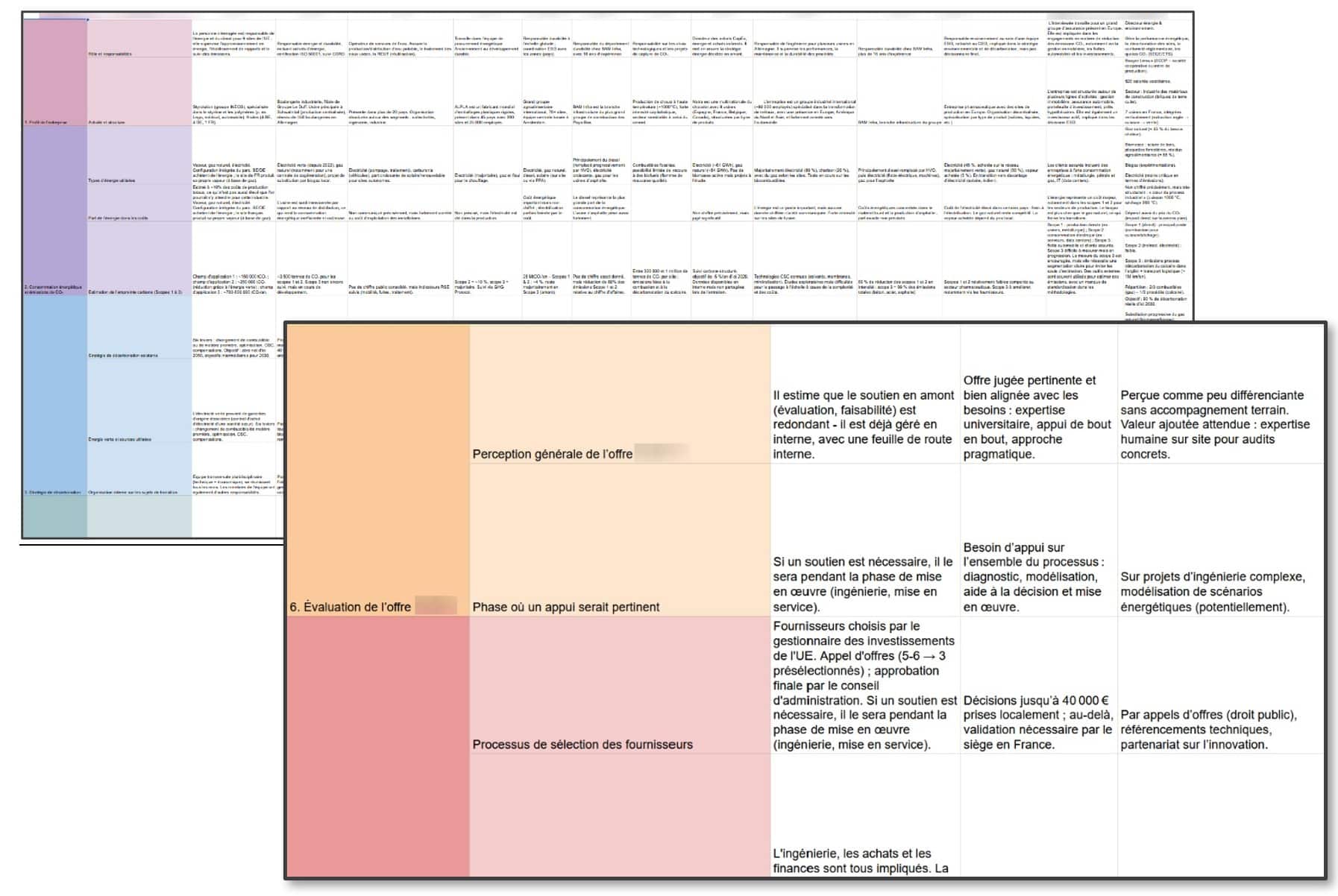
If your brief involves market research using a qualitative methodology, it may be useful to specify how interview analysis should be documented. This also allows you to specify the format of intermediate deliverables. For IntoTheMinds, we analyze both qualitative interviews and focus groups using a grid detailing themes and sub-themes (rows) and respondents (columns). This internal deliverable is also handed over to the client at the end of the project.
Data Format
Specify the format of raw data (CSV, Excel, SPSS for quantitative studies), weighting level, full labels, and anonymized structure. This precision facilitates internal result exploitation. For our part, we always provide raw data to clients.
Also plan for the delivery of a variable dictionary and a detailed methodological note to allow for additional analyses.
For projects using a qualitative approach, the provider may rely on a correlation matrix for analysis. They will inevitably use software, and it might be appropriate for you to obtain this file as well (for IntoTheMinds, we use Maxqda).
Key Indicators
Define expected indicators to avoid a correct but disappointing report misaligned with your actual expectations. These indicators should be consistent with the study’s strategic objectives.

Provider Selection Criteria
Price-Quality Balance
Avoid overemphasizing price at the expense of methodological quality, research design, sector experience, or analytical capacity. The best briefs value method, team, references, and understanding of the need. Personally, I do not respond to any request where price accounts for more than 50% of the weighting. When I see public tenders where price counts for 100% of the score, I run away. Assigning 100% of the score to price ensures choosing the lowest quality offer.
Assigning 100% of the score to price ensures choosing the lowest quality offer.
A balanced distribution could be: 40% for methodological quality, 25% for team and references, 20% for understanding the need, and 15% for price.
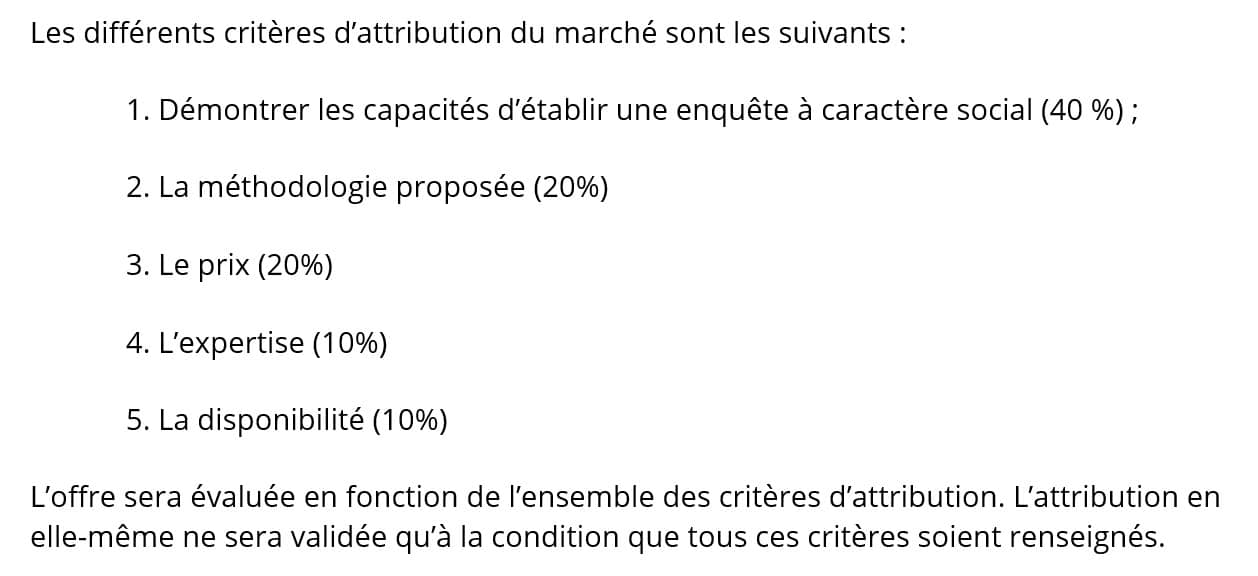
Decision criteria and weighting in a brief for market research services in France
Methodological Evaluation
Provide sufficient information on available bases, real constraints, history, and access channels to allow providers to design a relevant approach.
This transparency fosters innovative and context-specific proposals. It also avoids unpleasant surprises during the project.

Frequently Asked Questions About Market Research Briefs
What is the ideal length of a market research brief?
An effective brief is typically between 10 and 20 pages. The key is not length but the precision and completeness of the information provided. A document that is too short risks generating misunderstandings, while one that is too long can bury essential information.
Should a specific methodology be imposed in the brief?
It is generally preferable to let providers propose their methodological approach. You can specify your constraints (budget, deadlines, hard-to-reach targets) and preferences, but methodological expertise is part of the provider’s value-added.
How to assess the quality of a brief before distributing it?
Test your brief internally: can someone outside the project understand your needs and challenges? Are the objectives measurable? Is the link between research questions and decisions clear? This internal validation avoids many subsequent problems.
What timeframe should be planned between distributing the brief and starting the study?
Allow at least 4 to 6 weeks: 2 weeks for provider responses, 1 week for offer analysis and selection, 1 to 2 weeks for finalizing the questionnaire and launching fieldwork. This timeframe can extend depending on the study’s complexity and internal validation constraints.
How to manage changes during the project?
Plan a change management mechanism in your brief with pre-set rates for minor changes and an amendment procedure for major changes. This anticipation avoids tense negotiations during the project.