
Fixing the right price for a product or service is a crucial element of your marketing strategy. Too expensive, and you lose customers. Too cheap, and you sacrifice your margins. That is why our market research consultancy offers proven methods to find the optimal price. Among them, the Gabor Granger technique stands out as one of the most reliable and pragmatic approaches to determine what your customers are truly willing to pay.
Contact the IntoTheMinds consultancy
The key takeaways in 30 seconds
- A simple but powerful method: Gabor Granger directly tests customers’ willingness to pay at different price levels
- Concrete results: You obtain an accurate demand curve and identify the optimal price to maximize revenue
- Ideal for existing products: Particularly effective when you already have a price range in mind
- Ease of use: Unlike other techniques, this one is intuitive for both respondents and analysts
- Known limitation: It does not directly take competition into account, which can bias results
Developed in the 1960s by economists André Gabor and Sir Clive Granger, this method makes it possible to analyse demand elasticity and identify price points that maximise revenue. Elasticity analysis is at the core of all pricing research techniques, including Van Westendorp.
How does the Gabor Granger method work?
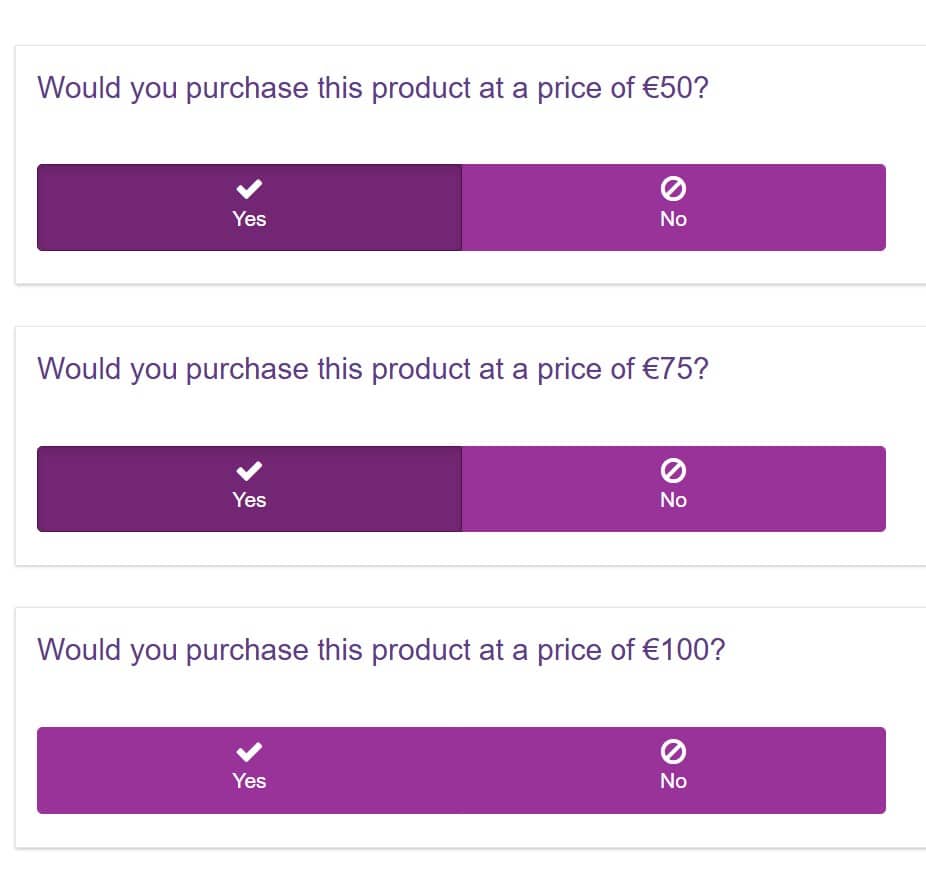
Imagine presenting your product to a potential customer. You show an initial price and simply ask: “Would you buy this product at this price?” This is exactly the core principle of this pricing research technique.
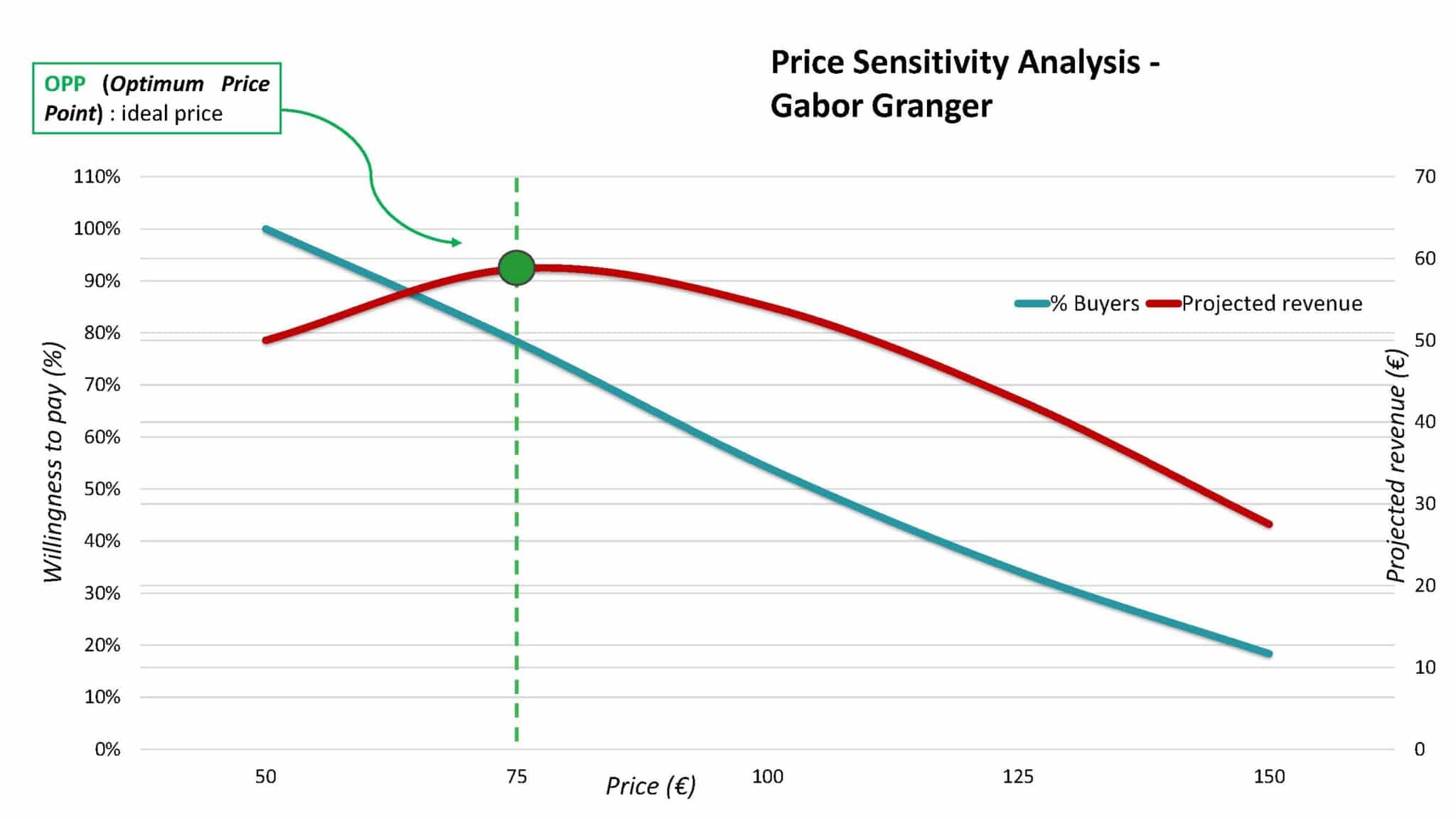
The Gabor Granger analysis highlights the price point that allows the market to be exploited most effectively. Expected revenue is maximised at €75, the optimal price point that represents the best balance between sales volume and value generated. Beyond this point, the loss of buyers becomes too significant and revenue potential declines.
The process is remarkably straightforward. If the respondent accepts the proposed price, a higher price is automatically presented. If they refuse, a lower price is shown. This sequential approach continues until the switching point is identified: the maximum price that person is willing to pay.
Concretely, a typical session unfolds as follows:
- Product presentation: Clear description with visuals and key features
- Starting price: Randomly selected within your predefined range
- Purchase question: “Would you buy this product at X euros?”
- Automatic adjustment: Next price based on response (higher if yes, lower if no)
- Repetition: Until the acceptable price threshold is identified
This randomised sequential monadic method allows you to build a realistic demand curve. With a sufficient number of respondents (the consensus is at least 50, but I personally recommend a minimum of 100 respondents for statistically significant results), you obtain a clear view of market elasticity.
When should you use Gabor Granger instead of another technique?
Not all pricing methods are equal depending on context. The Gabor Granger technique excels in specific situations that are important to identify.
- You already have a price range in mind. Unlike Van Westendorp, which explores broadly, Gabor Granger optimises within a defined range. If you know your product will be between 50 and 200 euros, this method helps you refine it precisely.
- Your product already exists on the market. This approach works particularly well for goods or services that consumers can easily evaluate. They have benchmarks and comparisons, making responses more reliable.
- You want to maximise revenue. Note: maximising revenue is not necessarily maximising profit! Gabor Granger identifies the price that generates optimal turnover, but costs must be integrated separately to assess profitability.
- Other product variables are fixed. If product features, packaging, and functionality are final and only price remains to be determined, this method is ideal. It isolates the price variable effectively.
However, avoid Gabor Granger if you are launching a disruptive product with no equivalent, or if competition plays a major role in purchasing decisions. In such cases, conjoint analysis is more appropriate.
Gabor Granger vs Van Westendorp
These two techniques dominate pricing research, but they serve different purposes. Understanding their differences helps avoid strategic mistakes.
Van Westendorp: for exploration
This method asks four open questions about price perception: too expensive, expensive, cheap, and too cheap (suspicious). It defines a psychologically acceptable price range without predefined values.
Van Westendorp is excellent for new products when you have no idea what price level is acceptable. It reveals deep consumer attitudes toward your offer.
Gabor Granger: for optimisation
More direct, Gabor Granger tests concrete prices and measures purchase likelihood. It provides a precise demand curve and identifies the revenue-maximising point.
This approach is better suited when you already understand your market and want to refine your pricing strategy. It produces more actionable results for commercial decision-making.
How to choose between them?
Use Van Westendorp in the exploratory phase to understand perceptions and define a price interval. Then switch to Gabor Granger to optimise within that range. Some companies even combine both approaches in a single study to maximise insights.
Contact us for your pricing studies
Interpreting your results
Having data is good. Knowing how to read it is better. The results of a Gabor Granger study are presented in the form of curves and tables that need to be properly interpreted.
The demand curve shows how purchase intent evolves depending on price. As the price increases, the percentage of customers willing to buy decreases. This is logical, but the shape of the curve reveals a lot about your market.
A very steep curve indicates high price sensitivity: your customers are elastic. A small price change significantly impacts demand. Conversely, a flatter curve suggests inelastic demand: you can increase your prices without losing a large number of customers.
The revenue curve combines price and volume to identify the point of maximization. It is not necessarily the highest acceptable price! Sometimes, a moderate price generates more revenue thanks to higher volume.
Price elasticity is calculated simply: percentage change in demand divided by percentage change in price. A result greater than 1 indicates high elasticity (lower your prices), less than 1 indicates low elasticity (you can increase them).
Let’s take a concrete example: your study shows that at €140, 60% of respondents would buy, compared to 35% at €200. The calculated elasticity of 0.58 indicates a relatively inelastic product. It is in your interest to favor a higher price to maximize your margins.
Pitfalls to avoid
Like any method, Gabor Granger has its limitations. Knowing them will help you avoid costly mistakes in your pricing decisions.
The trap of ignoring competition
The main weakness of this technique? It abstracts from the competitive environment. Your respondents evaluate your product in isolation, without reference to available alternatives.
The result: you might identify an “optimal” price of €150 while a competitor offers a similar product at €120. Your study becomes obsolete when confronted with market reality.
The solution? Integrate elements of the competitive context into your presentation. Show a “virtual shelf” with competitors’ products and prices. Studies show that this approach significantly improves the reliability of results.
The error of an insufficient sample
A minimum of 50 respondents is the golden rule for obtaining statistically significant results. Below that threshold, your conclusions risk being biased by a few atypical profiles.
The confusion between revenue and profit
Gabor Granger optimizes revenue, not necessarily profit. Never forget to include your costs in the final analysis. The price that maximizes turnover is not always the one that maximizes profitability.
Use cases
Nothing beats a concrete example to understand the power of this method. Here’s how a multinational video game studio revolutionized its pricing strategy thanks to Gabor Granger.
This studio releases several games per year across different platforms and geographic regions. Their challenge? Determining the optimal price for each market, taking into account local specifics and consumption habits.
Initially, they used Van Westendorp, which provided interesting price ranges but varied by country. The bias was significant: responses fluctuated greatly from one region to another, making decision-making difficult.
Switching to Gabor Granger changed everything. By testing specific prices in each market, they were able to:
- Identify optimal prices by geographic area
- Adapt their strategy depending on platforms (PC, consoles, mobile)
- Differentiate prices between physical and digital versions
- Reduce biases linked to cultural differences in price perception
The result: a significant increase in revenue and a much more refined pricing strategy tailored to each context. This approach has become an integral part of their launch process.
Setting up your Gabor Granger study
Convinced? Great! Here’s how to effectively structure your study to obtain actionable results.
Define your price range
This is the foundation of everything. Your range must be realistic: neither too narrow (you would miss opportunities) nor too wide (you would lose precision). A range of 1 to 3 or 1 to 4 generally works well.
Prepare your product presentation
High-quality visuals, clear description, key features: your respondents must be able to evaluate your offer as if they were in a real purchasing situation. The more realistic it is, the more reliable your results will be.
Set up your questionnaire
You can choose between manual configuration (custom price intervals) and automatic (even distribution within your range). The automatic version works in most cases.
Target your respondents
Your sample must accurately represent your target audience. There is no point in surveying students about a luxury product! Clearly define your demographic and behavioral criteria.
Analyze methodically
Do not rely solely on the raw “optimal” price. Analyze the curves, calculate elasticity, and segment your results by respondent profiles. The most valuable insights are often hidden in the details.

Frequently asked questions about the Gabor Granger method
How many respondents are needed for a reliable study?
A minimum of 50 respondents is required for statistically significant results, but 100 to 200 respondents provide greater robustness. For niche markets, you can go down to 30–40 respondents, but be aware of the higher margin of error.
Can Gabor Granger be used for services?
This method works very well for services, provided the offer is clearly described. Specify duration, terms, guarantees… everything that helps respondents realistically project themselves into the purchase.
How can competition be integrated into the analysis?
Present your product in a realistic competitive context. Show a selection of similar products with their prices, or explicitly mention available alternatives. This significantly improves the validity of responses.
Does Gabor Granger work for innovative products?
It is more challenging. For truly revolutionary products with no equivalent, respondents struggle to assess value. In this case, prioritize Van Westendorp in the exploratory phase, then use Gabor Granger once the market is better defined.
What is the difference between maximizing revenue and profit?
Gabor Granger identifies the price that generates maximum revenue (price × volume). But this is not necessarily the price that maximizes profit! Always incorporate your costs into the final analysis to make the right business decision.
Can Gabor Granger be combined with other methods?
Yes. Combine it with Van Westendorp for a comprehensive view, or with conjoint analysis to incorporate variables beyond price. This multi-method approach significantly enriches your insights.



![Illustration of our post "Remote work: are employees cheating? [Survey]"](/blog/app/uploads/telework3-120x120.png)