What is the cost of a franchise? In this article, you will find an analysis of all the costs associated with starting a franchise and a comparison of 21 brands.
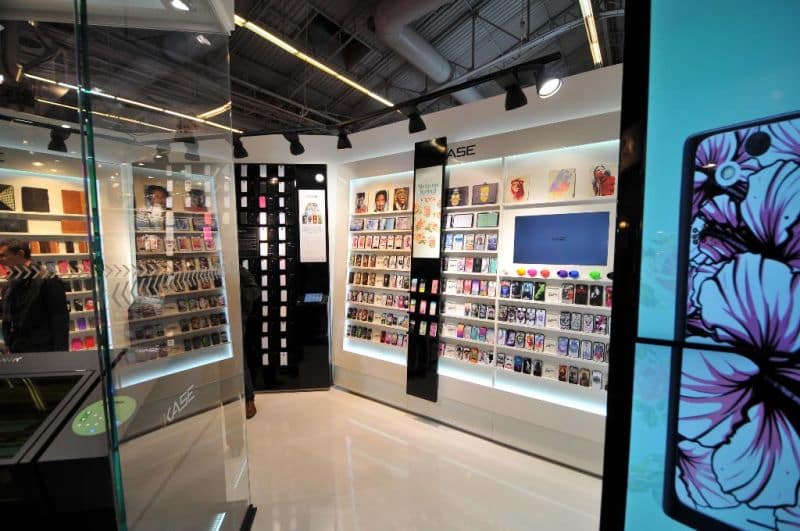
As every year, I participated in the Franchise Expo in Paris which allowed me to meet numerous brands and update my analysis of the franchise market. Choosing a franchise is often based on marketing criteria but must also take into account financial elements, namely the costs associated with that franchise. This is the topic of this article in which I have also included a comparative table of 21 brands. This analysis is part of our market research services in France for project holders. If you would like to carry out a location study for your future franchise, feel free to contact us.
Contact IntoTheMinds for your market research
Key takeaways
- Entry fees range from €0 to €50,000 depending on the brand in France
- Total investment can reach €650,000 for certain restaurant concepts
- Operating royalties range from 0% to 9% of revenue
- Required personal contribution varies between €15,000 and €300,000 depending on the sector
- Working capital is often the most underestimated cost item
A sector consolidating despite economic challenges
The 2025 data I analyzed reveal a striking trend in the French franchise market. The number of networks decreased by 2.5% to reach 2,035 brands, but paradoxically, total revenue increased by 4.9% to €93.71 billion. This evolution reflects a consolidation of the sector around the most efficient concepts.
At the same time, the number of outlets increased by 2.6%, representing 2,605 new openings, bringing the total to 93,395 establishments across France. This selective growth indicates that entrepreneurs now favor proven networks over new concepts. For a franchise candidate, this reality reinforces the importance of a rigorous financial analysis before any commitment.
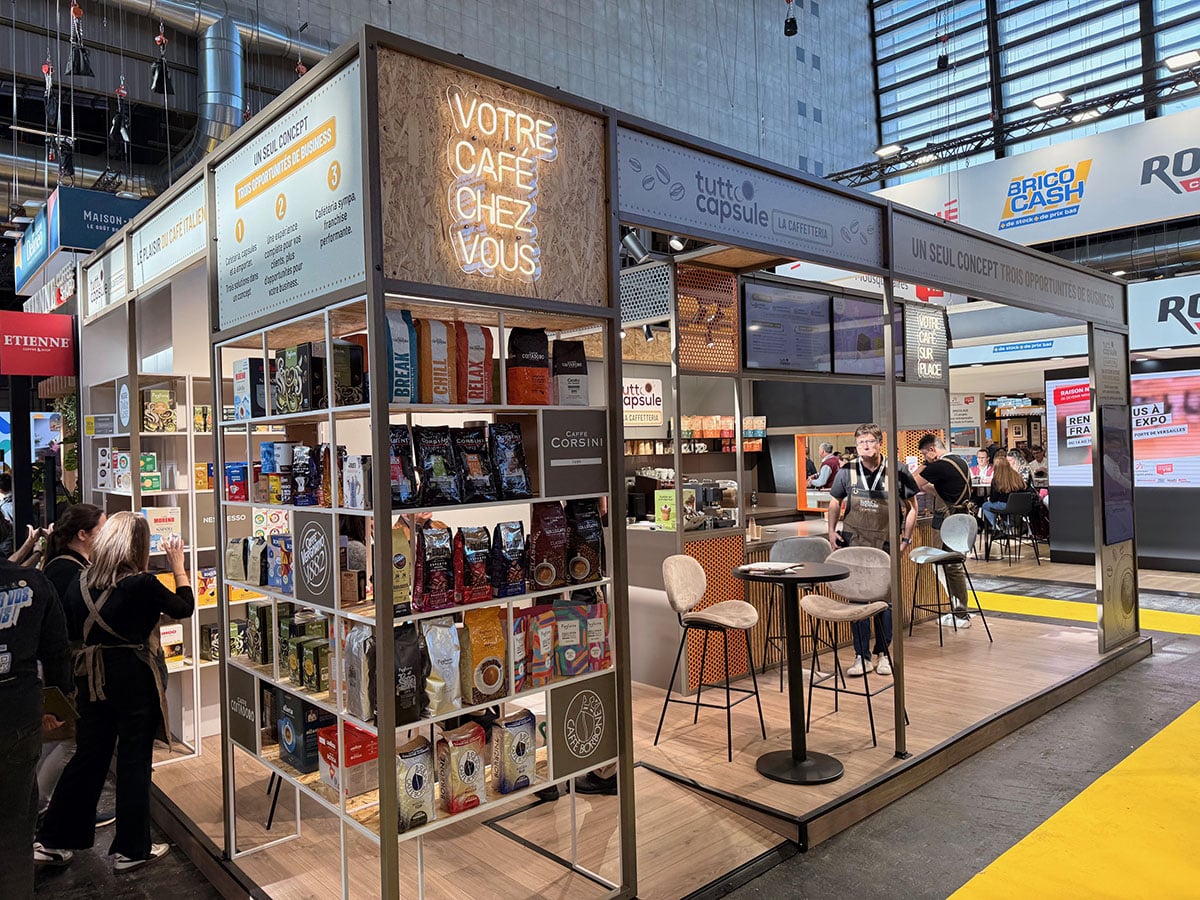
With 350 outlets, Tutto Capsule offers different franchise formats. What appealed to me is the complementarity between retail and bar activities, which increases the average basket. Implementation costs are also relatively low, ensuring good profitability.
Entry fee
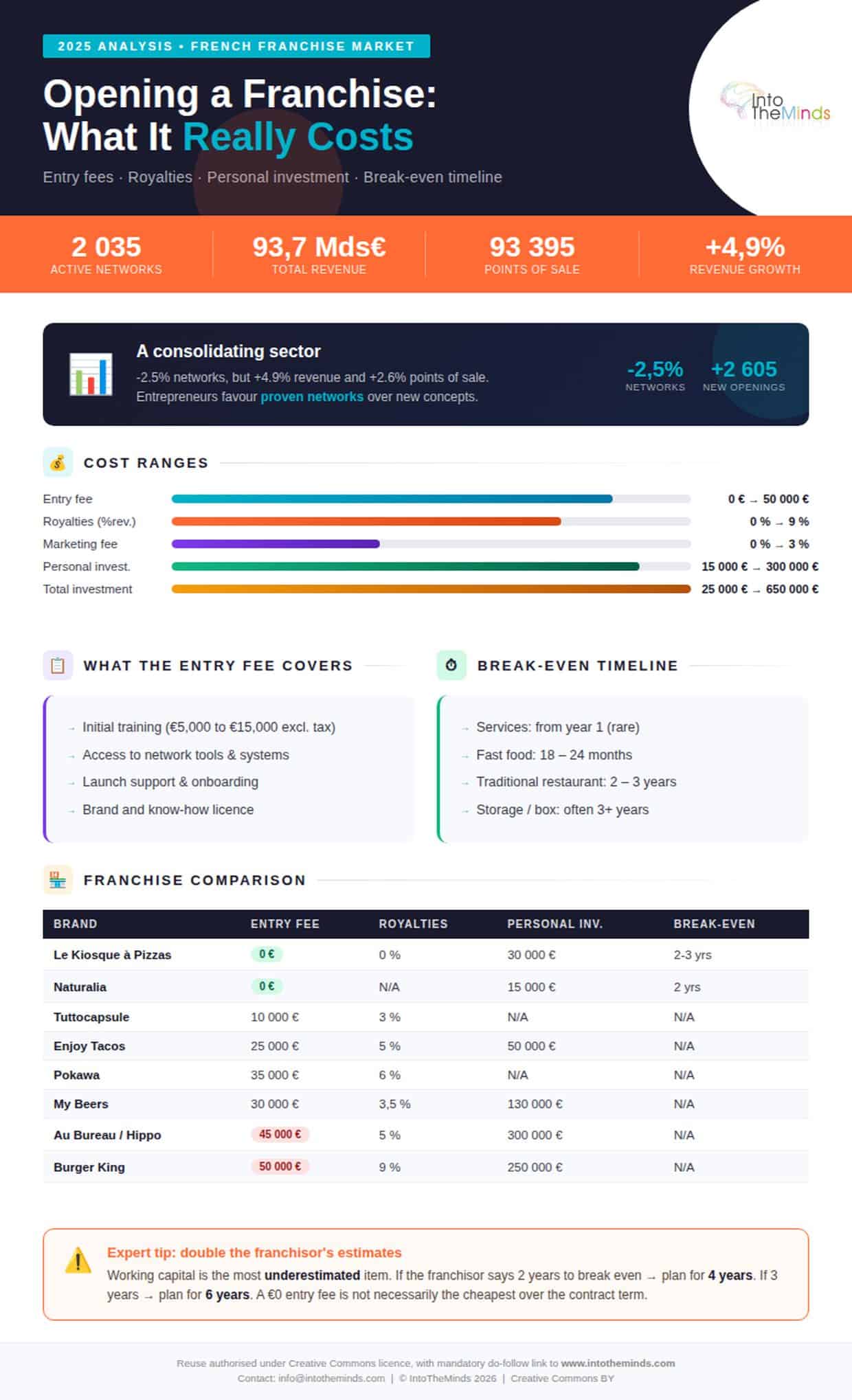
My comparative analysis reveals considerable gaps between brands. Some, such as Naturalia in lease management or Le Kiosque à Pizzas, display an entry fee of €0. At the opposite end, Burger King (the franchise is managed by Groupe Bertrand in France) requires €50,000 to join its network. Between these extremes, most franchises fall within a range of €20,000 to €45,000.
This disparity reflects different economic strategies. Brands with high entry fees generally include training, initial support, and access to network tools in this amount. Those with lower fees often compensate through other items: higher royalties, heavier equipment investments, or exclusive purchasing obligations.
I have observed that candidates who focus solely on this criterion risk missing the overall economic equation. A “free” franchise may ultimately prove more expensive than one with a substantial entry fee, depending on the structure of recurring costs.
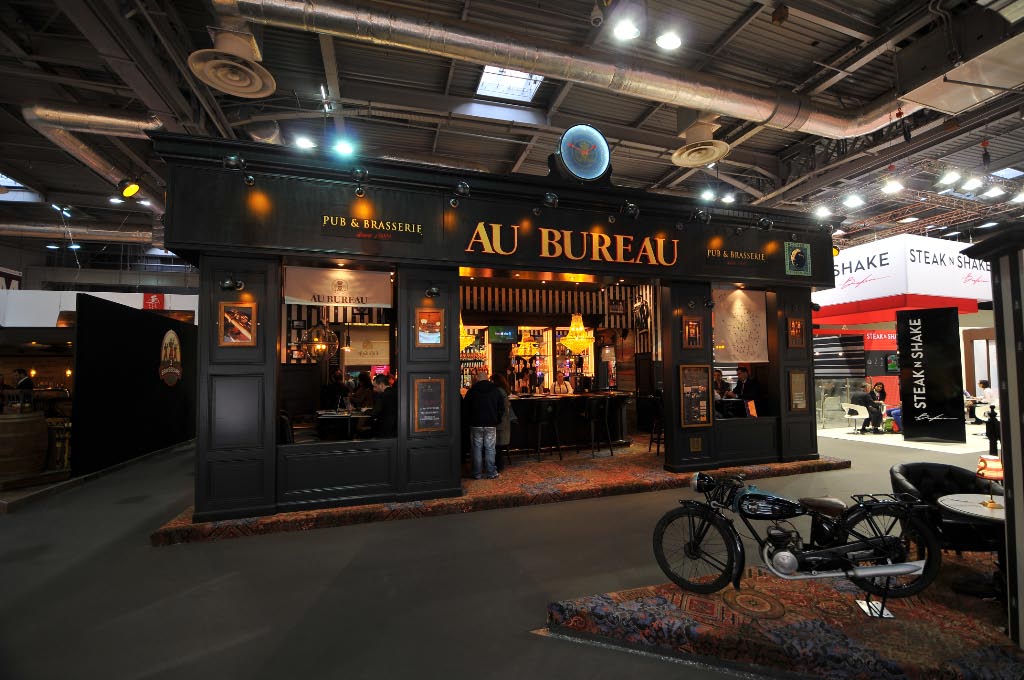
Au Bureau is a brand of Groupe Bertrand, the leader in franchising in France. Franchise-related costs are among the highest, but the model is robust, proven, and profitability is achieved.
Royalties for network membership
Operating royalties
Operating royalties constitute the second financial pillar of the franchise model. In my study, I identified a range from 0% to 9% of revenue, with a concentration around 4% to 6% for most brands.
Some networks, such as Le Kiosque à Pizzas, claim no royalties or advertising fees at all. At the other extreme, Burger King applies a 9% royalty on revenue. Between these positions, various models exist: 3% at Tutto Capsule, 3.5% at My Beers, 4% at Mersea, 5% at Enjoy Tacos and Doppio Malto, 6% at Pokawa and Pitaya, and 7% at Homebox and Matsuri.
Marketing fee
The marketing fee is often added to these percentages. It ranges from 0% to 3% depending on the brand. Pokawa clearly structures its model with 6% operating royalties plus 2% marketing. Matsuri applies a similar scheme (7% + 2%), while Mersea opts for a 4% + 1% formula.
Analyzing these royalties cannot be limited to percentages. One must examine what they actually finance: network management, centralized purchasing, national communication, operational support, digital tools, ongoing training, and business development.
Training and support costs
Training represents another cost element that varies across networks. Some include it in the entry fee, others charge it separately. Enjoy Tacos mentions €5,000 excl. VAT for initial training, Groupe Bertrand brands indicate €15,000, while other concepts mention €7,000.
Beyond the amount, it is important to analyze the actual content of this training. Is it only theoretical initial training? Does it include opening support? Are teams trained? Is there a continuous training program? The value of a franchise lies in the operational transfer of know-how, not just the use of a brand.
Total investment
Personal contribution
The required personal contribution is often the determining factor for accessing a franchise. My observations show requirements that vary considerably depending on the nature of the concept and its positioning.
The most accessible models start at €15,000 for Naturalia in lease management, €25,000 to €30,000 for certain service concepts, or €30,000 for Le Kiosque à Pizzas. Conversely, Groupe Bertrand brands (Au Bureau, Hippopotamus, Léon, Volfoni, Jōyō, Le Paradis du Fruit) all require €300,000 in personal contribution.
This segmentation reflects the diversity of economic models. A fast-food kiosk, a service activity, or a wine bar concept do not require the same capital, skills, or return-on-investment timelines. The term “franchise” therefore covers very heterogeneous economic realities.
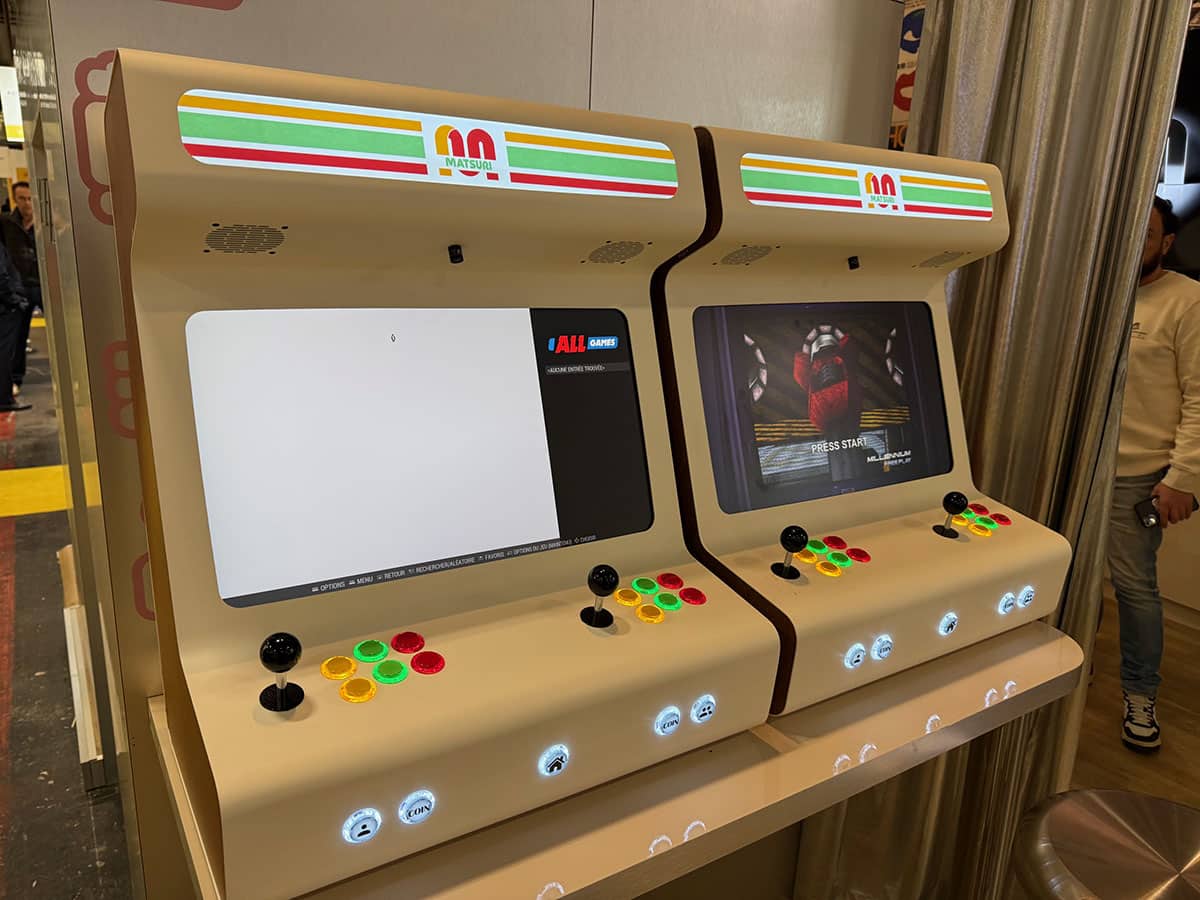
One of the major restaurant trends in 2026 is Asian cuisine. This is the segment leveraged by Matsuri, which also offers a very joyful customer experience. The group is looking for franchisees with strong prior experience in the restaurant industry.
Market research upstream
All franchisors systematically require a market research study prior to your project. They provide general guidelines (city size, catchment area), but it is up to you to conduct the market research, financial plan, and business plan. Some franchisors also support you in this phase and even introduce you to banks with which they have privileged relationships.
However strong these relationships may be, a bank will always refuse to finance a poor project. The market research stage is therefore essential. I provided a concrete example for opening a gym, which you can apply to other sectors. If you need help, feel free to contact us.
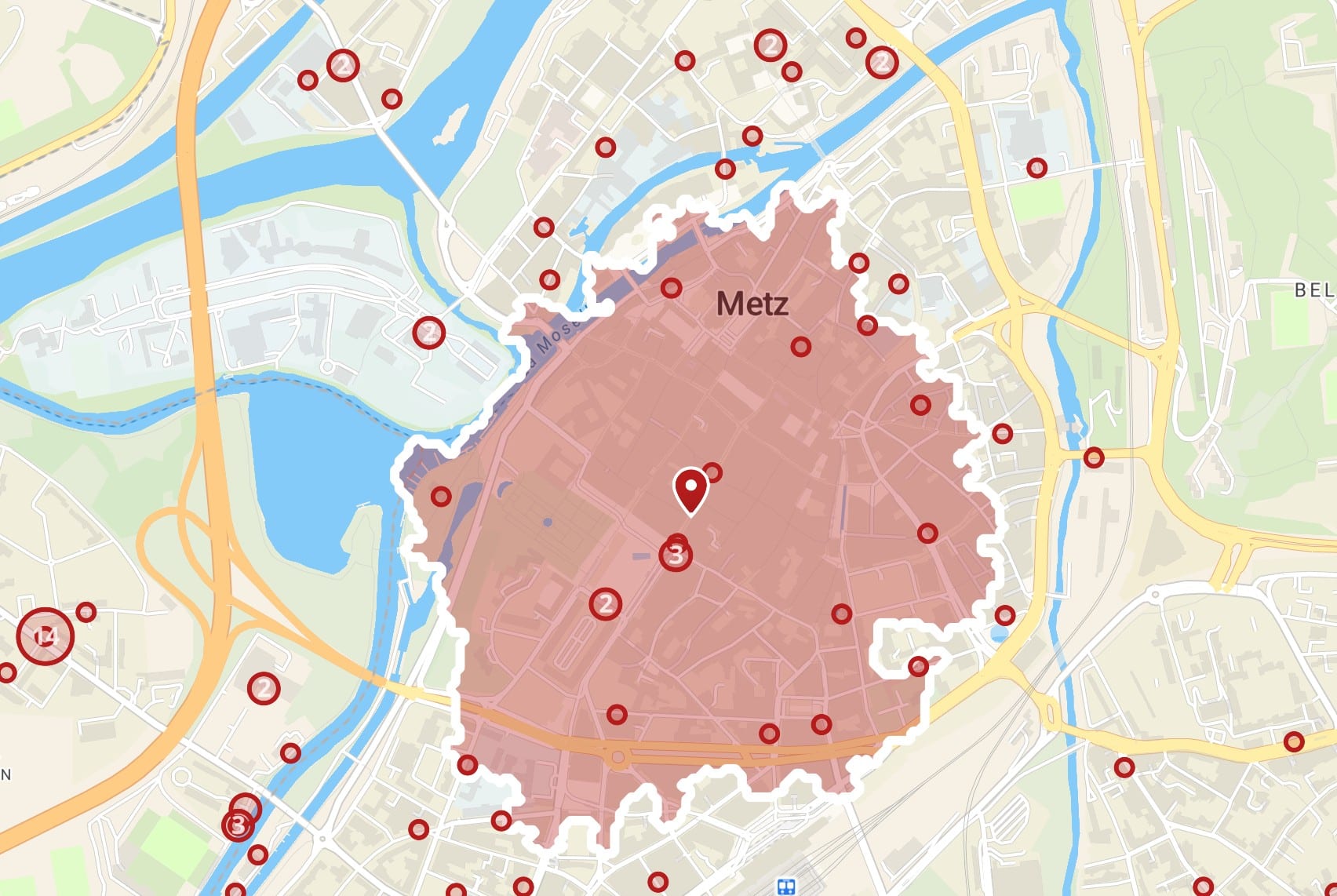
Defining the right catchment area is absolutely essential for the accuracy of your market research. If the catchment area is too small, your project will not be profitable. If it is too large, the project will be overly optimistic.
Fit-out costs
Fit-out costs vary greatly from one franchise to another and depend, of course, on the commercial space. Tutto Capsule offers a relatively light model with an initial investment of €25,000 to €60,000. At the other extreme, Matsuri indicates €650,000 in investment (excluding lease rights) for a restaurant of 150 to 200 m².
This amount breaks down as follows:
- €200,000 for the restaurant concept and furniture
- €150,000 for equipment, €200,000 for structural works
- €40,000 entry fee including training
- €60,000 miscellaneous
I spoke extensively with one of Matsuri’s partners, and their vision of the ideal franchisee is clear: beyond financial criteria, Matsuri seeks experienced restaurant professionals. This position clearly differs from other franchisors that open up to “neo-restaurateurs,” i.e., project holders with no prior experience in the restaurant sector.
Other concepts also show substantial budgets: My Beers indicates €530,000 average investment, Doppio Malto adds €22,000 in planning and €2,500/m² in works, Enjoy Tacos starts from €150,000 excl. VAT excluding real estate.
This reality highlights the importance of a global approach. A seemingly inexpensive franchise can become costly if works, equipment, or fit-out consume most of the budget. Conversely, a high entry fee may be rational if the concept requires limited additional investment.
Working capital
One aspect is often underestimated: working capital requirements. Opening a store does not guarantee immediate profitability. The franchisee must be able to absorb the first weeks or even months of operation, paying salaries, rent, and expenses before reaching break-even. Profitability in some franchises may be achieved in the first year (rarely), more often in the second year, or even later. For brands offering storage solutions (box rental), profitability is generally not reached before the third year. My advice is therefore to double the franchisor’s estimates when calculating your working capital needs. If the franchisor mentions 2 years, plan for 4 years. If they mention 3 years, plan for 6 years.
Some brands communicate their break-even timelines: Naturalia mentions profitability starting from the second year, Homebox indicates a break-even generally reached between 18 and 24 months, Le Kiosque à Pizzas mentions a return on investment of 2 to 3 years depending on location. These indicators help assess the required working capital and put entry costs into a realistic perspective.
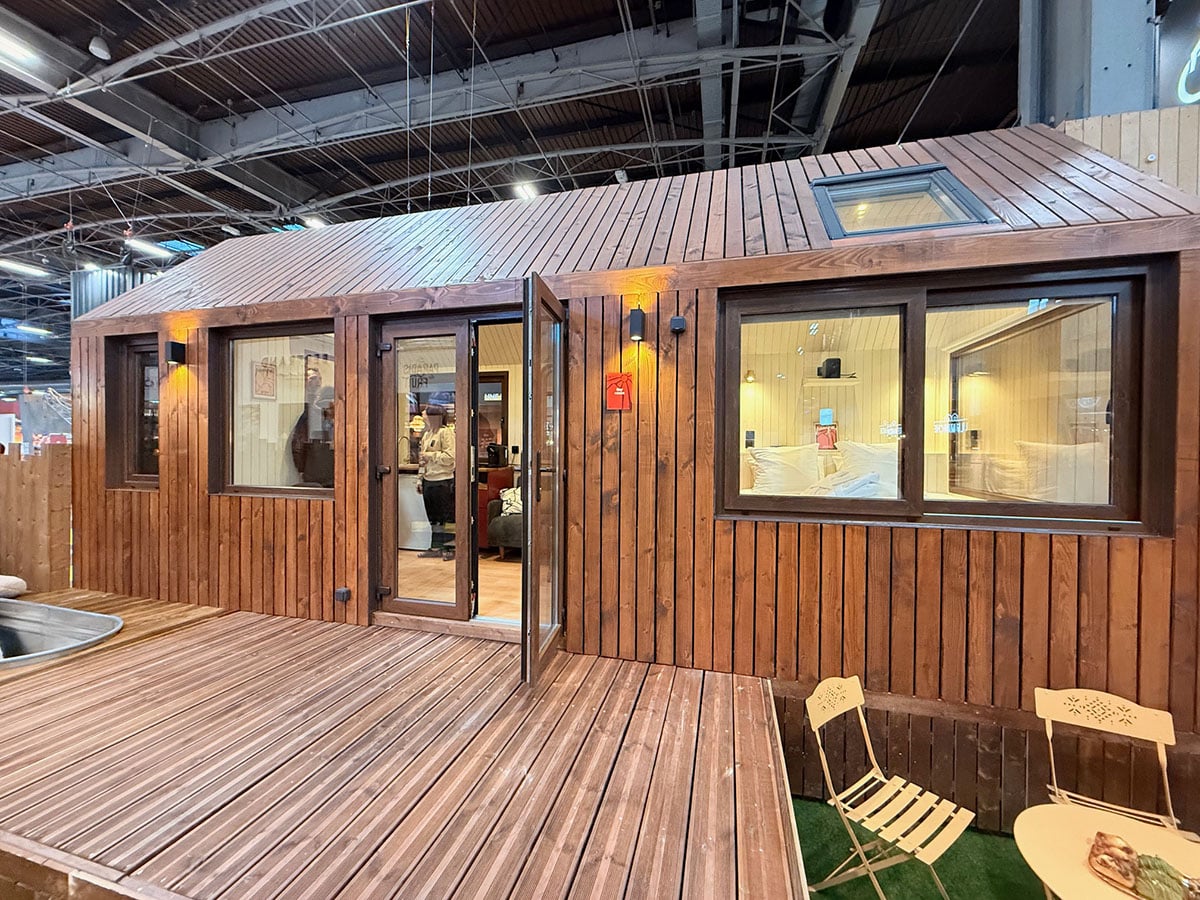
The world of franchising is not limited to the traditional restaurant sector. A brand like Pampa Lodges offers a turnkey “tiny houses” concept that can be installed almost anywhere. Costs are minimized because the model itself is very simple.
Brand comparison
Evaluating a franchise cannot be limited to entry costs. Operating ratios reveal the economic viability of the concept. Pokawa details a food cost of 27% to 30%, labor cost of 20% to 25%, delivery costs of 6% to 10%, rent of 10%, and an EBITDA margin of 15% to 20%.
Matsuri shows a food cost of ≤25% and staff cost of ≤30%, with annual revenue of €2 to €3 million excl. VAT. These data allow for assessing the real impact of royalties on profitability. A franchise with high royalties may remain viable if its concept generates strong revenue per square meter and maintains a controlled cost structure.
| Brand | Entry fees | Royalties | Marketing | Personal contribution | Investment | Break-even timeframe |
|---|---|---|---|---|---|---|
| Naturalia | 0€ | Not disclosed | 0% | 15 000€ | Not disclosed | 2 years |
| Le Kiosque à Pizzas | 0€ | 0% | 0% | 30 000€ | 123 900€ excl. VAT | 2-3 years |
| Tutto Capsule | 10 000€ | 3% | Not disclosed | Not disclosed | 25-60 000€ | Not disclosed |
| Homebox | 20 000€ | 7% | 3% | 100 000€ | 220€/m² excl. VAT | 18-24 months |
| Moustache | 25 000€ | 5% on purchases | Not disclosed | 25 000€-30 000€ | 500€/m² of works | 365 days |
| Enjoy Tacos | 25 000€ excl. VAT | 5% | 2% | 50 000€ | 150 000€ excl. VAT | Not disclosed |
| Lounge Car | 25 000€ excl. VAT | 3.9% | 300€ excl. VAT/month | Not disclosed | Not disclosed | Not disclosed |
| Picard | 25 000€ | 2.5% | Not disclosed | 100 000€ | From 380 000€ of works | Not disclosed |
| Mersea | 30 000€ | 4% | 1% | 80 000€ | Not disclosed | Not disclosed |
| My Beers | 30 000€ | 3.5% | 1% | 130 000€ | 530 000€ | Not disclosed |
| Doppio Malto | 52 000€ | 5% | 2% | 200 000€ | 2 500€/m² | Not disclosed |
| Pokawa | 35 000€ excl. VAT | 6% | 2% | Not disclosed | 2 300€-2 500€ excl. VAT/m² | Not disclosed |
| Pitaya | 35 000€ + 15 000€ training | 6% | 2% | 150 000€-250 000€ | Not disclosed | Not disclosed |
| Matsuri | 40 000€ excl. VAT | 7% | 2% | Not disclosed | 650 000€ | Not disclosed |
| Au Bureau | 45 000€ + 15 000€ training | 5% | 1% | 300 000€ | Not disclosed | Not disclosed |
| Hippopotamus | 45 000€ + 15 000€ training | 5% | 1% | 300 000€ | Not disclosed | Not disclosed |
| Léon | 45 000€ + 15 000€ training | 5% | 1% | 300 000€ | Not disclosed | Not disclosed |
| Volfoni | 45 000€ + 15 000€ training | 5% | 1% | 300 000€ | Not disclosed | Not disclosed |
| Jōyō | 45 000€ + 15 000€ training | 5% | 2% | 300 000€ | Not disclosed | Not disclosed |
| Le Paradis du Fruit | 45 000€ + 15 000€ training | 6% | 2% | 300 000€ | Not disclosed | Not disclosed |
| Burger King | 50 000€ | 9% | Not specified | 250 000€ | Not specified | Not disclosed |
Deferred costs: an often overlooked dimension
The financial analysis of a franchise does not end on opening day. The contract may generate deferred costs upon renewal: new entry fees, renovation works, development commitments, or other obligations. The franchisee must therefore evaluate the project over the entire contract duration, generally 5 to 10 years depending on the brand.
This time dimension directly influences the overall return on investment. A concept with moderate entry costs but frequent renovation obligations may ultimately be more expensive than a franchise with higher initial investment but limited renewal costs.

Frequently asked questions about franchise costs
What is the minimum budget to open a franchise in France?
The minimum budget varies significantly depending on the sector. For the most accessible concepts such as certain service franchises, you can start with €15,000 to €30,000 in personal contribution. However, the total investment including fit-out, equipment, and working capital can reach €50,000 to €100,000. I always recommend planning a safety margin of 20% to 30% compared to initial estimates.
How to assess whether royalties are justified?
The evaluation of royalties must be based on the services provided by the franchisor. A 6% royalty may be justified if it finances effective national communication, strong digital tools, ongoing training, and regular commercial support. I advise requesting details on how these royalties are used and meeting other franchisees to assess the actual quality of support.
Should you prioritize a franchise with a low entry fee?
Not necessarily. A low entry fee may hide higher costs elsewhere: high royalties, heavy equipment investments, or exclusive purchasing obligations. The key is to analyze the total cost of ownership over the contract duration. A franchise with a €40,000 entry fee but 3% royalties may be more profitable than a free one with 8% royalties.
How long does it take to make a franchise profitable?
The return on investment timeline ranges from 18 months to 3 years depending on the sector and location. Fast-food concepts generally reach break-even faster than traditional restaurants. Service franchises may be profitable in the first year, while concepts requiring heavy investment require more patience. It is essential to have sufficient working capital to cover this period.
What are the most common hidden costs?
The most underestimated costs include working capital, additional training fees, specific insurance, contract renewal costs, and renovation obligations. Some franchises also impose exclusive purchasing at above-market prices. I recommend carefully reading the Pre-contractual Information Document (DIP) and having the business plan validated by an accountant.



![Illustration of our post "Pricing: strategies, techniques, examples [Guide 2025]"](/blog/app/uploads/pricing-120x90.jpg)