Action stores are everywhere and are gaining market share throughout Europe. In this article, I examine the reasons for this success and project into the future of this “low-cost” model.

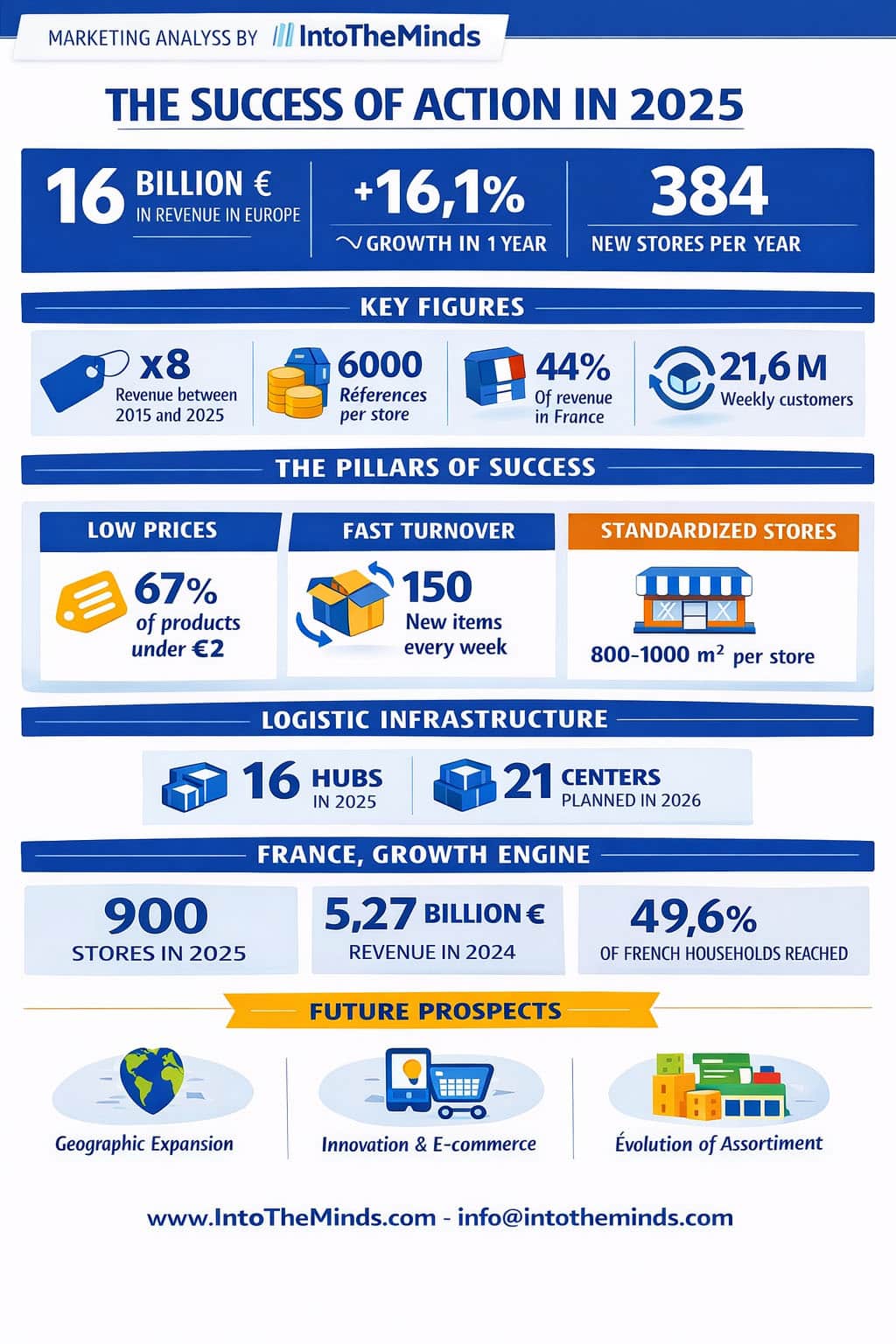
December 2025: for the first time, I visit an Action store. So yes, I know, I’m not an early adopter 😯. But I had always wondered how this Dutch chain had managed to turn a non-food discount concept into a cash machine. And I must say that this visit opened my eyes to what explains Action’s success. So I wanted to share my thoughts in this article, and it’s fitting, as much of it relates to marketing, which, as you know, is the specialty of the marketing research institute I founded over 20 years ago. Before diving into the details, here are a few numbers: Action generated €16 billion in revenue in Europe in 2025, up +16.1% in one year, with more than one new store opening each day. You can find these figures in the infographic at the bottom of this page. Buckle up for the breakdown of Action’s strategy!
Contact the IntoTheMinds research institute
Key Takeaways
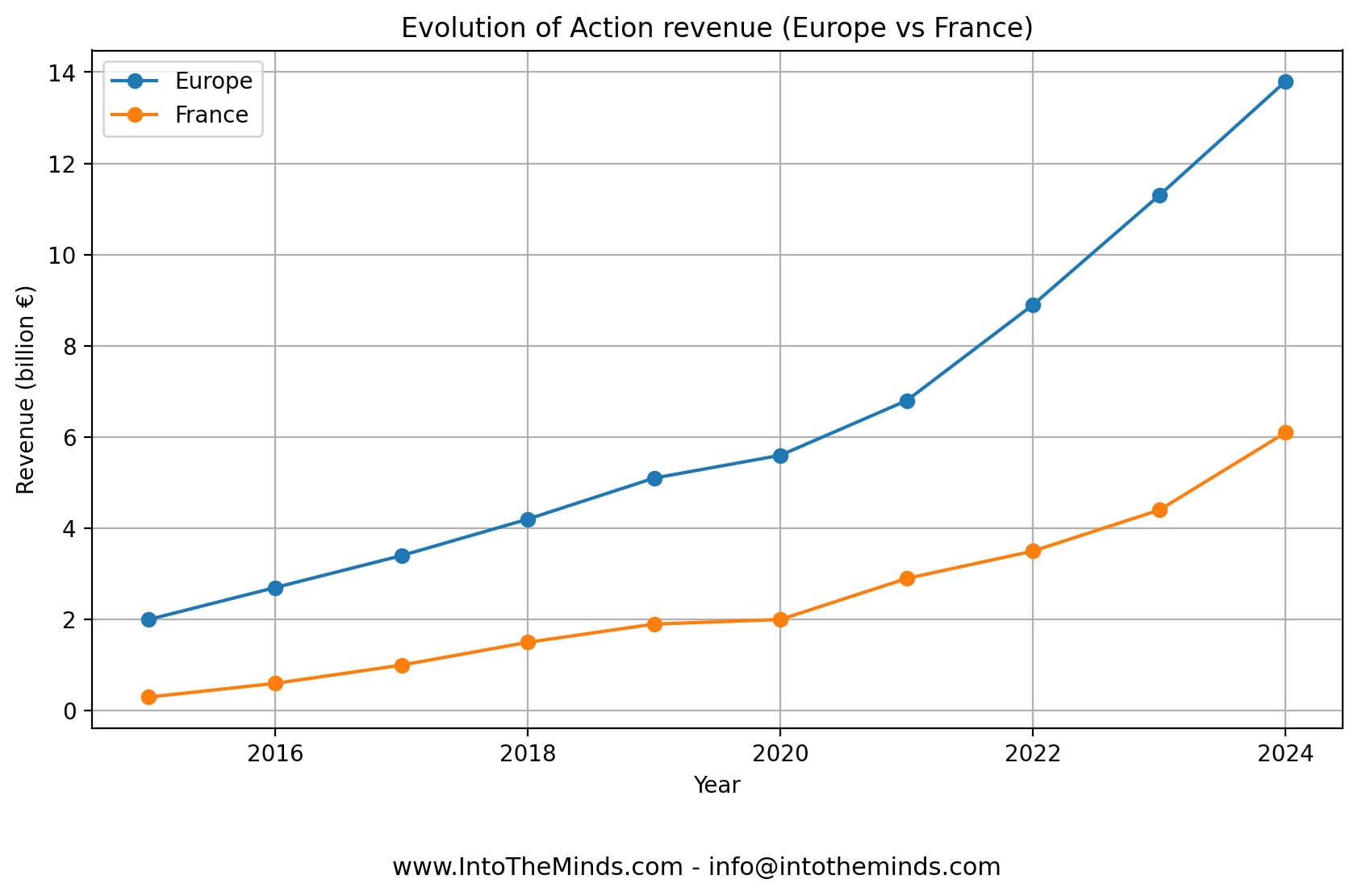
- Strong European growth: Action multiplied its revenue by 8 between 2015 and 2025, from €2 billion to €16 billion
- Standardized business model: 6,000 SKUs per store, 67% of products sold for less than €2, weekly rotation of 150 new items
- France as the main driver: 44% of the group’s total revenue in 2024, with 900 stores by the end of 2025
- Robust logistics infrastructure: 16 European hubs currently, expansion planned to 21 centers by 2026
- Effective popular positioning: 21.6 million weekly customers in Europe, reaching 49.6% of French households
The Foundations of a Controlled European Expansion Strategy
Let me start this analysis by recalling a few facts.
Action’s strategic approach is primarily based on a European geographic expansion strategy. Since its founding in 1993 in Enkhuizen, the Netherlands, the company has developed a method of progressive internationalization. I place the real international takeoff in 2005. But it was from the 2010s that Action’s strategy truly took on a European dimension.
What is striking in this approach is the consistency of financial results. Between 2022 and 2025, Action generated revenue growth exceeding €2 billion each year:
- +€2.1 billion in 2022
- +€2.4 billion in 2023
- +€2.5 billion in 2024
- +€2.2 billion in 2025
This regularity is impressive. I know some who would love to see Action listed on the stock market 🤑.
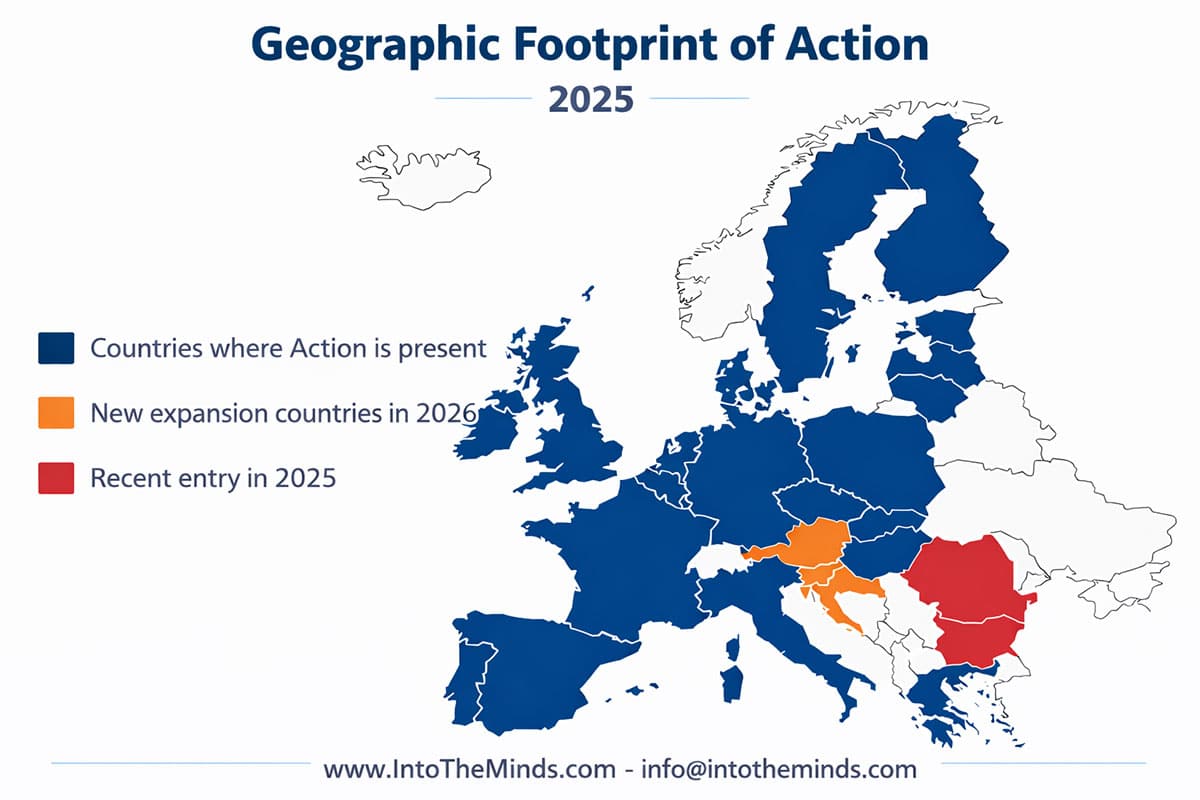
Geographic expansion follows a methodical logic. In 2025, Action is present in 14 European countries with 3,302 stores. The year 2025 saw the opening of 384 new stores, more than one per day. This pace of expansion relies on a logistics infrastructure scaled to support this growth:
- 16 logistics hubs at the end of 2025
- 21 logistics centers by the end of 2026
A Business Model Based on Rotation and Pricing
In my view, Action’s commercial strategy rests on three fundamental pillars, detailed below (some statistics are insane, take the time to read them carefully). For those who have never been in an Action store, I’ve included a short video below.
Pricing Policy
With 67% of products sold for less than €2 and only 7% exceeding €5, the chain has created a unique price positioning in the European non-food retail market.
This pricing strategy is based on a globalized sourcing approach. Action works with 3,247 manufacturers and 595 suppliers worldwide. The geographic distribution of sourcing is fairly balanced:
- 55% of products come from Asia
- 44% of products come from Europe
This geographic diversification allows the chain to maintain margins while offering attractive prices.
Product Rotation
The second strategic pillar concerns product rotation. Each Action store offers around 6,000 SKUs across 14 categories. Innovation lies in assortment management: one-third remains permanent while two-thirds continuously evolve. This rotation is supported by the weekly introduction of 150 new items, creating a constant discovery effect for customers. People return, and the customer loyalty effect is maximized.
Single Store Model
The third pillar involves real estate standardization. Action stores have standardized surfaces of 800–1,000 m² and are generally located in urban peripheries. This approach enables rapid replication of the concept and optimization of real estate costs. The model facilitates opening numerous stores each year, sometimes approaching a daily opening pace.
This standardization reminds me somewhat of Ryanair, which became Europe’s leading airline by maximizing standardization of equipment (single aircraft model, single engine type) and procedures. The customer experience offered is therefore highly standardized. Although criticized, it remains a model I had also studied.
A Large, Popular, and Loyal Customer Base
Increased Store Traffic
Action’s exceptional performance relies heavily on massive store traffic and loyalty. Here are a few figures you will find spectacular, I’m sure:
- In 2025, Action stores welcomed an average of 21.6 million customers per week!
- In 2024, weekly traffic was 18.7 million
- From 2024 to 2025, the average number of customers increased by +15.5%
Popular Positioning
This success is explained by store openings and by marketing positioning. Action is clearly positioned toward the most popular socio-demographic segments. The current weak economic situation slowly impoverishes society, and it is in this customer base that Action also finds growth. Unfortunately, Action’s strategy is fueled by crisis.
In France, nearly half of French households (49.6%) made a purchase at Action!
Loyalty Effect
Consumption habits confirm customer loyalty. French customers visit stores an average of 9 times per year and buy about 3.5 items per visit, nearly 32 items annually per customer. This high visit frequency is explained by the nature of the offer and continuous product rotation.
An especially interesting aspect of Action’s strategy is its positioning in drugstore, perfumery, and hygiene products. These categories represent 68% of the chain’s sales and helped reach a 7.6% market share in France, up over 5 points between 2021 and 2025, illustrating Action’s rising strength in everyday consumption categories.
France: Engine of European Growth
Analyzing Action’s strategy cannot ignore France’s central role. The French market entry in 2012 with the first store in Courrières marked a major strategic turning point.
French growth perfectly illustrates Action’s execution capacity. In just over a decade, the French network grew from zero to over 900 stores by the end of 2025. This expansion comes with exceptional commercial performance: French revenue reached €5.27 billion (excl. tax) in 2024, up +18% year-on-year.
Over a longer period, French revenue grew from €2.92 billion in 2021 to €5.27 billion in 2024, a gain of €2.35 billion in three years. France is at the core of Action’s European strategy.
| France Indicator | 2021 | 2024 | Change |
|---|---|---|---|
| Revenue (€B) | 2.92 | 5.27 | +80.5% |
| Number of stores | ~600 | 858 (March 2025) | +43% |
| DPH Market Share | ~2.6% | 7.6% | +5 points |
| Household penetration | – | 49.6% | – |
Action’s dominance in the French discount market shows the effectiveness of its strategy. In March 2025, Action had 858 stores in France. In the previous year alone, it opened 71 of the 168 new stores in this market, 42% of sector openings.
French performance represents a major share of the group’s European activity. Out of €13.8 billion in European revenue in 2024, French sales exceeded €6 billion, over 44% of total activity. This geographic concentration highlights the strategic importance of the French market for Action.

Strategic Perspectives and Future Development Axes
Despite already considerable expansion, Action sees significant growth potential in Europe. The future strategy is structured around three main axes, reflecting a particularly structured long-term vision.
1. Continued Geographic Expansion
After entering Switzerland and Romania in 2025, Action plans to open in Croatia and Slovenia from 2026. This methodical move into Eastern Europe reflects a coherent geographic expansion strategy.
2. Intensifying Presence
The second strategic axis focuses on intensifying presence in countries where the group is already established. Even in mature markets such as France, Action sees significant expansion potential. This geographic densification approach also explores new formats and distribution channels.
3. Innovation
Commercial innovation is the third development lever. Action is exploring new avenues, especially in city centers and through e-commerce. Tests are ongoing in the Netherlands and Belgium. Diversifying formats shows adaptability to retail changes.
4. Assortment Evolution
Assortment evolution is another strategic transformation axis. FMCG products, especially in hygiene-beauty and home care, now represent over 30% of store purchases. This shows Action moving closer to everyday consumption categories, broadening its positioning beyond traditional non-food discount. 
Frequently Asked Questions About Action’s Strategy
How does Action keep prices so low while remaining profitable?
Action’s pricing strategy relies on several complementary levers. The chain works with 3,247 manufacturers and 595 suppliers worldwide, achieving economies of scale and tight negotiations. Mixed sourcing (55% Asia, 44% Europe) optimizes costs while maintaining quality. Standardized store size (800–1,000 m²) and peripheral locations reduce real estate costs. Rapid product rotation (150 new items per week) limits unsold inventory and optimizes stock management.
What is the key to Action’s success in the French market?
Action’s French success stems from perfect adaptation to consumer expectations. The chain captured a broad audience (49.6% of French households) with an attractive product mix. Growth in drugstore, perfumery, and hygiene products (7.6% market share) meets everyday consumption needs. Rapid network expansion (900 stores by the end of 2025) ensures proximity. This strategy generates high traffic (9 visits per year per client) and long-term loyalty.
Can Action maintain growth amid European competition?
Action’s growth prospects remain strong. Expansion into new European countries (Croatia, Slovenia from 2026) provides growth opportunities. Densification in existing markets still has significant potential. Logistics infrastructure (expanding from 16 to 21 hubs by 2026) supports growth. Commercial innovation (e-commerce, new formats) diversifies approaches. Moving toward FMCG products (30% of purchases) enlarges the addressable market.
What are the main risks to Action’s strategy?
Several challenges could impact Action’s strategy. Dependence on Asian sourcing (55% of products) exposes the company to geopolitical and logistical fluctuations. Geographic concentration (44% of revenue in France) creates vulnerability in case of local slowdown. Increased discount competition could erode margins. European regulatory changes (environmental, social) may impact costs. Gradual market saturation will require adaptation of the business model.


![Illustration of our post "LinkedIn Top Voice: who are these influencers? [Research]"](/blog/app/uploads/algorithme-linkedin-2022-120x90.jpg)
![Illustration of our post "Generation Z and work: employers’ perceptions [Research]"](/blog/app/uploads/generation_y_youngsters-120x90.jpg)