In just a few years, Rigoni di Asiago has become Nutella’s most serious competitor in the European market. In this article, we decode the brand’s strategy behind Nocciolata.
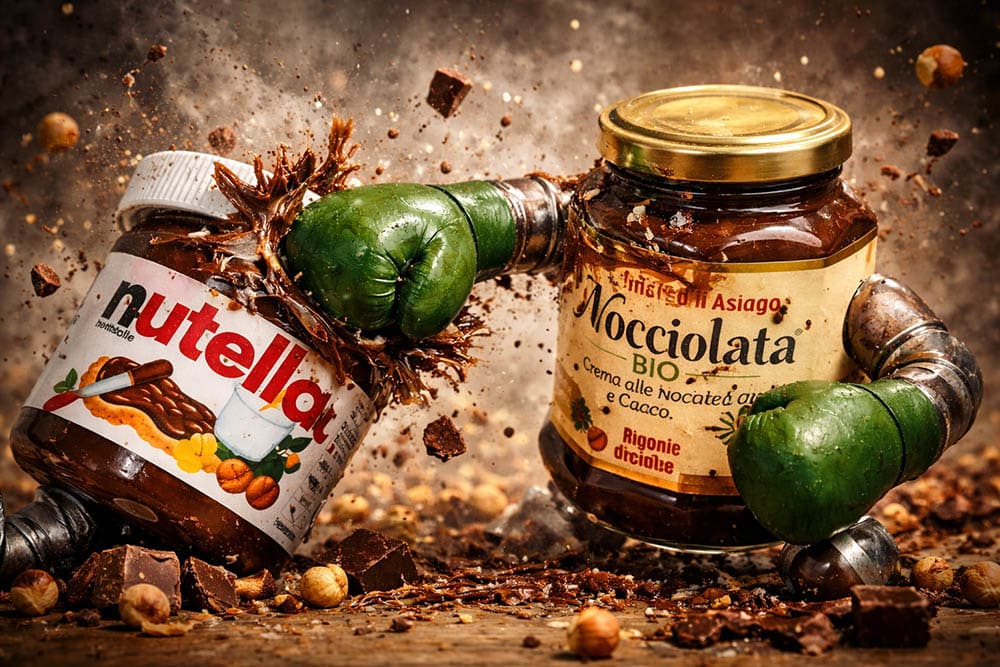
In a market for spreads largely dominated by Nutella, the Italian company Rigoni di Asiago has managed to develop a particularly effective marketing approach with its brand Nocciolata. This commercial strategy is based on several fundamental pillars that allow the group to position itself as the main challenger to Ferrero in France and internationally. This article analyzes this marketing strategy, relying in particular on the latest figures and statistics that our firm has collected on the French market.
Contact the IntoTheMinds research firm
Key Takeaways
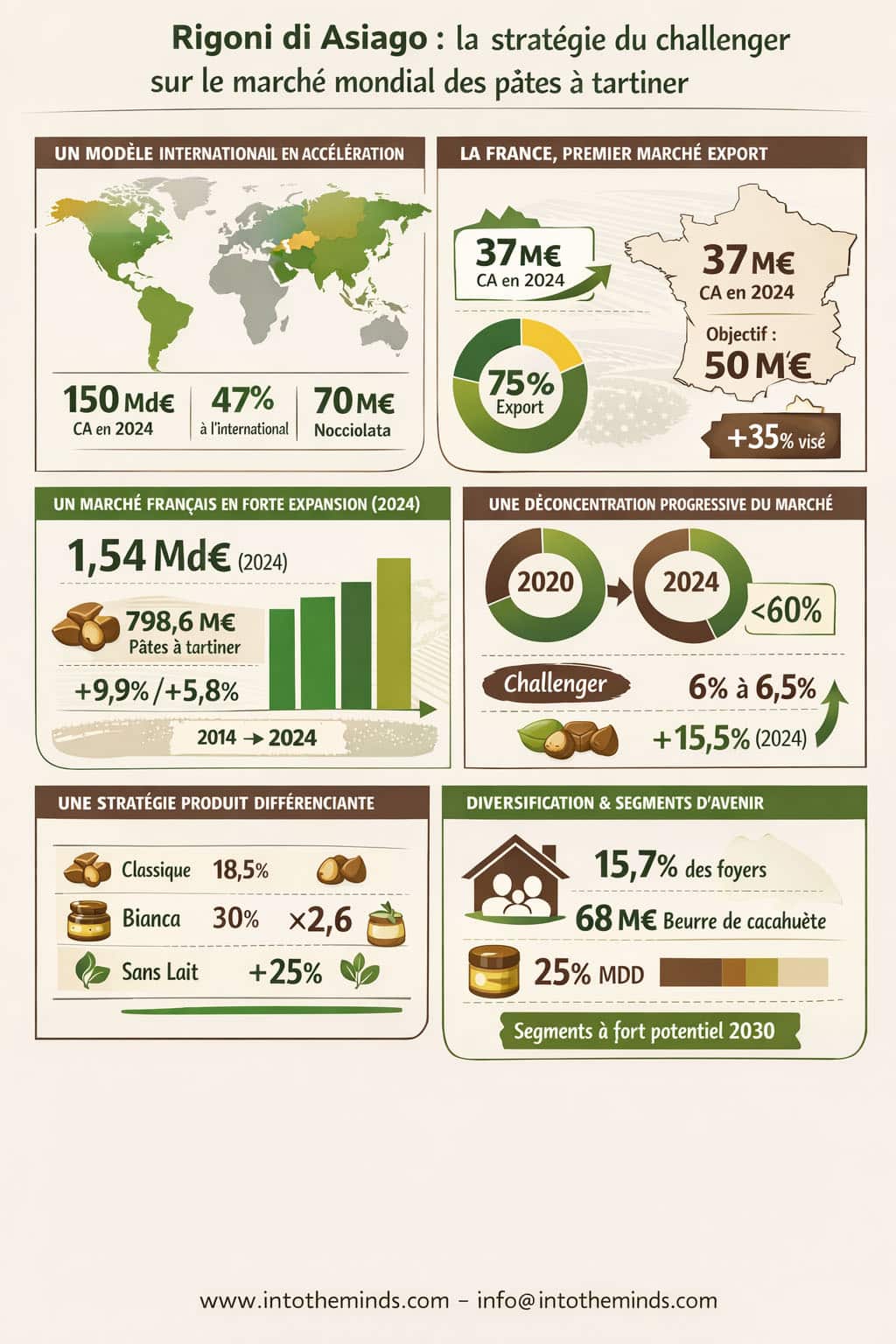
- The company Rigoni di Asiago generates more than 150 million euros in revenue in 2024, with 47% from international markets
- Nocciolata holds between 6% and 6.5% market share in France, with 15.5% growth in 2024
- The Nocciolata product sells 75% internationally
- The goal is to reach 200 million euros in revenue within the next two years
- France represents the top export market with 37 million euros in 2024
- The strategy relies on product innovation, naturalness, and a targeted digital marketing approach
- The driving force behind Rigoni’s growth is its marketing strategy, which emphasizes transparency and ingredient quality. This strategy counters the scandals that shook Nutella with its hydrogenated palm oil recipes.
A market context favorable to organic alternatives
The comfort food market has been expanding significantly since Covid. Consumers seek reassurance in an anxiety-inducing context. The category of sweet spreads benefits from this positive dynamic. In France, for example, this market represented 1.54 billion euros in revenue in supermarkets in 2024. The growth was 5.5% in value and 2.5% in volume compared to 2023. This growth contrasts with the decline in mass-market food products, which fell by 1.1% in value and 0.7% in volume over the same period.
Spreads are the main driver of this expansion. In 2024, their revenue reached 798.6 million euros in France, up 9.9% in value and 5.8% in volume. This growth is part of a long-term trend: the volume of spreads has increased by 27% between 2014 and 2024 in France.
This favorable evolution is explained by several factors:
- consumers are increasingly seeking natural and organic products
- the diversification of consumption occasions beyond traditional breakfast expands commercial opportunities
- the main growth driver is perhaps the promise of a palm oil-free recipe, which echoes the scandals that shook Nutella.
The rivalry with Nutella: the main strategic challenge
Despite this market growth, concentration remains extreme around Nutella. In 2020, Ferrero’s brand held 67.7% market share in value in France. In 2021, this dominance continued with 67.1% in value and 62.5% in volume. However, as we showed in our analysis of Nutella’s strategy, the first signs of erosion are beginning to appear. In 2024, Nutella falls below 60% market share in volume for the first time, with slower growth than the overall market (+8.8% in value and +3.6% in volume).
It is in this competitive environment that Rigoni di Asiago develops its challenger strategy. As early as 2021, Nocciolata already held about 7% market share in value in France. In 2024, the brand confirms its second-place position in the French spread market, with a market share between 6% and 6.5%. More importantly, Nocciolata shows a much stronger dynamic than the leader Nutella, with 15.5% growth in value in 2024.
This performance reflects a gradual deconcentration of the French market. Although Nutella remains largely dominant, the emergence of challengers like Nocciolata is gradually altering competitive balances.
The main growth driver for Rigoni di Asiago may be the promise of palm oil-free recipes, which echo the scandals that shook Nutella.
Internationalization at the heart of the growth model
Rigoni di Asiago’s strategy relies heavily on its international development. In 2024, the group generates more than 150 million euros in revenue, with 47% from international markets. This share, nonexistent in the early 2000s, has been steadily increasing and is expected to surpass the Italian market by 2025.
This international expansion is driven almost exclusively by Nocciolata. In 2024, this brand generates more than 70 million euros in revenue, with 75% coming from exports. France is the top market outside Italy, followed by the Benelux and Germany. The group is also present in North America (Canada and the United States) and is beginning developments in Asia, particularly in China.
The recent hiring of a new export sales director specializing in Asia and the Middle East illustrates this desire for geographical expansion. This internationalization strategy allows Rigoni di Asiago to reduce its dependence on the Italian market while capitalizing on the growing global demand for organic and natural products.
France: a marketing testing ground
France holds a strategic place in the trajectory of the Italian group. In 2024, Rigoni di Asiago’s revenue in France reaches 37 million euros. The stated goal is to reach 50 million euros within the next two years, representing a growth of over 35%.
This ambitious growth is based on a particularly well-developed field marketing strategy:
- Local anchoring: Rigoni di Asiago has chosen to establish a local commercial subsidiary with five employees, complemented by multi-brand agents. This organization allows the company to stay connected to retailers in a highly concentrated French market.
- In-store promotions: in-store tastings play a central role. In a sector where product trial is crucial against a leader with near-universal brand recognition, these operations allow consumers to discover the specificities of Nocciolata.
- Digital strategy: the brand prioritizes digital marketing, press relations, and partnerships with influencers. This targeted communication strategy optimizes advertising investments while reaching qualified audiences. Rigoni di Asiago does not rule out future use of more traditional advertising to accelerate Nocciolata’s brand awareness in France.
A differentiating product strategy
Rigoni di Asiago’s product strategy is at the heart of its rivalry with Nutella. While the leader historically relies on a single iconic recipe, Nocciolata multiplies consumer entry points. The classic recipe still accounts for more than 70% of sales, but growth is driven by innovations.
| Product | Hazelnut content | 2024 Performance | Positioning |
|---|---|---|---|
| Nocciolata classic | 18.5% | 70% of sales | Historical recipe |
| Nocciolata Bianca | 30% | Sales x2.6 (Oct. 2024-Jan. 2025) | Premium innovation |
| Nocciolata Crunchy | 22% | Launched in 2021 | Upscale offering |
| Dairy-free versions | Variable | +25% (classic version) | Plant-based segment |
Nocciolata Bianca perfectly illustrates this innovation logic. Composed of 30% hazelnuts, its sales multiplied by 2.6 between October 2024 and January 2025, becoming the brand’s second-best-selling product. This performance demonstrates the effectiveness of the product innovation strategy.
This innovation dynamic even forces Nutella to react. In 2024, Ferrero’s brand launched a plant-based version after five years of development, a sign of the pressure exerted by challengers like Rigoni di Asiago on recipes, naturalness, and product image.

Development prospects
Rigoni di Asiago’s development prospects are based on a clearly assumed change in scale. The group aims for revenue exceeding 200 million euros within the next two years, compared to over 150 million euros in 2024. This ambition relies on several combined levers.
First, the continuation of internationalization, with the export share expected to exceed the Italian market share in the long term. Second, the consolidation of the French market, the top market outside Italy, with a goal of 50 million euros within two years.
At the same time, Rigoni di Asiago seeks to reduce its dependence on spreads by expanding its product portfolio. The Natù brand embodies this expansion strategy towards wellness and functional breakfasts, with products featuring no added sugars, enriched with proteins, and displaying a Nutri-score A.
This direction aligns with a structural evolution of the French market. At the end of 2024, peanut butter penetration reached 15.7% of households, up 3.4 points over the year. This segment is worth 68 million euros and could double by 2030. By positioning itself on nut purees, granolas, and porridges, Rigoni di Asiago invests in high-growth segments, less exposed to Nutella’s dominance.
These prospects are supported by significant industrial investments. The group is modernizing its historic site on the Altopiano d’Asiago to increase volumes, modernize equipment, and prepare new production lines. This industrial mastery is accompanied by tight control of fruit, honey, and hazelnut supply chains, with integrated production in Bulgaria complemented by international purchases. As you’ll see in the video below, Rigoni di Asiago also highlights the fruits produced on its territory, strengthening consumer trust.
In a market where private-label brands represent about 25% of the spreads’ value and are growing rapidly, this control constitutes a key strategic lever to support Rigoni di Asiago’s upscale positioning and long-term growth.

Frequently Asked Questions
What is Nocciolata’s market share in France?
Nocciolata holds between 6% and 6.5% market share in value in the French spread market in 2024. This position makes it the second-largest player in the market behind Nutella, with dynamic growth of 15.5% in value over the year. At the same time, Nutella’s market share has fallen below 60% as the sweet spread market becomes increasingly competitive. As we’ve shown in this article, the growth of this market attracts competition, further intensifying rivalry.
How does Rigoni di Asiago differentiate itself from Nutella?
Differentiation is based on several elements:
- the absence of palm oil in the recipe
- higher hazelnut content (minimum 18.5% compared to 13% for Nutella)
- organic certification
- an innovation strategy with multiple variations (Bianca, Crunchy, dairy-free)
- traceability of its supplies.
What are Rigoni di Asiago’s growth targets?
The group aims for revenue exceeding 200 million euros within the next two years, compared to over 150 million euros in 2024. In France, the goal is to reach 50 million euros within two years, compared to 37 million euros in 2024, representing a growth of over 35%.
On which markets is Rigoni di Asiago developing?
Internationalization represents 47% of revenue in 2024. France is the top export market, followed by the Benelux and Germany. The group is present in North America (Canada, the United States) and is developing Asia (China). A new export sales director specializing in Asia and the Middle East was recently hired.
“