Our firm has analyzed the latest available data on the Buy Now, Pay Later (BNPL) market to provide you with a comprehensive global study, featuring a focus on several specific countries.
Paying in 3 or 4 installments when checking out has become common practice. This payment method goes by the name of BNPL, for buy now, pay later. Our market research agency, leveraging its experience in the banking sector, analyzed all available data to offer you a synthetic overview of this market.
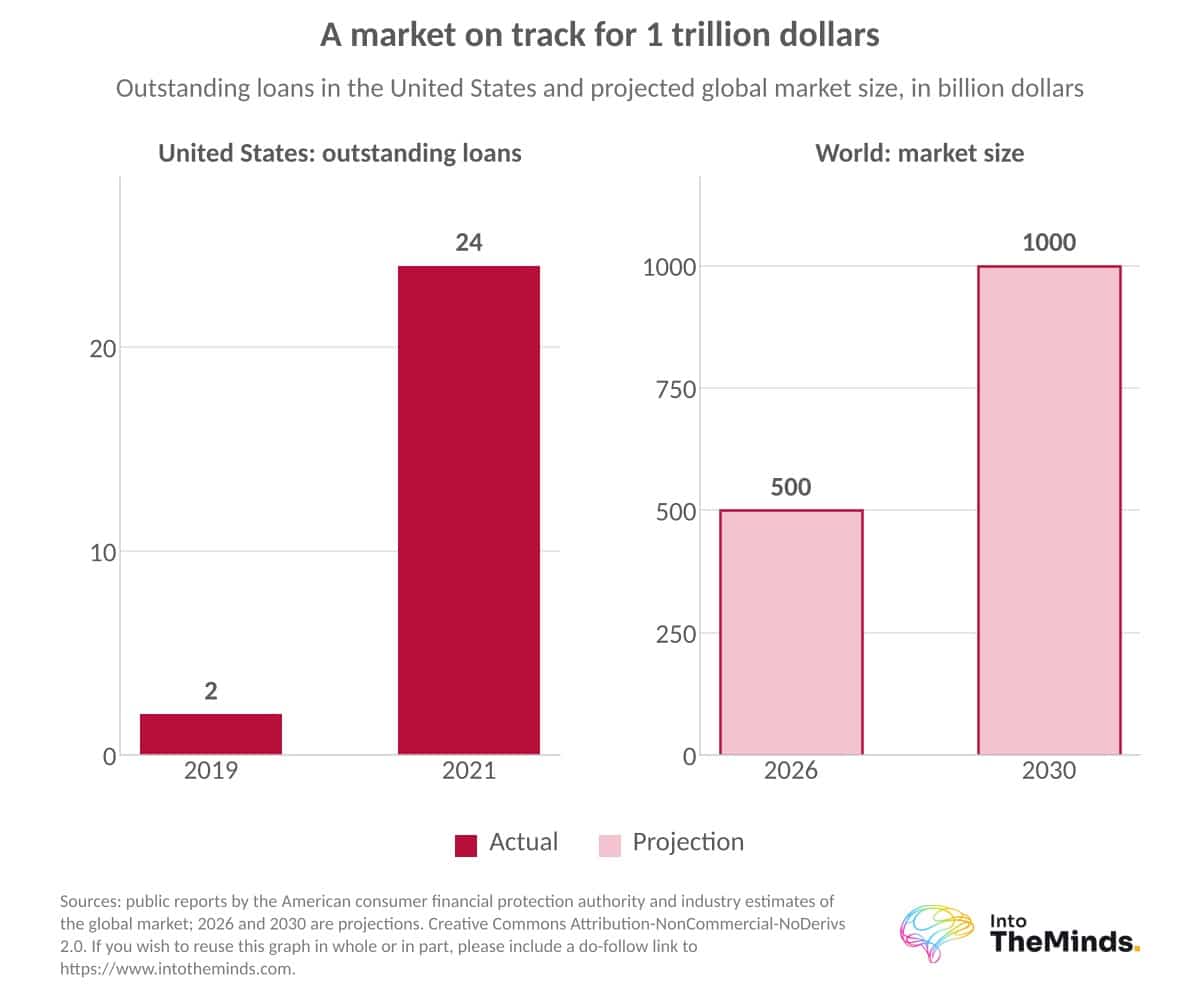
The global BNPL market is projected to reach approximately 500 billion dollars in 2026. It could approach 1,000 billion dollars by 2030. This growth comes at a price. Providers’ margins have been tightening since the rate hikes of 2022, and over-indebtedness is rising. The European CCD2 directive attempts to restore order. For companies considering integrating a split payment solution, legal aspects must be taken into account alongside purely commercial considerations.
Contact the IntoTheMinds institute
Key takeaways
- The global BNPL market is estimated at approximately 500 billion dollars in 2026 and could approach 1,000 billion dollars in 2030.
- In the United States, BNPL loan volume rose from 2 to 24 billion dollars between 2019 and 2021. Approximately 50% of consumers had used a BNPL service by September 2025.
- In France, split payment accounts for 8.2 billion euros in 2024, representing 12.1% of consumer credit excluding overdrafts.
- French merchants pay a commission of 2 to 5.5%. At Oney, however, the extra cost was borne by the customer in 60% of cases in 2025.
- In France, the share of over-indebtedness cases involving split payment or mini-credit rose from 1% in 2022 to 17% in 2024.
- As of November 20, 2026, the CCD2 directive requires 2 to 4-installment payment providers to obtain authorization, conduct creditworthiness assessments, and display the APR.
Split payment in brief
Before diving into the figures, allow us to clarify a few terms and definitions. Below, you will find what sets split payment apart from credit. We also detail the customer journey as well as the merchant journey.
Split payment, installment payment, BNPL, and consumer credit
Split payment divides the price of a purchase into 2, 3, or 4 installments over a short period of 30 to 90 days. The first installment is debited upon ordering. Subsequent installments are automatically charged. BNPL (buy now, pay later) also covers deferred payment, which consists of paying 15 or 30 days after purchase, and monthly installment options extending up to 12 months or beyond.
The payment journey on customer and merchant sides
For the customer, the experience boils down to a few clicks:
- choosing split payment among the offered payment methods
- the provider checks eligibility within seconds
- the first installment is debited from their bank card
Acceptance rates exceeded 90% at Scalapay as early as 2021 and at Alma in 2025.
The merchant does not bear the risk. The company behind the BNPL solution bears it, and naturally gets remunerated for it. Here are the 4 steps of the payment flow on the merchant side:
- The customer selects payment in 3 or 4 installments on the payment page.
- The payment service provider assesses the risk and validates the transaction.
- The merchant immediately receives the full amount, minus the commission.
- The provider collects subsequent installments, manages reminders, and assumes the risk of unpaid balances or fraud.
Eligible amounts vary by retailer. La Redoute accepts carts from 100 to 5,000 euros. In 2025, SNCF lowered the threshold for 3-installment payments to 120 euros. Displaying the monthly installment right on product pages, and not just at checkout, makes the option visible at the moment the customer hesitates.
To visualize this journey, you will find below a video showing an end-to-end 4-installment transaction.
Perspectives and key figures
In this section, we will analyze the market taking 3 perspectives:
- first, the global BNPL market
- a focus on Europe
- a specific analysis of 3 countries with very different models: the United States, France, and Germany.
The first observation on the BNPL market is that its “takeoff” dates back to 2020. Over the first 9 months of 2020, the 4 main providers (Klarna, Afterpay, Affirm, and PayPal) recorded growth of over 50%. This growth should be set against that of the payments sector, which registered “only” 8% between 2019 and 2023 and 4% in 2024. This 4% pace is anticipated through 2029. We therefore conclude that BNPL is one of the few segments growing much faster than overall payments.
To place the BNPL market in a global context, you will find a chart below showing its trajectory from 2020 to 2030. Pay attention to scales: the y-axis for the US market is not the same as for the global market.
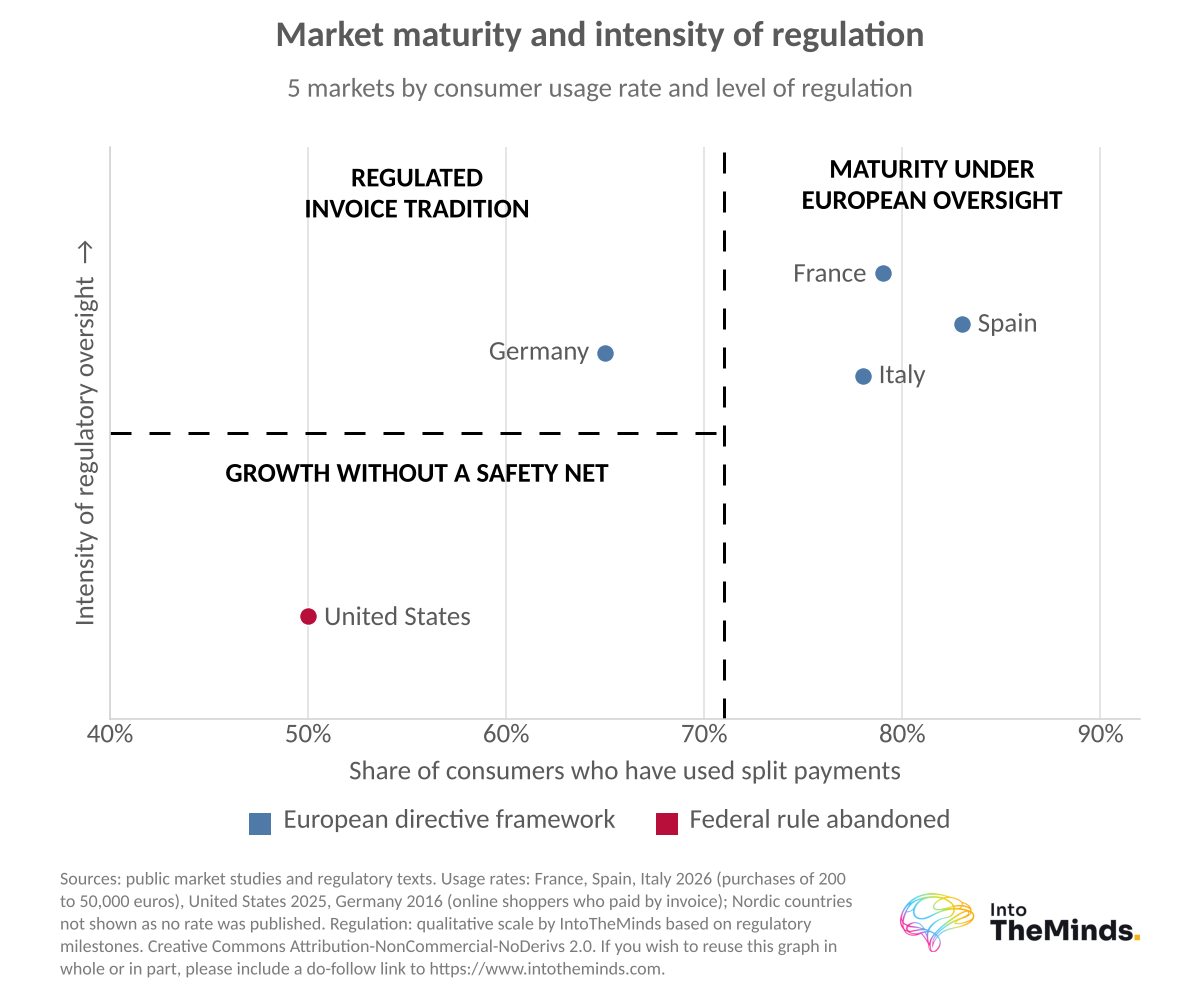
Maturity levels differ sharply from one geographical region to another. In our quest for numbers, we managed to gather quite telling indicators that you will find in the table below.
| Region | Market maturity indicator | Year | Comment |
|---|---|---|---|
| Nordic countries | BNPL accounts for 20 to 25% of payments | 2022 | Birthplace of Klarna (2005) |
| United Kingdom | 80% of merchants offer BNPL | 2022 | Most equipped market |
| United States | Penetration rate: 50% of consumers use BNPL | 2025 | Loan volume multiplied by 12 in 2 years |
| Spain | 83% of buyers use it for purchases of 200 to 50,000 euros | 2026 | Fastest adoption, strong physical channel |
| France | 79% of buyers use it for purchases of 200 to 50,000 euros | 2026 | Banking consolidation, regulation in November 2026 |
| Italy | 78% of buyers use it for purchases of 200 to 50,000 euros | 2026 | Longer formats, high loyalty |
| Germany | BNPL represents 28 to 31% of online revenue via invoice purchase (which is not split payment but deferred payment) | 2018 to 2021 | Klarna’s primary market |
The intention to pay in multiple installments reaches 44% in France, 37% in Portugal, and 35% in Spain.
European market: highly contrasting maturity levels
Nordic countries remain the benchmark in penetration: split payment accounted for 20 to 25% of payments there in 2022, compared to 4 to 5% in France. The United Kingdom dominates in equipment, with 80% of merchants equipped in 2022, compared to 50 to 70% in France.
We observe that Southern Europe is catching up:
- In a survey conducted in September 2022, the intention to pay in multiple installments reached 44% in France, 37% in Portugal, and 35% in Spain.
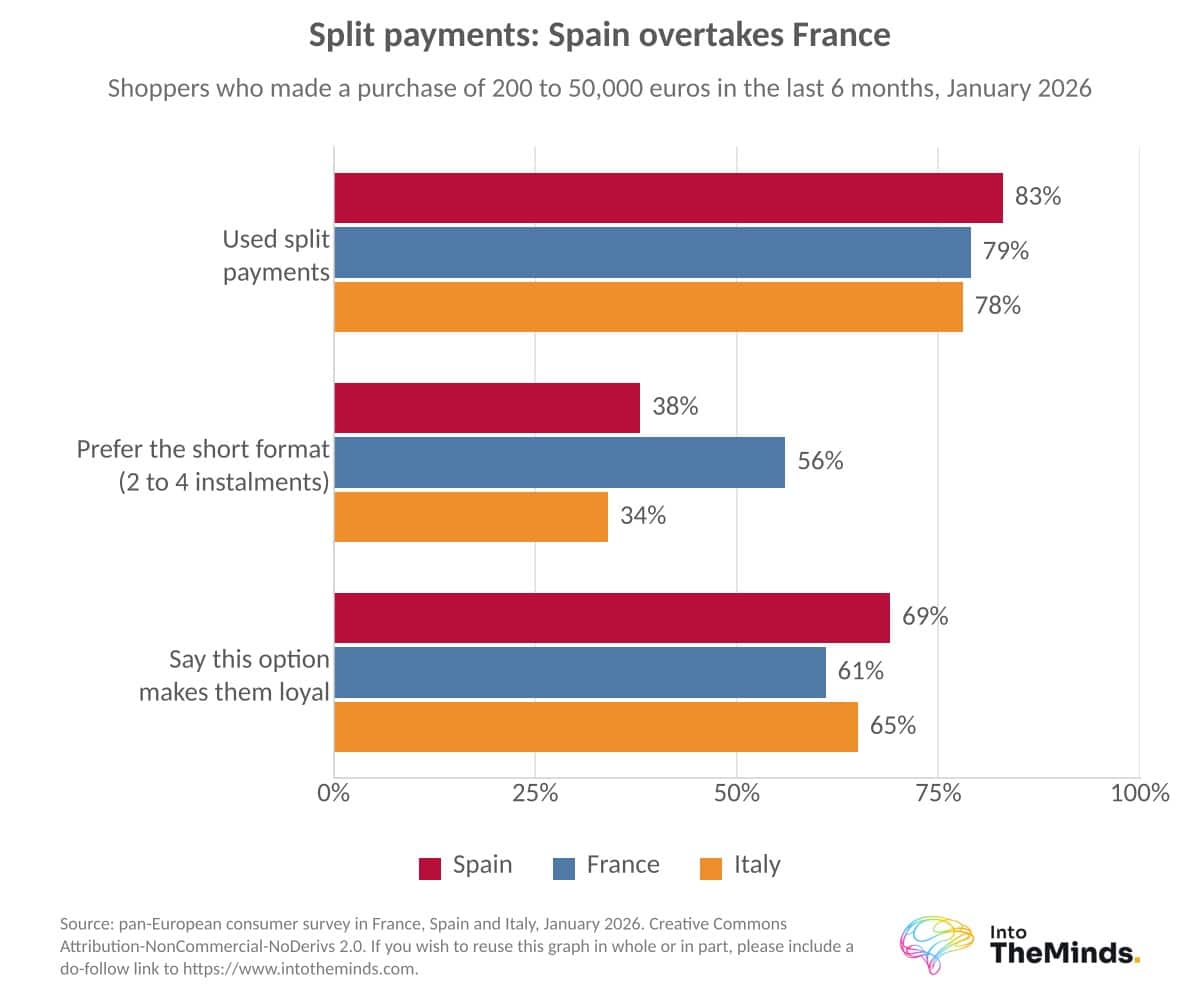
- In January 2026, actual usage on purchases of 200 to 50,000 euros was 79% in France, 83% in Spain, and 78% in Italy.
In 2026, Spain posted the highest usage rate among the 3 countries, even though these two metrics are not strictly comparable.
Usage patterns, however, do not converge. Here are the 3 sharpest differences measured in 2026:
- The short format of 2 to 4 installments concerns 56% of respondents in France, compared to 38% in Spain and 34% in Italy.
- Physical points of sale represent 44% in Spain and 41% in Italy, compared to 39% in France.
- The French primarily cite fee-free options (44%), while the Spanish cite flexibility (39%).
In the United States, BNPL loan volume multiplied by 12 in 2 years, from 2 to 24 billion dollars.
United States: the largest split payment market, and the least regulated
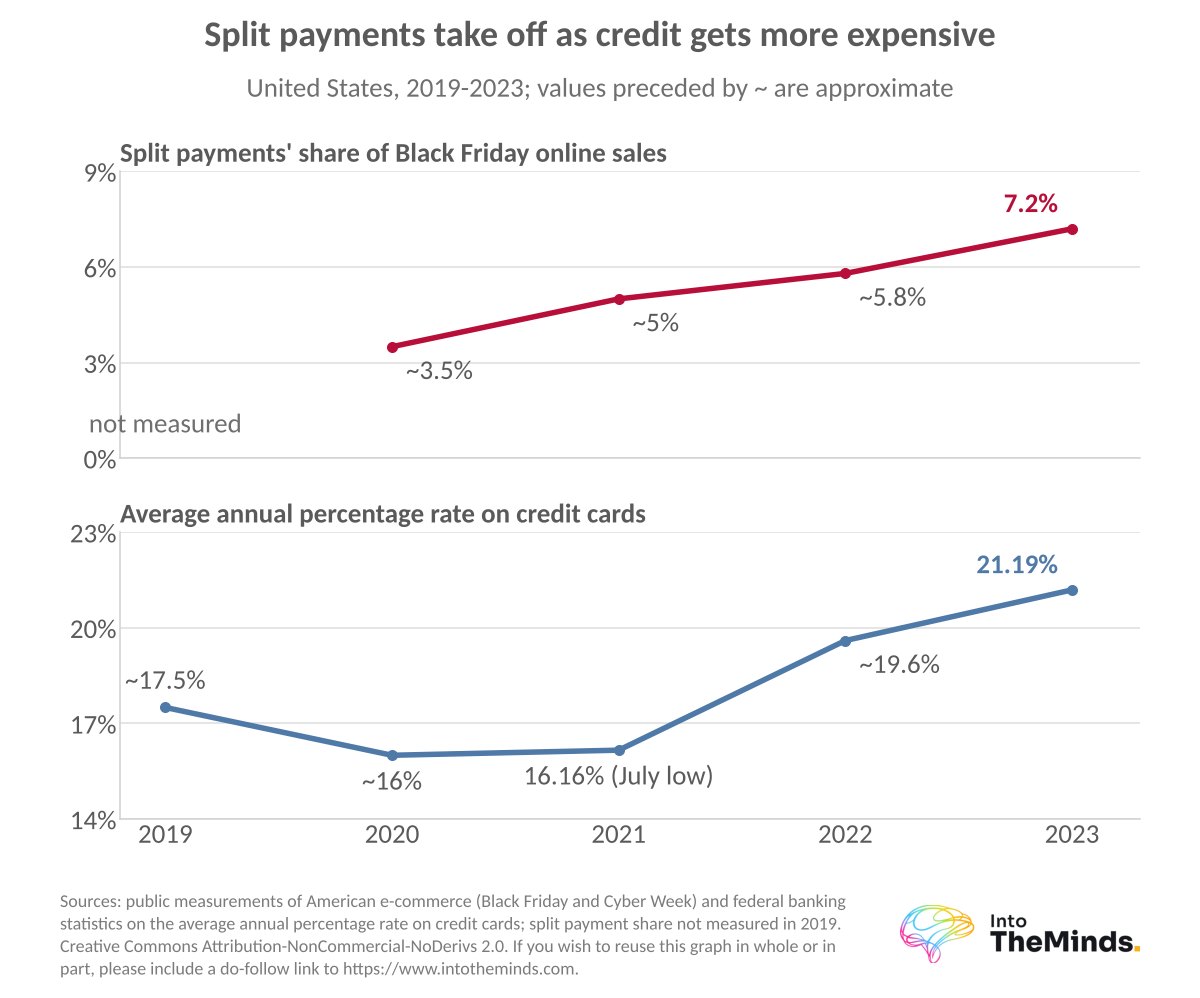
The US market is the most mature because credit is deeply ingrained in American consumer habits. Between 2019 and 2021, BNPL loan volume grew from 2 to 24 billion dollars, and the sector was expected to reach approximately 100 billion dollars in transactions for the year 2025. A quarter of adults had used a BNPL loan in December 2023, rising to about half of consumers by September 2025. During Black Friday and Cyber Week, split payment captured 7.2% of online sales in 2023 according to a market research study, compared to about 3.5% in 2020.
The nature of purchases has changed. According to the CFPB, necessary and everyday purchases paid via BNPL surged by 434% between 2020 and 2021. Discretionary spending has given way to essential purchases.
Risk follows the same trajectory. Here are 3 warning signs:
- About half of users reported being late on a payment in 2025.
- 14% of users resort to BNPL after a credit card refusal.
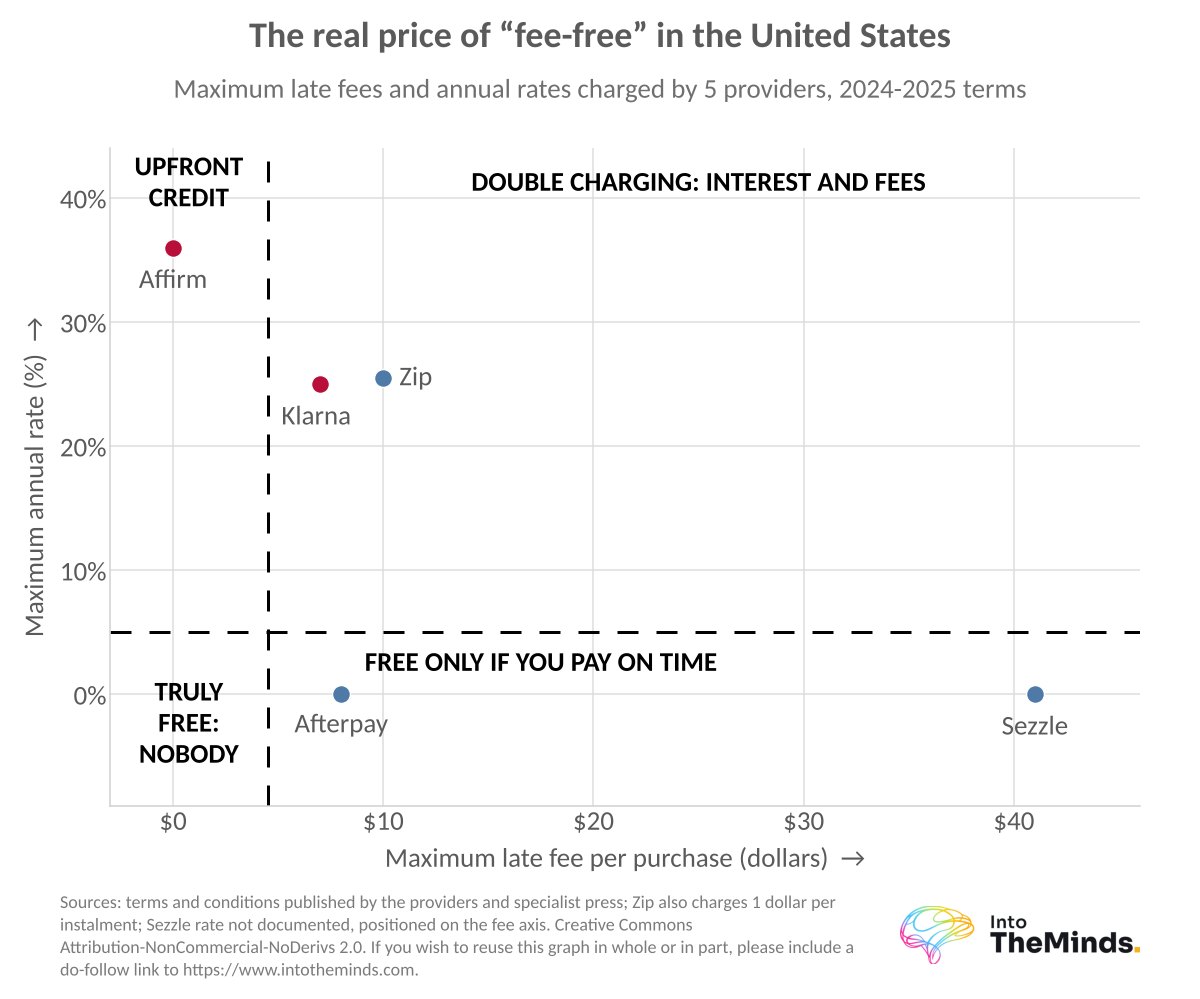
- Rates can reach 36% and loans 20,000 to 25,000 dollars.
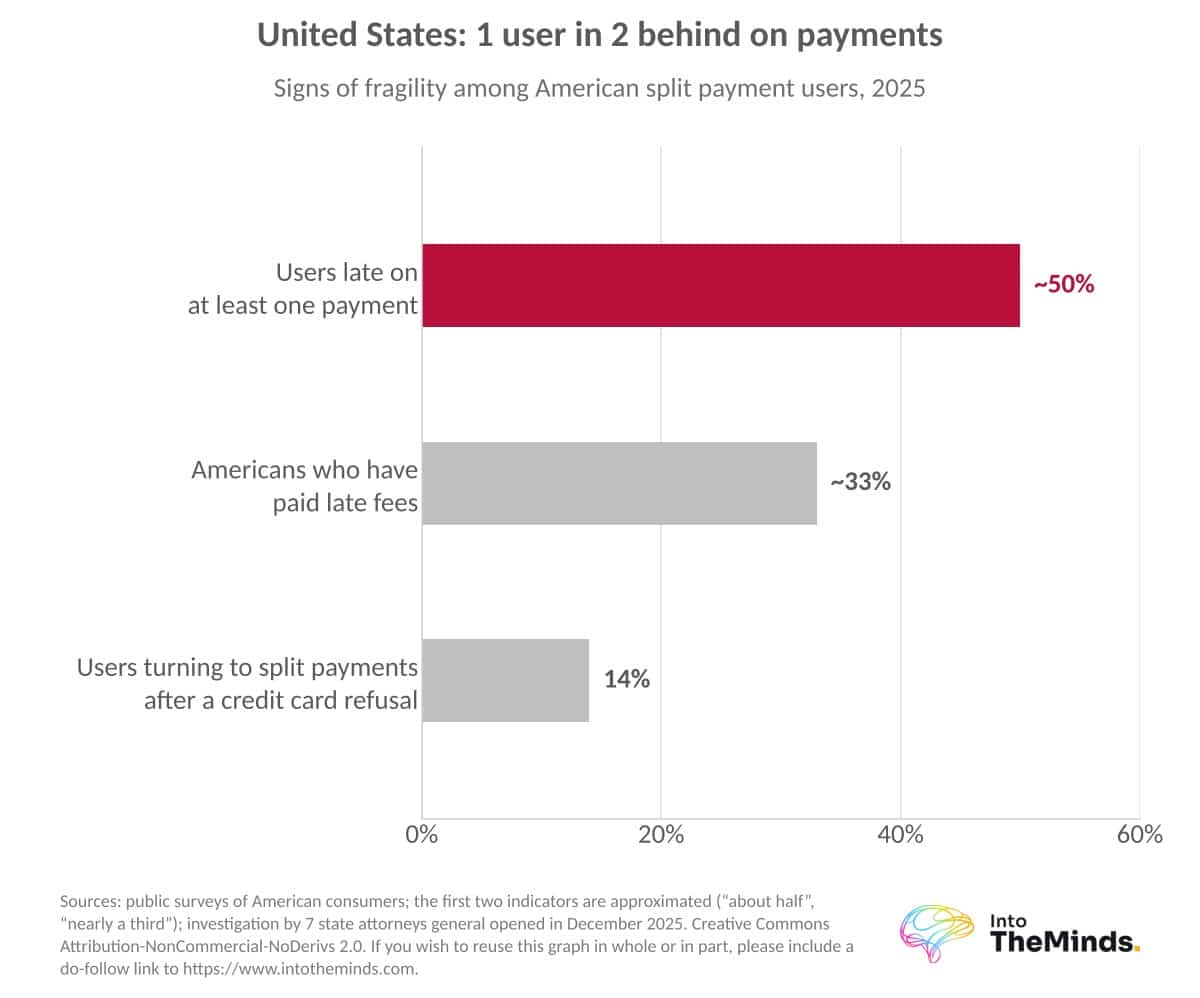
Regulation moves in the opposite direction from Europe. The federal rule adopted under the Biden administration was abandoned by the Trump administration. In December 2025, state attorneys general from 7 states opened an inquiry into the 6 largest providers: Affirm, Klarna, PayPal, Afterpay, Sezzle, and Zip. In 2025, Affirm became the first major player to transmit all its data to US credit bureaus.
To understand this takeoff, you will find below a chart comparing the BNPL share on Black Friday with the average APR of US credit cards. This rate rose from a low of 16.16% in July 2021 to 21.19% at the end of 2023, making zero-interest BNPL all the more attractive.
In the United States, necessary and everyday purchases paid via BNPL surged by 434% between 2020 and 2021.
France: a bank-dominated split payment market
The French market grew from approximately 6 billion euros in 2019 to 8.2 billion euros in 2024. The snapshot established by the ACPR for 2020 gives a sense of scale:
- 4.8 billion euros in outstanding loans
- 18 million credit accounts
- 10.5 million borrowers
- average amount of 350 euros.
Online retail is the primary distribution channel for split payment. In 2023, 20 to 25% of e-commerce purchases involved split payment. This share reached as high as 43% at Cdiscount in 2022. According to a survey published by Floa, 31% of French consumers had used split payment in 2020, up 6% compared to 2019. Furthermore, Fevad estimated in 2020 that 10 to 15% of French e-commerce merchant sites offered a multiple-installment payment solution.
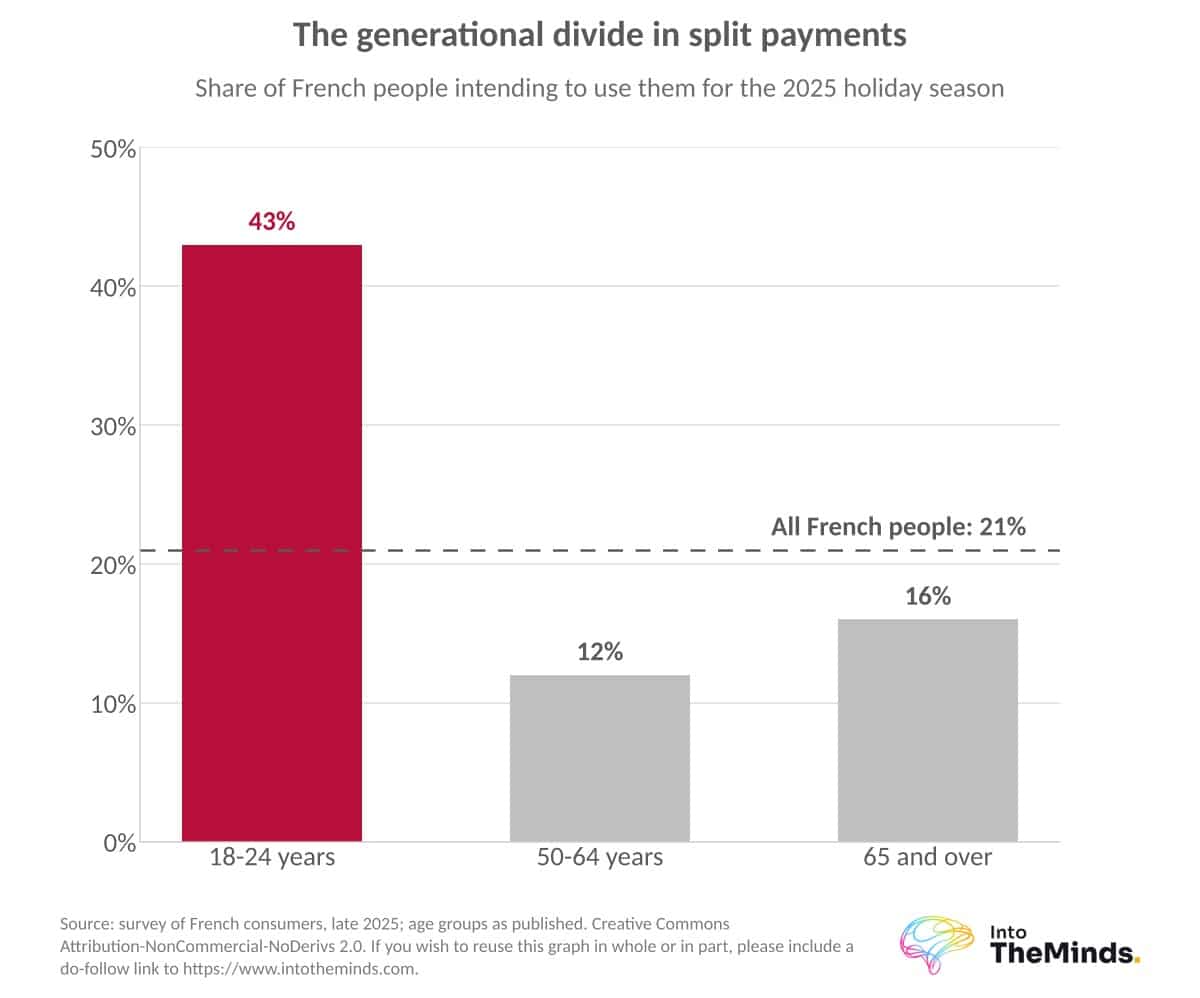
Split payment accounted for 43% of Cdiscount sales in 2022.
The title of this section refers to the bank-dominated nature of the sector, which is indeed visible in acquisition movements:
- BPCE acquired Oney in 2019.
- BNP Paribas acquired Floa for 250 million euros (Floa processes 1 out of 3 split payments in France).
- La Banque Postale created its own solution, Django.
- Crédit Agricole Consumer Finance acquired Pledg in February 2024 (200 partners, 220 million euros in production in 2023) to bolster Sofinco.
In France, split payment is therefore primarily a banking affair.
Germany: the invoice purchase culture
Germany did not wait for BNPL to pay later. Purchase on invoice accounted for 28 to 31% of online revenue there between 2018 and 2021, compared to 12% for credit/debit cards.
However, monthly installment credit is expensive there: 11.95% per year plus 45 cents per month, representing an APR of 14.79% for 500 euros over 12 months. At the end of 2023, it was deemed 86% more expensive than traditional bank loans.
Increased sales make BNPL profitable for merchants despite commissions being higher than credit card fees.
Benefits of BNPL for merchants
A merchant accepts a higher commission than that of a bank card because the impact on sales is proven. Increased sales therefore make BNPL profitable for the merchant.
Below, you will find the most solid data, followed by sectors where leverage is strongest.
Increase in conversion rate and average basket size
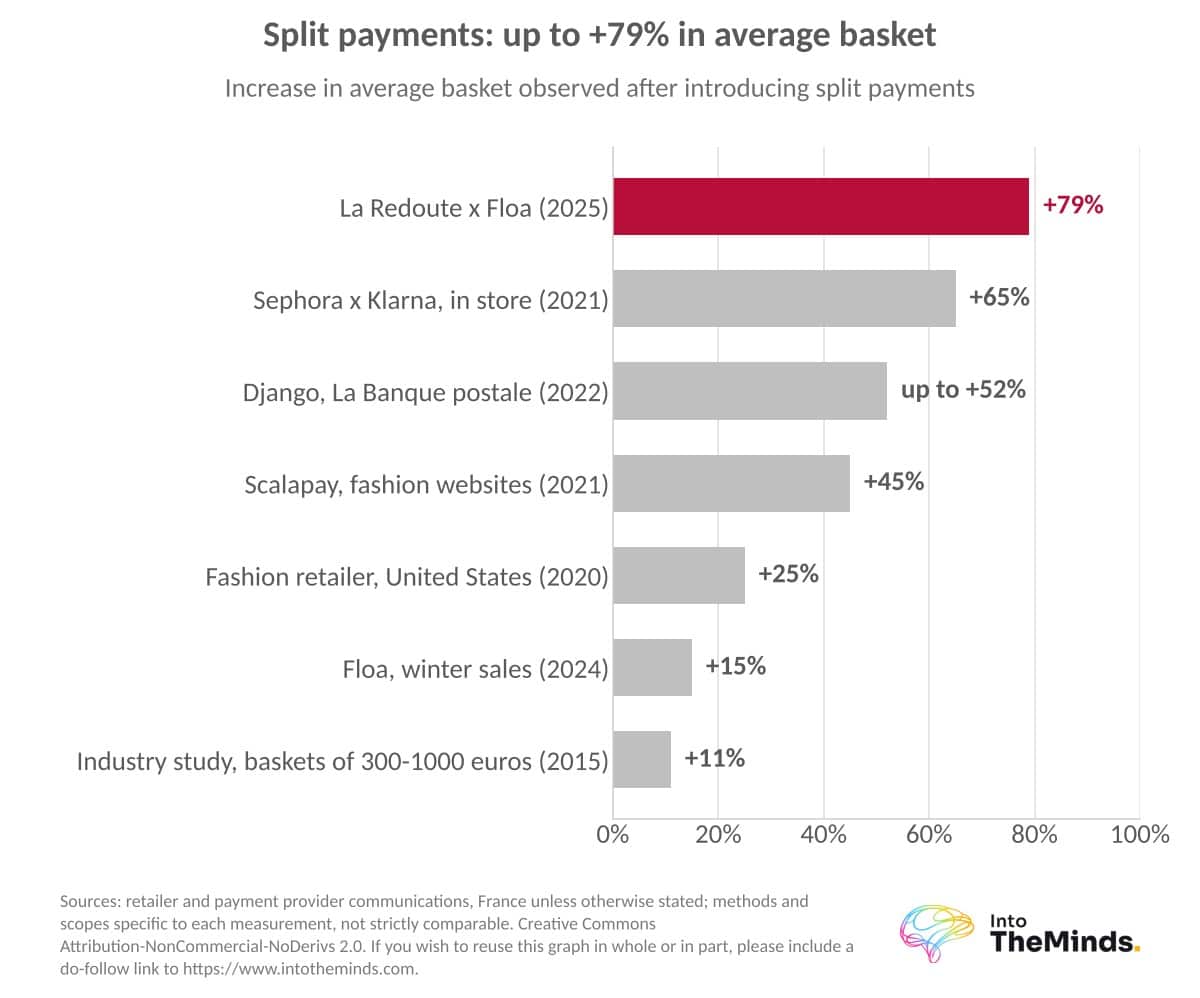
The mechanism is psychological and can be categorized under pricing techniques. A 600-euro washing machine becomes 4 installments of 150 euros, and the price barrier disappears at checkout. Here are the effects measured by retailers and providers:
| Year | Country | Player | Measured effect |
|---|---|---|---|
| 2018 | France | Alltricks and Oney | Basket of 288 euros in 3 installments, 410 euros in 4 installments, over 1,300 euros in 10 installments |
| 2021 | France | Scalapay (fashion sites) | Conversion +15%, basket +45% |
| 2021 | France | Klarna and Sephora | In-store basket +65% |
| 2022 | France | Django (La Banque Postale) | Basket up to +52% |
| 2024 | France | Oney (winter sales) | Basket +15% to 392 euros; transactions +5% according to BPCE |
| 2025 | France | La Redoute and Alma | Orders +50%, basket +79%, conversion multiplied by 2 |
| 2025 | United States | Affirm (travel) | Average order 3 times higher than other transactions |
These figures come directly from retailers and providers themselves. We therefore invite you to interpret them as orders of magnitude.
Customer loyalty and experience
Split payment also influences store choice. According to Oney’s 2022 European barometer, 1 out of 2 consumers would not have purchased without this facility: 25% would have postponed their payment, 15% would have gone to a competitor, and 6% would have given up. 1 out of 3 Europeans was already choosing their retail store based on the option to pay in installments.
This effect erodes as BNPL becomes commonplace. In 2026, it still played a role for 69% of Spaniards, 65% of Italians, and 61% of French consumers, but it has declined by 13 points since 2023. Customers now expect complementary benefits: discounts, cashback, trade-in offers. To find out what your own customers expect, a customer satisfaction survey on checkout experience remains the most direct method.
Travel, circular economy, renovation: new frontiers for split payment
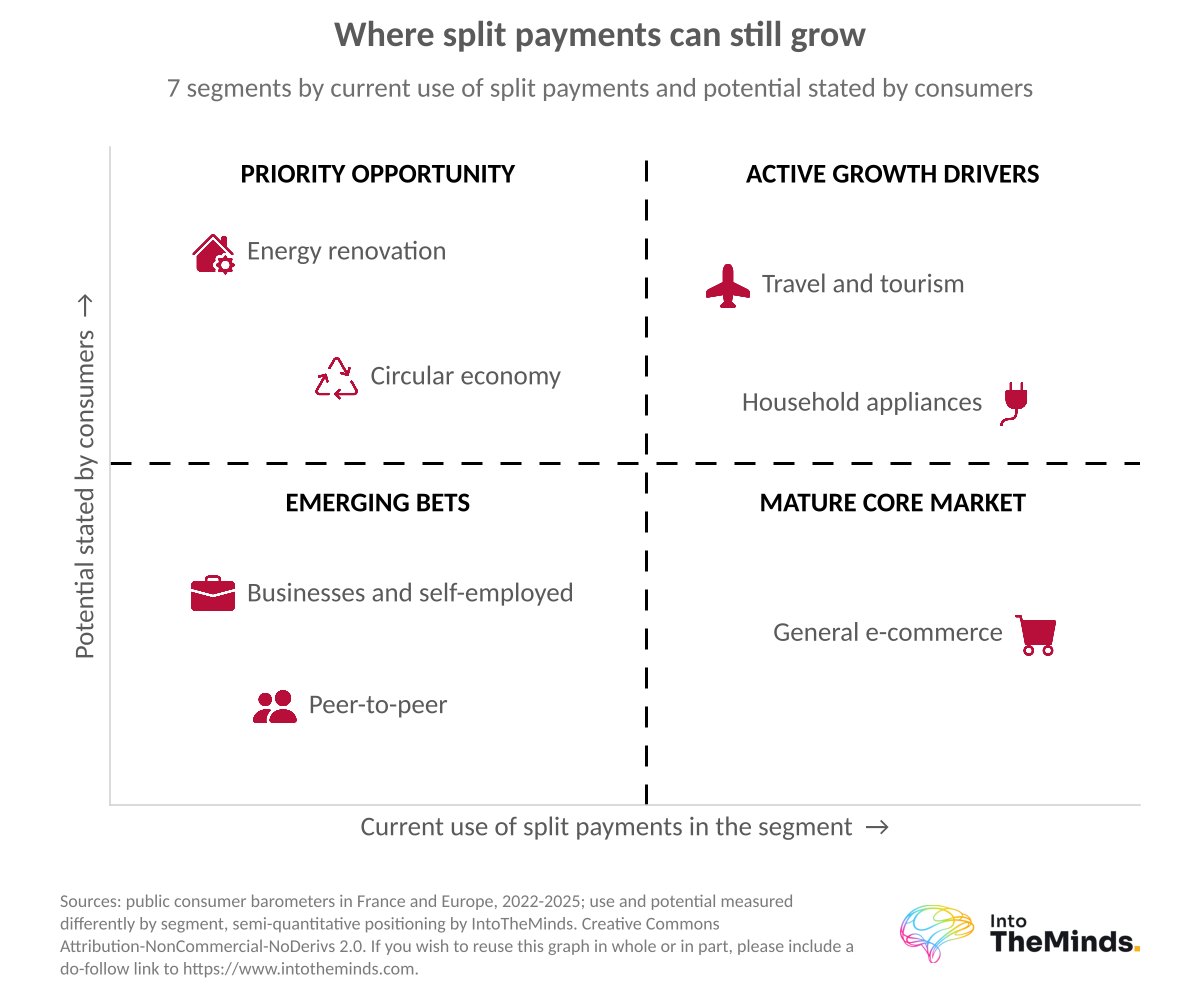
Historical sectors remain home appliances (32% of financed purchases in 2025) and smartphones, whose share doubled from 13% to 27% between 2021 and 2025. But new use cases are emerging. Here are the most documented:
- Travel: SNCF has been offering 3 or 4-installment payments with Alma since 2023 (1.5% fee). At Center Parcs, usage rose from 12% to 17% of purchases in early 2025, and Pierre et Vacances launched interest-free 3-installment payments on April 15, 2025.
- Circular economy: 74% of French consumers would be incentivized to buy second-hand or refurbished goods with split payment (2024).
- Energy renovation: 73% of French homeowners would be incentivized to undertake renovation work with a financing solution, and 76% would more readily choose a retailer offering one (2025).
- B2B: as early as 2021, Mansa was financing freelancers and VSEs from 1,000 to 20,000 euros, at 1% per month.
Durations are also lengthening: in 2026, 34% of French consumers had used a payment option of 13 installments or more for purchases over 300 euros.
17% of over-indebtedness cases involved split payment or mini-credit in France in 2024, compared to 1% in 2022.
Regulatory framework: CCD2 and others
If you offer or plan to offer multiple-installment payments, this section directly concerns you. It details the reform timeline and what changes for providers.
Until now, split payment escaped consumer credit regulations under two thresholds: 90 days and 200 euros. The European Consumer Credit Directive, known as CCD2, ends this exemption. Here is its timeline:
- June 30, 2021: proposal for a directive by the European Commission.
- December 2022: agreement on a text including BNPL contracts, zero-interest, and under 200 euros.
- 2023: adoption of the directive.
- September 2025: publication of the French transposition ordinance.
- November 20, 2026: entry into application in France.
On that date, 2 to 4-installment payment providers must obtain authorization, systematically assess each customer’s creditworthiness, display the APR and payment schedule, and will no longer be able to present these offers as purchasing-power friendly. For providers, the challenge will be integrating creditworthiness assessment without weighing down the smooth payment journey that was their core strength. Major players in the French market had actually anticipated these obligations even before the ordinance was published.
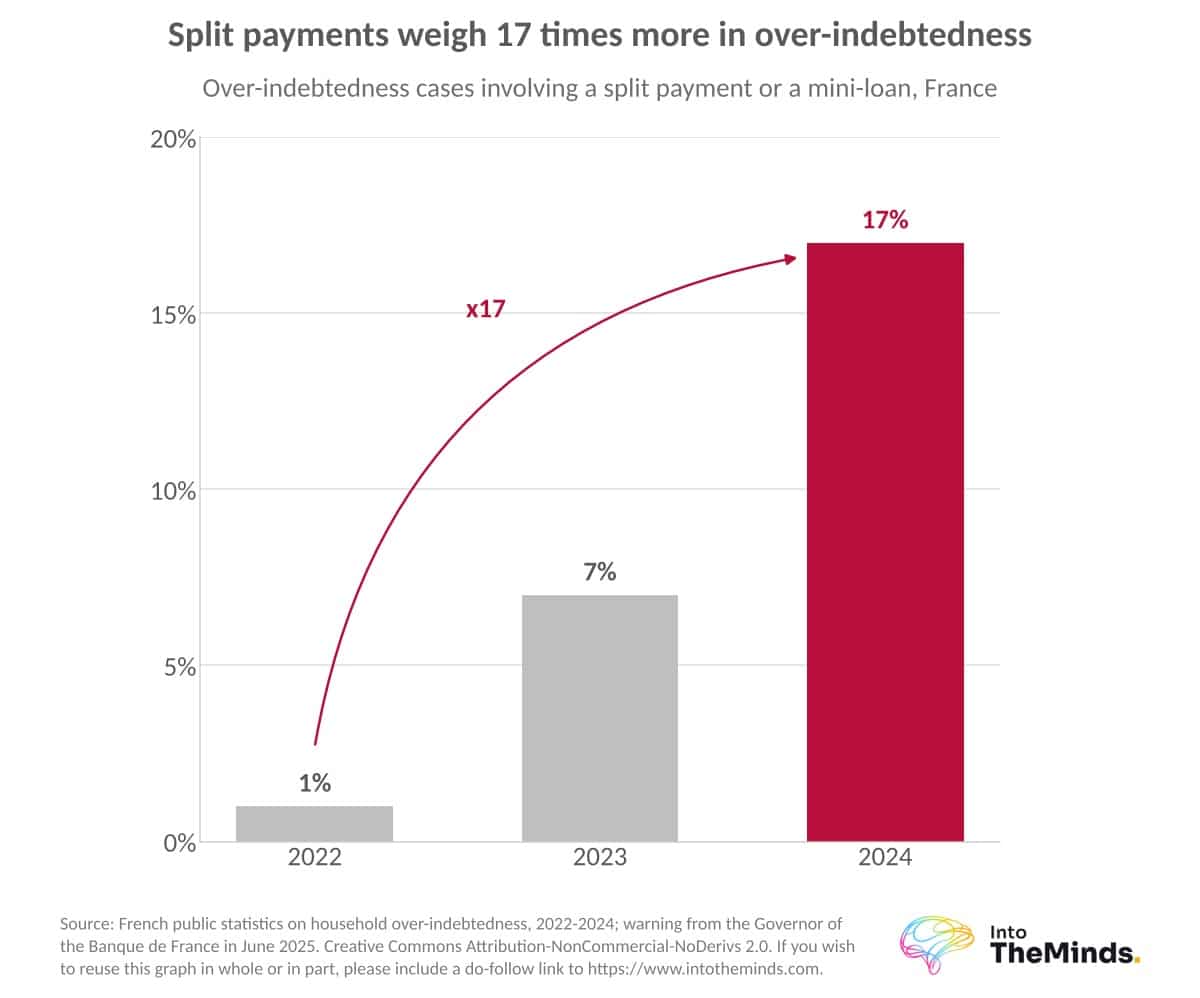
Regulators have solid reasons to act. The share of over-indebtedness cases involving split payment or mini-credit grew from 1% in 2022 to 7% in 2023, then to 17% in 2024. François Villeroy de Galhau, Governor of the Banque de France, publicly raised the alarm on this point in June 2025. Over-indebtedness increased by 6% over the first 5 months of 2025, and 4.6 million people were in a situation of financial vulnerability.
Below you will find a chart depicting this progression.
The economic model of BNPL
The apparent fee-free nature for the customer comes at a cost, and that cost has shifted hands since 2022. Here is how it is distributed.
The founding principle relies on the merchant. In France, merchants pay a commission ranging between 2 and 5.5% of the transaction amount depending on the provider. These fees significantly exceed credit card processing fees. In the United States in 2022, BNPL commission stood between 7 and 8%, compared to 2 to 3% for a credit card. Affirm charged between 8% and over 15% for long-term zero-interest financing. At the end of 2020, commissions were still between 2.5 and 4%.
In the United States, BNPL commission stood between 7 and 8%, compared to 2 to 3% for a credit card.
Rising interest rates broke this equation. The ECB raised its refinancing rate to 1.25% as early as September 2022, increasing the cost of funds advanced by providers. The effects are measurable:
- In 2023, Younited estimated the drop in merchant-sponsored credit at nearly 50% among its clients, a decline concentrated on high-basket financing.
- In 2025, Oney indicated that the extra cost was borne by the consumer in 60% of cases.
- Rates applied at Oney reached 1.67% for 3 installments and 2.5% for 4 installments, with a cap of 60 euros for purchases over 2,400 euros.
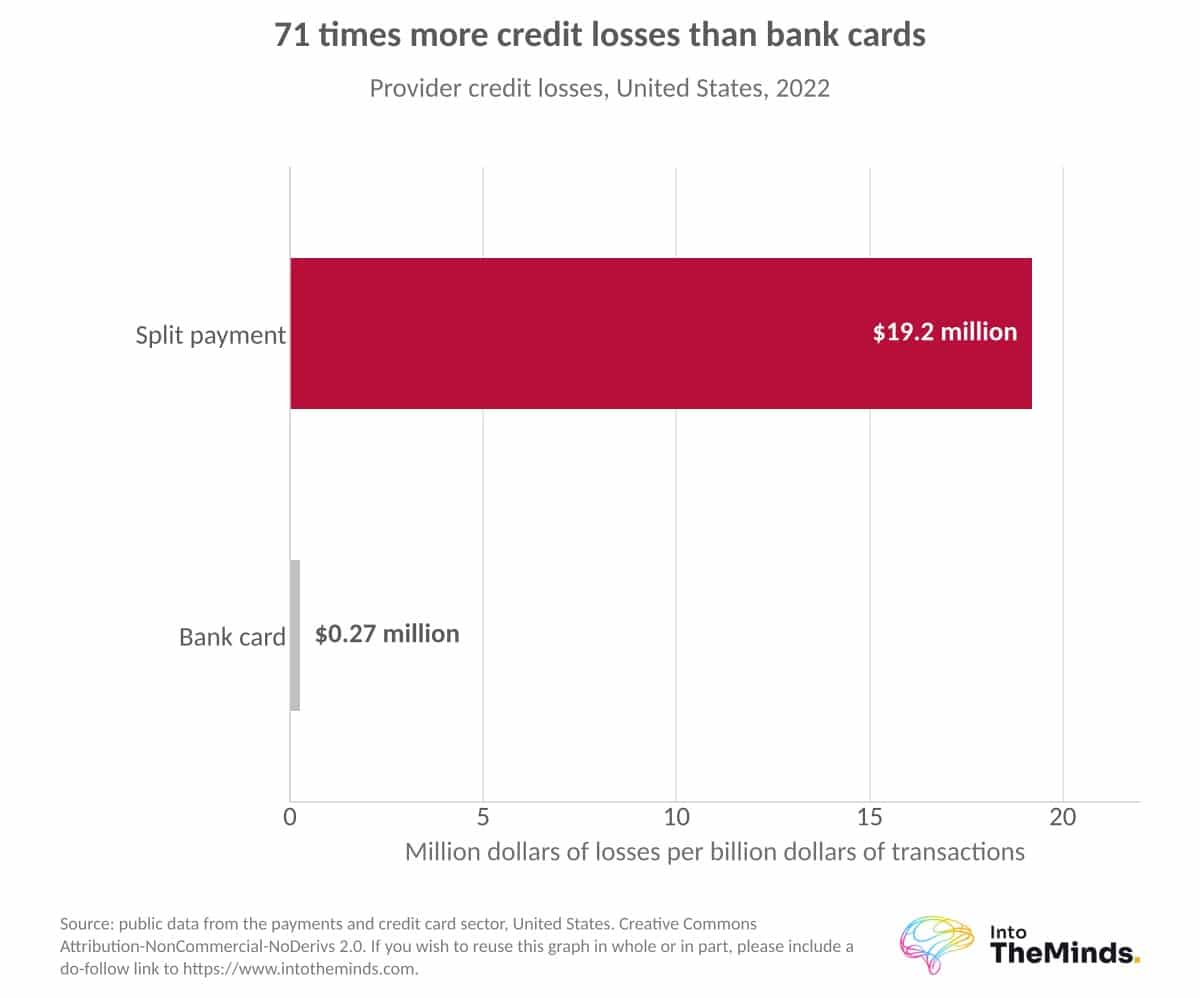
Credit risk also weighs heavily on margins. In 2022, losses reached 19.2 million dollars per billion dollars in BNPL transactions, compared to 270,000 dollars for bank cards. This gap is considerable: split payment loses about 70 times more than bank cards for the same volume.
Integrating a split payment solution: Buy or Build?
Once the decision is made, the integration model remains to be chosen. As you will see below, the Buy option suits the majority of businesses, but proprietary development and embedded lending fulfill specific needs.
The Buy option: relying on a payment service provider
Integrating an existing solution takes a few days. Alma, Klarna, Scalapay, Oney, or Floa offer APIs and plugins for CMS platforms like Shopify or Prestashop. The provider handles scoring, financing, collections, and default risk. For a company without internal financing capacity, it is the fastest route.
Selecting the right payment service provider nevertheless warrants a thorough analysis grid. Here are the criteria to check:
- Registration with national regulatory authorities (e.g. ACPR) and held authorizations (financing company, payment institution), which determine compliance post-November 2026.
- Commission charged and the portion of extra cost passed on to the customer.
- Transaction acceptance rate.
- Omnichannel coverage: website, app, in-store POS terminal, and cash register software.
The Build option and embedded lending
Developing a proprietary solution gives full control over customer experience, underwriting rules, and margins. But the company must build a complete infrastructure for payment, scoring, and collections, advance the funds, and master regulations. With CCD2, this last requirement becomes far heavier.
Embedded lending represents a middle ground. The merchant integrates financing directly into its own journey, often as a white-label service, while delegating financing, scoring, and risk to an authorized partner. It maintains control over the interface and pricing without requiring a banking license or taking on debt. For an SME or VSE, it is often the only way to offer split payment under its own brand.
The competitive landscape: fintechs, banks, and tech giants
Who controls this market, and where is it heading? In this section, you will find the main categories of players, the trajectory of leaders, and the 3 developments shaping the period up to 2030.
Three consolidating families of players
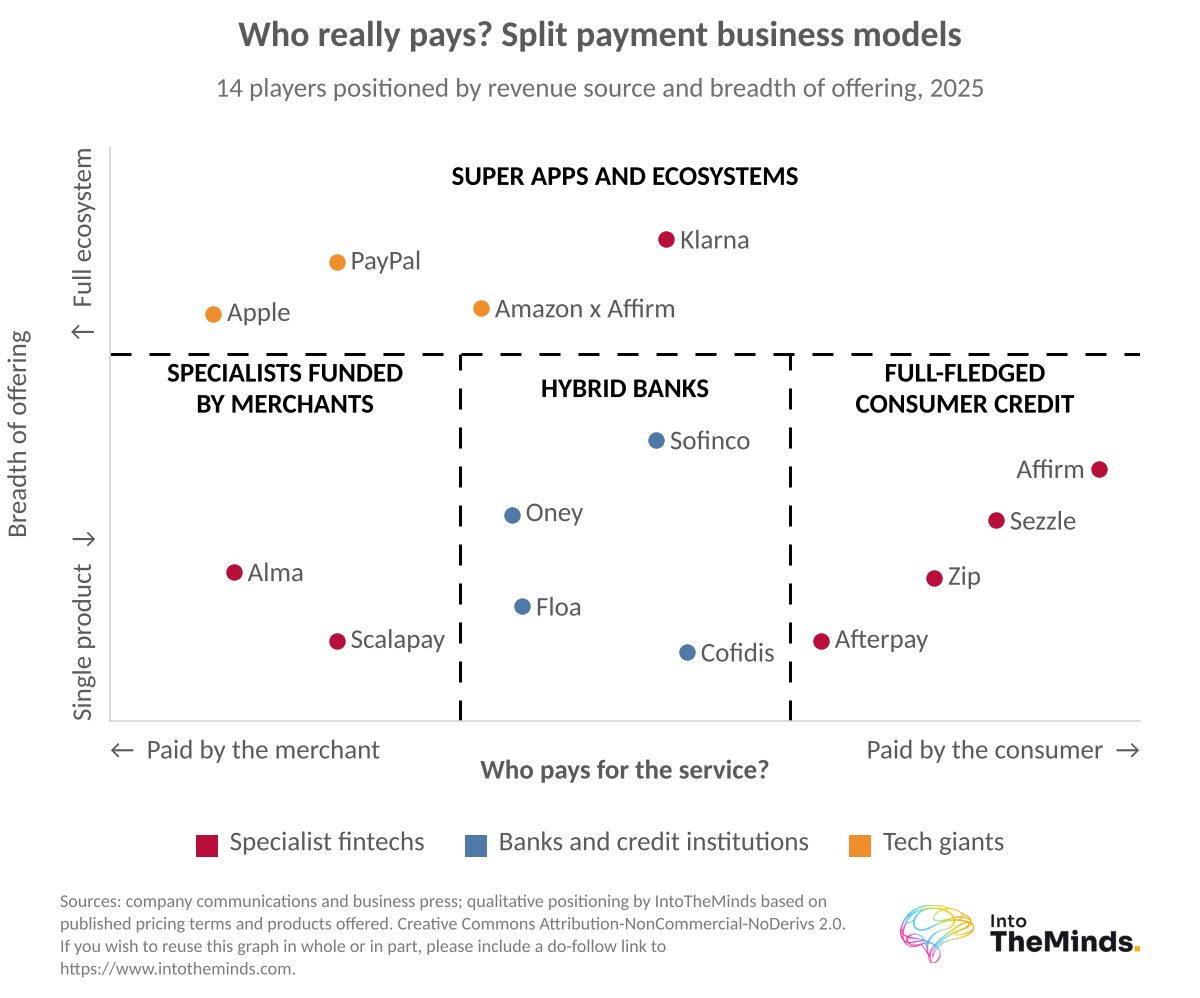
The market is organized around 3 families. First, specialized fintechs: Klarna, Affirm, Afterpay, Alma, Scalapay, Pledg, Sezzle, and Zip. Second, banks and consumer credit institutions: Oney, Floa, Cofidis, Sofinco, Younited, and Django. Finally, tech giants: PayPal, whose Pay in 4 processed 750 million dollars as early as Q4 2020, Amazon, an Affirm partner since August 2021, and Apple, which launched Apple Pay Later in March 2023 for amounts ranging from 50 to 1,000 dollars.
Fundraising peaked in 2021-2022 before reversing: amounts raised by fintechs dropped by 66% between Q3 2021 and Q3 2022. Certain players continued growing nonetheless. Alma expanded from 4,000 merchants in 2021 to 21,000 in 2025. Scalapay crossed the 1 billion dollar valuation mark in February 2022 thanks to Tencent’s investment.
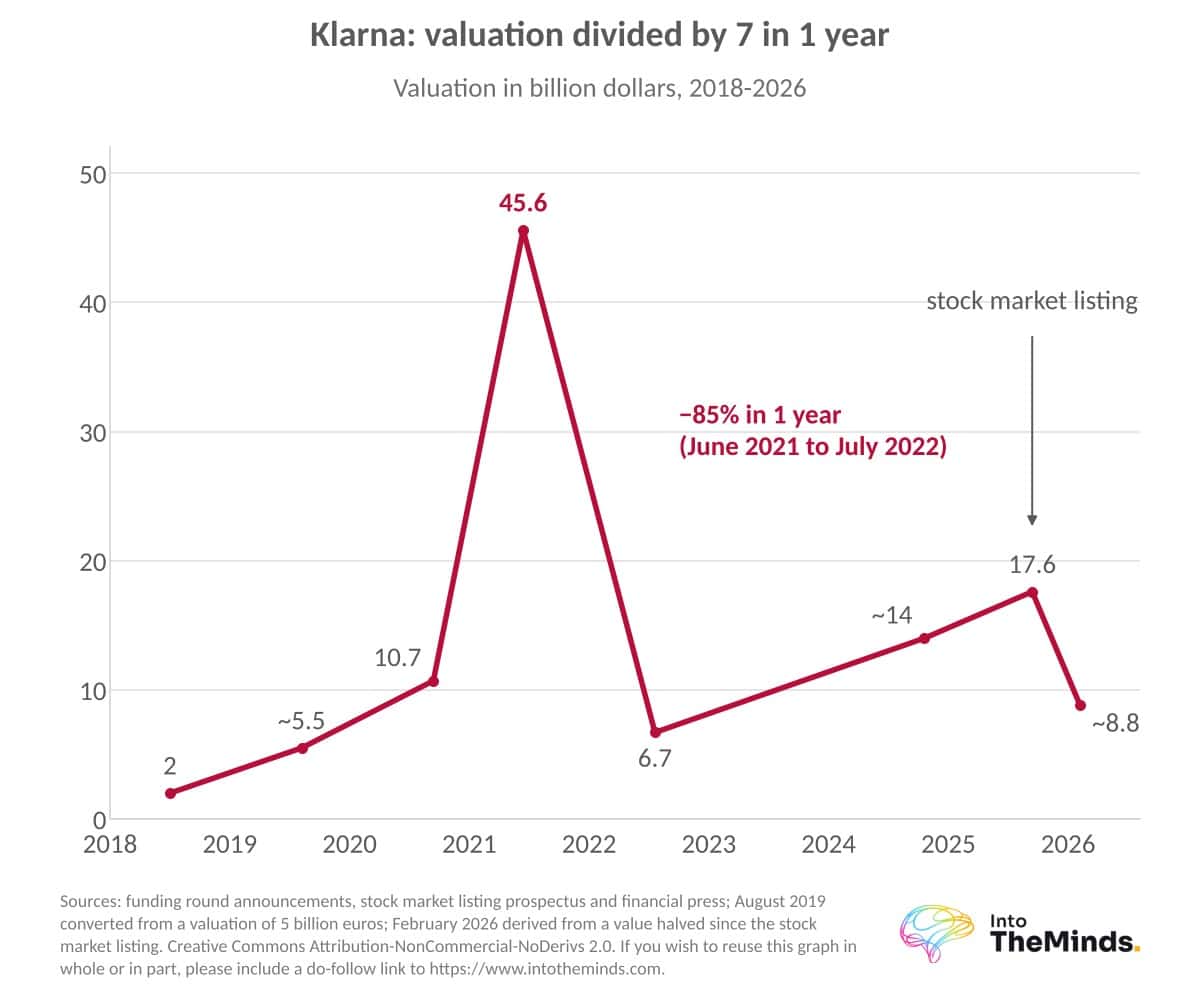
Klarna lost 85% of its valuation in one year, from 45.6 billion dollars in June 2021 to 6.7 billion in July 2022.
Klarna and Affirm: two trajectories summarizing the sector
Klarna’s trajectory mirrors market cycles. Here are its main milestones:
- June 2021: valuation of 45.6 billion dollars, but a net loss of 668 million euros for the year.
- July 2022: valuation reduced to 6.7 billion dollars.
- September 2025: IPO in New York, closing its first trading day with a market capitalization of 17.6 billion dollars.
- Fourth quarter 2025: revenue of 1.08 billion dollars (+38%), 118 million active users, but a loss of 26 million dollars and loan loss provisions up 59%.
- February 2026: share value halved since the IPO.
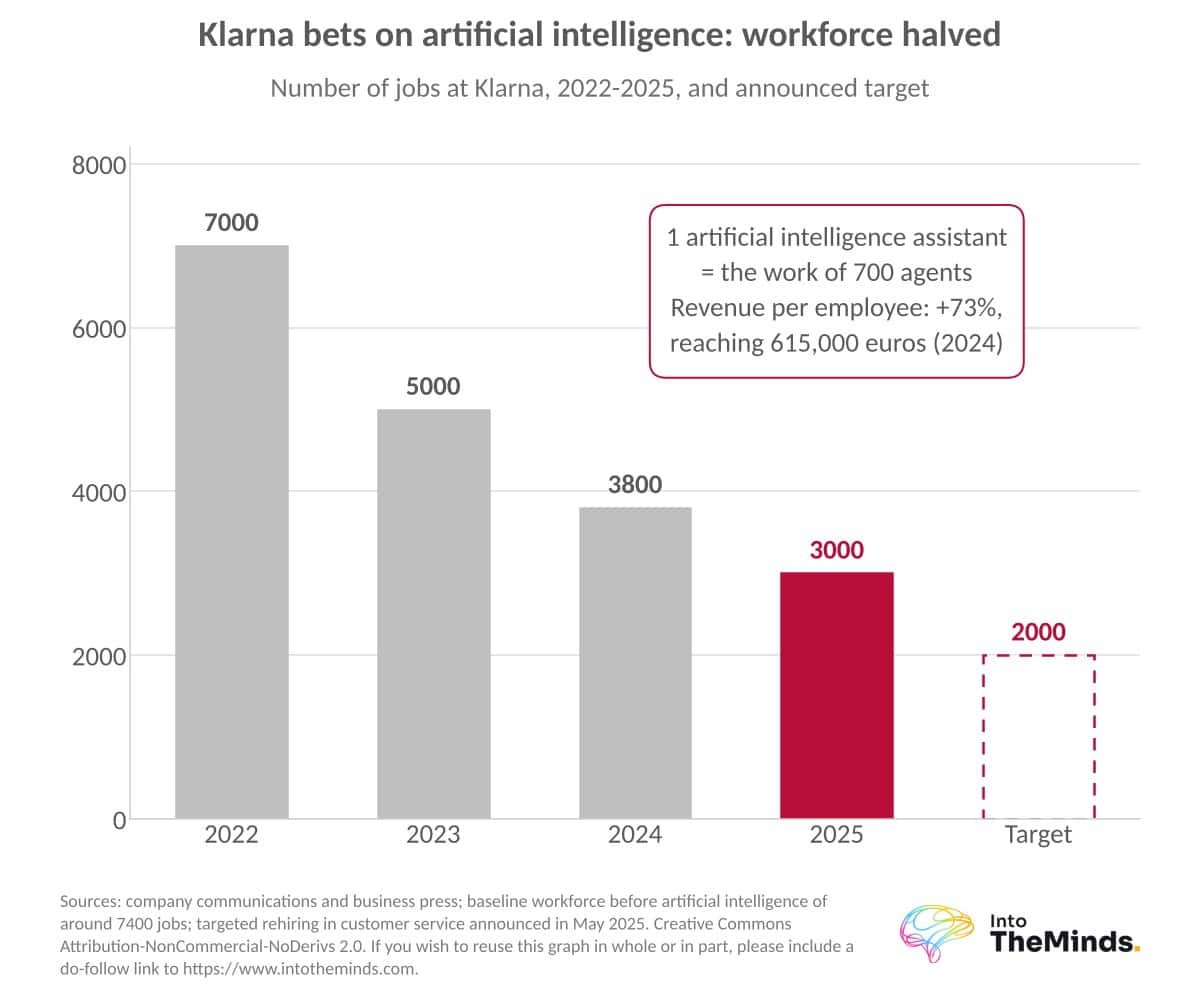
Klarna also bet heavily on artificial intelligence, downsizing its workforce from approximately 7,400 to 3,000 positions by September 2025. In May 2025, however, the company re-hired for customer service after noting a drop in support quality.
Affirm, founded in 2012 by PayPal co-founder Max Levchin, chose a different path. The company counted 27.8 million active users in June 2026, up 21% year-on-year, and prides itself on imposing no late fees.
Cards, conversational agents, and Wero: the split payment market towards 2030
Three key developments will shape the coming years. First is the shift from the merchant-side model to direct-to-consumer cards. Affirm launched its debit card in 2023 and had 2.8 million cardholders by late 2025. Klarna launched its card in July 2025 and claimed 700,000 US cardholders by September.
Second is AI-assisted commerce: 64% of gift shoppers were expected to use conversational agents during the 2025 holiday season. Split payment will need to integrate into these journeys where customers no longer browse traditional website pages.
Third stems from European payment infrastructures. The European Payments Initiative’s Wero wallet reached 43.5 million users in October 2025, including 35 million in France. It will integrate split payment capabilities, potentially under white-label arrangements.
For an e-commerce merchant, the recommendation is straightforward: measure the actual impact on your own checkout baskets before rolling out the offer broadly, and select an authorized partner now for compliance post-November 2026.

FAQ: questions you may have
Is split payment really free for the customer?
Not always. The original model charges the merchant, with a commission of 2 to 5.5% in France. But since the 2022 interest rate hikes, the cost has been shifting toward the customer: at Oney, consumers bore the extra cost in 60% of cases in 2025, at 1.67% for 3 installments and 2.5% for 4 installments.
What are the over-indebtedness risks associated with split payment?
They are real and rising. In France, the share of over-indebtedness cases involving split payment or mini-credit grew from 1% in 2022 to 17% in 2024. A payment default can rapidly trigger penalties. Accumulating multiple simultaneous split payments is the main pitfall.
How to choose between an existing split payment solution and in-house development?
Choose an existing solution if you want to launch within days without advancing funds. Proprietary development only makes sense if you possess internal financing capacity and regulatory expertise, whereas embedded lending offers a white-label compromise. A B2B market research study among providers helps compare commissions and terms.
Will split payment be mandatory for e-merchants after November 2026?
No. The CCD2 directive regulates entities offering 2 to 4-installment payments, requiring authorization, creditworthiness checks, and APR disclosure. It does not mandate merchants to offer it. If you do offer it, ensure your provider will be compliant by November 20, 2026.
Why can a split payment be refused even when the account has sufficient funds?
Because the decision depends on the provider’s scoring model, not just your balance. Refusals occur even when funds are sufficient and card limits are not reached, and certain specific card types are poorly accepted. To understand how your customers experience these refusals, a B2C market research study provides precise answers.