
Opening a gym represents a significant investment that requires careful preparation. In France, the fitness sector shows sustained growth, with a turnover of €1.9 billion in 2024 and over 5,910 facilities recorded. This positive momentum should not obscure the reality of a highly competitive market, where only a thorough market analysis can maximize your chances of success. Our market research firm regularly conducts such studies and provides in this article concrete guidance for carrying out your own.
A market study for a gym is the cornerstone of your entrepreneurial project. It will allow you to validate the economic viability of your concept, identify differentiation opportunities, and build a commercial strategy adapted to your location. In this article, our firm explains how to carry out your market study step by step to create a solid financial file. And as always, if you need help, do not hesitate to contact us.
Key Points to Remember Before Starting
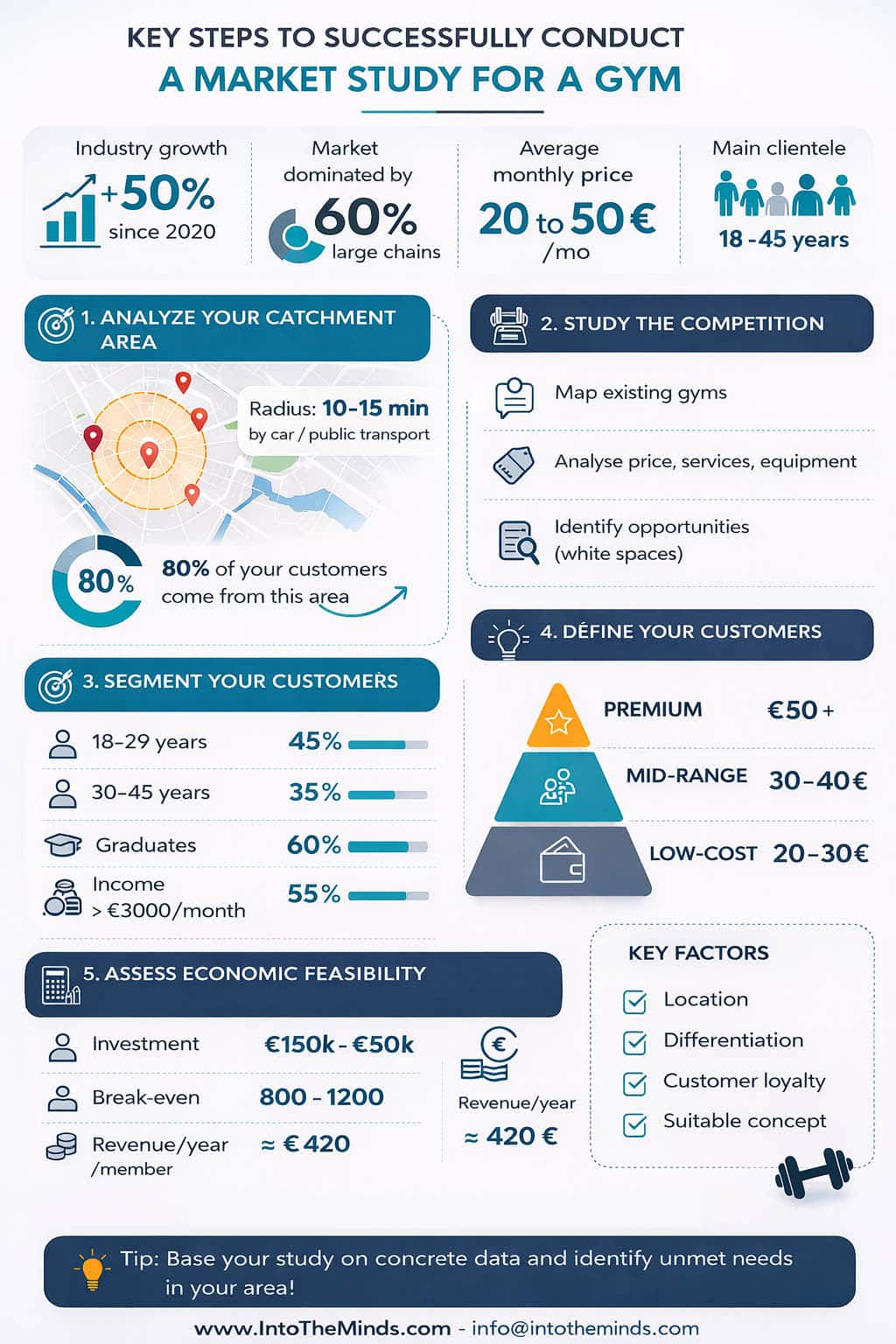
- The French fitness market: €1.9 billion in 2024 with a 50% increase in the number of facilities since 2020
- Intense competition: 60% of facilities controlled by major chains (Basic-Fit, L’Orange Bleue, Keepcool)
- Average price: Between €20 and €50 per month depending on positioning, stabilizing around €32–33
- Typical clientele: Mainly 18–29-year-olds, university graduates, living in urban areas
- Marked seasonality: Peaks of interest in September and January according to Google Trends data

1. Analyze the Economic Environment of the Fitness Sector
Any good market study begins with an overview of the market. This is the macroeconomic analysis. It forms the starting point of your market analysis for a gym. The crucial point to highlight here is that the fitness sector has been undergoing a period of accelerated transformation since the 2020–2021 health crisis.
Take France as an example. In 2024, the French market represents €1.9 billion, regaining its pre-Covid growth trajectory. This recovery is accompanied by a significant increase in the number of facilities: from 3,924 gyms in 2020 to 5,910 in 2024, a 50% growth over four years.
This growth is part of a favorable European dynamic. The European fitness market reaches €36 billion in 2024, far exceeding its 2019 level (€28.8 billion). The European penetration rate stands at 8.9% of the population, with significant variations by country.
In France, 61% of people aged 15 and over engage in regular physical activity, and 11% attend commercial facilities such as gyms. This proportion tends to increase, driven by growing awareness of public health issues.
That said, you will easily understand that more gyms mean “more competition.” Since demand is not infinite, you need to carefully design your concept to differentiate from competitors and retain clients. Customer loyalty is a key success factor in this sector.

2. Define and Analyze Your Catchment Area
The catchment area analysis is another crucial step in your market study. This geographic area determines your potential client base and directly influences the viability of your project. Remember that 80% of your clients will come from this catchment area, which is generally small in size (entrepreneurs often overestimate its size, skewing business plan results). As with any physical retail project, location accounts for more than 50% of project success.
Location accounts for more than 50% of project success.
For a gym, the primary catchment area generally extends within a 10–15 minute drive or public transport. This range varies depending on urban context: smaller in dense city centers, wider in the suburbs.
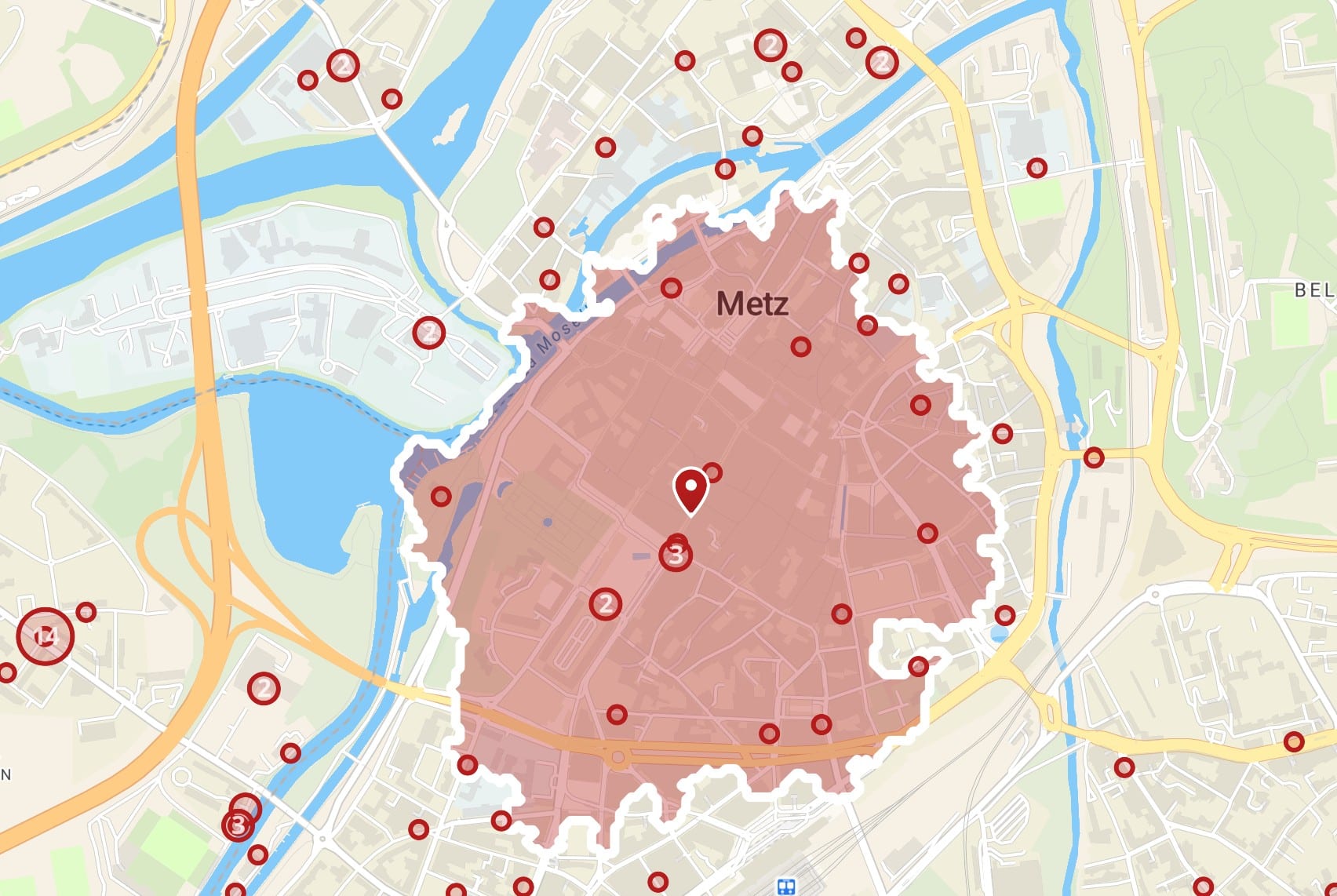
On this map, we visualized a 10-minute public transport catchment area and identified existing gyms. This type of visualization is essential for your market study, allowing you to understand local competition intensity and identify “white zones,” i.e., areas with weaker competition.
Your analysis should include several key demographic indicators. The population aged 18–45 forms your core target, with particular attention to 25–35-year-olds, who are the most frequent clients. Education level significantly influences subscription propensity: 85% of Master’s graduates engage in regular sports activity compared to 40% of non-graduates in 2025.
Household income is another determining factor. Households with medium to high incomes (over €3,000 per month) form the main clientele for commercial gyms. Socio-professional category analysis shows an overrepresentation of executives, intermediate professions, and students.
| Demographic Criterion | Weight in Clientele | Characteristics |
|---|---|---|
| 18–29 years | 45% | High loyalty, receptive to innovations |
| 30–45 years | 35% | High purchasing power, seeking premium services |
| Graduates Bac+3 and above | 60% | Regular practice, long-term subscriptions |
| Income > €3,000/month | 55% | Accept premium prices, additional services |

3. Study Direct and Indirect Competition
The competitive analysis of your gym market study must distinguish several levels of competition:
- Direct competition includes traditional gyms within your catchment area
- Indirect competition includes alternatives to gym-based practice
Continuing with our French example: the competitive landscape is characterized by strong concentration around a few major players:
- Basic-Fit dominates with 858 clubs in France in 2024
- L’Orange Bleue has 390,000 members
- Keepcool has over 300 locations
- Fitness Park claims 291 clubs
These four chains control about 60% of the national network. Rest assured, their marketing departments are well organized to analyze their market. Nevertheless, having been in contact with 2 of the 4 brands above, we can guarantee that many opportunities for establishment and development remain.
Since the catchment area is generally limited in size, you must conduct your competitive analysis within this area. Your analysis should map the local competitive offer precisely. For each competitor, identify:
- Pricing positioning
- Marketing positioning (points of differentiation?)
- Range of services
- Opening hours
- Equipment quality
- Time in operation
- Profitability (see this article for financial data)
This analysis grid reveals exploitable market gaps.
Indirect competition deserves special attention. Outdoor group classes, fitness apps, corporate gyms, and home equipment are all alternatives to monitor. Accelerated digitalization during the health crisis has strengthened this indirect competition.
Price analysis reveals a range of €20–50 per month depending on positioning. The low-cost segment (€20–30) dominates in volume, but premium concepts (€40–60) often show better profitability per square meter.

4. Identify and Segment Your Target Clientele
Client segmentation is a pillar of your gym market study. This approach allows you to adapt your offer to the specific expectations of each segment and optimize your marketing strategy.
- The “young urban professionals” segment (25–35 years) represents the traditional core target. These clients seek flexible schedules, modern equipment, and geographic proximity. They prefer non-binding subscriptions and are sensitive to technological innovations.
- The “senior executives” segment (35–50 years) has high potential. With high purchasing power, they value premium services: personalized coaching, relaxation spaces, less crowded time slots. This segment accepts higher prices in exchange for a differentiated experience.
- The “students” segment has specific characteristics. Price-sensitive but loyal throughout their studies, they seek preferential rates and extended hours. Their presence generates a dynamic atmosphere appreciated by other segments.
- The “active seniors” segment (50+ years) is rapidly growing. They prefer gentle activities, adapted classes, and morning slots. This segment requires a specific approach regarding equipment and support.
Your analysis should quantify each segment in your catchment area and assess their development potential. INSEE data, supplemented by field surveys, provide the necessary elements for this segmentation. If you need help, do not hesitate to contact us.

5. Analyze the Offer and Define Your Positioning
Analyzing the existing offer guides the definition of your competitive positioning. This step of your gym market study determines your differentiation strategy and business model.
The French market is structured around several distinct positions:
- The low-cost segment, dominated by Basic-Fit, offers aggressive pricing (€19.99–€24.99) with a standardized offer. This model focuses on volume and operational cost control.
- Mid-range positioning (€30–40) balances price and services. These chains offer varied group classes, modern equipment, and personalized support. L’Orange Bleue and Keepcool illustrate this approach.
- The premium segment (€50 and up) targets demanding clients. These concepts include high-end services: individual coaching, wellness spaces, personalized nutrition. Profitability relies on added value rather than volume.
Clients either choose low-cost or opt for premium. There is hardly room for a mid-range positioning anymore.
Specialized concepts emerge as alternatives to general gyms. CrossFit, electrostimulation, women’s fitness, or senior fitness constitute niches to explore. These positions allow bypassing direct competition from major chains.
Your positioning must address an unmet need identified during the competitive analysis. The coherence between concept, pricing, and target clientele determines the success of your project. Keep in mind that current economic trends lead to a sort of polarization: clients either choose low-cost or opt for premium. There is hardly room for mid-range positioning. For confirmation, read the analysis we devoted to Technogym. Consider this in your business plan.

6. Evaluate Economic and Regulatory Feasibility
Feasibility evaluation is the culmination of your gym market study. This analysis synthesizes collected data to validate the economic viability of your project.
The size of your gym directly influences profitability. A facility of 800–1,200 m² optimizes the investment-to-capacity ratio. The number of potential members is calculated by applying a 3–5% penetration rate to your target population, depending on competitive density.
Initial investment ranges from €150,000 to €500,000 depending on size and positioning:
- Equipment represents 40–50% of this investment,
- Fit-out 25–30%,
- Startup costs 20–25%.
These ratios serve as references for your business plan.
The break-even point generally ranges between 800 and 1,200 members depending on average spending. A subscription at €35 generates annual revenue of €420 per member, after cancellation fees. This base allows projecting your forecasted income statement.
The regulatory environment imposes specific constraints to be studied via a PESTEL study. In France, the activity falls under NAF code 93.13Z and requires compliance with ERP standards (Public Access Building). Obligations include:
- Accessibility for people with reduced mobility
- Fire safety
- Hygiene standards
- Urban planning regulations
These constraints affect initial investment and operating costs. They also influence location choice.
Location significantly impacts success. Favor commercial activity areas, proximity to public transport, and visibility from main roads. Land costs should not exceed 12–15% of projected revenue.

Frequently Asked Questions about Gym Market Studies
How long does it take to complete a comprehensive market study?
An in-depth market study for a gym requires 6–12 weeks depending on project complexity. This timeframe includes collecting demographic data, on-site competitive analysis, customer surveys, and result synthesis. IntoTheMinds recommends not rushing this crucial step, which conditions the success of your investment.
How much does a professional market study for a gym cost?
The cost of a professional market study ranges from €3,000 to €15,000 depending on the scope of the analysis and geographic coverage. This expenditure represents a profitable investment given the financial risks of a gym project. A well-conducted study can prevent costly errors and optimize your return on investment.
What key indicators should be monitored in a catchment area?
Priority indicators include population density of 18–45-year-olds (minimum 15,000 inhabitants), median household income (over €2,500), percentage of higher education graduates (minimum 40%), and direct competition (maximum 3 gyms within a 2 km radius). These benchmarks help evaluate the potential of your location.
How to accurately estimate the number of potential members?
Estimating membership potential combines several variables: target population × fitness penetration rate (8–12% in France) × market share goal (5–15% depending on competition). For example, in a target area of 20,000 inhabitants with a 10% penetration rate and 10% market share, the potential is 200 members. This method provides a conservative estimate to refine based on your positioning.
What are the most common mistakes in a gym market study?
Typical mistakes include underestimating indirect competition, superficially analyzing customer mobility habits, neglecting regulatory constraints, and overestimating penetration rates. A methodical approach with field validation avoids these pitfalls. Support from a specialized firm like IntoTheMinds secures this strategic step.